
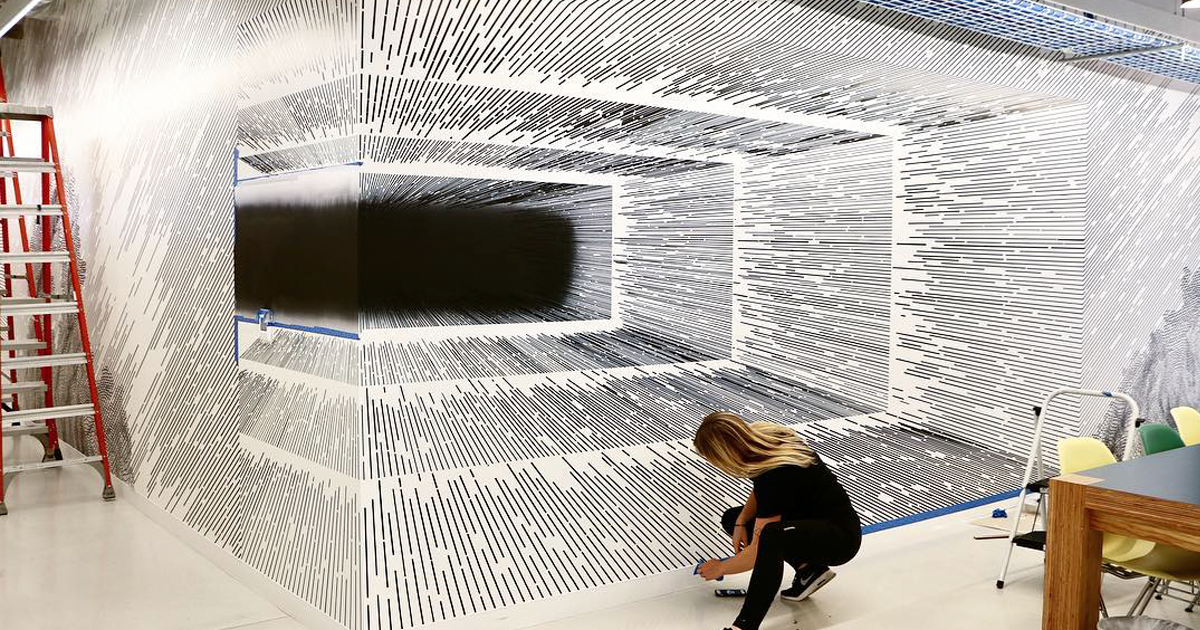
At first glance, Katy Ann Gilmore’s artwork looks like something a computer dreamed up after drinking too much coffee with a geometry textbook. Lines bend, surfaces swell, walls seem to fold inward, and flat drawings suddenly behave as if they have been quietly hiding a third dimension. Then you look closer and realize the magic trick is not digital wizardry. It is mostly simple lines, careful spacing, mathematical thinking, and the kind of patience that makes the rest of us feel guilty for abandoning a grocery list halfway through.
Gilmore, a Los Angeles-based visual artist, has become known for optical illusion art that transforms ordinary flat surfaces into deep, shifting visual spaces. Her work sits at a fascinating crossroads: part line drawing, part Op Art, part architectural sketch, part topographical map, and part “wait, is that wall breathing?” Using black-and-white patterns, curved contours, straight edges, and repeated marks, she creates images that trick the eye into seeing depth, movement, pressure, and volume where none physically exists.
What makes her work especially compelling is its simplicity. The ingredients are not flashy. There are no exploding colors, no overstuffed compositions, no need for a neon sign screaming “look at me.” Instead, the artwork whispers through repetition. A line shifts slightly. A curve tightens. A grid warps. Suddenly, the viewer is pulled into an imagined space that feels both logical and impossible.
Who Is Katy Ann Gilmore?
Katy Ann Gilmore is a contemporary artist whose background in mathematics and art deeply shapes her creative approach. She studied mathematics, art, and Spanish as an undergraduate and later earned an MFA in visual art. That combination explains a lot. Her work does not merely look mathematical; it behaves mathematically. It feels planned, measured, and structured, yet it never becomes cold or mechanical.
Her practice includes drawings, paintings, murals, installations, and sculptures. Across these formats, she often explores how two-dimensional planes can suggest three-dimensional space. In simpler terms, she asks a very fun question: how much can a flat surface lie to our eyes before we happily believe it?
Many of her pieces are inspired by architecture, topography, geometry, and natural formations. Some drawings resemble contour maps of imaginary landscapes. Others look like folded paper, vibrating tunnels, layered fabric, or structural blueprints from a building that may or may not obey the laws of physics. The result is optical illusion line art that feels precise but alive.
How Simple Lines Become Optical Illusions
The secret behind Gilmore’s art is not one single trick. It is a carefully balanced combination of repetition, perspective, spacing, scale, and contrast. Lines are among the most basic visual tools in art, but in the right hands, they become suspiciously powerful. Give a line enough friends, arrange them carefully, and suddenly the whole group starts causing perceptual mischief.
Repetition Creates Rhythm
Repeated lines help create visual rhythm. When the spacing between those lines changes gradually, the eye reads the shift as depth or motion. Lines placed close together can suggest shadow, compression, or distance. Lines spaced farther apart can feel like expansion, light, or surface tension. Gilmore often uses these subtle changes to make a flat image appear to dip, bulge, fold, or stretch.
Curved Lines Suggest Landscape
Curved contours in her work often resemble topographical maps. On a map, contour lines describe elevation. In Gilmore’s drawings, similar lines suggest imaginary peaks, valleys, waves, and slopes. The viewer’s brain sees the pattern and begins constructing a landscape, even though the drawing may only be ink on paper or paint on a wall.
Straight Lines Build Architecture
Straight lines are equally important. When angled with precision, they can create the illusion of corners, corridors, platforms, and dimensional grids. A simple diagonal can push the eye backward into space. A repeated set of diagonals can make the surface feel tilted or stretched. This is why some of Gilmore’s murals appear to carve openings into walls or create rooms inside rooms.
The Connection Between Math and Art
Gilmore’s work is a beautiful reminder that math is not just something that happens on tests while everyone quietly panics. Mathematics can be visual, emotional, and surprisingly poetic. Geometry, symmetry, proportion, and spatial relationships all play major roles in her pieces.
Her art does not need to show equations directly to feel mathematical. Instead, the math lives in the structure. It appears in the way lines repeat, rotate, expand, and bend. It appears in the balance between order and distortion. It appears in the way each mark contributes to a larger visual system. One line alone may seem ordinary. Hundreds of lines working together can create a small universe.
This is where her work differs from casual doodling. The drawings may look spontaneous from a distance, but they are built through careful planning. Large-scale murals, in particular, require a strong sense of measurement and orientation. A small mistake in spacing can disrupt the illusion. In this kind of art, precision is not a bonus; it is the engine.
Why Her Optical Illusions Feel So Satisfying
Optical illusions are popular because they make us aware of our own perception. They reveal that seeing is not as simple as opening our eyes and receiving reality like a package delivery. The brain edits, predicts, fills gaps, and interprets. Sometimes it does an excellent job. Sometimes it looks at a flat drawing and says, “Ah yes, a three-dimensional tunnel,” and we all go along with it.
Gilmore’s art taps into this playful weakness. Her lines give the brain just enough information to build depth. The viewer completes the effect mentally. That participation makes the artwork feel active. You are not only looking at the piece; your perception is helping finish it.
This is one reason optical illusion art has remained so fascinating across generations. From classic Op Art to contemporary murals and digital illusions, people love images that challenge the eye. They are visual puzzles. They reward close looking. They make us pause in a world where most images are swallowed in half a second while scrolling.
How Katy Ann Gilmore Fits Into the Op Art Tradition
Gilmore’s work connects naturally to Op Art, a movement that became widely recognized in the 1960s. Artists such as Bridget Riley and Victor Vasarely used geometric patterns, contrast, and repetition to create sensations of movement, vibration, swelling, and spatial instability. Their paintings did not physically move, but the eye often felt as if they did.
Gilmore brings that spirit into a contemporary setting. While classic Op Art often emphasized bold graphic contrast, her work frequently adds an architectural and topographical sensibility. She is not simply making patterns that shimmer. She is building imaginary spaces through line. Her drawings can feel like landscapes, structures, portals, or surfaces under pressure.
There is also a handmade warmth in her practice. In an era when many visual effects can be generated instantly with software, her hand-drawn approach feels refreshing. It reminds viewers that patience still has a pulse. A human hand, guided by mathematical logic, can create illusions as mesmerizing as anything produced by a machine.
Examples of Visual Effects in Her Work
Walls That Seem to Open
In some murals, Gilmore uses line systems that make walls appear to bend inward or open into another space. The illusion depends on perspective and repeated contours. The physical wall remains perfectly still, of course, but the eye experiences it as flexible. It is like architecture suddenly deciding to practice yoga.
Drawings That Look Like 3D Objects
Her smaller works on paper can appear sculptural. Curved lines gather into forms that resemble folded fabric, rippling terrain, or suspended structures. These pieces show how powerful line density can be. Where lines cluster, the form feels shadowed or compressed. Where they loosen, the surface seems to rise or expand.
Patterns Inspired by Topography
Many of her compositions echo the language of maps. This gives the artwork a strange double identity: it feels abstract, yet somehow geographical. Viewers may see mountains, waves, valleys, or geological layers. The beauty is that none of those readings has to be literal. The lines suggest enough for the imagination to take over.
Why Simple Line Art Works So Well for SEO, Design, and Visual Culture
Optical illusion line art is not only popular in galleries. It also has strong appeal in digital culture, interior design, branding, education, and social media. The reason is simple: it catches attention quickly without needing complicated subject matter. A strong line illusion can stop a viewer mid-scroll because the brain wants to solve it.
For web design and visual storytelling, this kind of art offers several lessons. First, simplicity can be powerful. A clean black-and-white composition can outperform a noisy design if it creates curiosity. Second, repetition builds identity. Patterns are memorable when they have rhythm. Third, interaction matters. Even if the viewer is only looking, an optical illusion creates a mental interaction. The audience becomes part of the experience.
That makes artists like Gilmore especially relevant today. We live in a visual environment overloaded with polished images. Her work proves that something as humble as a line can still feel fresh, intelligent, and emotionally engaging.
The Beauty of Handmade Precision
One of the most impressive aspects of Gilmore’s work is the discipline behind it. Optical illusion drawings often look effortless after they are finished, which is deeply unfair to the artist and dangerously encouraging to beginners with rulers. In reality, this kind of work requires planning, patience, and a strong understanding of how small changes affect the whole image.
Every line matters. A curve that bends too sharply can break the illusion. A spacing error can flatten the form. A misplaced angle can confuse the perspective. The artwork succeeds because each mark supports the larger structure. It is similar to music: one note may be simple, but arranged with care, many notes become rhythm, tension, and movement.
This handmade quality gives the work emotional weight. Viewers can sense the time invested. The artwork becomes not only an image but a record of concentration. In a culture obsessed with speed, that slowness feels almost rebellious.
What Artists and Beginners Can Learn From Her Approach
Gilmore’s art offers useful lessons for anyone interested in drawing, design, or creative thinking. You do not need expensive tools to explore optical illusions. A pen, paper, ruler, and curiosity can take you surprisingly far. The hard part is not buying materials. The hard part is staying patient when line number 247 looks almost exactly like line number 246.
Beginners can start by experimenting with contour lines around simple shapes. Draw a circle, then create repeated curved lines around it. Notice how the form begins to rise from the page. Try bending parallel lines around an imaginary object. Try varying the spacing between lines to create depth. These exercises reveal the basic principles behind more advanced optical illusion art.
The bigger lesson is that creativity often grows from constraints. Gilmore limits herself in powerful ways. Instead of relying on countless colors or dramatic imagery, she works with line, space, and structure. Those limits sharpen the result. They force the artwork to communicate through precision and rhythm.
Experience: Seeing Optical Illusion Line Art in Real Life
Looking at optical illusion art online is enjoyable, but seeing it in person is a different experience. On a screen, the image is already flattened and framed. In real life, especially with murals and installations, the viewer’s body becomes part of the equation. You step closer, and the lines expand. You move sideways, and the illusion shifts. You back away, and the whole structure snaps into place like a visual punchline.
The first experience many people have with line-based illusion art is confusion, followed quickly by delight. From a distance, the artwork may look like a digital print or a strange architectural feature. Then the handmade nature becomes visible. You see the individual marks. You notice how carefully they are placed. The illusion does not disappear, but it becomes more impressive because you understand how little the artist is using to create so much visual drama.
There is also a surprisingly physical feeling to this kind of art. Some pieces seem to pull the viewer forward. Others create a sense of tilt, pressure, or motion. Your eyes may want to wander along the lines as if following a path through a landscape. That movement is part of the pleasure. The artwork does not tell a story in the traditional sense, but it creates an experience of discovery.
For students, designers, and casual viewers, this can be inspiring. It shows that complexity does not always require clutter. A page filled with controlled lines can feel deeper than a colorful scene packed with details. It also encourages slower looking. Instead of consuming the image instantly, you spend time with it. You test it from different angles. You wonder how it works. You may even feel the dangerous urge to buy a set of pens and announce, “I too shall become a master of perception,” which is charming until you remember that straight lines require a steady hand.
Trying to create a simple optical illusion yourself gives even more appreciation for Gilmore’s skill. At first, the process seems easy: draw lines, bend them a little, repeat. But the moment you begin, you realize how sensitive the illusion is. Too much spacing and the form collapses. Too little variation and the image becomes flat. The best effects come from controlled changes so gradual that the viewer feels them before noticing them.
This is why Gilmore’s work stays memorable. It is not a cheap visual trick. It is a thoughtful exploration of how we understand space. Her art invites viewers to enjoy being fooled, but also to admire the intelligence behind the illusion. It proves that simple lines can become architecture, landscape, movement, and mystery. Not bad for something most of us use mainly to underline bills and draw questionable stick figures during phone calls.
Conclusion
Katy Ann Gilmore’s optical illusion art shows how far simple lines can go when guided by mathematics, patience, and imagination. Her drawings and murals transform flat surfaces into visual spaces that seem to bend, swell, ripple, and recede. By combining geometric precision with handmade warmth, she creates work that feels both analytical and deeply human.
In a digital world full of instant effects, her art reminds us that the oldest tools still have power. A pen, a wall, a repeated line, and a sharp understanding of perception can create something astonishing. The result is not just beautiful to look at; it changes how we think about seeing itself. And honestly, any artwork that can make a flat wall feel like it has secret dimensions deserves a round of applause and possibly a very respectful ruler.











