
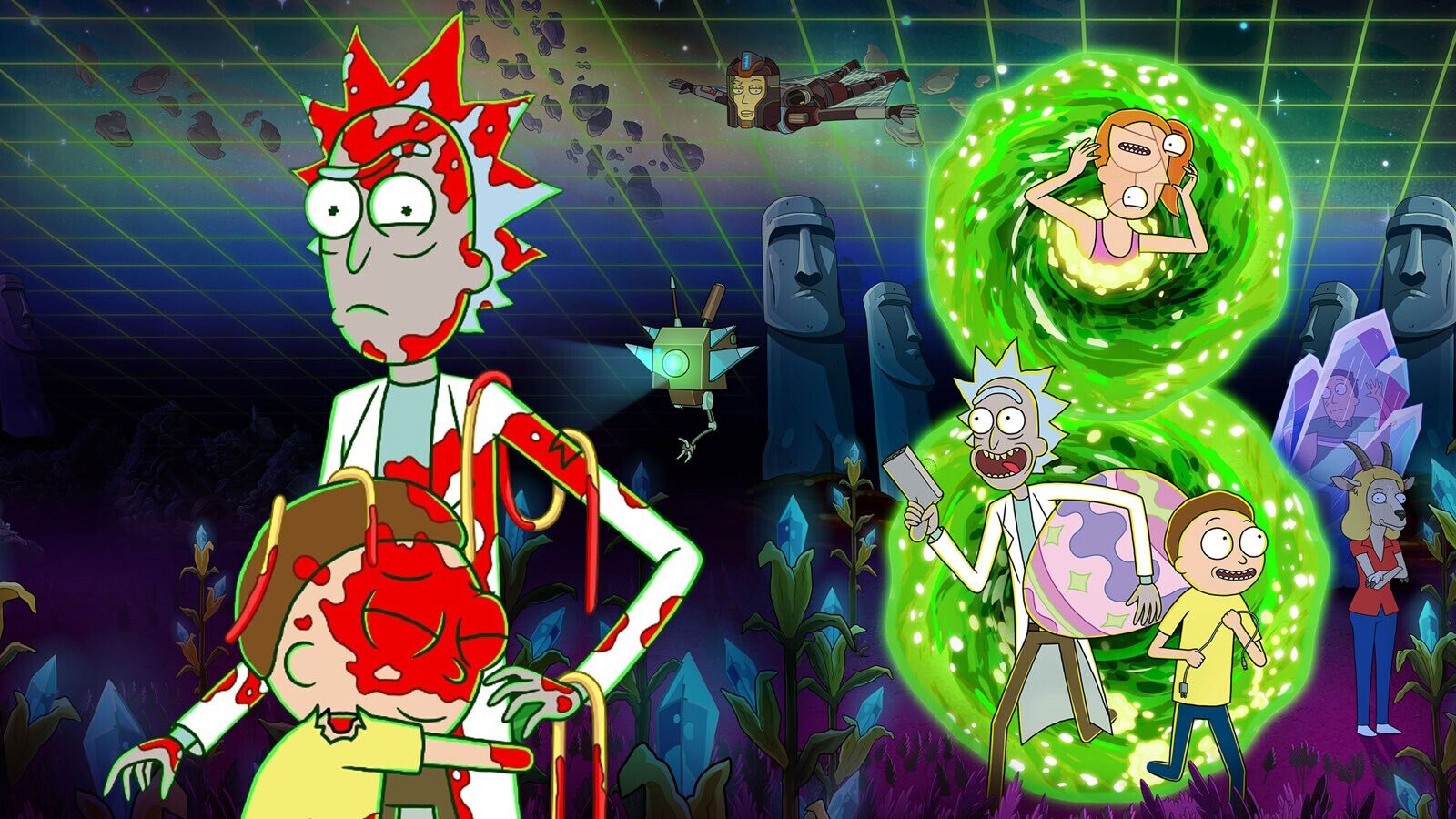
Note: This article is based on real public information from official show materials, creator interviews, entertainment reporting, episode coverage, and industry updates available through U.S. media sources.
For years, Rick and Morty ran on a deliciously toxic fuel blend: portal fluid, family dysfunction, sci-fi chaos, and Rick Sanchez’s bone-deep hunger for revenge. Then Season Seven did the thing fans had been circling on message boards like conspiracy detectives with too much caffeine: Rick finally killed Rick Prime, the man tied to the loss of Diane and the wound that turned Rick’s genius into a universe-hopping grief machine.
So when Rick and Morty Season Eight arrived on Adult Swim in 2025, the big question was not just “What weird thing will happen next?” It was “What does Rick Sanchez even want now?” A man who can build gods in his garage, erase civilizations before breakfast, and emotionally avoid eye contact across infinite realities suddenly had to face something far scarier than Evil Morty, the Citadel, or a killer spaghetti planet: purpose.
Showrunner Scott Marder has described Season Eight as having a lighter, more emotional arc rather than a heavy, canon-stuffed saga. That choice matters. Instead of rushing to replace Rick Prime with another mustache-twirling cosmic villain, the season gives Rick space to exist after vengeance. Not heal perfectly, because this is still Rick Sanchez and not a scented-candle wellness retreat, but at least wobble toward something like emotional movement.
Rick After Revenge: Why Season Eight Feels Different
The end of Rick’s revenge mission did not magically make him healthy. It simply removed the loudest excuse he had for being miserable. For much of the series, Rick could point to Rick Prime as the source of his pain. That enemy gave shape to his grief. It gave him a target, a map, and a reason to keep sprinting away from the family sitting right in front of him.
Season Eight explores the awkward silence after that sprint stops. Without vengeance driving him, Rick becomes less of a hunter and more of a haunted person stuck at home with people who love him, fear him, resent him, and occasionally borrow his phone charger at their own peril. That shift lets the show treat Rick not as a finished mystery, but as an ongoing emotional disaster with good Wi-Fi and terrible coping skills.
This is where Scott Marder’s approach becomes important. Rick and Morty has always had a push-pull relationship with canon. Fans love Evil Morty, Rick Prime, the Central Finite Curve, and the mythology puzzle pieces. Dan Harmon, however, has often preferred standalone adventures where Rick and Morty can crash into a new idea each week like drunk astronauts in a stolen rental car. Marder’s job, especially since becoming showrunner, has been to help balance those two pleasures: the mythology fans crave and the absurd one-off comedy that keeps the show from collapsing under its own lore.
Season Eight’s “Light Arc” Is Actually a Smart Move
Calling Season Eight a “light arc” may sound modest, but it is a clever creative strategy. After the emotional weight of Rick Prime, going bigger immediately might have felt fake. Another giant villain could have turned the show into an arms race of trauma. Instead, Season Eight steps sideways. It keeps the universe wild, but lets Rick’s inner life become the thread.
The season premiered on May 25, 2025, and ran for ten episodes, concluding on July 27, 2025. Across that run, the show leaned into family-centered stories, strange genre riffs, and smaller emotional consequences. It was not a season without canon. It was a season that treated canon like seasoning instead of soup. A little Citadel here, a little Memory Rick there, a little Beth and Space Beth tension bubbling under the surfaceenough flavor to matter, not so much that every episode required a corkboard and red yarn.
That restraint helps Season Eight feel like a reset without feeling empty. Rick is still Rick. He is still arrogant, brilliant, sarcastic, impatient, and about as emotionally transparent as a black hole wearing sunglasses. But he is also slightly less driven by the old script. He has killed the villain. He has reached the end of a revenge story. Now he has to deal with the part nobody writes epic music for: the morning after.
BugAnne and the Possibility of Moving On
One of the most intriguing emotional details from Marder’s reflections on Season Eight is Rick’s connection with BugAnne. The show has long treated Diane as both a lost love and a mythic absence. For Rick, Diane is not merely someone he loved; she is the emotional center of a universe that broke and then kept breaking. That makes the idea of a new romantic interest tricky. Put too much pressure on it, and fans might reject it. Make it too casual, and it could feel disrespectful to the character’s history.
BugAnne works because she does not arrive as a replacement Diane. She feels more like someone from Rick’s past who can exist without turning the story into a melodrama with laser guns. Marder has suggested that Rick’s calmer behavior in Season Eight can be partly understood through this behind-the-scenes relationship. That is a fascinating idea because it reframes Rick’s “chill” moments not as random softening, but as evidence that he may be experimenting with life after obsession.
Of course, this is Rick and Morty, so “moving on” does not mean Rick starts journaling beside a succulent. It means he may be capable of forming a connection that is not entirely built around pain, conquest, or being the smartest guy in the morgue. That is progress. Tiny, weird, possibly radioactive progressbut progress.
The Beths Become the Emotional Backbone
Season Eight also finds meaningful texture in the relationship between Beth and Space Beth. The two Beths have always been one of the show’s strangest emotional inventions: a domestic identity crisis split into two living people. One stayed. One left. Both are real. Both are incomplete. Both carry the question Rick created when he gave his daughter the possibility of escape and then refused to make the moral decision himself.
By returning to the Beths, Season Eight gives Rick’s family history room to breathe. The season’s finale, “Hot Rick,” uses Memory Rick and Beth’s mind to pull the show back toward grief, identity, and emotional inheritance. Memory Rick is especially powerful because he represents a version of Rick not yet fully calcified by loss. He is a reminder that the Rick we know was not born this way. He became this way, one wound and one catastrophic decision at a time.
That matters because Rick’s future cannot be understood only through villains. It has to be understood through family. Morty, Summer, Beth, Space Beth, and Jerry are not just comedy accessories orbiting Rick’s ego. They are the people who keep exposing the lie that he does not care. Season Eight is strongest when it lets that lie wobble.
Why Evil Morty’s Absence Makes Sense
Fans naturally wondered whether Evil Morty would return in Season Eight. After all, Season Seven elevated him by having him leave with the plans for the Omega Device, making him more dangerous than ever. But keeping him away for a season was not a failure; it was discipline.
Evil Morty works because he appears when the story truly needs him. Overusing him would shrink his mystery. He is not just another villain waiting in line at the cosmic DMV. He is the rare character who can outthink Rick, reject the show’s central relationship, and expose the prison built into the multiverse. Saving him for a future saga keeps the character potent.
Season Eight did not need Evil Morty to prove it had stakes. Its stakes were quieter: Can Rick remain interesting without revenge? Can the family change without breaking the show’s comedy engine? Can Rick and Morty age without becoming a museum of its own greatest hits? Those are big questions, even if nobody is vaporizing a planet while asking them.
Season Eight’s Best Trick: Big Ideas from Small Annoyances
One reason Rick and Morty still works is that it can turn tiny, familiar irritations into apocalyptic science fiction. Season Eight’s premiere, “Summer of All Fears,” builds a dystopian, Matrix-like scenario out of the very human frustration of missing phone chargers. That premise is classic Rick and Morty: take something stupidly ordinary, attach a philosophical bomb to it, and throw it at the Smith family.
The episode also centers Summer in a way that reminds viewers the show is not limited to Rick and Morty alone. Summer has gradually become one of Rick’s most capable adventure partners because she is practical, sharp, and less easily hypnotized by Rick’s genius. She does not worship him the way Morty sometimes does. She negotiates with the chaos. Occasionally, she rules it. Honestly, if the multiverse had a human resources department, Summer would be terrifying in middle management.
Then there is “The Rick, the Mort & the Ugly,” Season Eight’s Western-flavored Citadel return. The episode revisits the aftermath of Evil Morty’s destruction while showing that the Citadel’s influence still echoes through the multiverse. Inspired by Western storytelling, it demonstrates how Rick and Morty can return to canon without becoming trapped by it. The result is an episode that feels mythological and silly at the same time, which is basically the show’s house cocktail.
Scott Marder’s Role in Stabilizing the Chaos
Scott Marder’s influence on Rick and Morty is easy to underestimate because the show still feels wild. But that wildness now appears to operate inside a more sustainable machine. Marder has helped turn a notoriously intense creative process into something steadier, allowing the series to keep producing seasons while maintaining its high-concept identity.
That stability matters for a show renewed through Season 12. Rick and Morty can no longer behave like a cult favorite that appears whenever the gods of animation feel generous. It is now a long-running television institution. That means the creative team has to think not only about the next shocking episode, but about how Rick, Morty, and the family can keep evolving without losing the dangerous spark that made the series special.
Marder’s reflections suggest that the show is not abandoning canon. It is becoming more selective about when canon should dominate. That is healthy. Too much mythology can make a comedy feel like homework. Too little can make emotional investment feel pointless. Season Eight finds a middle lane: enough continuity to reward long-time fans, enough standalone madness to welcome viewers who simply want a good alien disaster with jokes.
Where Rick Goes Without Vengeance
So where is Rick going now? The answer is not simple, which is good because simple answers are where interesting characters go to die. Rick is moving into a phase where his greatest enemy may no longer be Rick Prime, the Galactic Federation, the Citadel, or even Evil Morty. His greatest enemy is the absence of an excuse.
Without vengeance, Rick has to confront desire. What does he want from Beth? What does he owe Morty? What does Diane mean if grief is no longer allowed to be an engine for destruction? What kind of grandfather, father, partner, or friend can he be if he stops defining himself by the worst thing that happened to him?
The show will probably never turn Rick into a fully healed person. That would be both unrealistic and, frankly, less funny. But it can let him become more complicated. Season Eight suggests that Rick may be capable of softer choices, even when he interprets those choices through self-punishment. He may believe he does not deserve a happy ending, but the show is increasingly interested in testing whether that belief is wisdom or just another form of ego.
Why This Direction Is Good for the Future of Rick and Morty
The best long-running shows understand that characters cannot stay frozen forever. They can return to familiar rhythms, but they need new emotional weather. Season Eight gives Rick and Morty a new weather pattern. The storm of revenge has passed. Now the air is weird, unstable, and full of possibilities.
That does not mean the show has become gentle. It is still packed with grotesque jokes, sci-fi violence, genre parody, and sudden emotional gut punches hiding inside jokes about body horror or family brunch. But the center of gravity has changed. Rick is no longer only the man chasing the ghost of Rick Prime. He is a man standing in the wreckage of getting what he wanted and realizing that revenge is not the same as peace.
For viewers, that is a richer place to be. It allows the series to ask more mature questions without losing its immature joy. Can a nihilist grow up without becoming boring? Can a genius admit he is lonely without immediately turning the moon into a defense mechanism? Can a family comedy about cosmic trauma still surprise us after eight seasons? Season Eight argues yes, as long as the show keeps treating emotional change as another form of science fiction.
Viewing Experience: Watching Rick Learn What Comes After the Mission
Watching Season Eight after the Rick Prime storyline feels a little like seeing someone finish a lifelong project and then wander into the kitchen unsure what to do with their hands. That is the strange pleasure of this season. It is not built around a single roaring objective. Instead, it is built around the discomfort of life after the objective. The experience is less like riding a rocket and more like floating in zero gravity while an emotionally unavailable scientist insists everything is fine.
For long-time fans, that can be surprisingly satisfying. The show has trained viewers to expect huge swings: lore bombs, shocking deaths, meta episodes, fake-outs, and universe-breaking reveals. Season Eight still has those flavors, but it often lets the jokes and emotional subtext simmer instead of detonating everything at once. Rick’s slightly calmer presence creates a different kind of tension. You keep waiting for him to snap back into full revenge mode, but he does not have the same target anymore. That makes every small choice feel more revealing.
The family episodes also hit differently because the Smith household no longer feels like just Rick’s hiding place. It feels like the arena where his next identity is being built. Morty is still anxious and reactive, but he is not merely Rick’s sidekick. Summer continues to prove she can handle the absurdity of Rick’s world without turning every adventure into a moral panic. Beth and Space Beth bring adult emotional conflict into the room, while Jerry remains the show’s finest reminder that weakness and honesty are not always the same thing. Jerry may be ridiculous, but at least he usually knows when he is upset. Rick often needs a multidimensional catastrophe to reach the same conclusion.
There is also a relatable human layer beneath the sci-fi madness. Many people know the odd emptiness that comes after achieving something they thought would fix them. A career goal, a breakup, a move, a personal victorysometimes the finish line does not heal the wound. It just removes the distraction. Rick’s post-vengeance arc exaggerates that feeling through portals and clones, but the emotional truth is recognizable. He got revenge. He did not get Diane back. He killed Rick Prime. He did not kill grief.
That makes Season Eight an interesting experience for viewers who enjoy both absurd comedy and character study. You can laugh at the phone-charger dystopia, the Citadel weirdness, and the show’s relentless genre jokes while still noticing that Rick is quietly being redefined. He is no longer just running from pain. He is learning, badly and unevenly, how to exist with it. That is not a clean redemption arc. It is something messier and more fitting for Rick and Morty: a brilliant man discovering that the hardest universe to survive is the one where nobody is left to blame.
Conclusion
Rick and Morty Season Eight proves that the show does not need to replace Rick Prime immediately to remain compelling. Scott Marder’s reflections reveal a season interested in aftermath, family, emotional drift, and the question of what Rick Sanchez becomes when vengeance is no longer his compass. By using a lighter arc, the show gives itself room to breathe while still honoring its mythology. Rick is not fixed, and he probably never will be. But he is changing, and for a character who once treated growth like a software bug, that is a pretty big deal.











