
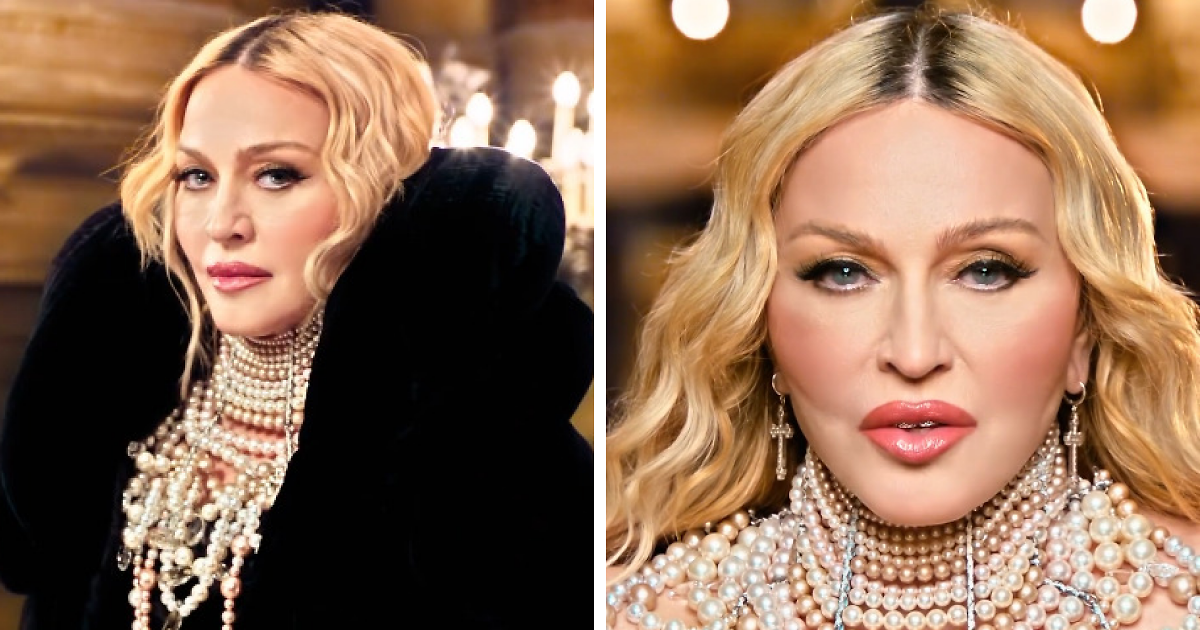
Madonna has spent more than four decades turning pop music into a mirror, a dance floor, a courtroom, and occasionally a very stylish boxing ring. So when the Queen of Pop appeared in a dramatic campaign declaring that age is not the number that defines her, it did not feel like a polite brand message. It felt like a challenge delivered in diamonds, black fabric, cinematic lighting, and the kind of confidence that does not ask permission to enter the room.
The campaign, created around Itaú Unibanco’s 100-year celebration and its “Made of Future” idea, places Madonna in exactly the role she has always played best: the artist who refuses to be reduced. Not reduced to a decade. Not reduced to a face. Not reduced to a headline about how she looks. And absolutely not reduced to someone who should quietly exit the stage because the internet has decided women over a certain age should become decorative throw pillows.
In the ad, Madonna leans into one of the most powerful themes of her career: longevity as defiance. She reminds viewers that she is not simply one version of herself but many versions, layered across eras, reinventions, scandals, records, tours, videos, and cultural battles. Most memorably, she revisits a line that has followed her since her emotional 2016 Billboard Women in Music speech: the most controversial thing she has ever done is to stick around.
That sentence lands because it is funny, brutal, and true. In pop culture, survival can be treated like a crime when the survivor is a woman who refuses to shrink. Madonna has not just stuck around. She has stuck around loudly.
What Happened In Madonna’s Bold Ageism Campaign?
The campaign features Madonna in a grand, theatrical setting, climbing through a lavish visual world while reflecting on fame, time, identity, and reinvention. It was connected to Itaú Unibanco’s centennial messaging, which focused on legacy and the future. Madonna shared the film as a tribute to her Brazilian fans, thanking the bank, her team, and director Jonas Åkerlund, a frequent creative collaborator known for bold visual storytelling.
One especially notable detail: the spot uses “Vogue,” Madonna’s 1990 classic that became both a dance anthem and a cultural statement. The song is not just background music. It is a reminder that Madonna has never been a passive figure in pop. She has used image, movement, fashion, religion, sexuality, controversy, and performance as tools to rewrite the rules of celebrity.
The message of the campaign is simple but sharp: count what she has built, not how many birthdays she has had. Madonna’s argument is not that aging does not exist. It is that aging should not be used as a muzzle. In other words, she is not denying time. She is refusing to let time become a cage.
Why The Line About The “Most Controversial Thing” Still Hits Hard
When Madonna first said that the most controversial thing she had done was “to stick around,” she was accepting Billboard’s Woman of the Year honor in 2016. The speech was raw and unusually direct for an awards stage. She talked about sexism, misogyny, creative survival, and the impossible rules women are expected to follow in entertainment.
The rules she described were familiar: be sexy, but not too sexual. Be ambitious, but not threatening. Be beautiful, but do not admit that beauty is labor. Be opinionated, but not inconvenient. And above all, do not age. Because once a woman ages in public, every wrinkle, outfit, photo angle, and performance choice can be treated like breaking news.
Madonna’s campaign revives that old line because the problem has not disappeared. If anything, social media has made ageism louder, faster, and more casual. A blurry screenshot can travel farther than a full performance. A bad-faith joke can get more attention than a four-decade career. The internet loves a comeback story, but it often gets weirdly cranky when the comeback lasts too long.
That is why Madonna’s message matters. She is not simply defending herself. She is pointing at a cultural pattern: older women are often expected to be grateful for visibility while accepting strict limits on how visible they are allowed to be.
Madonna, Ageism, And The Double Standard In Pop Culture
Ageism in entertainment rarely arrives wearing a name tag. It usually disguises itself as “concern,” “honest opinion,” or “just jokes.” But the pattern is easy to spot. Male rock stars can age into leather jackets, gravelly voices, and “legend” status. Female pop stars are more likely to be interrogated about their faces, clothes, bodies, dating lives, and whether they are acting their age.
And what exactly does “act your age” mean for Madonna? Wear beige? Start a sensible herb garden? Appear only in soft lighting while discussing bone broth? Madonna’s entire career has been built on rejecting the approved script. Asking her to become conventional now is like asking a fireworks show to become a desk lamp.
The backlash she faced after appearing at the 2023 Grammy Awards made this double standard painfully clear. Madonna introduced Sam Smith and Kim Petras, praising artists who challenge norms, but much of the online conversation swerved away from her words and into commentary about her appearance. She later responded by calling out ageism and misogyny, specifically criticizing a culture that punishes women over 45 for remaining strong-willed, adventurous, and visible.
That phrase “women over 45” matters because it exposes how early the cultural narrowing begins. Women are not only judged for getting older; they are judged for failing to perform aging in a way that makes others comfortable. Madonna’s campaign pushes back by making discomfort part of the point.
Why Madonna’s Reinvention Is Not A Gimmick
Madonna’s critics often accuse her of reinventing herself as if reinvention is a trick. But reinvention is not a costume change when it lasts for 40 years. It is a discipline. From the downtown club kid of the early 1980s to the lace-covered provocateur of Like a Virgin, from the spiritual and cinematic ambition of Like a Prayer to the electronic sophistication of Ray of Light, Madonna has treated identity as an evolving art form.
Her campaign message echoes that history. She suggests that changing is how she remains herself. That sounds paradoxical only if we believe authenticity means staying frozen. In reality, most people change constantly. They change careers, haircuts, beliefs, friends, cities, priorities, and passwords they immediately forget. Madonna simply changes in public, at arena scale, often while wearing something that makes comment sections lose their tiny minds.
Reinvention is also why the campaign connects so neatly to a bank celebrating 100 years. On paper, Madonna and a financial institution may seem like an odd pairing. Pop rebellion and banking do not usually sit at the same lunch table. But the shared theme is endurance: how institutions, artists, and individuals survive by adapting rather than fossilizing.
The Campaign Is Really About Legacy
Madonna’s career is not just long; it is unusually dense. She has shaped music video aesthetics, stadium performance, celebrity branding, fashion, queer visibility in mainstream pop, and the conversation around female sexual autonomy. She has been praised, mocked, imitated, banned, awarded, protested, and studied. At this point, reducing her to a debate about whether she looks the way strangers think she should look is not commentary. It is cultural laziness wearing cheap sunglasses.
The campaign’s strongest idea is that legacy should be measured by impact. Madonna’s impact includes chart success, touring power, visual innovation, and a long record of forcing public conversations before those conversations were comfortable. She has never been controversy-adjacent. She has been controversy’s landlord.
But the new campaign does something subtler than shock. It turns survival into aspiration. Madonna is not asking to be remembered as a museum exhibit. She is positioning herself as future-facing. That is why the campaign slogan works: the future is not only for the young. The future belongs to anyone still willing to create, risk, adapt, and annoy the right people.
Her Celebration Tour Made The Same Point On A Massive Scale
The timing of the campaign also matters because it arrived during a period when Madonna’s endurance was visible in a very literal way. After a serious bacterial infection delayed the start of her Celebration Tour in 2023, she returned to the stage and delivered a major global run celebrating four decades of work.
The tour became more than a greatest-hits show. It was a moving argument for artistic survival. It revisited the New York clubs, the AIDS crisis, Catholic imagery, tabloid scandals, dance music, motherhood, grief, sex, joy, and loss that have shaped her life and career. It was not a nostalgia machine. It was a career autobiography with choreography.
Then came Rio de Janeiro. Madonna closed the tour with a free concert at Copacabana Beach in May 2024, drawing an estimated 1.6 million people. That number is not just impressive; it is the kind of number that makes “she should retire” sound like it was typed by someone yelling into a microwave.
Her Brazilian fan base has always been passionate, and the Itaú campaign’s tribute to those fans added emotional weight. Madonna was not simply selling endurance as a slogan. She was living it in front of crowds large enough to look like a nation had decided to go dancing.
Why Ageism Against Women Remains So Stubborn
Ageism persists because it is convenient. It lets audiences dismiss women without engaging with their work. It turns complex careers into punchlines. It allows people to pretend that discomfort with powerful older women is really just aesthetic preference.
The entertainment industry has trained audiences to expect women to peak early, remain visually unchanged, and exit gracefully before they become too complicated. That expectation is absurd, but it is also profitable. Entire industries sell the fear of aging while pretending to celebrate confidence. The message is often: love yourself, but please buy twelve products before attempting it.
Madonna disrupts that sales pitch. She does not offer soft-focus acceptance. She offers confrontation. She does not say, “Please see older women as valuable.” She says, in effect, “I am valuable whether you have updated your worldview or not.”
That is why she remains polarizing. Some people find her refusal inspiring. Others find it exhausting. But the exhaustion says more about the audience than the artist. Madonna has been telling the world who she is for decades. At some point, disbelief becomes a choice.
The Fashion And Visual Language Of Defiance
The campaign’s styling is pure Madonna: dramatic, glamorous, a little dangerous, and entirely aware of its own symbolism. The pearls, black gown, grand staircase, and cinematic mood all serve the same message. This is not a woman asking to be let back into the palace. This is a woman walking through it as if she owns the deed.
Fashion has always been one of Madonna’s languages. The cone bra, bridal lace, crucifixes, tailored suits, corsets, cowboy hats, leotards, grills, veils, and red carpets have never been random. They are punctuation marks. Sometimes exclamation points. Occasionally question marks thrown like knives.
In the ageism campaign, the visual language says what the copy says: Madonna contains many ages, many selves, and many eras. She is not trying to look like the Madonna of 1984, 1990, 1998, or 2005. She is presenting the current Madonna as an accumulation of all of them. That is a much richer idea than youth worship, which is mostly just panic with better lighting.
Why The Message Resonates Beyond Madonna Fans
You do not have to be a lifelong Madonna fan to understand the core issue. Many people know what it feels like to be judged by a number instead of a contribution. Workers over 50 feel it in hiring. Women feel it in beauty standards. Public figures feel it in commentary. Everyday people feel it at family gatherings when someone makes a joke about aging and expects everyone to laugh politely while internally planning revenge via potato salad.
Madonna’s campaign resonates because it speaks to a broader frustration: the feeling that society loves experience only when it is quiet, useful, and nonthreatening. But experience can also be loud. It can dance. It can wear diamonds. It can headline a stadium. It can say no.
For younger audiences, the campaign offers another lesson. Aging is not failure. Visibility after youth is not embarrassing. Reinvention is not desperation. In fact, learning how to keep becoming yourself may be one of the most valuable skills a person can develop.
Specific Examples Of Madonna Turning Criticism Into Power
1. The 2016 Billboard Speech
Madonna used an awards platform not for a safe thank-you speech, but for a blunt analysis of sexism in music. She spoke about survival, double standards, and the cost of being a woman who refuses to obey. Years later, the “stick around” line still feels like a thesis statement.
2. The 2023 Grammys Backlash
After online commentary focused heavily on her appearance, Madonna responded by naming the problem: ageism and misogyny. Instead of apologizing for how she looked, she redirected attention to the cultural habit of punishing women for aging in public.
3. The Celebration Tour Comeback
After a major health scare, Madonna returned to a demanding world tour. The performances did not erase the difficulty of recovery; they made the recovery part of the story. The tour turned survival into spectacle.
4. The Itaú Campaign
In the campaign, Madonna compresses decades of public battles into a sleek message about future, legacy, and reinvention. It is an advertisement, yes, but it also functions as a manifesto with better jewelry than most manifestos get.
What Brands Can Learn From Madonna’s Campaign
From a marketing perspective, the campaign works because it does not treat Madonna’s age as a problem to solve. It treats her longevity as the value proposition. That is a major difference. Too many campaigns featuring older women either over-explain aging or soften it into vague inspiration. Madonna’s spot does neither. It lets her be grand, confrontational, glamorous, and unmistakably herself.
Brands that want to speak to mature audiences should pay attention. Representation is not just casting someone older and then sanding down everything that makes them interesting. Real representation allows complexity. It allows power. It allows humor, sexuality, ambition, style, contradiction, and edge.
Madonna’s campaign also understands that older audiences are not a niche group waiting for beige cardigans and gentle piano music. They are consumers, creators, workers, fans, travelers, leaders, and culture-makers. Many of them have money, taste, memory, and a very low tolerance for being spoken to like they just discovered email yesterday.
Experiences And Reflections Related To Madonna’s Ageism Message
One reason Madonna’s campaign feels personal to so many people is that ageism rarely begins as a dramatic public insult. It often starts quietly. Someone calls a woman “brave” for wearing something stylish after 50. A coworker assumes an older employee cannot learn a new platform. A family member suggests a person is “too old” to start dating, studying, moving, dancing, changing careers, or posting a photo they love. These moments may sound small, but they add up. They teach people to ask for less space.
Madonna’s response offers a different model: take up more space, not less. Her campaign says that a life should become bigger with time because it contains more stories, more skills, more losses survived, more mistakes corrected, and more reasons to stop pretending. That message can apply far beyond celebrity culture. A 55-year-old woman returning to college is also made of the future. A 62-year-old starting a business is made of the future. A grandmother learning video editing, a retired teacher launching a podcast, or a manager refusing to be pushed aside by younger jargon in a meeting all belong in the same conversation.
The most relatable experience here is the pressure to become invisible before you are ready. Many people know the feeling of walking into a room and sensing that others have already filed them under “past tense.” Madonna rejects that filing system. She does not wait for the room to approve her relevance. She brings her own relevance with a soundtrack.
There is also a lesson in how she handles mockery. Not every criticism deserves a full courtroom defense. Sometimes the best answer is continued excellence. Madonna has answered decades of jokes, headlines, and moral panic by making more work. That does not mean criticism never hurts. It means criticism does not get the final edit.
For readers, the practical takeaway is surprisingly simple: do not let someone else’s discomfort become your boundary. Wear the outfit. Learn the tool. Start the project. Say the thing. Change your mind. Change your hair. Change your business model. Change your life. Reinvention is not reserved for pop stars with lighting crews. It is a human right, though admittedly it looks very dramatic on a staircase.
Madonna’s ageism campaign is powerful because it reframes aging as accumulation instead of decline. Every year lived becomes evidence. Every reinvention becomes proof. Every return becomes rebellion. The campaign does not ask whether Madonna is still allowed to be Madonna. It answers the question before anyone finishes asking: yes, today, tomorrow, and as long as she decides to keep going.
Conclusion: Madonna’s Real Controversy Is Refusing To Disappear
Madonna’s bold campaign is not just another celebrity ad with dramatic lighting and a famous soundtrack. It is a statement about who gets to own the future. By challenging ageism directly, she turns a common insult into a badge of endurance. She reminds audiences that relevance is not reserved for the young, reinvention is not a sign of insecurity, and longevity is not something women should apologize for.
Whether people love her, criticize her, misunderstand her, or continue debating her every move, Madonna remains exactly where ageist culture least wants an older woman to be: visible, powerful, glamorous, opinionated, and unfinished. The most controversial thing she has ever done may indeed be sticking around. The funniest part is that she seems nowhere near done.
Note: This article synthesizes publicly reported information from entertainment, music, fashion, business, advertising, and cultural analysis coverage, along with widely reported details from Madonna’s campaign, speeches, public statements, and recent touring history.











