
Note: Body-only HTML, ready to paste into a CMS.
Some home decor pieces enter a room like they own the mortgage. Lyngby’s 20 cm vase does the exact opposite. It stands there quietly, all clean lines and calm confidence, and somehow still becomes the thing your eyes return to. That is the charm of this Danish design classic: it does not beg for attention, yet it steals the scene anyway. Official brand materials and current retail descriptions consistently frame the Lyngby vase as an iconic piece of Danish porcelain history, recognizable for its cylindrical silhouette and signature grooves, with the 20 cm size sitting right in that sweet spot between “tiny accent” and “centerpiece with ambition.”
If you are searching for a vase that can hold flowers without looking fussy, decorate a shelf without becoming clutter, and nod to Scandinavian design without shouting “I just discovered minimalism last Tuesday,” the 20 cm Lyngby vase is a serious contender. It is elegant, practical, and surprisingly versatile. In other words, it is the rare decorative object that can play nice with tulips, dried stems, a dining table, a console, and your overly opinionated coffee table books.
The Story Behind the Vase
The Lyngby vase traces its roots to 1936, when the original Porcelænsfabrikken Danmark–Lyngby Porcelæn introduced a design that looked radically different from the heavily decorated porcelain traditions that came before it. Official Lyngby materials say production continued until the factory closed in 1969, and the vase later returned in an early-2010s relaunch led by the modern brand. Across official pages and U.S. retail descriptions, the same core idea keeps showing up: this vase became iconic because it rejected ornament-heavy conventions in favor of a simple, fluted cylinder that felt modern, functional, and refreshingly unpretentious.
That history matters because the vase is not just “pretty Scandinavian decor.” It represents a shift in how porcelain was viewed. Instead of relying on painted motifs to do all the talking, the object itself became the statement. Shape, rhythm, proportion, and surface texture took over. Dwell describes the Lyngby vase as one of the most emblematic pieces of Danish porcelain, while official Lyngby and Rosendahl materials describe it as a symbol of modern Danish design history. Translation: this is not a random cylinder with grooves. This is a cylinder with a résumé.
Why the 20 cm Size Is the Goldilocks Option
The 20 cm version works so well because it lands in the practical middle. Retail descriptions place it at roughly 7.87 inches tall and around 4 inches in diameter, which is large enough to hold a real bouquet but compact enough not to dominate a tabletop. It is not a bud vase pretending to be useful, and it is not a floor statement piece demanding a stage. It is the size that says, “Yes, I can hold flowers,” without also saying, “Please reorganize the whole room around me.”
That middle-ground scale makes the vase unusually flexible. On a dining table, it can carry a modest arrangement without blocking conversation. On a coffee table, it has enough height to create visual contrast with books and trays. On a console or shelf, it reads as sculpture even when empty. This is one reason the Lyngby vase keeps appearing in retail styling and editorial design coverage: the proportions are easy to live with. They look deliberate rather than accidental.
Design Language: Minimalism With a Pulse
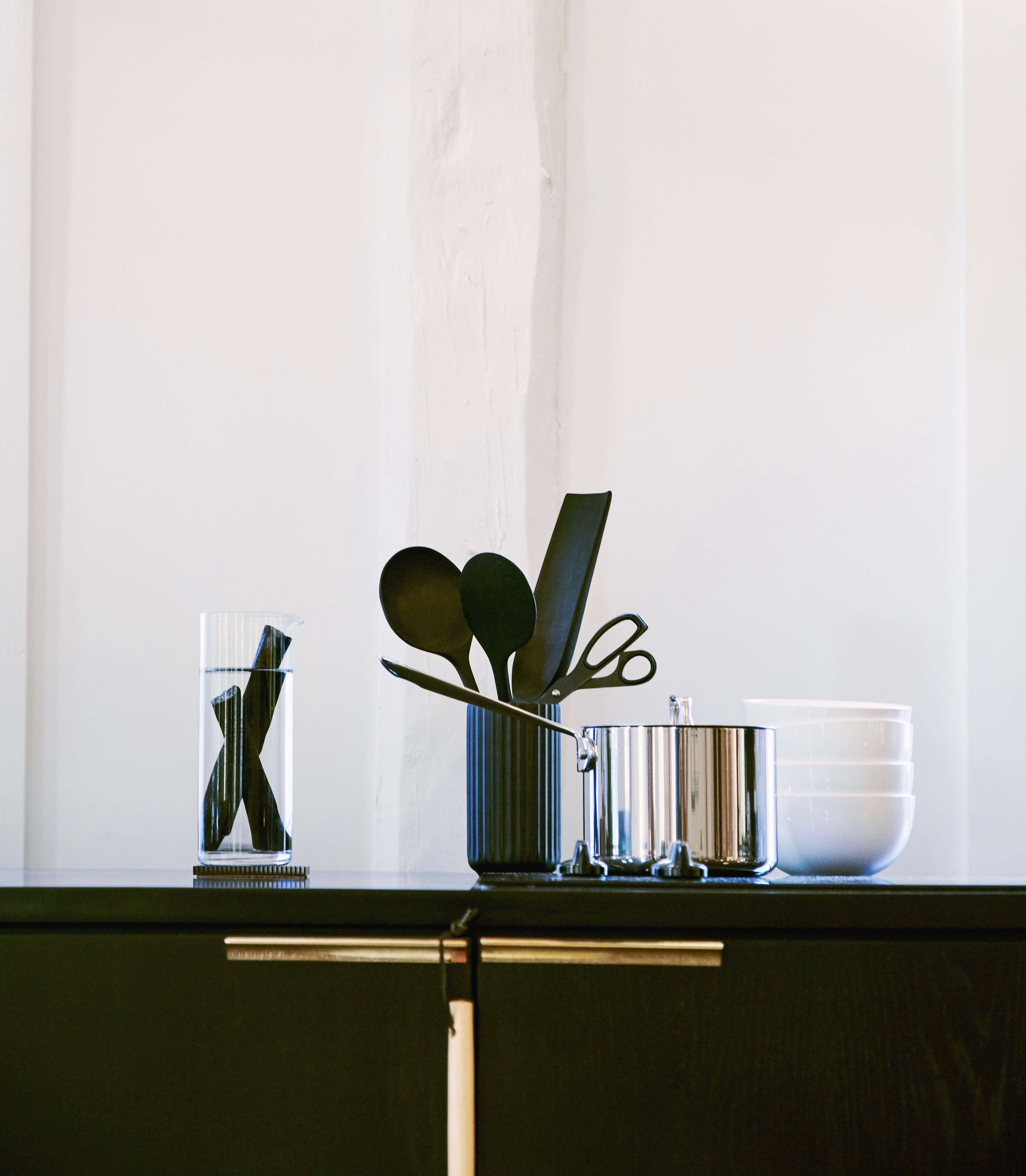
The first thing people notice is the vertical ribbing. Those grooves are the signature. They run from base to rim, giving the surface a disciplined rhythm that catches light and creates shadow without adding clutter. Lumens highlights how each ridge picks up brightness differently, while official materials describe the grooves as central to the vase’s identity. In design terms, the effect is subtle. In real life, it is what keeps the vase from feeling flat or boring. The surface does the visual work that decoration would normally do.
The second thing people notice is the shape: a clean cylinder, calm and balanced, with almost architectural composure. Several product and editorial descriptions connect the vase to Bauhaus and functionalist thinking, the design philosophy that form should be driven by use, material, and structure rather than unnecessary flourish. Britannica defines functionalism as the idea that form should follow practical considerations, and that lens helps explain why the Lyngby vase still feels current. It is simple, yes, but it is not empty simplicity. It is purposeful simplicity. That is much harder to pull off than most minimalist decor would like you to believe.
Materials, Finishes, and Why They Matter
Official Lyngby materials show that the 20 cm format has appeared in multiple versions, including porcelain, glass, and special marble editions. The original white porcelain remains the brand’s defining expression, but the design has also been adapted into mouth-blown glass and limited, more luxurious interpretations. That matters because the 20 cm size is not just one product; it is a format within a broader design family. Same silhouette, different mood swings. Porcelain is crisp and graphic. Glass is lighter and more luminous. Marble turns the vase into something closer to a small monument.
Porcelain: The Classic Purist Choice
The porcelain version is the one most closely associated with the Lyngby legacy. Retail and brand descriptions repeatedly emphasize its clean, cylindrical form, vertical ribbing, and enduring appeal. In white, the vase reads as bright, architectural, and very Scandinavian in the best possible sense. In darker or matte finishes, it feels moodier and more graphic. If you want the most classic expression of the design, porcelain is the safeand smartbet. It has enough visual structure to stand alone, which means it works even when your grocery-store flowers have given up on life.
Glass: Softer, Brighter, More Atmospheric
The glass versions keep the iconic grooves but trade opacity for light play. Retail descriptions from 2Modern and Bloomingdale’s present the mouth-blown glass vase as equally minimal yet more decorative in an optical way: transparency, reflection, and color do extra work. A clear or tinted 20 cm glass Lyngby vase can feel especially good on a dining table or near a window, where daylight turns those vertical channels into tiny light events. It is the same design language, just with a little more sparkle and a little less stoicism.
Marble and Deluxe Editions: Same Shape, Different Drama
Official catalog materials also document anniversary marble editions in 20 cm, produced as a tribute to the vase’s long history. These versions lean into the sculptural quality of the form, with natural veining making each piece visually distinct. They are beautiful, but they are also less of an everyday “buy flowers on Friday, feel accomplished by Saturday” vase and more of a collector-minded decor object. Gorgeous? Absolutely. Casual? Not even a little.
How to Style Lyngby’s 20 cm Vase Without Overthinking It
The easiest way to style this vase is to let the shape do half the job. Because the form is already graphic, you do not need a chaotic bouquet. A few tulips, ranunculus, branches, or a restrained cluster of stems usually look better than a floral explosion that resembles a panic attack in botanical form. Architectural Digest notes a common styling principle that the vase should be about one-third the height of the arrangement, which means a 20 cm vase pairs well with flowers roughly in the 16- to 24-inch range. Better Homes & Gardens and The Spruce also emphasize how simple floral displays often make the cleanest statement on tables and mantels.
For a coffee table, go asymmetrical: one vase, one small stack of books, one contrasting object. The Spruce specifically recommends varying heights and embracing asymmetry for a more effortless look, and that advice suits the Lyngby vase perfectly. For a dining table, keep the arrangement airy so people can still see one another and avoid having to play conversational peekaboo around a bouquet. For a shelf, the empty vase can work as a sculptural accent on its own. This is one of the great perks of the design: it does not need constant floral labor to earn its keep.
Dried flowers are another strong match. Architectural Digest points out that dried arrangements benefit from proportion and restraint, and the Lyngby vase’s ribbed cylinder gives dried stems just enough structure without making the whole setup look dusty or overly rustic. If your taste leans modern, this vase is especially good at keeping organic materials from veering into farmhouse cosplay.
What to Check Before Buying
Here is where the sensible grown-up advice arrives, wearing glasses. Check the exact version. Current listings across retailers show real variation in material, finish, care instructions, and manufacturing details. Some descriptions emphasize porcelain, others mouth-blown glass; some note dishwasher-safe care, while others advise hand washing; some listings describe handmade Scandinavian production, while others list European manufacturing locations that differ by model. None of that makes the product suspiciousit just means the Lyngby family is broader than one single SKU, and buyers should confirm the details of the specific 20 cm vase they want.
Also think about what you actually want the vase to do. If you want a crisp year-round decor object, white porcelain is usually the most timeless choice. If you want more glow and color interplay, glass may be better. If you mostly arrange a few stems rather than full bouquets, the 20 cm size is likely ideal. If you dream in giant branches and dramatic floral installations, you may want to size up. Design is romantic until hydrangeas start toppling like overconfident gym bros. Then proportion matters very quickly.
Experience: Living With Lyngby’s 20 cm Vase
Living with Lyngby’s 20 cm vase is less like owning a flashy decor item and more like having one extremely well-dressed friend who always knows how to stand in the right light. The first thing you notice is how easy it is to place. Some vases need a whole support team: giant table, giant bouquet, giant sense of commitment. This one does not. It slides onto a console, windowsill, sideboard, kitchen shelf, or bedside table without turning the area into a design hostage situation. Empty, it reads as sculpture. Filled, it becomes functional without losing its cool. That balance is rare. A lot of decorative pieces are either useful and dull or beautiful and impractical. Lyngby’s 20 cm vase manages to avoid both traps. Its grooves catch morning light in a way that makes even plain stems feel a little more intentional, and the cylindrical shape gives a neat, disciplined frame to flowers that might otherwise sprawl into chaos.
The everyday experience is also pleasantly low-drama. You do not have to be a floral wizard to make it look good. A few supermarket tulips? Great. Three clipped branches from the yard? Also great. A bundle of dried stems you forgot you owned until a cleaning spree uncovered them? Miraculously, still great. Because the vase already has such a strong graphic identity, it does a lot of the heavy lifting for you. It makes sparse arrangements look curated rather than accidental. It makes simple arrangements feel modern rather than cheap. It even makes no arrangement at all feel like a deliberate styling decision instead of a failure to buy flowers this week. That is part of why the Lyngby vase has held onto its reputation for so long: it is forgiving. It works with real life, not just magazine life. It can look polished in a minimalist apartment, warm in a more layered room, and surprisingly sharp in traditional spaces that need one cleaner note. The 20 cm size is especially satisfying because it feels substantial in the hand without becoming bulky. It is large enough to matter, small enough to move around, and refined enough to keep earning new spots in the house. One week it is on the dining table; the next it is on a shelf beside art books; then suddenly it is the best thing on the mantel. The experience, in short, is not loud. It is steady. And that may be the best compliment a home object can get: you keep using it, keep noticing it, and never get tired of it.
Final Thoughts
Lyngby’s 20 cm vase endures because it solves several design problems at once. It offers history without feeling old-fashioned, minimalism without sterility, decoration without fuss, and practicality without compromise. Official brand history, U.S. retail descriptions, and design-editorial coverage all point to the same conclusion: this is a piece whose appeal comes from restraint, proportion, and a strong understanding of form. In a market full of home accessories trying very hard to be memorable, the Lyngby vase takes the opposite route. It is calm, useful, and beautifully sure of itself. Frankly, more objects should try that strategy.











