
Note: This article is written for education, defensive hardware security awareness, and authorized security review. It intentionally avoids step-by-step attack instructions, unsafe lab procedures, and operational parameters.
When a Tiny Flash of Light Becomes a Security Conversation
Laser fault injection sounds like the title of a sci-fi movie where the villain owns too many mirrors. In reality, it is a serious hardware security technique used to study how chips behave when their physical environment is disturbed. Instead of attacking software through passwords, malware, or suspicious email attachments from “Prince Totally Real,” laser fault injection focuses on the silicon itself.
The basic idea is simple at a high level: a precisely directed laser can disturb the operation of a running integrated circuit. That disturbance may cause a temporary fault, such as a flipped bit, an altered logic state, or a skipped operation. In secure embedded systems, even a tiny fault can matter because many devices rely on short, critical security decisions: verify a signature, check a lock bit, protect a key, or confirm that secure boot is working as expected.
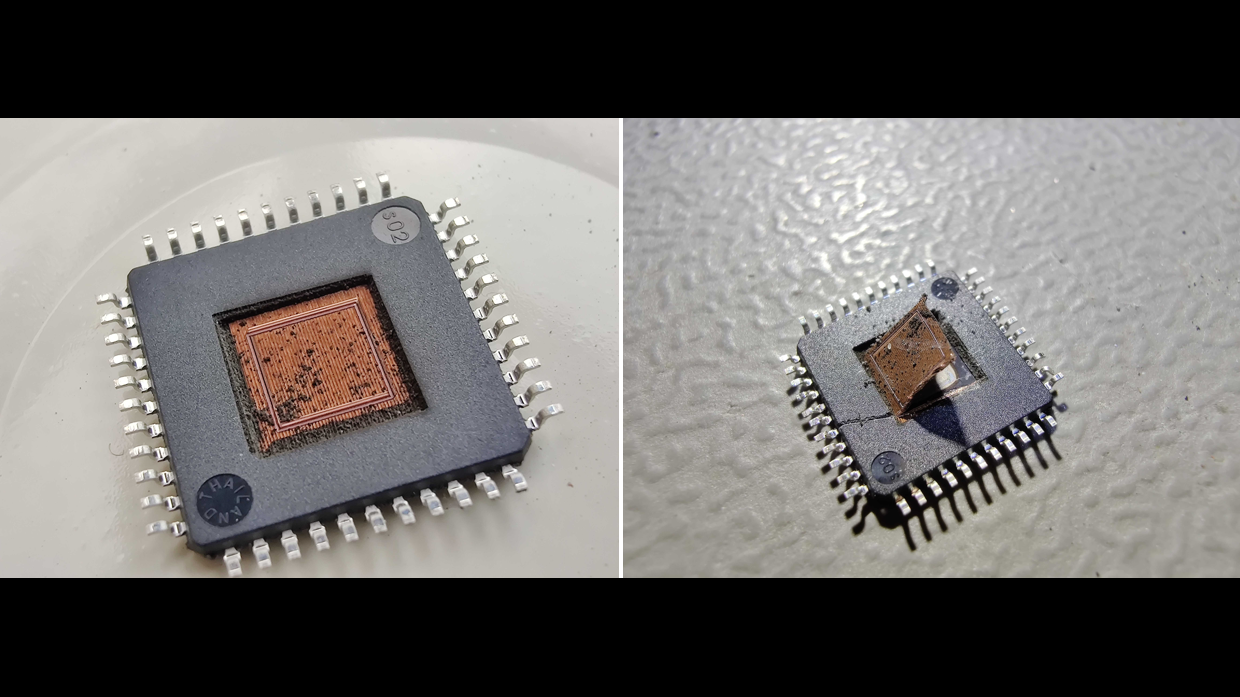
The phrase “now with optional decapping” adds another layer. Decapping means removing or modifying part of a chip package to expose the die, the actual silicon inside. In older laboratory workflows, decapping and laser testing were separate steps. Recent hobbyist and research discussions have explored whether the same kind of laser-based setup used for fault injection can also help with package removal or chip preparation. That does not make the work casual. It makes the security lesson louder: physical access still matters, and hardware designers must assume that motivated testers may look beneath the plastic.
What Is Laser Fault Injection?
Laser fault injection, often shortened to LFI, is a form of physical fault injection. It belongs to the broader family of hardware fault injection attacks, alongside voltage glitching, clock glitching, electromagnetic fault injection, and environmental stress techniques. These methods attempt to make a device behave incorrectly at a carefully chosen moment.
Unlike broad electrical disturbances that may affect an entire chip or board, laser fault injection can be spatially focused. That precision is what makes it interesting to security researchers. In theory, a laser can target a region associated with memory, control flow, security checks, or cryptographic operations. In practice, results are complicated, noisy, and highly dependent on chip design, packaging, timing, optics, and safety-controlled lab conditions.
At the silicon level, light can create electrical charge in semiconductor structures. That charge may temporarily influence the state of transistors or memory cells. The result is not magic; it is physics walking into a security meeting and refusing to leave until everyone updates the threat model.
Why Security Engineers Care
Modern embedded devices are everywhere: payment terminals, hardware wallets, medical devices, industrial controllers, smart locks, vehicles, routers, authentication tokens, and IoT gadgets that insist your toaster needs firmware. Many of these devices rely on secure boot, encrypted storage, debug locks, fuses, secure elements, or trusted execution features.
Those protections are valuable, but they are not invisible force fields. If an attacker has physical access to a device and enough skill, the hardware itself becomes part of the attack surface. Laser fault injection is one way researchers test whether a chip fails safely or fails dramatically, like a cat discovering gravity for the first time.
What Does “Optional Decapping” Mean?
In chip security, decapping refers to exposing the silicon die by removing or altering the protective package around it. Packages exist to protect the die, connect it electrically to the outside world, manage heat, and keep the fragile inner structure from becoming an expensive crumb. For physical analysis, however, the package can block visual inspection or interfere with certain forms of probing and optical testing.
Optional decapping does not mean every laser fault injection experiment requires opening the chip. Some approaches explore backside access, where infrared light can pass through silicon under certain conditions. Other research setups may use prepared samples, specialized labs, or chips already designed for evaluation. The key point is that packaging influences the feasibility, reliability, and risk of optical fault testing.
From a defensive standpoint, decapping matters because it reminds designers that plastic is not a security boundary. A chip package can slow down analysis, increase cost, and create practical barriers, but it should not be treated as the only thing standing between a secret key and a determined lab.
How Laser Fault Injection Fits Into the Hardware Security Landscape
Laser fault injection is best understood as one tool in a larger security testing toolbox. Side-channel analysis studies information that leaks through power, timing, electromagnetic signals, sound, or optical behavior. Fault injection, meanwhile, asks a different question: what happens if the device is pushed into making a mistake?
That mistake can be useful to a defender during evaluation. For example, a security lab might test whether a secure boot process detects abnormal behavior and resets safely. A chip vendor might evaluate whether redundant checks actually catch faults. A product team might discover that a “verified” condition is checked once when it should be checked multiple times with fault-resistant logic.
Laser testing is especially relevant when a product’s threat model includes physical capture. A consumer gadget sitting in a kitchen may not need the same defenses as a banking token, but a device that protects money, identity, firmware signing keys, or safety-critical control should take physical attacks seriously. In other words, threat modeling is not paranoia; it is engineering with coffee.
Why “Low-Cost” Laser Research Changed the Conversation
For years, laser fault injection was associated with expensive laboratories, specialized equipment, and a skill barrier tall enough to need its own elevator. More recent research and public projects have shown that parts of the technique can be explored at lower cost than many people assumed. Open-source hardware, 3D-printed positioning platforms, repurposed optics, and community documentation have made the topic more visible.
That does not mean laser fault injection is easy, safe, or automatically effective. It means the accessibility curve is changing. When advanced testing becomes more affordable, defenders can benefit because more teams can evaluate products before attackers do. The uncomfortable flip side is that products relying on “nobody will have the equipment” look weaker over time.
This is a familiar story in security. Techniques begin in elite labs, then move into conferences, then into university projects, then into open-source tooling, then into the “wait, people can do that now?” phase. The best response is not panic. It is better design, better testing, and fewer assumptions that security is safe because the attack sounds expensive.
Common Targets of Fault Injection Testing
Secure Boot
Secure boot is designed to ensure that a device runs only trusted firmware. A fault injection test may examine whether the device can be disturbed during the verification process. The defensive lesson is straightforward: signature verification should not be a fragile single moment. It should be supported by robust control flow, repeated checks, safe error handling, and hardware features designed to resist tampering.
Debug Locks and Readout Protection
Many microcontrollers include mechanisms that prevent external tools from reading protected memory. Fault testing may evaluate whether those protections behave correctly under abnormal conditions. A good design should not unlock secrets because one internal state was momentarily confused.
Cryptographic Operations
Cryptographic implementations can be sensitive to faults. If a device produces incorrect cryptographic outputs in a predictable way, researchers may study whether those errors reveal information. Strong implementations use countermeasures such as redundancy, consistency checks, fault detection, and safe shutdown behavior.
Embedded AI and Edge Devices
As machine learning models move into embedded systems, fault injection research is expanding beyond classic cryptography. A disturbed instruction, memory value, or control-flow decision may alter model behavior. This matters for edge AI used in sensors, robotics, industrial monitoring, and safety-related applications.
Defensive Countermeasures: Making Chips Less Gullible
Defending against laser fault injection is not about adding one magical shield and calling it a day. Effective protection usually combines design choices, layout strategies, sensors, software checks, and secure failure behavior.
Redundant Checks
Critical decisions should not rely on a single comparison or branch. Redundant verification, diverse logic paths, and repeated checks can make it harder for one transient fault to change the final security decision.
Fault Detection Sensors
Some chips include sensors intended to detect abnormal light, voltage, clock, temperature, or timing conditions. Research continues into digital sensors, optical detection, and layout-aware protection methods. Sensors are not perfect, but they raise the difficulty and can help a device fail safely.
Secure Error Handling
A device should respond to suspicious faults by entering a safe state, clearing sensitive data where appropriate, or requiring a clean restart. The worst design is one that notices something strange and then politely hands over the crown jewels.
Physical Layout Hardening
Chip layout can influence how vulnerable a design is to localized faults. Sensitive logic may be protected through shielding, spacing, duplication, sensor placement, and careful routing. This is where hardware security becomes less like ordinary coding and more like building a tiny castle where the walls are measured in microns.
Pre-Silicon Security Review
Waiting until a chip returns from fabrication to think about fault injection is expensive. Pre-silicon modeling, formal verification, simulation, and design reviews can identify weak assumptions earlier. Hardware security teams increasingly treat physical attack resistance as a design requirement, not a decorative sticker added at the end.
Why This Topic Matters for Product Teams
Many organizations still treat physical attacks as exotic. That can be a mistake. Not every product needs bank-grade silicon security, but every product should understand what it protects, who might want it, and what physical access means.
A smart thermostat probably does not need the same protection profile as a cryptocurrency hardware wallet. A toy robot does not need the same defenses as an automotive control unit. But if a device stores credentials, protects firmware, controls access, or participates in a larger trusted system, hardware fault injection belongs somewhere in the risk conversation.
The real value of studying laser fault injection is not learning how to zap chips for fun. It is learning that security assumptions must survive contact with physics. Software can be patched. Hardware, once shipped at scale, is much harder to fix. That makes early testing and conservative design especially important.
Practical Experience: Lessons From Watching Hardware Security Get Real
Anyone who has worked near embedded security eventually learns a humbling truth: the chip does not care about your PowerPoint threat model. It cares about voltage, timing, heat, light, layout, packaging, and whether your “impossible” state is actually just “unlikely on a normal Tuesday.” Laser fault injection sits right in that uncomfortable gap between clean design diagrams and messy physical reality.
One of the biggest lessons from this topic is that physical attacks reward patience. Software security often feels fast: scan, exploit, patch, retest. Hardware security moves differently. It involves observation, sample preparation, measurement, environmental control, failure analysis, and a strong tolerance for experiments that almost work. The joke in many labs is that the equipment is precise, but the universe is petty.
Another lesson is that good documentation matters. A product team that knows exactly how secure boot works, where keys are stored, what happens on reset, and how error states are handled is already ahead of a team that simply says, “The chip vendor handles security.” Vendor features are useful, but integration choices can weaken them. A secure element used carelessly is like buying a vault and leaving the receipt taped to the door.
Testing also teaches teams to respect failure modes. A device should not merely work when everything is normal. It should fail safely when something is strange. That includes abnormal power behavior, clock instability, unexpected resets, corrupted reads, and inconsistent security states. Laser fault injection is one dramatic way to explore those questions, but the mindset applies broadly: assume faults happen, then design so one fault does not become a full compromise.
For writers, educators, and security teams explaining this topic to non-specialists, the best analogy is usually not “hacking with lasers.” That phrase is catchy, but it can make the issue sound like a party trick. A better explanation is this: secure chips make decisions, and physical fault injection tests whether those decisions remain trustworthy when the chip is disturbed. The laser is just one disturbance method. The security question is whether the system can tell the difference between normal execution and a tiny silicon hiccup wearing a fake mustache.
The rise of lower-cost tools also changes training culture. More students, researchers, and product teams can now learn about physical security without needing a secret mountain laboratory guarded by owls. That is good news when the work is ethical and authorized. More defenders understanding hardware attacks means better products, better standards, and fewer systems that rely on wishful thinking.
The final experience-based takeaway is simple: laser fault injection is not just a hardware hacking curiosity. It is a reminder that security exists across layers. Firmware, silicon, packaging, manufacturing, testing, and field deployment all interact. When one layer assumes another layer is perfect, attackers look for the seam. Good engineering closes those seams before the product reaches customers.
Conclusion: The Laser Is a Warning Light
Laser fault injection, especially when discussed with optional decapping, is a fascinating and slightly intimidating window into modern hardware security. It shows how physical access can challenge assumptions built into secure boot, cryptographic operations, debug locks, and embedded trust models.
The lesson is not that every device is doomed. The lesson is that serious products need serious threat models. If a device protects valuable secrets, it should be designed and tested against realistic physical attacks. That means stronger hardware design, better fault detection, safer error handling, and security reviews that begin before the chip is already baked into a million devices.
In the end, laser fault injection is less about lasers and more about humility. Silicon is powerful, but it is still physical. And when security meets physics, physics usually asks the first question.











