
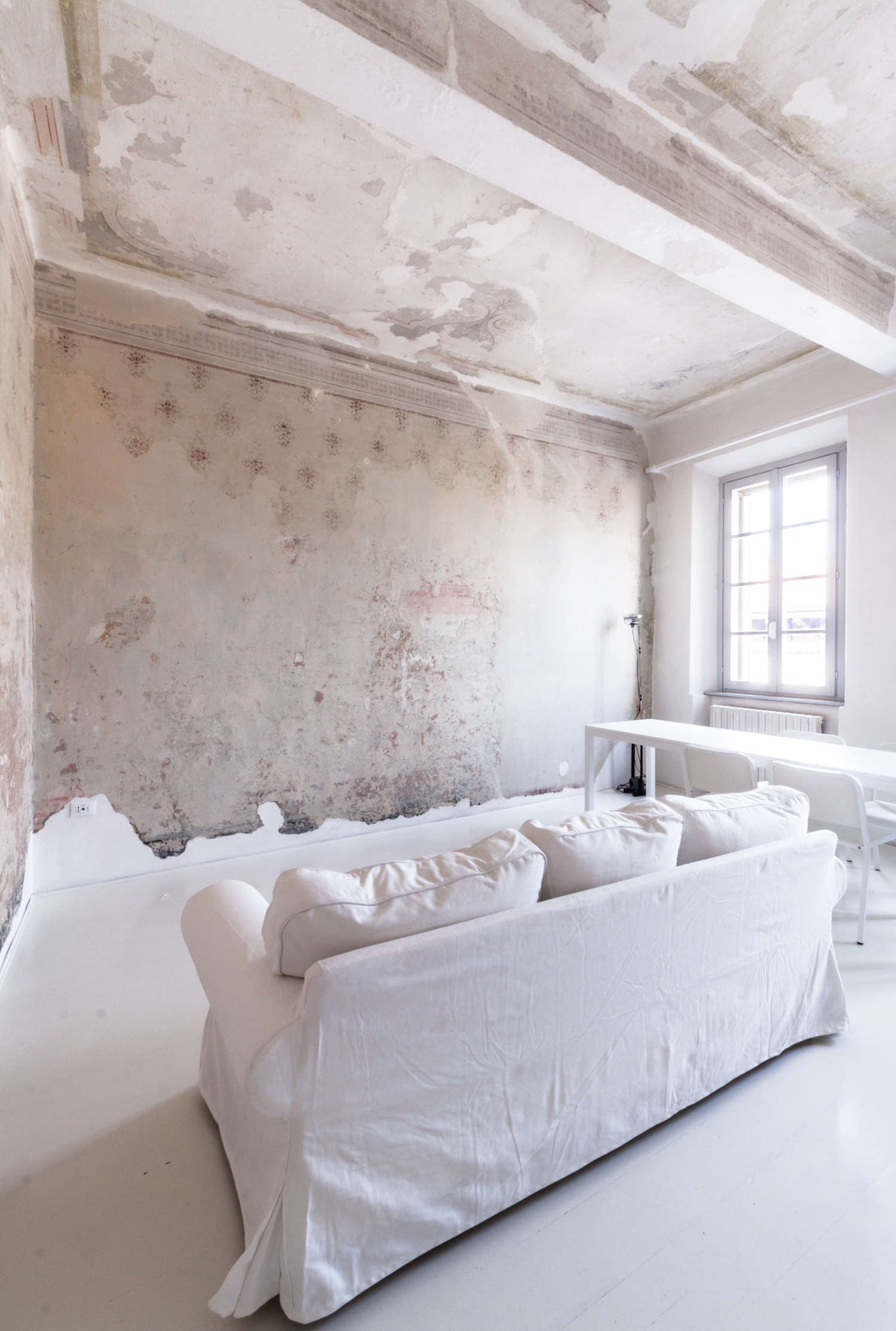
Some apartments ask you to admire the view. Others ask you to remove your shoes, lower your voice, and pretend you are not emotionally attached to plaster. In Mantova, a northern Italian city wrapped in lakes, Gonzaga history, and enough Renaissance atmosphere to make a ceiling feel ambitious, one romantic apartment does exactly that. It turns the remains of a late Renaissance fresco into the soul of the home.
This is not the kind of renovation where old walls are bullied into behaving like new construction. Instead, the apartment treats time as a design material. A circa-1600 structure, softly restored by local architects, reveals fragments of a roughly 400-year-old fresco across its rooms. White furnishings, glossy painted floors, original doors, a preserved archway, and upward-facing lighting all work together like a respectful supporting cast. The fresco is the star. The kitchen knows it. The bathroom knows it. Even the storage seems to whisper, “Please do not compete with the ceiling.”
For readers searching for Mantova apartment design, late Renaissance fresco interiors, or romantic Italian apartment ideas, this home offers a beautiful lesson: preservation does not have to feel dusty, and minimalism does not have to feel cold. When done well, the old and the new can flirt shamelessly across the centuries.
Why Mantova Is the Perfect Setting for a Fresco-Lined Apartment
Mantova, also known in English as Mantua, is one of those Italian cities that seems almost unfairly well composed. Located in Lombardy, it sits near the Mincio River and is historically surrounded by lakes, giving the old city the feeling of a cultural island. It is not as loud as Rome, not as polished for postcards as Venice, and not as aggressively fashion-conscious as Milan. Mantova is quieter, stranger, more theatrical. In other words, ideal fresco territory.
The city rose to major cultural importance under the Gonzaga family, who ruled Mantua from the 14th century into the early 18th century. Their court attracted artists, architects, musicians, scholars, and ambitious decorators who clearly believed blank walls were a missed opportunity. Andrea Mantegna worked here. Leon Battista Alberti designed here. Giulio Romano transformed Palazzo Te into one of the great Mannerist masterpieces of Europe. Mantova was not just a city with art; it was a city that used art as a civic language.
That history matters because the apartment’s fresco fragments are not random decoration. They belong to a broader Mantuan habit of painting architecture into poetry. Frescoes appeared in palaces, churches, façades, and private residences. Even lesser streets once carried elaborate painted surfaces, with ornamental bands, mythological creatures, plant motifs, faux masonry, and decorative friezes. In Mantova, walls were never just walls. They were announcements, memories, jokes, status symbols, and sometimes very expensive flexes in lime plaster.
The Apartment: Romantic, Minimal, and Respectfully Dramatic
The apartment at the center of this story is a one-bedroom flat inside a building dating to around 1600. Rather than erase its age, the renovation highlights it. The most compelling feature is the remains of a late Renaissance fresco that appears throughout the home, especially across upper walls and ceilings. The effect is not museum-perfect. It is better than that. It is partial, textural, mysterious, and alive.
In many historic renovations, owners face a difficult question: should the old surface be restored to its original appearance, preserved as a fragment, or covered for practical living? Here, the answer is poetic restraint. The fresco remains are carefully integrated into new plaster walls. The missing parts are not aggressively reconstructed. The apartment does not pretend to be a palace. It accepts itself as a home with an extraordinary memory.
A White Interior That Lets the Fresco Breathe
Nearly all the furnishings are white, which may sound risky if your idea of domestic life includes coffee, shoes, or being human. But visually, the decision is brilliant. White furniture, white-painted doors, and glossy white wood plank floors create a quiet field around the fresco fragments. The eye naturally moves upward to the aged surfaces, where color, texture, and irregularity do the emotional work.
This is not sterile minimalism. It is more like silence in a church before someone sings. The white palette gives the fresco room to breathe. A louder interior would have turned the home into a shouting match: antique chair versus historic plaster, patterned rug versus Renaissance ceiling, decorative lamp versus decorative wall. Instead, the design understands that when your apartment already contains 400-year-old art, you do not need twelve throw pillows named “Tuscan Sunset.”
The Original Archway and the Modern Kitchen
One of the apartment’s most memorable moments is an original archway dating to around 1600. It now frames a custom white laminate kitchen, creating a satisfying contrast between old architecture and contemporary function. The arch gives the kitchen gravitas; the kitchen gives the arch daily purpose. Together, they prove that historic interiors do not need to be frozen in ceremonial gloom.
The kitchen does not attempt to imitate the past. That is important. Fake-old cabinetry, distressed finishes, and decorative “Renaissance-inspired” hardware could easily push the space into theme-restaurant territory. Instead, the clean white kitchen behaves like a modern insert. It is useful, quiet, and reversible in spirit. It allows the old structure to remain legible while making the apartment livable for a contemporary resident who, presumably, still needs pasta water, espresso, and a place to hide snacks.
What Makes Fresco So Special?
Fresco is not simply paint on a wall. In true fresco, pigments are applied to fresh, wet lime plaster. As the plaster dries and carbonates, the pigment becomes part of the wall surface. This is why fresco can endure for centuries when conditions are favorable. It is also why damaged frescoes are so moving: they are not just images that have faded; they are walls that have aged.
In a late Renaissance apartment, fresco remains can carry multiple layers of meaning. They may reveal taste, wealth, fashion, mythology, religion, domestic aspiration, or simply a love of ornament. Even fragments can suggest the rhythm of the original room. A band of color near the ceiling may imply a decorative frieze. A surviving botanical motif may hint at courtly symbolism. A patch of blue or ocher can shift the entire atmosphere of a room.
Unlike framed art, fresco is inseparable from architecture. You do not hang it; you inherit it. That changes the relationship between resident and room. Living with a fresco means living with a surface that was made for that exact wall, in that exact place, long before modern lighting, plumbing, and Wi-Fi passwords entered the plot.
Late Renaissance Style: Beauty with a Wink
The phrase “late Renaissance” often overlaps with Mannerism, especially in places like Mantova, where Giulio Romano helped push classical harmony into something more playful, theatrical, and surprising. Palazzo Te, built for Federico II Gonzaga between the 1520s and 1530s, is the city’s great example of this spirit. Its fresco cycles, illusionistic spaces, and inventive architecture show how Renaissance order could be stretched into drama.
That context helps explain why a frescoed apartment in Mantova feels so romantic. Mantuan Renaissance art was not only about balance and proportion. It was also about spectacle, cleverness, and atmosphere. Walls could open into imagined worlds. Ceilings could become skies. Rooms could make guests feel slightly overwhelmed, which was probably the point. A noble patron did not commission a painted chamber merely to say, “We own walls.” He commissioned it to say, “Welcome to my mythological brain.”
In this apartment, the surviving frescoes are quieter than Palazzo Te, of course. No giants appear to be collapsing through the ceiling while you brush your teeth. Still, the same regional love of painted surfaces lingers in the fragments. The apartment feels romantic because it does not explain everything. It leaves room for imagination.
Design Lessons from the Mantova Apartment
1. Let the Oldest Element Lead
The strongest design move in the apartment is also the simplest: the historic fresco is treated as the main decorative element. Everything else steps back. This is a useful lesson for anyone renovating an older home. If you uncover brick, beams, plasterwork, tile, or painted decoration, do not immediately bury it under trends. First ask what the house is trying to tell you. Old buildings can be chatty when treated kindly.
2. Use Contrast, Not Imitation
The white laminate kitchen works because it does not pretend to be 400 years old. Modern design beside historic architecture can be more honest than imitation. The contrast clarifies both eras. The arch looks older and more beautiful because the kitchen is crisp and contemporary. The kitchen looks calmer because the arch gives it depth.
3. Keep the Palette Quiet
A restrained palette lets texture become the luxury. In the Mantova apartment, white surfaces amplify the fresco’s faded tones and irregular plaster. This approach is especially helpful in small historic apartments, where too many colors can make rooms feel busy. When in doubt, let age provide the pattern.
4. Light the Ceiling Like It Matters
Upward-facing lighting highlights the frescoed ceiling and textured surfaces. This is a smart alternative to blasting a room with flat overhead light. Grazing light reveals depth, cracks, brushwork, and plaster movement. In a frescoed space, lighting is not just practical; it is interpretation.
5. Mix Practical Living with Poetic Restraint
The apartment includes modern plumbing, a remodeled bathroom, built-in storage, and a functional kitchen. It is not a shrine to inconvenience. The romantic quality comes from balance: the home supports daily life while keeping its historic atmosphere intact. That is the sweet spot of adaptive reuse.
The Bathroom: Proof That Romance Can Include Plumbing
Historic apartments are charming until the plumbing gets involved. Then romance can leave the room wearing work boots. In this Mantova apartment, however, the remodeled bathroom continues the broader design strategy: clean, practical, and lightly theatrical. New fixtures, white ceramic tile, an antique mirror, and storage tucked into a blue-and-white armoire create a layered but uncluttered space.
The bathroom matters because it shows how preservation does not mean refusing comfort. A home can honor a fresco and still have a proper shower. It can keep original doors and still include modern fixtures. It can look like a love letter to the Renaissance without asking residents to live like minor courtiers waiting for hot water to be invented.
Why This Romantic Italian Apartment Feels So Modern
Although the apartment contains historic fresco remains, its appeal feels very current. Contemporary design culture is increasingly interested in patina, reuse, craft, and authenticity. People are tired of interiors that look assembled in one afternoon from a single online cart. The Mantova apartment offers the opposite: a home that cannot be duplicated because its best feature is time itself.
This is especially relevant for SEO searches around historic apartment renovation, Italian interior design, and Renaissance fresco apartment. The project reflects a larger design movement toward preservation-minded minimalism. Instead of adding luxury through expensive materials alone, it finds luxury in restraint, history, and atmosphere.
There is also an emotional reason the space resonates. A fragment is more intimate than a flawless restoration. Perfect rooms can be impressive, but imperfect rooms invite curiosity. They let us imagine the missing parts. They remind us that beauty survives in pieces. In an age of filters and flawless renderings, a cracked fresco feels refreshingly human.
Experience Notes: Living, Visiting, and Dreaming in a Frescoed Mantova Apartment
Imagine arriving in Mantova in the late afternoon, when the city seems to be deciding whether it is made of brick, water, or opera. You walk through narrow streets where the façades hold their secrets politely. Some buildings show fragments of old paint; others keep their age behind shutters. Then you step into an apartment where the ceiling carries the soft remains of a late Renaissance fresco. Suddenly, checking the Wi-Fi password feels like a minor historical event.
The first experience is visual. Your eyes go up before your bags go down. The fresco does not shout. It murmurs. You notice worn color near the ceiling, pale plaster, uneven edges, and places where time has edited the image more boldly than any designer would dare. The white floor reflects light upward, and the room feels brighter than expected. Minimal furniture makes the space feel calm, but not empty. The fresco fills the silence.
The second experience is behavioral. You move differently in a room like this. You close doors more gently. You think twice before dragging a chair. You become aware that domestic habits leave traces, and that this building has been collecting traces since before your country had a constitution. This does not make the apartment stiff. Oddly, it makes it warmer. The room has survived so much that your suitcase is not going to intimidate it.
The third experience is culinary, because this is Italy and pretending otherwise would be rude. A small white kitchen framed by an old archway is the kind of place where even slicing bread feels curated. You might bring home pumpkin tortelli, Grana Padano, pears, or a bottle of Lambrusco Mantovano. You eat simply, because the room is already doing the dramatic work. The fresco becomes your dinner companion: quiet, elegant, and thankfully not judgmental about second helpings.
The fourth experience is architectural. After visiting Palazzo Ducale or Palazzo Te, returning to a private apartment with fresco remains changes your understanding of Mantova. The grand monuments show what power could commission. The apartment shows how the city’s decorative culture seeped into everyday spaces. It makes history feel less like a museum category and more like a neighbor who still has the keys.
The final experience is emotional. A romantic apartment with a Renaissance fresco does not simply look beautiful; it changes your sense of time. Morning light reveals one set of textures. Evening light reveals another. At night, upward-facing lamps make the ceiling hover like a memory. You may come to Mantova for art, architecture, or a weekend escape, but a room like this sends you home with a stranger souvenir: the feeling that old walls are not background. They are participants.
Conclusion: When a Home Becomes a Time Machine
The romantic apartment in Mantova proves that historic renovation does not need heavy decoration to feel rich. By preserving the remains of a late Renaissance fresco and surrounding them with white surfaces, modern conveniences, original architectural details, and thoughtful lighting, the design creates a home that is both livable and lyrical.
Its beauty comes from restraint. The architects did not over-explain the past, over-restore the fresco, or drown the apartment in antique gestures. They allowed the fragment to remain a fragment. That choice gives the home its power. In Mantova, where Renaissance culture shaped streets, palaces, churches, and private interiors, even a small apartment can feel connected to a much larger story.
For lovers of Italian interior design, historic apartment renovation, fresco painting, and romantic travel, this space offers a memorable lesson: sometimes the most luxurious thing in a room is not what has been added, but what has been carefully left alone.
Note: This article is written for web publication in standard American English and synthesizes real historical, architectural, and design context without inserting source links into the body content.











