
Most Walmart trips end with groceries, shampoo, and at least one item nobody remembers putting in the cart. Victoria Schild’s shopping trip ended differently: She went home with a pale, badly deteriorated betta fish she feared might not survive the night.
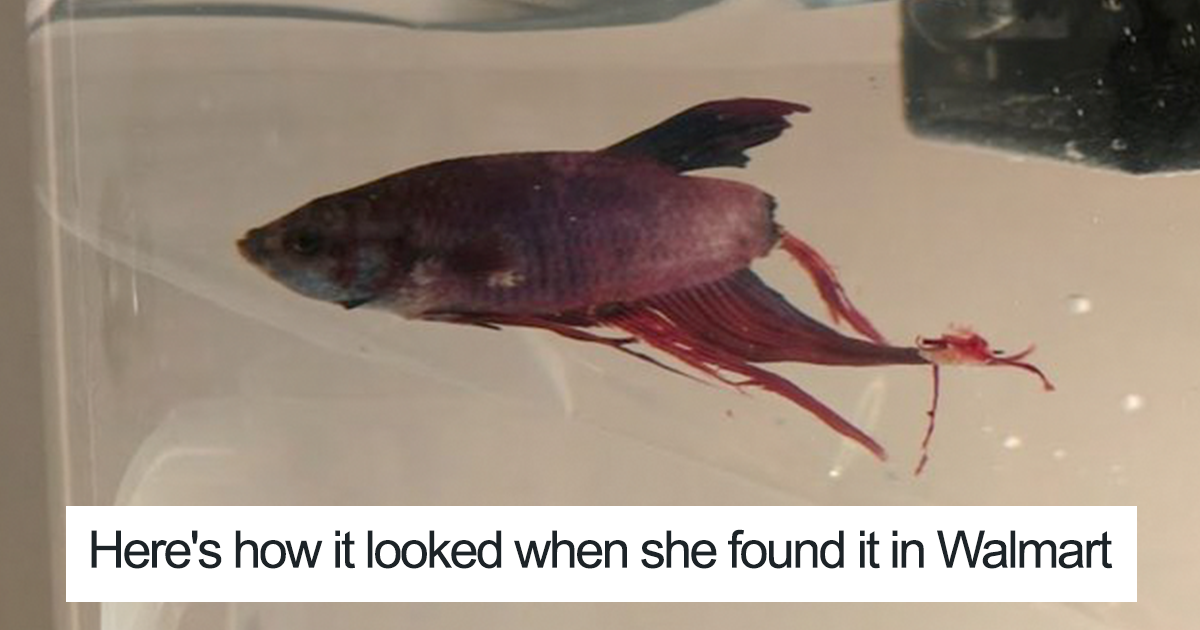
The fish was reportedly sitting in a small cup toward the back of a store shelf. His body appeared weak, his fins were severely damaged, and pieces of his tail came loose when Schild lifted the container. The situation looked so grim that she expected to provide little more than a peaceful place for him to spend his final hours.
Instead, the tiny fish had other plans.
With warm, clean water, attentive care, appropriate treatment, and one determined human refusing to give up, the struggling betta began to recover. Four weeks later, Schild could barely believe she was looking at the same animal. The frail fish had developed flowing, sail-like fins, rich color, an active personality, and enough enthusiasm to leap for food.
She named him Argo. His transformation became more than a satisfying before-and-after story. It challenged the persistent idea that betta fish are disposable decorations capable of thriving in cups, bowls, or whatever glass object happens to be available after someone finishes a scented candle.
A Chance Encounter in the Aquarium Aisle
Schild had not entered the store intending to buy a pet. According to the original 2018 account of the rescue, she noticed the sick betta behind healthier-looking fish and picked up his cup for a closer look.
What she saw was alarming. The fish was pale and listless, while his tail appeared to be disintegrating. Although descriptions of him “rotting away” captured the severity of his appearance, no publicly documented veterinary diagnosis established exactly what disease he had. Severe fin deterioration may be associated with bacterial fin rot, poor water quality, physical injury, stress, or several problems occurring at once.
Schild believed there was only a small chance he would live. Nevertheless, leaving him in the cup felt impossible. She purchased the fish and brought him home, initially hoping that a larger, more comfortable environment would at least spare him from dying on a retail shelf.
That decision created an uncomfortable ethical question. Buying a neglected animal can save that individual, but the sale may also reward the retailer and create space for another animal to replace it. There is no perfect answer when a living creature is suffering directly in front of you. Schild chose immediate intervention, then used Argo’s story to raise awareness about the treatment of bettas in stores.
The First Week: Clean Water and a Small Sign of Hope
Once home, Schild began researching how to care for a severely weakened betta. She placed him in clean, warm water and reportedly used medication while performing frequent water changes during his recovery.
Within approximately one week, the fish showed signs of improvement. He began swimming slowly, exploring his surroundings, and using his healing fins. These might sound like modest accomplishments, but anyone who has cared for a critically ill animal knows that one voluntary lap around the tank can feel like winning the Kentucky Derby.
Warmth was especially important. Bettas are tropical freshwater fish, and veterinary and aquarium-care guidance commonly recommends maintaining a stable temperature around 76 to 81 or 82 degrees Fahrenheit. Cooler water may reduce activity and contribute to physiological stress, while sudden temperature changes can be dangerous.
Clean water was equally critical. Fish continuously release waste into their environment. Uneaten food and organic debris also break down, producing ammonia that can irritate tissues, damage gills, increase stress, and make disease more difficult to overcome. In a tiny cup, harmful waste can become concentrated rapidly because there is almost no water volume to dilute it.
Four Weeks Later, Argo Looked Like a Different Fish
As the days passed, Argo’s damaged fins began to regrow. His tail expanded, his body developed stronger coloration, and his behavior changed from weak and withdrawn to curious and energetic.
After about four weeks, the transformation was dramatic. The betta who had barely moved in a small retail cup now had long, elegant fins resembling the sails of a ship. That appearance inspired the name Argo, recalling the famous vessel of Greek mythology.
His personality emerged along with his appearance. Schild described him swimming actively, following her shadow, jumping toward food, and generally behaving like a confident little aquatic celebrity who had recently discovered he was the star of the household.
The recovery demonstrated something experienced fishkeepers already understand: A betta’s condition in a store cup does not necessarily reveal what the fish can become in an appropriate environment. Stress can dull coloration, suppress normal behavior, weaken immune defenses, and leave fins clamped against the body. Improved conditions may reveal colors and patterns that were previously almost invisible.
Why Betta Fish Can Survive in Cups but Should Not Live There
Bettas possess a specialized labyrinth organ that allows them to breathe atmospheric air at the water’s surface. This adaptation helps them survive in warm, shallow, low-oxygen habitats. Unfortunately, their resilience has been converted into one of the most persistent myths in the pet trade: Because a betta can survive in a tiny container, a tiny container must be an acceptable permanent home.
Survival and good welfare are not the same thing.
Peer-reviewed behavioral research has found that bettas housed in larger, furnished aquariums are more active and display fewer abnormal behaviors than fish confined to small, barren containers. Plants, shelters, gravel, and sufficient swimming room allow the fish to explore, forage, rest, and express more of their natural behavioral range.
Small cups also create practical husbandry problems. Their temperature changes quickly, waste becomes concentrated rapidly, and there is little room for a heater, filter, hide, or healthy biological cycle. A cup may be easy to place on a shelf, but it is remarkably difficult to maintain as a stable aquatic environment.
A Better Home for a Betta
Care recommendations vary slightly, but a five-gallon aquarium is a practical starting point for one betta, particularly for a beginner. Some veterinary care sheets list 2.5 gallons as a minimum, while larger tanks are generally easier to heat, filter, decorate, and keep chemically stable.
A suitable setup should normally include:
- A properly sized aquarium with a secure lid
- A reliable heater and separate thermometer
- A low-flow filter that does not push the fish around
- Conditioned water free from harmful chlorine or chloramine
- Aquarium-safe plants and shelters without sharp edges
- A water-testing kit for ammonia, nitrite, nitrate, and pH
- A varied, species-appropriate diet offered in controlled portions
Long-finned bettas may struggle against powerful currents, so the filter should provide gentle circulation. Live plants or soft artificial plants can offer cover and resting places. Plastic decorations should be checked carefully because rough edges can snag delicate fins.
Was Argo Suffering From Fin Rot?
Argo’s appearance was consistent with severe fin damage, but it would be irresponsible to declare a specific diagnosis based solely on photos and a secondhand account. “Fin rot” is a broad term commonly used for progressive deterioration of fin tissue, often involving bacterial infection and environmental stress.
Possible warning signs include ragged edges, discoloration, receding fin tissue, reduced activity, loss of appetite, clamped fins, or difficulty swimming. Similar changes can also result from biting, sharp decorations, aggressive tank mates, poor nutrition, or chemical injury.
The first priority for a sick betta is usually to evaluate its environment. Owners should check temperature and test ammonia, nitrite, nitrate, and pH. Ammonia and nitrite should remain at zero in an established aquarium. Any new water must be conditioned and closely matched to the tank’s existing temperature.
Medication should not become an underwater guessing game. Different illnesses require different treatments, and unnecessary medication can stress the fish, disturb beneficial bacteria, or mask the real problem. A veterinarian experienced with aquatic animals is the best resource for serious, persistent, or rapidly worsening symptoms.
What to Do After Finding a Sick Betta in a Store
Seeing an obviously distressed fish can trigger an immediate desire to carry the entire shelf home. Compassion is valuable, but a thoughtful response may help more animals.
Document the Conditions
Record the date, location, and visible problems. Photographs can help store management understand what needs attention, provided photography is allowed and employees are not harassed.
Speak With a Manager
Calmly explain that the fish appears ill and ask what the store can do. Management may isolate the animal, arrange treatment, contact a supplier, or review care procedures. A factual conversation is generally more productive than turning the aquarium aisle into a one-person courtroom drama.
Report Repeated Neglect
If poor conditions are widespread or continue after being reported, contact the company’s customer-service department. Serious suspected neglect may also be reported to an appropriate local animal-control or humane authority, depending on local regulations and jurisdiction.
Prepare Before Attempting a Rescue
A sick fish should not be placed directly into an established community aquarium. Use a separate heated quarantine tank with dedicated equipment. Keep conditions stable, observe symptoms closely, and avoid exposing healthy animals to possible pathogens.
Do not assume that every damaged fish can recover as quickly as Argo. Some arrive with advanced infections, organ damage, genetic problems, or injuries that cannot be reversed. Providing appropriate care remains meaningful even when the outcome is not the miraculous transformation everyone hoped to post online.
What Argo’s Transformation Teaches Us
Argo’s story became memorable because the visual contrast was extraordinary. A pale fish with disappearing fins became a brilliant, active betta within one month. Yet the deeper lesson is not that every sick fish needs a heroic makeover. It is that every fish deserves conditions designed for living rather than merely delaying death.
Fish are often treated differently from dogs, cats, or other companion animals. Their pain is quieter. They do not cry at the door, chew the couch, or leave an emotional support hairball on a favorite sweater. Their distress may appear only as faded color, unusual stillness, damaged fins, rapid breathing, or refusal to eat.
That silence makes informed observation essential.
A properly maintained aquarium can reveal a betta’s individual behavior. Some patrol every inch of the tank. Others build bubble nests, inspect new decorations, beg for meals, flare at reflections, or rest dramatically on leaves as though exhausted from a twelve-hour office shift.
Schild did not simply restore Argo’s appearance. She created the conditions in which his personality could emerge. His recovery showed that the animal hidden beneath the damage had been present all along.
Experiences Commonly Shared by People Who Rescue Neglected Betta Fish
The first night of a betta rescue is often dominated by uncertainty. The fish may lie near the bottom, breathe heavily, ignore food, or struggle to remain upright. New caregivers frequently watch the tank so closely that every gill movement becomes a major event. The natural impulse is to change five things at once, but stability is usually more helpful than frantic experimentation. Warm, conditioned water and careful observation provide a foundation while the caregiver researches symptoms or contacts an aquatic veterinarian.
The next experience is learning to appreciate tiny improvements. A sick betta may not transform overnight. Progress can begin with one trip to the surface, a fin held slightly more open, or a cautious bite of food. These moments are easy to dismiss until someone has spent hours wondering whether the fish will survive. Suddenly, eating one pellet deserves a parade, a commemorative plaque, and perhaps a very small marching band.
Many rescuers also experience the surprise of changing coloration. Bettas can appear pale, grayish, or muted when severely stressed. As conditions improve, blues, reds, greens, purples, metallic patches, or marbled patterns may become more pronounced. The fish may look so different that early photographs seem to show another animal. Fin regrowth is usually slower and may initially appear as clear or translucent tissue before developing stronger color.
Another common lesson is that aquarium care involves more chemistry than expected. A clear tank is not automatically a healthy tank. Ammonia and nitrite are invisible, temperature can fluctuate without obvious warning, and untreated tap water may contain disinfectants harmful to aquatic life. Rescue situations quickly teach owners why test kits, thermometers, water conditioner, filtration, and the nitrogen cycle matter. The aquarium stops being a glass container and becomes a small ecosystem that sends its maintenance department exactly one employee: the person holding the siphon.
Caregivers often become emotionally attached to the fish’s personality during recovery. A betta that initially hid may begin approaching the front of the tank, following movement outside the glass, recognizing feeding routines, or inspecting the caregiver’s hands during maintenance. These interactions explain why the phrase “just a fish” can become irritating to anyone who has watched an individual animal regain curiosity and confidence.
Finally, a successful rescue may leave mixed emotions. There is happiness for the fish that survived, frustration about the conditions that allowed the decline, and concern for the animals still on store shelves. Some people respond by documenting problems, supporting responsible breeders or aquatic rescues, educating new owners, and encouraging retailers to improve housing standards.
Argo’s four-week comeback offered a joyful ending, but its greatest value lies in what happened afterward: More people began discussing warm water, clean tanks, proper space, enrichment, and the responsibilities involved in keeping bettas. His flowing fins caught the internet’s attention. His will to live delivered the message.
Conclusion
When Victoria Schild found a severely deteriorated betta at Walmart, she expected that he might die within hours. Instead, consistent care gave the fish an opportunity to recover. Four weeks later, Argo had regrown much of his fin tissue, developed striking colors, and become an energetic companion with a personality far larger than his body.
The transformation was remarkable, but it was not magic. It reflected the enormous difference between surviving in a cup and living in a stable, enriched aquarium. Bettas need warm, conditioned water, sufficient space, gentle filtration, appropriate food, environmental enrichment, and owners willing to monitor their health.
Argo’s story asks a simple question the next time we see a fish displayed as an inexpensive ornament: Are we looking at a product, or are we looking at an animal whose true colors have not yet had the chance to appear?
Note: This article reconstructs a rescue first reported in 2018. Argo’s exact medical condition was not publicly confirmed by a veterinarian, so references to fin rot or infection describe possible explanations rather than a definitive diagnosis. The care information was cross-checked against veterinary, university, animal-welfare, commercial care-sheet, and peer-reviewed sources.












