
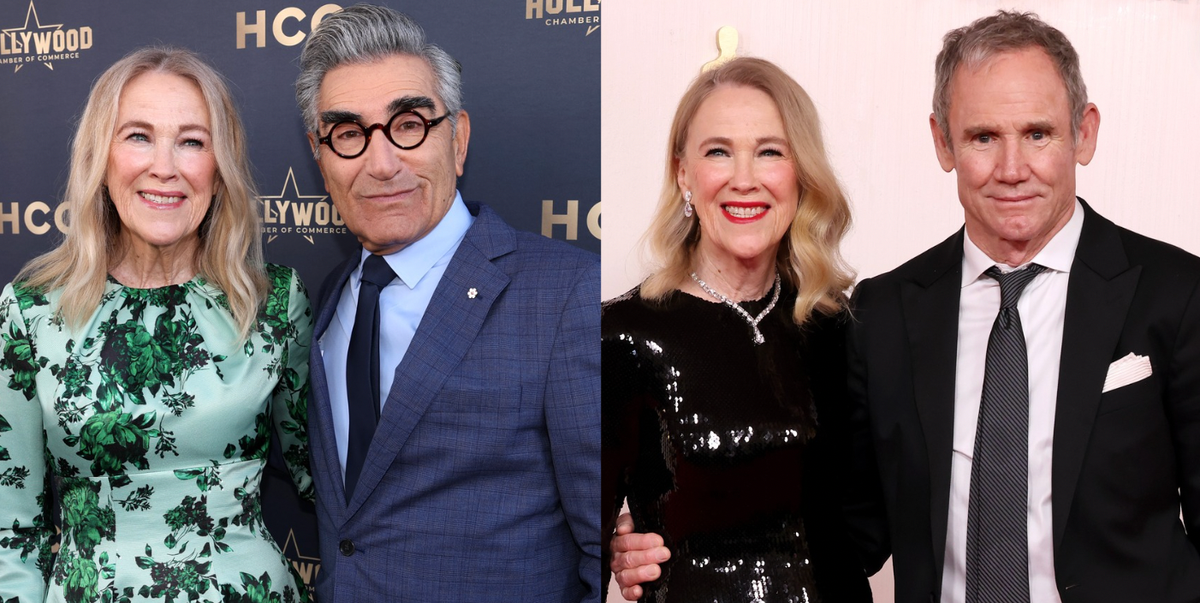
Some Hollywood love stories arrive with fireworks, tabloid chaos, and at least one regrettable yacht photo. Catherine O’Hara and Bo Welch’s story took a classier route. It began on the set of Beetlejuice, developed with a little help from Tim Burton, and grew into one of those rare show-business marriages that felt sturdy, private, and refreshingly low on drama. In other words, it was the opposite of a reality show and therefore instantly more interesting.
So, who was Catherine O’Hara’s husband, Bo Welch? He was not merely “the man standing beside the famous actress on red carpets.” Welch built a career of his own as a celebrated production designer, art director, and director, with a visual fingerprint all over some of the most memorable films of the past few decades. And together, he and O’Hara built a family life that stayed mostly out of the spotlight, even while both of them worked in an industry that treats privacy like an optional feature.
If you’ve been searching for details about Catherine O’Hara’s husband, her marriage, and her kids, here’s the full story behind the woman audiences adored in Beetlejuice, Home Alone, and Schitt’s Creek, and the man she shared more than three decades of life with.
Bo Welch Was Much More Than “Catherine O’Hara’s Husband”
Let’s start with the obvious answer. Catherine O’Hara was married to Bo Welch, an acclaimed Hollywood production designer who also worked as an art director and later stepped into directing. If his name doesn’t immediately ring a bell, his work probably does. Welch helped shape the look and mood of films including The Color Purple, Edward Scissorhands, Batman Returns, A Little Princess, The Birdcage, Men in Black, and Thor. That is a ridiculously strong résumé, even by Hollywood standards.
Before film sets and Oscar nominations entered the picture, Welch trained in architecture and began working as an architect in Los Angeles. That background makes a lot of sense once you look at the worlds he helped build on screen. His design style often carried a sense of shape, scale, atmosphere, and just enough weirdness to feel unforgettable. He wasn’t simply decorating movies. He was helping invent the emotional weather inside them.
Over the years, Welch earned four Academy Award nominations for his production design and art direction work. He also made his directorial debut with The Cat in the Hat and picked up recognition in television for directing episodes of A Series of Unfortunate Events. More recently, the Art Directors Guild honored him with a lifetime achievement award, which feels like the professional version of Hollywood saying, “Yes, we noticed all that magic you were doing in the background.”
How Catherine O’Hara Met Bo Welch on Beetlejuice
The Catherine O’Hara and Bo Welch love story began where many excellent oddball things begin: on a Tim Burton set. O’Hara was making the original Beetlejuice in the late 1980s, and Welch was working as the film’s production designer. She was playing Delia Deetz with glorious high-strung energy; he was helping shape the movie’s off-kilter visual world. It was, frankly, a very on-brand place for a memorable romance to begin.
By O’Hara’s own recollections in later interviews, the two talked often while filming, laughed together, and clearly had chemistry. There was only one problem: Welch wasn’t asking her out. This is the kind of detail that makes the story instantly relatable. No matter how glamorous the setting, a crush is still a crush, and mixed signals are still mixed signals. Even if you’re standing inside a Tim Burton movie, somebody still has to make the first move.
Tim Burton Played Accidental Matchmaker
In one of the more delightfully specific details attached to their relationship, O’Hara later revealed that Tim Burton more or less nudged the romance into existence. She told him that Welch kept talking to her but never actually asked her out. Burton, apparently deciding that directing a movie was not enough work for one man, stepped in behind the scenes. Soon after, Welch finally invited O’Hara to join his department on an outing.
That ask-out was not a sweeping speech in the rain. It was more casual, more human, and probably more charming because of it. Their first steps as a couple grew out of time spent together during the end of filming, including location work in Vermont. Sometimes the best Hollywood romance starts less like a scripted rom-com and more like, “Hey, our department is going somewhere. Want to come?”
She Moved to Los Angeles for Love
One of the most revealing details about their early relationship is that O’Hara later said she moved to Los Angeles for Welch. Not for a career strategy. Not for some grand plan to optimize visibility or “expand her brand,” a phrase that deserves a permanent timeout. She moved for love. That small fact says a lot about how personal the relationship was from the beginning. It wasn’t built as publicity. It was built as life.
That move also helps explain why their marriage came to feel so grounded. The relationship was not a side quest bolted onto two busy careers. It was central. They made choices around it, and that kind of intention tends to matter.
When Did Catherine O’Hara and Bo Welch Get Married?
Catherine O’Hara and Bo Welch married on April 25, 1992. By Hollywood standards, that date marks the beginning of something almost suspiciously stable. Their marriage lasted for more than three decades, a stretch long enough to outlive trends, reboots, platform wars, fashion crimes, and approximately twelve thousand celebrity breakups.
Their wedding also came with one of the strangest and most wonderful footnotes in celebrity marriage lore. Tim Burton gave the newlyweds a private tour of the Vatican as a wedding gift. Yes, really. Not a toaster. Not monogrammed towels. A private Vatican tour. O’Hara later told the story with the kind of amused disbelief it deserved, describing access to places most tourists will never see. It is an absurdly memorable detail, and yet it somehow suits them. Their relationship always seemed to sit at the intersection of elegance, humor, and a little bit of delightful oddness.
Did Catherine O’Hara and Bo Welch Have Kids?
Yes, Catherine O’Hara and Bo Welch had two children together: sons Matthew Welch and Luke Welch. Matthew was born in 1994, and Luke followed in 1997. While O’Hara played famous mothers on screen, from the frazzled but loving Kate McCallister in Home Alone to the magnificently theatrical Moira Rose in Schitt’s Creek, motherhood in real life became one of the roles she seemed to value most deeply.
O’Hara spoke more than once about family coming first. That priority shaped the way she approached work and helps explain why the Welch household seemed to stay relatively steady and private. She did not present motherhood as a sentimental accessory to success. She treated it as the center of the house.
Matthew and Luke Followed Their Parents Into Entertainment, But Quietly
Matthew and Luke Welch did not become front-of-camera stars. Instead, they followed a more behind-the-scenes route, which feels incredibly fitting for the children of an actress and a production designer. According to O’Hara, both sons worked on sets, with one involved in set dressing and the other in set construction. In other words, they inherited creative instincts without necessarily inheriting the need for a spotlight.
That choice says something lovely about the family culture. This was a household where the work itself clearly mattered. Not just fame. Not just applause. Not just the glamorous side of entertainment where everyone pretends award season is a normal human experience. The boys found careers in the bones and texture of production, in the making rather than the posing.
At one point, O’Hara also shared that both sons worked on Schitt’s Creek, making the beloved series a little more of a family affair than many viewers realized. It is a sweet detail, and one that fits the broader picture of the Welches: talented, funny, hardworking, and not especially interested in turning every family fact into a press release.
Why Their Marriage Worked for So Long
Anyone who has ever read a celebrity profile knows the usual formula for explaining a long marriage: mutual respect, communication, and “we make each other laugh.” Normally that can sound like publicist wallpaper. In the case of Catherine O’Hara and Bo Welch, though, those ideas felt real because O’Hara talked about them with honesty rather than polish.
She acknowledged that their marriage was not magically smooth every second. They went through rough times, like most long-term couples do. The difference, as she described it, was that both of them wanted to work on it. That point matters. A lasting marriage is not built because two people avoid difficulty. It lasts because both people remain willing to repair, adapt, and stay present when life gets messy.
O’Hara also emphasized laughter, and that tracks perfectly with everything audiences knew about her. Humor was not just her profession. It seemed to be part of the architecture of the marriage. You can imagine that in a house shared by Catherine O’Hara and Bo Welch, tension probably did not survive for long without at least one devastatingly funny comment wandering through the room.
There was also privacy. The couple made red carpet appearances together and clearly supported each other in public, but they never seemed interested in over-explaining themselves. They let the marriage be a marriage, not a content strategy. In the social media era, that almost feels radical.
A Full-Circle Beetlejuice Moment
One of the most touching chapters in their story came decades after they first met. In 2024, O’Hara and Welch walked the red carpet for Beetlejuice Beetlejuice, the sequel to the film where they first crossed paths. It was one of those full-circle moments that would feel corny if it were fictional and perfect because it wasn’t. The original movie gave them the beginning; the sequel offered a graceful echo.
That appearance also reminded fans why interest in Catherine O’Hara’s husband never really faded. People were not just curious about a spouse’s name. They were responding to a partnership that felt unusually enduring, especially in entertainment. Welch was part of her story, yes, but he also had a creative legacy of his own. Together they looked less like a celebrity couple manufactured for headlines and more like two artists who built a life side by side.
What Made Bo Welch So Interesting to Fans?
Part of the fascination with Bo Welch comes from the fact that he represents a different kind of Hollywood success. He is not the face on the poster. He is one of the people who helped make the poster’s world possible. Production designers rarely get the same level of public attention as actors, yet their work can define how a film feels in the mind long after the plot details get fuzzy.
Welch’s career also pairs beautifully with O’Hara’s on a symbolic level. She was a performer known for transforming scenes from the inside out. He was a designer known for creating visual environments from the outside in. One worked through voice, timing, and expression; the other through mood, space, and world-building. It makes sense that those two kinds of imagination would find each other.
And fans love a couple that feels both glamorous and believable. O’Hara and Welch had enough Hollywood sparkle to be intriguing, but enough normality to feel human. They raised kids, kept much of their family life private, got through difficult patches, and stayed funny. That’s not flashy, but it is compelling. Maybe especially now.
Experiences and Life Lessons We Can Take From Catherine O’Hara and Bo Welch’s Story
There is a reason this marriage still catches people’s attention. It is not just because Catherine O’Hara was beloved, or because Bo Welch has a fascinating career, or because “Tim Burton played matchmaker” is the kind of sentence that practically writes its own headline. It is because their relationship contains experiences that feel familiar, even if most of us did not meet our partner while standing on the set of Beetlejuice.
For one thing, their story captures the strange experience of timing. Two people can clearly enjoy each other, laugh together, and still need a nudge before anything actually happens. That part feels incredibly real. So many relationships begin not with a dramatic declaration but with hesitation, missed cues, and one person thinking, “Are we doing this, or are we just being charmingly confusing forever?” O’Hara and Welch’s beginning reminds us that even strong chemistry sometimes needs one brave moment to become a real life.
Then there is the experience of choosing a relationship on purpose. O’Hara moved to Los Angeles for love, which is not a tiny decision. It suggests a willingness to reorganize life around something emotionally meaningful. A lot of readers will recognize some version of that experience, even if it looked less like Hollywood and more like changing cities, shifting jobs, or simply learning how to make room for another person’s world inside your own. Relationships deepen when people stop treating them as convenient and start treating them as consequential.
Their marriage also speaks to the lived experience of long-term commitment. Not the polished anniversary-post version, but the actual thing. The part where two people go through rough patches and keep going because they both want to keep going. That may be the least glamorous lesson in their story and the most valuable one. Lasting marriages are not built by avoiding tension. They are built by deciding that difficulty is something to face together rather than separately.
Another relatable part of their story is how family identity evolves. Their sons did not copy their parents exactly, but they did absorb the creative environment around them and find their own lane within it. That is a deeply recognizable family experience. Kids often inherit the atmosphere before they inherit the profession. They pick up values, rhythms, skills, and ways of seeing the world, then translate those into lives that belong to them.
Finally, there is the experience of privacy. O’Hara and Welch did not vanish, but they also did not perform intimacy for public consumption. In a culture that often treats oversharing as proof of authenticity, their restraint feels almost elegant. They seemed to understand that some of the best parts of a life together get stronger when they are protected. Not hidden out of shame. Protected out of care.
That may be why their story lingers. Beneath the movie credits, the red carpets, and the Vatican anecdote that still sounds like a fever dream in formalwear, Catherine O’Hara and Bo Welch gave people something simple and rare: the example of a creative, funny, complicated, long-lasting family life. In Hollywood, that might be the biggest plot twist of all.











