
Note: This article is written for web publication and explains the science behind a viral molten copper experiment in clear, standard American English.
Introduction: When Sparkle Meets a Liquid Furnace
There are few internet experiments more satisfying than watching something fancy meet something outrageously hot. In this case, the star of the show is a giant fake diamond, the kind of oversized decorative “gem” that looks like it escaped from a cartoon treasure chest. Its opponent is molten copper, glowing orange and carrying enough heat to make common glass rethink its life choices.
The title sounds like pure chaos: Watch a Giant Fake Diamond Give Up the Ghost to Molten Copper. But behind the drama is a neat little materials-science lesson. The fake diamond in the famous video was not a natural diamond or a lab-grown diamond. It was a glass crystal shaped like a faceted gemstone. That distinction matters. A real diamond is made of carbon atoms locked in an extremely strong crystal structure. A glass imitation may look glamorous on a shelf, but under a blast of molten metal, it behaves less like “forever” and more like “goodbye, sparkly friend.”
This is the kind of science video that works because it gives viewers an instant payoff. Molten copper pours. The glass gem cracks, collapses, or loses its perfect shape. Everyone watching learns, without needing a lab coat, that beauty and durability are not the same thing. The fake diamond shines, but the copper brings the receipts.
What Actually Happens in the Molten Copper vs. Fake Diamond Video?
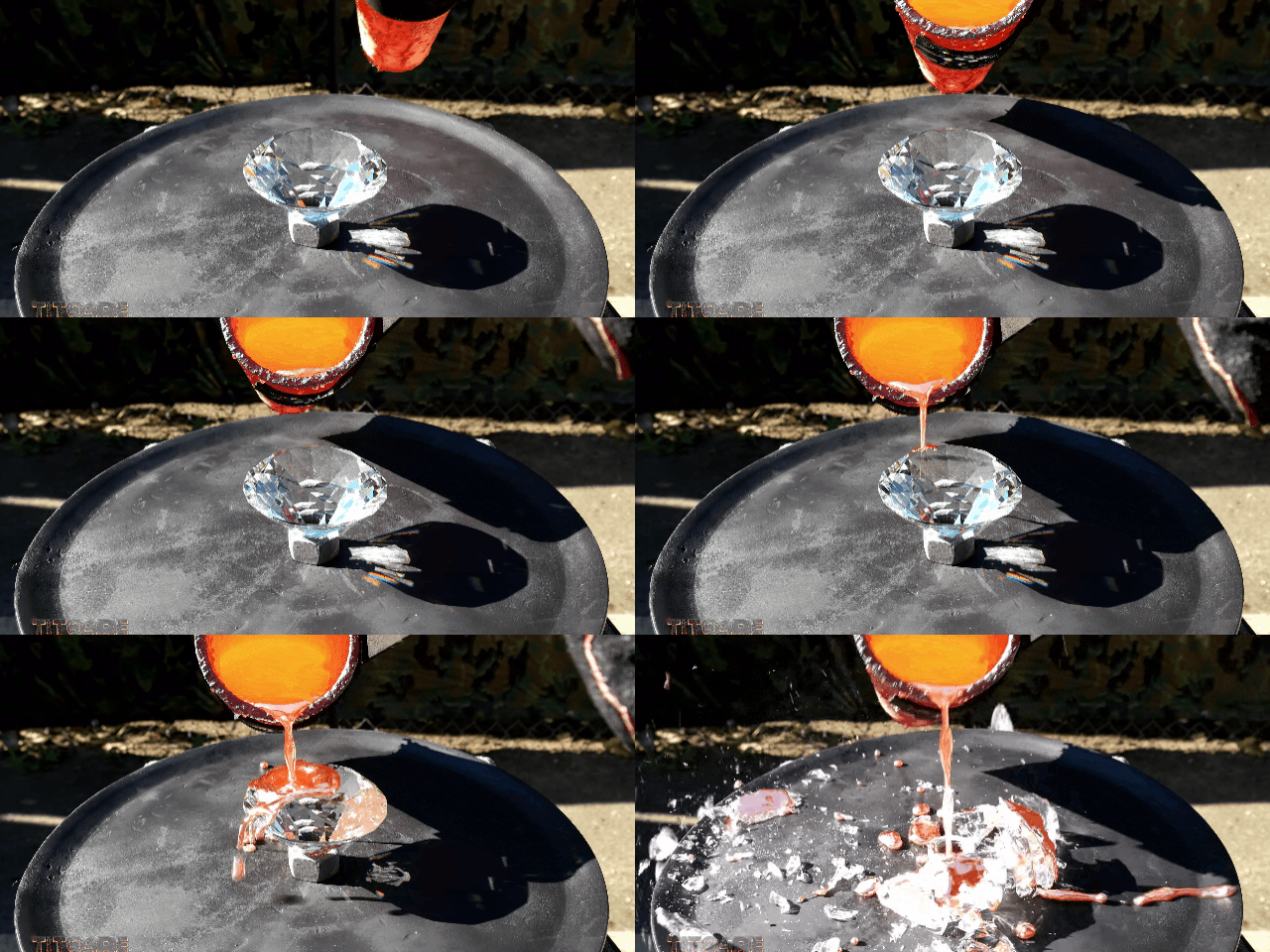
In the viral experiment, molten copper is poured onto a large glass “diamond.” Copper melts at roughly 1,984 degrees Fahrenheit, or about 1,084 degrees Celsius. That is not just hot; that is “your kitchen oven just retired out of embarrassment” hot. When copper reaches a liquid state, it can transfer heat rapidly to whatever it touches.
The fake diamond appears rigid and durable at room temperature. However, as soon as molten copper hits it, the outer surface is suddenly exposed to extreme heat while the inner portion remains cooler. This mismatch creates thermal stress. One part of the glass expands before the rest can catch up, and brittle materials do not enjoy that kind of pressure. Instead of bending gracefully, glass tends to crack. It is dramatic, but it is also predictable.
The result is a visual lesson in thermal shock. The fake diamond does not fail because it is “weak” in the everyday sense. It fails because glass is brittle, and sudden uneven heating is one of brittle materials’ least favorite party tricks. Imagine wearing a tuxedo to a volcano and expecting the evening to go smoothly. That is the glass diamond’s situation.
Why the Fake Diamond Was Doomed From the Start
It Looked Like a Diamond, But It Was Glass
The word “fake diamond” can mean several different things. It might refer to cubic zirconia, moissanite, glass, plastic, synthetic spinel, or other diamond simulants. A simulant is simply a material that looks like another gem but does not share the same chemical composition or physical properties. In the molten copper experiment, the object was described as a glass crystal, not a real diamond and not a lab-grown diamond.
That is a big difference. Glass can be beautiful, clear, and highly reflective, which is why it has been used for decorative gemstones for centuries. But manufactured glass is generally more vulnerable to sudden temperature changes than diamond, especially when the heat is concentrated in one area. It can imitate the look of a gemstone, but it cannot borrow diamond’s atomic structure for the afternoon.
Hardness Is Not the Whole Story
One reason people love this experiment is that it challenges a common assumption: if something looks like a diamond, it must be tough. Even real diamonds are often misunderstood. Diamond ranks 10 on the Mohs hardness scale, meaning it is extremely resistant to scratching. But hardness is not the same as toughness. Toughness describes how well a material resists breaking, chipping, or cracking.
Glass may resist light scratches reasonably well, depending on the type, but it is brittle. Hit it with enough thermal stress, and it can fracture quickly. A diamond, meanwhile, has exceptional hardness and excellent thermal conductivity, but even diamonds have cleavage planes and can chip under the wrong impact. In other words, “hard” does not mean “invincible.” The universe loves fine print.
The Science of Thermal Shock
Thermal shock happens when a material experiences a sudden temperature change that creates internal stress. In glass, this usually occurs because the hot area expands faster than the cooler area. If the stress exceeds the material’s ability to hold together, cracks form.
This is why certain glass products are designed differently for high-temperature use. Borosilicate lab glass, for example, is famous for handling temperature changes better than ordinary soda-lime glass. It has a lower thermal expansion rate, meaning it changes size less dramatically when heated. That lower expansion helps reduce internal stress. But even strong lab glass has limits, and molten copper is far beyond normal kitchen or classroom heat.
When the copper hits the fake diamond, it is not gently warming the surface. It is delivering a concentrated thermal assault. The glass is forced to expand quickly where it is hottest, while the cooler interior resists that movement. The result is cracking, popping, dulling, or structural failure. It looks like destruction, but it is really physics doing paperwork.
Why Molten Copper Is Such a Powerful Visual Tool
Copper makes a fantastic material for dramatic videos because it glows beautifully when molten, flows smoothly, and has a relatively accessible melting point compared with many other metals. It is also familiar. Copper is used in wiring, plumbing, electronics, architecture, and industrial equipment because it conducts heat and electricity extremely well and resists corrosion. In everyday life, copper is practical. On video, molten copper is theatrical.
The orange glow adds to the drama. Viewers do not need a thermometer to understand that glowing liquid metal is dangerous. The moment it touches an object, it creates a clear before-and-after story. Will the object burn? Melt? Crack? Explode? Survive like a tiny champion? That built-in suspense is why molten metal videos attract millions of viewers.
In this experiment, the fake diamond gives the perfect performance. It begins as a symbol of elegance and ends as a lesson in material failure. The contrast is irresistible: a glittering gem shape versus an industrial liquid metal. It is basically a science fair with better lighting and more danger.
Would a Real Diamond Survive Molten Copper?
A real diamond would likely behave very differently from a glass imitation. Natural diamonds and lab-grown diamonds are both made of carbon arranged in the diamond crystal structure. Lab-grown diamonds have essentially the same chemical, optical, and physical properties as natural diamonds, even though they are made by technological processes rather than geological ones.
Diamond has very high thermal conductivity. That means it can spread heat quickly through its structure, reducing some of the extreme temperature gradients that cause thermal shock in glass. Diamond is also extraordinarily hard because of the strong bonds between carbon atoms. Those qualities suggest that a real diamond may handle brief contact with molten copper better than a glass fake.
However, that does not mean anyone should try it with jewelry. Real diamonds can oxidize or burn under the right high-temperature conditions, especially in oxygen-rich environments. Settings, coatings, inclusions, fractures, and metal mounts can also create complications. A diamond ring is not a superhero suit; it is a valuable object that should not audition for a volcano documentary.
Fake Diamonds: The Sparkly Family Tree
Glass Imitations
Glass is one of the oldest gem imitation materials. It can be made in many colors and shaped into attractive decorative pieces. Its weakness is durability. It is less brilliant than diamond, more vulnerable to scratching, and much more likely to suffer from thermal shock when exposed to extreme temperature changes.
Cubic Zirconia
Cubic zirconia, or CZ, is one of the most common diamond simulants. It became popular because it is affordable, bright, and convincing in jewelry. CZ is harder than glass but still not diamond. It can be produced in many colors and large sizes, which is why it shows up everywhere from costume jewelry to display pieces. It is a great impersonator, but under extreme heat, it still follows the rules of its own material chemistry.
Moissanite
Moissanite is another popular diamond alternative. It is known for strong brilliance and intense fire, sometimes even more colorful than diamond. It is harder and more durable than many simulants, but it is not the same material as diamond. In large stones, its extra rainbow sparkle can be a giveaway. Think of it as the extrovert cousin at the gem family reunion.
Lab-Grown Diamonds
Lab-grown diamonds are not fake diamonds. They are real diamonds made in controlled environments using methods such as high-pressure, high-temperature growth or chemical vapor deposition. They share the carbon crystal structure that gives diamond its famous properties. The difference lies in origin, not basic composition.
Why Viewers Love Destruction Science
Videos like molten copper versus a fake diamond succeed because they combine curiosity, suspense, and instant visual feedback. You do not need to know equations to understand the stakes. Something beautiful is about to meet something unbelievably hot. The result is either survival or surrender.
There is also a satisfying myth-busting element. Many people casually use “diamond” as a synonym for toughness. The video reminds us that appearance can be misleading. A faceted shape does not make glass behave like diamond. A glittery surface does not create carbon bonds. And a giant decorative gem is not ready for a molten-metal handshake.
The experiment also makes materials science feel approachable. Instead of reading a dry definition of thermal expansion, viewers see it happen. Instead of memorizing the difference between hardness and toughness, they watch a brittle object fail. Good science communication often begins with a simple question: “What happens if we do this?” In this case, the answer is: “The fake diamond has a very bad afternoon.”
Safety: Do Not Try This in the Backyard
Molten metal experiments are not casual DIY projects. Molten copper can cause severe burns, start fires, shatter glass, and splash unpredictably. Moisture is especially dangerous around molten metal because trapped water can expand violently into steam, sending hot material outward. Professional foundry work treats molten metal as a serious hazard, not a weekend hobby with dramatic lighting.
Anyone working with extreme heat needs proper training, controlled equipment, ventilation, eye and face protection, heat-resistant clothing, fire safety planning, and safe distances for observers. Chemical demonstration guidelines emphasize risk assessment, written procedures, protective equipment, safety shields, and emergency preparation. Translation: molten copper is not something to pour while wearing sneakers and optimism.
The safest way to enjoy the fake diamond experiment is to watch it online, appreciate the physics, and leave the liquid metal to people with the right gear and a healthy respect for skin remaining attached to the body.
What the Experiment Teaches About Materials
The big lesson is that every material has a personality. Copper conducts heat well and flows when molten. Glass can be transparent and beautiful but brittle under stress. Diamond is extremely hard and thermally conductive, but it is not magic. Simulants can look similar while behaving very differently. The experiment works because it puts these differences on display in seconds.
It also shows why engineers care about more than appearance. When selecting materials for a phone screen, lab flask, furnace part, jewelry setting, or industrial tool, the question is not just “Does it look good?” It is “What happens under heat, impact, pressure, corrosion, and time?” The fake diamond looked ready for a royal crown, but molten copper revealed its résumé was mostly decorative.
of Experience: Watching the Fake Diamond Surrender
The first time you watch a giant fake diamond meet molten copper, the experience feels oddly cinematic. There is a quiet moment before the pour when the glass gem sits there looking confident, polished, and completely unaware that its opponent is basically liquid fire. The setup is simple, but the tension is real. You know something is going to happen. You just do not know whether it will crack, slump, explode, or somehow survive like a stubborn disco ball.
Then the copper arrives. It pours in a glowing stream, bright enough to make the entire scene feel industrial and almost unreal. The sound is part of the experience too: the hiss, the crackle, the tiny noises of heat forcing its way into a cold, brittle structure. The fake diamond’s glamour disappears quickly. What looked sharp, clean, and luxurious becomes stressed, damaged, and defeated. It is a tiny tragedy in the language of materials science.
What makes the video so memorable is not just the destruction. It is the surprise of seeing an object associated with wealth and permanence become vulnerable. A “diamond,” even a fake one, carries cultural weight. We use diamonds to symbolize endurance, commitment, and luxury. So when this giant clear gemstone gives up under molten copper, the brain notices the contradiction. It is like watching a sports car lose a race to a forklift.
There is also an oddly useful takeaway for everyday life. After seeing thermal shock in such an extreme form, you never look at glass the same way again. A cold glass dish on a hot stove, a frozen casserole dish going straight into an oven, or boiling water poured into the wrong container suddenly seems less harmless. The fake diamond becomes a dramatic reminder that sudden temperature changes matter.
The experience also encourages better skepticism. Not everything that shines is strong. Not everything labeled “diamond-like” behaves like diamond. Products, materials, and viral videos often rely on appearance, but science cares about structure. The fake diamond’s shape is only geometry. Its composition is what decides the ending.
And yes, part of the fun is simply watching the spectacle. Humans have always been fascinated by fire, metal, gemstones, and transformation. This video bundles all four into one compact moment. It is satisfying in the way a good experiment should be: dramatic enough to grab attention, simple enough to understand, and educational enough to justify watching it more than once. The fake diamond may lose the battle, but as a teaching tool, it absolutely wins.
Conclusion: A Sparkly Defeat With a Smart Lesson
Watch a Giant Fake Diamond Give Up the Ghost to Molten Copper is more than a viral destruction clip. It is a clear, entertaining demonstration of thermal shock, material identity, and the difference between looking durable and actually being durable. The glass gem fails because molten copper delivers intense, uneven heat faster than the material can handle. Real diamonds, glass simulants, cubic zirconia, moissanite, and lab-grown diamonds may all sparkle, but they do not behave the same under extreme conditions.
The experiment is fun because it is dramatic. It is valuable because it is memorable. And it is safe only when watched from a distance, preferably through a screen, with snacks and absolutely no crucible in the garage.











