
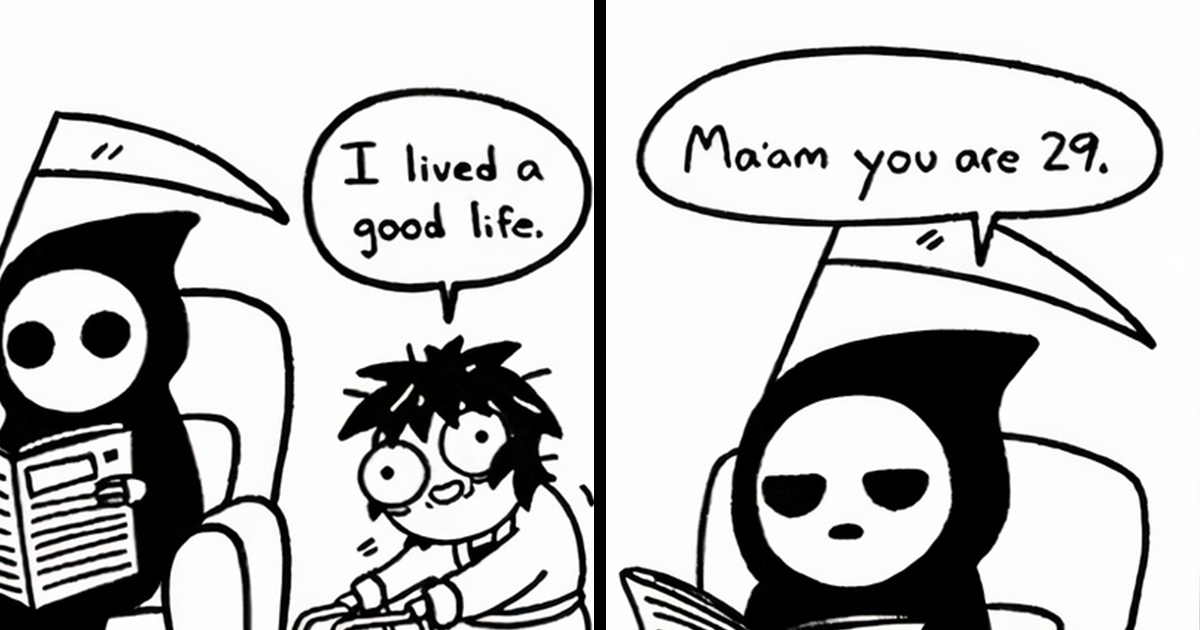
Growing up is supposed to bring wisdom, confidence, and the ability to fold a fitted sheet. In reality, adulthood often means answering emails while wrapped in a blanket, eating cereal for dinner, and wondering whether canceling plans counts as self-care. Sarah Andersen understands this gap between expectation and reality better than mostand she has turned it into an internationally recognized comic series.
When the original 40-picture collection appeared in September 2022, Andersen’s Instagram account had attracted more than 4 million followers. That enormous audience did not arrive because her characters live glamorous lives. It arrived because they oversleep, procrastinate, avoid awkward conversations, adore animals, struggle with creativity, and occasionally treat clean laundry as an interior-design concept.
Through Sarah’s Scribbles, Andersen transforms ordinary frustrations into compact black-and-white jokes with wonderfully exaggerated endings. The drawings look simple, but their observations are sharp. One expressive face or unexpected final panel can summarize an experience readers have spent years trying to explain.
Who Is Sarah Andersen?
Sarah Andersen is an American cartoonist, illustrator, and author best known for the semi-autobiographical webcomic Sarah’s Scribbles. She studied at the Maryland Institute College of Art, graduating in 2014, and began developing her online comics while she was still a student.
The series was originally called Doodle Time. Andersen has explained that it began as a small personal project: she drew early comics in Microsoft Paint and posted them on Tumblr. Regular publishing helped the series grow, while a strip about the misery of waking up became one of her first major viral successes.
The central character is a messy-haired, wide-eyed version of Andersen, but she is intentionally broad enough for readers to see themselves in her. She might be fighting a deadline in one strip, hiding from social interaction in another, and surrendering her entire bed to a tiny pet in the next. Her world is exaggerated, yet emotionally accurate.
From Online Experiment to Award-Winning Series
Andersen’s digital audience eventually carried her work into bookstores. Her first collection, Adulthood Is a Myth, was published in 2016. It was followed by Big Mushy Happy Lump, Herding Cats, Oddball, and Adulthood Is a Gift!.
The first three collections won the Goodreads Choice Award for Best Graphic Novels & Comics in three consecutive years. Those awards confirmed something millions of readers already knew: small stories about blankets, anxiety, pets, and unfinished work can have surprisingly large cultural reach.
Why Sarah’s Scribbles Feels So Relatable
Relatable humor is often treated as easy comedy, but good observational cartooning requires precision. A joke cannot merely say that adulthood is difficult. It has to identify the exact moment when adulthood becomes ridiculoussuch as feeling proud after making one phone call, then needing the rest of the afternoon to recover.
Andersen repeatedly finds those moments. She presents the optimistic version of a situation, allows the reader to recognize it, and then introduces the chaotic reality. The funny twist works because it is surprising in the panel but familiar in life.
Simple Artwork With Precise Expressions
The visual language of Sarah’s Scribbles is immediately recognizable. Thick black lines, large eyes, untidy hair, and compact panels keep attention on movement and emotion. Andersen can turn mild discomfort into a full theatrical emergency simply by changing a character’s posture.
This economy is especially effective on social media. Readers can understand the setup quickly on a phone screen, scroll through a few panels, and reach the punch line without decoding a crowded page. The format may be short, but each reaction has been carefully staged.
Humor Without Pretending Life Is Perfect
The comics frequently explore procrastination, periods, body image, creative insecurity, relationships, social anxiety, introversion, and the pressure to become a properly organized adult. These subjects can be uncomfortable, but Andersen approaches them with affection rather than cruelty.
Her protagonist is imperfect, yet the comic does not punish her for it. Instead, it suggests that struggling with productivity or confidence is part of being human. The result feels less like a lecture and more like receiving a reassuring message from a friend who is also hiding beneath a blanket.
40 Funny Everyday-Life Twists That Define the Collection
The 40-comic selection covers a wide emotional range, from tiny domestic battles to larger questions about identity and creativity. The following gallery guide highlights the recurring experiences and comic reversals that make Andersen’s work so memorable.
Introversion, Anxiety, and Social Survival
- The canceled plan celebration: Disappointment disappears quickly when staying home suddenly becomes an officially approved activity.
- The social battery warning: A pleasant conversation quietly drains every available unit of energy, leaving the protagonist ready for hibernation.
- The conversation replay: One harmless sentence returns at bedtime for a completely unnecessary internal investigation.
- The unexpected phone call: A ringing phone is treated less like communication and more like the opening scene of a thriller.
- The party corner: While everyone else networks, the introvert forms a deeper relationship with the nearest household pet.
- The confident entrance: A carefully imagined arrival collapses the moment the character forgets what to do with her hands.
- The compliment emergency: Receiving praise causes confusion, denial, and an urgent attempt to return the compliment with interest.
- The stranger at the door: The doorbell turns a quiet home into a stealth mission requiring silence and strategic crawling.
- The “quick” errand: Leaving the house for one item somehow demands preparation normally associated with an international expedition.
- The recovery period: A short social event is followed by several peaceful hours of blankets, snacks, and absolutely no eye contact.
Adulthood, Work, and Procrastination
- The productive morning fantasy: An ambitious schedule meets the snooze button, which arrives with a remarkably persuasive business proposal.
- The tiny task triumph: Sending one difficult email produces the emotional satisfaction of completing a marathon.
- The deadline monster: Work remains invisible until the final hour, when it grows teeth and begins chasing its creator.
- The organized desk experiment: A spotless workspace lasts briefly before mugs, paper, cords, and mysterious crumbs reclaim their territory.
- The laundry chair: Clean clothing never reaches the closet because one chair has already accepted a permanent position in wardrobe management.
- The grocery-store ambition: Fresh vegetables enter the cart with heroic intentions, then watch snacks win the week.
- The budget plan: Financial responsibility holds strong until a beautiful book, sweater, or cat-shaped object appears.
- The adult comparison trap: Other people seem to own homes and understand taxes while the protagonist celebrates finding matching socks.
- The creative warm-up: Preparing to work expands into coffee making, desk cleaning, playlist selection, and several essential internet detours.
- The reward-first system: A snack intended as motivation is consumed before the task begins, ending negotiations immediately.
Relationships, Bodies, and Everyday Honesty
- The borrowed sweater: A partner’s comfortable clothing enters the relationship’s shared economy and never returns to its original owner.
- The romantic expectation: Elegant affection is replaced by strange noises, bad hair, teasing, and the intimacy of being completely ridiculous together.
- The period ambush: Plans for a normal day are interrupted by cramps, fatigue, cravings, and a body apparently staging a rebellion.
- The beauty routine: A polished final look is contrasted with the chaotic tools, expressions, and questionable posture required to create it.
- The mirror negotiation: Confidence changes depending on lighting, mood, clothing, and whether the mirror has chosen violence that morning.
- The fitness fantasy: The imagined athletic self is powerful and graceful; the actual workout includes wheezing and immediate regret.
- The hair problem: Hair behaves perfectly when nobody will see it and becomes experimental sculpture before an important event.
- The snack promise: “Just one” becomes an archaeological record of empty wrappers and missing self-control.
- The affectionate insult: Close relationships allow loving conversations to sound suspiciously like two goblins arguing over a blanket.
- The comfort-clothing victory: Fashion loses another decisive battle when soft pants and an oversized sweater enter the room.
Books, Pets, Creativity, and Cozy Chaos
- The book-buying distinction: Reading books and purchasing books are revealed to be separate hobbies with very different completion rates.
- The fictional crush: A reader becomes emotionally attached to a character who does not exist and still manages to cause real disappointment.
- The final-chapter mistake: “One more chapter” quietly turns into sunrise and a difficult conversation with tomorrow morning.
- The cat’s ownership policy: Furniture, keyboards, beds, and humans all become property of the smallest creature in the house.
- The pet-work conflict: Productivity ends when an animal sits nearby and activates the legally binding requirement to provide attention.
- The blank-page battle: Inspiration vanishes when needed, then returns with several brilliant ideas during a shower or at 2 a.m.
- The perfectionism trap: A promising project risks remaining unfinished because its creator keeps polishing details no reader would notice.
- The healthy-artist reminder: Suffering is not presented as a requirement for meaningful art; rest and stability can strengthen creative work.
- The spooky comfort zone: Monsters, witches, and strange creatures appear less frightening than ordinary human interaction.
- The blanket finale: After fighting adulthood, deadlines, and social expectations, the protagonist returns to her most dependable sanctuary.
Beyond Everyday Comics: Fangs and Cryptid Club
Although Sarah’s Scribbles remains Andersen’s best-known project, her work extends well beyond autobiographical comedy. In 2019, she began publishing Fangs, a supernatural romance about Elsie, a centuries-old vampire, and Jimmy, a werewolf with an easygoing sense of humor.
Their relationship is built around monster-specific problems: moonlight, garlic, unusual appetites, horror movies, and the practical difficulties of dating someone from another supernatural species. Beneath the fangs and fur, however, the series is about accepting a partner’s quirks. The collected hardcover was published in 2020 as a 112-page graphic novel and became a bestseller.
Andersen later created Cryptid Club, which gives famous creatures such as Mothman, ghosts, aliens, and Bigfoot charming personal problems. Instead of presenting cryptids as terrifying, she imagines them as shy, misunderstood, awkward, or desperate for friendship. The book was released in September 2022, just in time for readers who prefer their spooky season with more emotional support and fewer chainsaws.
These projects show that Andersen’s central talent is not limited to jokes about procrastination. She can build comedy around romance, mythology, loneliness, and belonging while preserving her recognizable warmth.
What Aspiring Comic Artists Can Learn From Sarah Andersen
Andersen’s career offers a useful lesson for anyone waiting for perfect conditions before publishing creative work: perfection can become a very elegant form of procrastination. She has encouraged new artists to make things, post them, and allow improvement to happen publicly.
Her early comics did not emerge with a completely finished visual identity. The style developed through repetition and trial and error. A regular posting schedule also created accountability. Instead of endlessly adjusting a panel, she had to complete the work and move to the next idea.
Consistency Creates Recognition
A recognizable character, clear visual language, and dependable publishing rhythm helped readers form a connection with Sarah’s Scribbles. Consistency did not mean repeating the same joke. It meant establishing a familiar world in which new jokes could land quickly.
Specific Experiences Become Universal
Many of Andersen’s comics begin with personal experiences, yet they are framed so that readers can project their own lives onto the protagonist. The more precisely a comic captures an awkward pause, an anxious thought, or a procrastination ritual, the more universal it can feel.
Creative Health Matters
One of Andersen’s favorite messages challenges the myth that artists must be miserable to produce worthwhile work. Emotional suffering is not a magical art supply. Rest, stability, curiosity, and a sustainable routine can give an artist more freedom to experiment and continue creating.
Why These Funny Comics Matter in the Age of Social Media
Social platforms often reward polished photographs, major achievements, and aggressively cheerful morning routines. Sarah’s Scribbles offers the opposite: unfinished chores, uncertain confidence, low energy, messy rooms, and tiny victories.
That contrast makes the comics comforting. They remind readers that the person who appears organized online may also be staring at a laundry pile and bargaining with an alarm clock. Humor breaks the illusion that everyone else received a secret instruction manual for adulthood.
Andersen’s recognizable work has also made her an important voice in conversations about online attribution, artistic ownership, and generative technology. Her experience demonstrates both sides of internet visibility: social media can build a global audience, but it can also separate art from its creator or make a distinctive style vulnerable to unauthorized imitation.
Proper credit therefore matters. Viral images may travel quickly, but a comic is still the product of a human artist’s experiences, decisions, training, and labor.
A Reader’s Experience: Finding Yourself in 40 Panels
Reading a large collection of Sarah Andersen comics can feel like opening a diary that somehow belongs to thousands of strangers at once. You may begin with a comic about avoiding a phone call and laugh because the character’s panic is exaggerated. Then you remember the three minutes you spent rehearsing a voicemail last week. The joke stops being merely funny and becomes suspiciously accurate.
The experience works best when the comics are viewed one after another. Individual strips deliver quick punch lines, but a longer gallery creates a fuller portrait of contemporary adulthood. There is enthusiasm followed by exhaustion, confidence followed by overthinking, and productivity followed by a cat sitting on the keyboard. The emotional rhythm resembles real life more closely than a perfectly ordered success story does.
Readers who are introverted may recognize the need to recover after social events. Creative people may see themselves in the cycle of inspiration, procrastination, perfectionism, and last-minute work. Pet owners will understand the mysterious law that allows a ten-pound animal to occupy 90 percent of a bed. Book lovers may feel personally attacked by the difference between their reading plans and their purchasing habits.
The most memorable strips often inspire a three-stage reaction. First comes laughter. Next comes recognition. Finally comes the urge to send the comic to someone with a message such as, “This is us,” or, “I did not give this artist permission to observe my life.” That act of sharing turns a private feeling into a small social connection.
There is also relief in seeing uncomfortable experiences presented without melodrama. Anxiety, body-image worries, low motivation, and creative doubt can feel isolating when considered alone. In comic form, they become visible and discussable. The problem has not magically disappeared, but it has shrunk enough to fit inside a few panelsand sometimes that change in scale makes it easier to handle.
A reader may also notice how little visual detail Andersen needs to create strong emotion. The protagonist’s large eyes, stiff posture, or sudden transformation into a frantic creature communicates more than a paragraph of explanation. This encourages slower viewing. After the punch line lands, returning to the earlier panels reveals how the expressions and timing prepared the joke.
Finally, the collection leaves readers with a kinder definition of adulthood. Competence is not a permanent condition. A person can meet a deadline and still lose a battle with laundry. Someone can be ambitious and need quiet time. A capable adult may occasionally eat a questionable dinner beneath a blanket while watching videos of cats. None of these contradictions cancels the others.
That is the lasting experience behind Andersen’s funny everyday-life illustrations: they do not offer a grand solution to modern chaos. They offer recognition, companionship, and permission to laugh while the chaos continues.
Conclusion
Sarah Andersen has built a remarkable career by paying attention to experiences that are easy to dismiss: the dread of a ringing phone, the seduction of the snooze button, the comfort of an oversized sweater, and the strange authority possessed by a household cat.
Her 40 funny comics succeed because their twists are rooted in emotional truth. Behind every exaggerated reaction is a recognizable struggle with adulthood, creativity, relationships, self-image, or social expectations. The drawings may be compact, but their impact is not.
From Sarah’s Scribbles to Fangs and Cryptid Club, Andersen continues to prove that relatable humor can be clever, compassionate, and artistically distinctive. Millions of followers came for the jokes, but many stayed for the reassuring discovery that their private weirdness is apparently a group activity.












