
Some people look at the Taj Mahal and see a masterpiece of marble, symmetry, and love. Others look at it and think, “Yes, beautifulbut how many LEGO bricks would that be?” That second group may not be in charge of city planning, but they are absolutely in charge of the internet’s most entertaining thought experiments.
The Toy Zone took that wonderfully impractical question and turned it into a full-blown digital art project. Their team asked digital artists to recreate 10 world-famous landmarks in LEGO at full scale, placing each imaginary brick-built monument back into its real-world setting. Then came the deliciously ridiculous part: they calculated how many bricks each landmark would require and how much the pieces would cost.
The result is a project that sits somewhere between architecture, toy design, travel fantasy, and financial comedy. It gives us the Statue of Liberty as a billion-dollar brick sculpture, the Burj Khalifa as a wallet-destroying plastic skyscraper, and Cinderella Castle as the “budget option”assuming your budget is still larger than the GDP of a small island nation.
Beyond the humor, the project is a clever reminder of why LEGO landmarks are so fascinating. They shrink the world into something touchable. They turn famous buildings into puzzles. And when scaled back up digitally, they reveal how absurdly complex even a “simple” monument becomes when every curve, column, tower, arch, and spire must be translated into tiny interlocking pieces.
Why LEGO Landmarks Are So Addictive
LEGO and landmarks are a perfect match because both are built on recognition. You do not need a history degree to recognize the Eiffel Tower’s iron silhouette, the Statue of Liberty’s torch, or the White House’s neoclassical front. These structures are visual shorthand. They say “Paris,” “New York,” “Washington,” or “Rome” before your brain even finishes loading the page.
LEGO works the same way. A few studs, a clever angle, and the right color can suggest an entire skyline. That is why LEGO Architecture sets have become such a hit with adults who want a building experience that feels more like design therapy than toy time. A miniature skyline set can fit on a bookshelf. A full-size LEGO Burj Khalifa, on the other hand, would require a construction crew, a billionaire, and possibly a new zoning category called “plastic megastructure.”
The Toy Zone’s concept takes that adult fascination and pushes it to cartoonish extremes. Instead of asking, “Can we make a nice model of this?” it asks, “What if we replaced the actual landmark with LEGO bricks and pretended this was a reasonable idea?” That is the fun. Nobody is actually recommending that we rebuild the Brandenburg Gate out of toy bricks. But once you see the numbers, you cannot unthink the question.
How The Toy Zone Created the LEGO Landmark Renders
The project was not made by simply applying a brick texture over landmark photos. The artists created digital models using LEGO-style design software, adjusted the shapes to resemble the real landmarks, and placed the structures into photographic environments. They also matched lighting, camera angles, depth, and shadows so the digital builds appeared as if they were standing in the real world.
That process matters because LEGO is not clay. It has rules. Bricks come in specific sizes, shapes, and colors. Curves have to be suggested through steps and slopes. Thin towers need enough visual mass to read correctly. Ornate architecture must be simplified without losing its identity. In other words, turning a landmark into LEGO is not just about counting bricks; it is about translation.
Think of it like asking a chef to recreate a cathedral using only waffles. It can be done, in theory, but the flying buttresses are going to need some negotiation.
The 10 World-Famous Landmarks Recreated in LEGO
The Toy Zone’s project included a mix of monuments, government buildings, sports venues, towers, and fantasy architecture. The estimates are based on the number and types of bricks required for a full-size LEGO-style rebuild.
| Landmark | Estimated LEGO Cost | Total Bricks Needed | Brick Types |
|---|---|---|---|
| Taj Mahal, India | $2.18 billion | 35,007,786,500 | 176 |
| Statue of Liberty, USA | $1.16 billion | 16,351,963,706 | 168 |
| Big Ben and Houses of Parliament, UK | $12.4 billion | 206,636,181,818 | 256 |
| Burj Khalifa, UAE | $759.2 billion | 2,528,544,159,544 | 64 |
| Eiffel Tower, France | $68.9 billion | 276,715,798,464 | 56 |
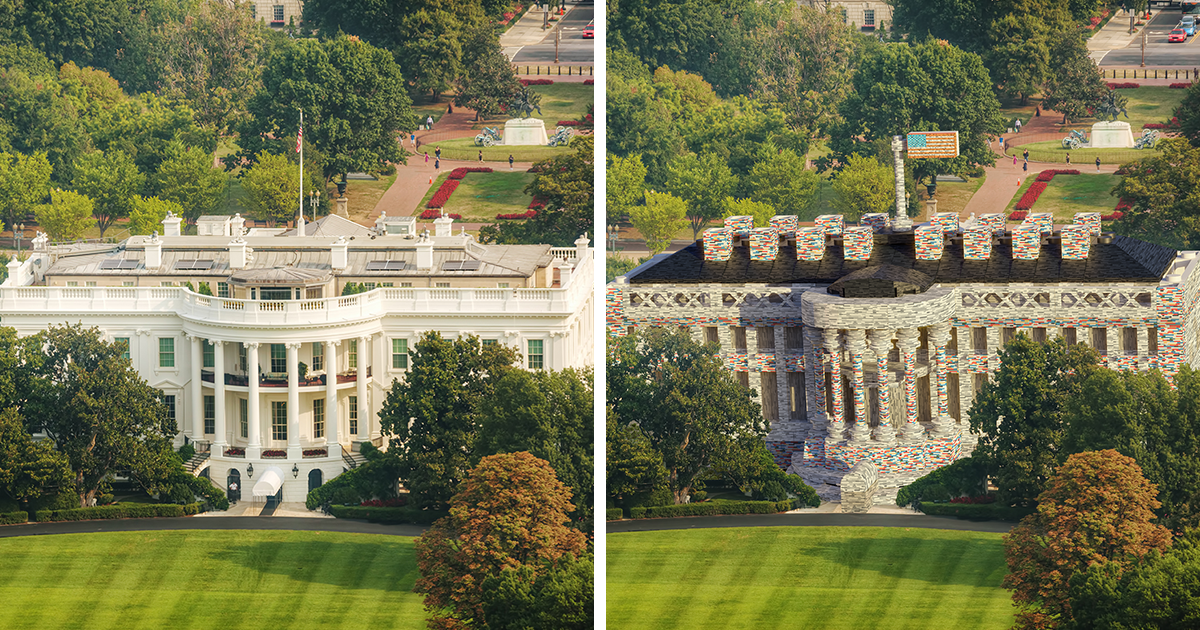
| White House, USA | $3.3 billion | 41,112,374,275 | 205 |
| Colosseum, Italy | $7.6 billion | 154,377,762,712 | 240 |
| Brandenburg Gate, Germany | $896 million | 9,302,667,653 | 44 |
| Old Trafford, UK | $24.4 billion | 317,957,620,206 | 365 |
| Disney Castle, USA | $181 million | 2,118,137,751 | 619 |
The Most Expensive LEGO Landmark: Burj Khalifa
No surprise here: the Burj Khalifa wins the “please call your bank before building” award. The real tower in Dubai is already a marvel of engineering, standing as the world’s tallest building and using enormous quantities of concrete, steel, glass, and labor. In LEGO form, the project becomes almost comically extreme.
The Toy Zone estimated that a full-scale LEGO Burj Khalifa would need more than 2.5 trillion bricks and cost roughly $759.2 billion. That is not a typo. That is “sell several tech companies and maybe a moon” money.
What makes the Burj Khalifa especially funny in LEGO terms is that its design looks sleek and simple from a distance. It is not covered in thousands of decorative sculptures like a cathedral. It does not have the lacy ironwork of the Eiffel Tower. But height is merciless. When you scale a building up to life size, every smooth surface becomes a brick-devouring monster. The Burj Khalifa’s elegant taper becomes a plastic avalanche.
The Eiffel Tower: A Billionaire’s Romantic Gesture
The Eiffel Tower was completed for the 1889 Exposition Universelle and became one of the most recognizable structures in human history. Its iron lattice design is delicate, airy, and unmistakably Parisian. In LEGO form, though, “delicate” becomes a problem. LEGO bricks are famously sturdy, but they do not naturally behave like thin wrought-iron members.
That is why the digital LEGO Eiffel Tower is so interesting. The artists had to suggest the tower’s open framework while still making it feel like a buildable object. The estimated 276.7 billion bricks would cost nearly $69 billion, which is a lot to spend on a date night. Still, if someone says, “I built you Paris,” they are probably getting at least one polite dinner.
The Statue of Liberty: Freedom, But Make It Plastic
The Statue of Liberty began as a French gift to the United States and became a symbol of welcome, democracy, and new beginnings. In The Toy Zone’s LEGO version, Lady Liberty keeps her torch, her crown, and her monumental posturebut gains the financial personality of a luxury space program.
The estimate: more than 16.3 billion bricks and a cost of about $1.16 billion. Compared with the Burj Khalifa, that almost sounds affordable. This is how the project breaks your sense of money. A billion-dollar LEGO statue starts to feel like a sensible weekend project once you have stared at a $759 billion skyscraper.
The Statue of Liberty also shows why color matters in LEGO landmark design. The real statue’s green patina is iconic. Use the wrong shade, and she stops looking like Liberty and starts looking like a giant decorative pickle. The digital artists had to preserve that recognizable copper-green identity while still giving the structure a brick-built texture.
The Taj Mahal: Symmetry Meets Brick Math
The Taj Mahal is one of the world’s great architectural love letters. Built by Shah Jahan in memory of Mumtaz Mahal, it is known for its white marble, balanced composition, domes, minarets, and long reflecting pool. LEGO, meanwhile, is known for making you step on one tiny piece and briefly question every decision that led to that moment.
A full-scale LEGO Taj Mahal would require over 35 billion bricks and cost more than $2.18 billion. The challenge is not just size; it is smoothness. The Taj Mahal is graceful, curved, and luminous. LEGO bricks are rectangular and very committed to being rectangular. To make the landmark feel right, the artists had to convert domes, arches, and delicate details into a language of studs, slopes, and stacked geometry.
That translation is what makes LEGO architecture so satisfying. The model does not need to reproduce every marble inlay. It needs to capture the feeling of the monument. If your brain says “Taj Mahal” before it says “pile of white bricks,” the design has won.
Big Ben and the Houses of Parliament: The Clock Is Ticking, And So Is the Budget
Big Ben is technically the nickname of the Great Bell, but most people use it to refer to the clock tower at the Palace of Westminster. The Elizabeth Tower is famous for its Gothic Revival style, clock faces, and London postcard energy. Rebuilding it with LEGO would not be a casual project.
The Toy Zone estimated more than 206.6 billion bricks and a cost of about $12.4 billion for Big Ben and the Houses of Parliament. This is where the project’s scale becomes especially funny. You are no longer building a tower. You are building a parliamentary complex out of toy parts. Somewhere, a minifigure is trying to pass a budget amendment for more tan bricks.
The real building has stone, brick, iron, glass, and centuries of political drama. The LEGO version has brick types, digital lighting, and the kind of price tag that makes infrastructure planners blink twice.
The White House: Small Compared With Skyscrapers, Huge Compared With Your Shelf
The White House is not the tallest landmark in the group, but its symbolic weight is enormous. Designed by James Hoban and built in the late 18th century, it has become one of the most recognizable government buildings in the world. It has also inspired official LEGO models, which are much more friendly to desks, shelves, and normal human incomes.
The full-scale LEGO estimate is around 41.1 billion bricks and $3.3 billion. That is a reminder that even a building we think of as relatively modest can become gigantic when converted piece by piece. Columns, windows, rooflines, and decorative trim all add complexity.
The White House also proves that LEGO landmarks are not just about height. Surface detail matters. A rectangular building can still become expensive if the façade requires many different pieces to capture its proportions.
The Colosseum: Ancient Rome, Now With Studs
The Colosseum is the largest ancient amphitheater ever built and remains one of Rome’s most visited symbols. It is also one of the best examples of how ruins can be more visually interesting than perfect buildings. The missing sections, exposed arches, and layered stonework all tell a story.
In LEGO form, the Colosseum would need about 154.3 billion bricks and cost around $7.6 billion. The official LEGO Colosseum set once held the title of the biggest LEGO set at its release, with 9,036 pieces. The Toy Zone’s full-scale version makes that official set look like a polite appetizer before a 12-course Roman banquet.
The Colosseum is especially suited to LEGO because its repeated arches and oval structure fit the logic of modular building. At the same time, its broken, weathered form creates a challenge: how do you make plastic look ancient without making it look messy? That is where digital artistry does the heavy lifting.
Brandenburg Gate: The Bargain Landmark, Somehow
Among these billion-dollar fantasies, Berlin’s Brandenburg Gate is practically the coupon item. The Toy Zone estimated its LEGO rebuild at about $896 million, using around 9.3 billion bricks. Again, “bargain” is doing Olympic-level stretching here.
The Brandenburg Gate was built in the late 18th century and is known for its neoclassical design, Doric columns, and the Quadriga sculpture above it. Its history includes Napoleon taking the Quadriga to Paris after entering Berlin, and the gate later becoming a symbol of division and reunification during the Cold War era.
As a LEGO landmark, it has a strong advantage: the shape is readable. Columns, horizontal entablature, and a central sculptural element are all clear visual cues. You do not need every historical detail to understand what you are seeing.
Old Trafford: The Theatre of Dreams, Brick Edition
Old Trafford, Manchester United’s stadium, adds a different flavor to the project. It is not an ancient monument or royal palace; it is a living sports venue full of history, noise, loyalty, heartbreak, and people arguing about transfers like their blood pressure depends on it.
The LEGO estimate is huge: more than 317.9 billion bricks and about $24.4 billion. Stadiums are deceptively expensive in brick form because they spread outward. Seats, tiers, corners, entrances, tunnels, roofs, and repeated structural details multiply fast. A tower may be tall, but a stadium is hungry.
The real Old Trafford was damaged during World War II and rebuilt over time, evolving into one of soccer’s most famous venues. In LEGO, that layered history becomes a giant circular puzzle. Every stand is a repeated pattern, and every repeated pattern is another reminder that “just one more section” is how builders lose entire weekends.
Disney Castle: The Cheapest, But Still Not Exactly Cheap
The Disney Castle is the least expensive build in The Toy Zone’s lineup, estimated at about $181 million. It also requires the fewest total bricks: just over 2.1 billion. Please enjoy the phrase “just over 2.1 billion” as if that is a normal thing to say about toys.
What makes Disney Castle fascinating is that it uses the most brick types in the project: 619. That means it is smaller in total volume but more varied in detail. Turrets, roofs, windows, decorative shapes, and fantasy architecture demand a wide vocabulary of parts.
The real Cinderella Castle at Walt Disney World is 189 feet tall and uses forced perspective to appear taller and more storybook-like. The LEGO version plays with a similar idea. It is not about realistic medieval defense. It is about emotion: the first glimpse at the end of Main Street, the photo everyone wants, the feeling that something magical is just ahead.
What These LEGO Cost Estimates Really Tell Us
The headline numbers are funny, but the deeper point is about scale. LEGO makes architecture understandable because it breaks everything into units. A dome becomes steps. A tower becomes stacked sections. A façade becomes repeated patterns. That is why LEGO is not just a toy; it is a miniature lesson in design thinking.
When The Toy Zone scaled these landmarks up, the math became absurd, but the lesson became clearer. Buildings are not just “big.” They are complex systems of material, labor, geometry, symbolism, and maintenance. A landmark survives because countless small decisions work together. LEGO makes those decisions visible, one brick at a time.
The project also highlights the difference between visual complexity and material complexity. The Burj Khalifa uses relatively few brick types in the estimate, but its massive height makes it the most expensive. Disney Castle uses far fewer bricks, but its fantasy details require the greatest variety of pieces. The Eiffel Tower has a recognizable open structure, but translating iron lattice into brick language creates its own puzzle. Each landmark is difficult in a different way.
Experience Section: What It Feels Like to Imagine Famous Landmarks in LEGO
There is a special kind of joy in seeing a familiar landmark turned into LEGO. It feels like the world has been temporarily made smaller, friendlier, and more willing to sit on your coffee table. A real monument can feel distant, crowded, expensive to visit, or wrapped in the seriousness of history. A LEGO version invites you closer. It says, “Go ahead, look at the structure. Notice the columns. Count the windows. Wonder why this tiny arch took 47 pieces and most of your patience.”
That is why The Toy Zone’s project works so well as an experience, not just as a list of numbers. The digital renders trigger the same feeling you get when you open a fresh LEGO set and pour the pieces onto the table. There is curiosity first, then disbelief, then the quiet confidence that maybe you could build it if the instructions were clear and nobody needed the dining table for the next eight months.
Imagining a full-scale LEGO Statue of Liberty changes how you think about the real one. Suddenly, the folds in her robe are not just sculptural details; they are construction problems. Her crown is not just symbolic; it is a series of angles and supports. Her torch is not just a torch; it is a design headache waiting to happen. The same is true for the Taj Mahal’s dome, Big Ben’s clock faces, and the Colosseum’s arches. LEGO turns admiration into active observation.
For travelers, this kind of project can also make landmarks feel fresh again. Many world-famous sites are so familiar from postcards and phone wallpapers that we stop truly looking at them. Reimagining them in LEGO forces the eye to restart. You notice silhouettes, repeated patterns, proportions, and colors. The question shifts from “Have I seen this before?” to “What makes this instantly recognizable?”
For builders, the experience is even more personal. Anyone who has assembled a complex LEGO set knows the emotional arc: confidence, confusion, missing-piece panic, recovery, pride, and finally the sacred commandment of “do not touch it.” Now multiply that by billions of bricks. A full-size LEGO Burj Khalifa would not just be a project; it would be a civilization. It would need warehouses, cranes, teams, schedules, and one very calm person whose only job is to say, “We are not sorting by color anymore; we are sorting by structural destiny.”
The charm of the idea is that it is impossible, but not meaningless. We are not meant to build these landmarks for real. We are meant to enjoy the mental stretch. The project lets adults play with scale, cost, history, and imagination without pretending to be practical. It reminds us that play is not the opposite of intelligence. Sometimes play is how intelligence relaxes enough to ask better questions.
And maybe that is why LEGO landmarks remain so popular. They sit at the intersection of nostalgia and design. Kids see a castle. Adults see a build system, a display piece, a memory, a weekend plan, and occasionally a mild threat to domestic floor safety. The Toy Zone simply took that fascination and gave it a skyscraper-sized punchline.
Conclusion
The Toy Zone’s LEGO landmark project is funny because the numbers are outrageous, but it is memorable because the idea is genuinely smart. By asking digital artists to recreate 10 world-famous landmarks in LEGO and estimate the cost, the project transforms familiar monuments into playful design case studies.
The Burj Khalifa becomes a trillion-brick monster. The Disney Castle becomes the “affordable” option with a wildly detailed parts list. The Statue of Liberty, Taj Mahal, Eiffel Tower, White House, Colosseum, Brandenburg Gate, Big Ben, and Old Trafford all reveal different challenges of shape, scale, color, and recognition.
Most of us will never build a life-size LEGO landmark, and that is probably best for our bank accounts, storage space, and lower backs. But the project gives us something almost as satisfying: a new way to look at famous architecture. Behind every landmark is a puzzle. Behind every puzzle is a set of choices. And behind every LEGO brick is the possibility that someone, somewhere, is seriously considering whether their backyard has room for a plastic Eiffel Tower.
Note: This article is an original, fully rewritten synthesis based on real public information about The Toy Zone’s LEGO landmark concept, landmark histories, LEGO architecture context, and digital modeling methods. It is not affiliated with or endorsed by the LEGO Group.












