
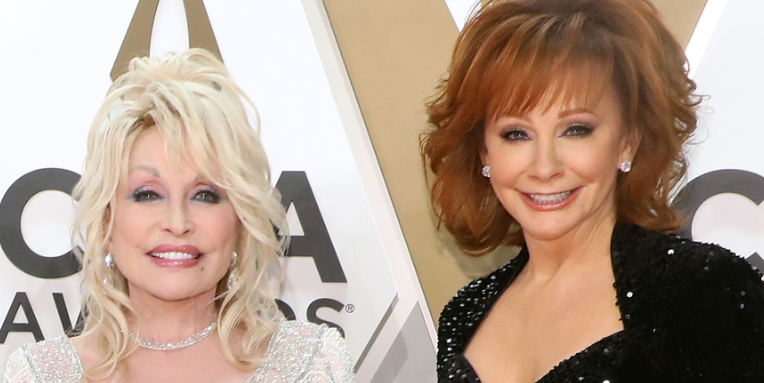
Some celebrity “first meeting” stories sound like they were designed by a publicist with a scented candle and a dream: two future icons lock eyes backstage, angels hum harmony, and everyone instantly knows history has entered the room wearing rhinestones. The real story of how Reba McEntire and Dolly Parton first crossed paths is much better than that. It has nerves, Nashville chaos, a Grand Ole Opry debut, a parking lot plot twist, and one very young Reba learning that when Dolly Parton arrives, even the schedule politely steps aside.
For fans searching for the story of Reba McEntire and Dolly Parton first met, here is the delightful twist: Reba did not exactly “meet” Dolly in the handshakes-and-small-talk sense that night. She saw her. She was in her presence. Dolly walked right in front of her. But Reba did not get the formal introduction she hoped for. Somehow, that makes the story even more country music perfect. It is not a polished networking moment. It is a vivid backstage memory from September 17, 1977, when Reba made her Grand Ole Opry debut and Dolly unexpectedly became part of the night without even trying.
Editorial note: In this article, “first met” is used in the popular entertainment sense, but the more accurate phrase is “first crossed paths.” Reba has explained that she did not get to properly meet Dolly that evening, even though it became her unforgettable first moment seeing the country legend up close.
A Night Reba McEntire Never Forgot
Before Reba McEntire became one of country music’s most decorated performers, she was a young singer from Oklahoma trying to get her chance on the most sacred stage in country music. The Grand Ole Opry was not just another venue. It was the place where legends stood, where radio made dreams feel close enough to touch, and where a new artist could feel both tiny and ten feet tall at the same time.
Reba’s Grand Ole Opry debut happened on September 17, 1977. She was 22 years old, still early in her recording career, and carrying the kind of nerves that could probably power the lights at the Opry House. Her family had traveled a long way to see her perform. It was supposed to be a milestone night: two songs, one big stage, and a chance to show Nashville what that Oklahoma voice could do.
Then Nashville did what Nashville does. It added a twist.
According to Reba’s own retellings, she was told her performance would be cut from two songs to one because Dolly Parton had just arrived. Not “Dolly might stop by later.” Not “Dolly is thinking about it.” Dolly had rolled into the parking lot, and the Opry was making room. That is the kind of sentence that could only happen in country music: “Sorry, kid, one of your songs is going to Dolly.”
The Surprise Dolly Parton Twist
Imagine being Reba McEntire that night. You are about to step into a dream you have carried for years. You are ready to sing two songs. Your family is there. You have probably replayed the moment in your head a thousand times. Then someone tells you Dolly Parton has arrived, and your stage time has just been trimmed.
A lesser artist might have been crushed. Reba, however, reacted in a way that tells you almost everything you need to know about her character. She did not turn it into a rivalry. She did not treat Dolly as competition. She wanted to meet her. Reba has recalled that she asked if she could meet Dolly, but the introduction did not happen. Instead, Dolly simply walked in front of her.
That brief pass-by became one of Reba’s most memorable early career stories. She has described Dolly as extraordinarily beautiful, almost angelic, and has made it clear that she admired her deeply from the beginning. The young singer who lost one song from her Opry debut did not walk away bitter. She walked away starstruck.
There is something wonderfully human about that. Reba was already talented, already determined, and already on the road to becoming “Reba.” But in that moment, she was also a fan. She saw Dolly Parton glide by and reacted the way many people probably would: with awe, admiration, and possibly the inner monologue of someone whose brain briefly turned into a banjo solo.
Why the Grand Ole Opry Made the Moment Matter
To understand why this story has stayed so powerful, you have to understand the Grand Ole Opry’s place in country music. The Opry is not just a stage; it is a symbol. For generations of artists, performing there has meant being welcomed into a living tradition. The radio roots, the family atmosphere, the history of the Ryman Auditorium, and the weekly rhythm of performances all give the Opry a special emotional weight.
Dolly Parton already had a deep Opry connection by the time Reba made her debut. Dolly had performed on the Opry as a young teenager and became an Opry member in the late 1960s. By 1977, she was not simply a successful singer. She was a major star, a songwriter of rare emotional intelligence, and a performer whose personality could fill a room before she even reached the microphone.
Reba, meanwhile, was just beginning to build the career that would eventually make her one of country music’s defining female artists. Her Opry debut was cut to one song, “Invitation to the Blues,” but that one song became part of a much bigger story. It was the beginning of a long relationship with the Opry, where she would later become a member in 1986.
The surprise is not just that Dolly’s arrival affected Reba’s performance. The surprise is that Reba turned the moment into a treasured memory rather than a grievance. In entertainment, where egos can sometimes be louder than the amps, that matters.
Reba’s Reaction Says Everything About Her
One reason this story continues to charm fans is that it reveals Reba’s humility. She could have framed the night as “Dolly took my song.” Instead, she has told it with warmth and humor. She has emphasized how thrilled she was simply to see Dolly up close. That attitude fits the Reba fans have come to love: grounded, funny, hard-working, and not too fancy, even when the outfit sparkles from across the county line.
Reba’s background helps explain that perspective. Raised in Oklahoma, connected to ranch life and rodeo culture, she learned early that work comes before glamour. Before the major awards, television success, Broadway turns, and arena tours, Reba was a singer trying to get through the gate and onto the stage. Her Opry debut story even includes another layer of tension: she nearly did not make it inside at first because of confusion at the gate. That means the night already had enough drama for a country song before Dolly even entered the parking lot.
And yet, Reba remembered the night with affection. She got three minutes, one song, and one unforgettable glimpse of Dolly Parton. For a storyteller like Reba, that was enough to become a classic.
Dolly Parton’s Star Power Was Already Legendary
Dolly Parton’s arrival carried weight because she had already become an artist other artists studied. Her songs were not just catchy; they were miniature movies. “Coat of Many Colors” could break your heart gently. “Jolene” could turn jealousy into poetry. “I Will Always Love You” could make goodbye sound like a blessing instead of a slammed door.
By the late 1970s, Dolly had also shown a rare ability to move across boundaries. She was rooted in Appalachian storytelling, but she understood television, image, humor, and business with remarkable instinct. She could be glamorous without losing sincerity. She could be funny without making herself small. She could write a devastating lyric and then turn around with a joke sharp enough to cut a rhinestone.
For Reba, seeing Dolly in person at the Opry was not like seeing a random celebrity. It was like seeing proof of what a country woman could become: a songwriter, a performer, a brand, a personality, and a force. Dolly’s career offered a kind of roadmap, even if no one else could follow it exactly. There is only one Dolly. Trying to duplicate her would be like trying to bottle lightning and then bedazzle the bottle.
From Missed Introduction to Longtime Friendship
The most satisfying part of the Reba and Dolly story is that the missed introduction did not remain the whole story. Over the years, the two country legends developed a warm mutual respect. Reba has repeatedly spoken about looking up to Dolly, learning from her, and appreciating her artistry. Dolly, in turn, has shown affection for Reba both publicly and musically.
Their friendship became especially visible through their collaboration on “Does He Love You.” The song was already one of Reba’s signature dramatic duets, originally recorded with Linda Davis in 1993. Decades later, Reba and Dolly recorded a new version together, giving fans the kind of duet they had been waiting for so long that the anticipation practically needed its own zip code.
The 2021 version of “Does He Love You” brought together two instantly recognizable voices. Reba delivered the emotional precision and theatrical fire that made the song famous. Dolly brought her unmistakable tone, warmth, and sly dramatic presence. The result felt less like a novelty pairing and more like a long-overdue chapter in country music history.
Fans loved the idea that the young singer who once lost a song slot because Dolly arrived would one day stand beside Dolly as an equal. That is the arc that makes the story so delicious. The first “meeting” was a near-miss. The later duet was a full-circle moment.
Why Fans Still Love This Story
The story of how Reba and Dolly Parton first crossed paths has all the ingredients of great country entertainment. It is funny, humble, a little bittersweet, and ultimately uplifting. It reminds fans that even icons start somewhere. Before Reba became a household name, she was a young artist hoping for her moment. Before she and Dolly became admired peers, Reba was watching Dolly walk by and thinking she had just seen something heavenly.
It also gives fans a rare glimpse into how country music traditions are built. Stars do not appear fully formed. They begin as hopeful newcomers, stand near legends, lose opportunities, gain stories, and keep singing anyway. Reba’s Opry debut may have been shorter than planned, but it did not shrink her future. If anything, it became part of her mythology.
There is also a valuable lesson tucked inside the sparkle: admiration is not weakness. Reba did not need to compete with Dolly to become great. She could honor Dolly, learn from her, and still build a career that was completely her own. In a world that often wants to pit successful women against one another, Reba’s attitude feels refreshing. She did not see Dolly as a threat. She saw her as Dolly. That was enough.
The Bigger Meaning Behind One Short Opry Moment
The Reba McEntire and Dolly Parton first meeting story is not really about a backstage snub or a lost song. It is about timing. Sometimes the moment you imagine is not the moment you get. Reba probably imagined singing two songs and making a clean, triumphant debut. Instead, she got one song, a bit of backstage confusion, and a glimpse of Dolly Parton floating through the room.
But life has a funny way of turning interruptions into keepsakes. That night did not go exactly as planned, but it became unforgettable. Reba’s career did not depend on singing two songs instead of one. It depended on talent, resilience, discipline, humor, and the ability to keep going after the schedule changed.
That is why the story resonates beyond country music. Everyone has had a “two songs became one song” moment. Everyone has watched a plan shrink, shift, or get interrupted by someone else’s arrival. The question is what you do next. Reba sang her song. She remembered the beauty of the moment. Then she kept building.
Related Experiences: What This Story Feels Like for Fans and Dreamers
For anyone who has ever chased a dream, Reba’s first brush with Dolly Parton feels surprisingly familiar. Maybe you did not make your Grand Ole Opry debut in 1977. Maybe Dolly Parton did not personally reduce your stage time by arriving like a glittering plot twist. But chances are, you have had a moment when the thing you planned turned into something else.
Think about the student who prepares for a big presentation and then has the time cut in half. Think about the musician who practices a full set and gets told there is only room for one song. Think about the young employee ready to impress the boss, only to have the meeting hijacked by someone more senior. In those moments, it is easy to feel invisible. It is easy to think, “Well, there goes my chance.” Reba’s story suggests another way to see it: maybe the chance is still there, just wearing a different outfit.
Country music fans often connect with stories like this because country music has always honored imperfect beginnings. The genre loves dusty roads, missed calls, wrong turns, family sacrifices, and dreams that take the scenic route. Reba’s debut night had all of that. Her family traveled far to support her. She almost missed getting inside. Her performance was shortened. Then Dolly appeared, and the night became something Reba would still be talking about decades later.
There is also something comforting in the way Reba admired Dolly without losing herself. Many people meet someone they look up to and feel suddenly smaller. Reba’s memory shows that admiration can become fuel. She could look at Dolly and think, “She is extraordinary,” without deciding, “I can never be extraordinary too.” That is a powerful experience for artists, writers, performers, and anyone building a life in the shadow of people they admire.
The story also speaks to the magic of almost-meetings. Sometimes a brief encounter stays with us because it is unfinished. A quick glance, a hallway moment, a person passing by at exactly the right timethese tiny scenes can become emotional bookmarks. Reba did not get a long conversation with Dolly that night, but perhaps that is why the memory stayed so bright. It was a glimpse, not a chapter. Later, life gave her the chapter.
For readers publishing or sharing this story online, the emotional hook is clear: the first Reba and Dolly moment was not glamorous in the expected way. It was awkward, funny, and slightly unfair. Yet it became beautiful because of how Reba carried it. She turned disappointment into admiration, and admiration into a lifelong respect. That is why fans still smile when they hear it. The story is not just about two country queens. It is about grace when the spotlight moves, humor when plans change, and the possibility that today’s near-miss might become tomorrow’s favorite story.
Conclusion
The surprising story of how Reba and Dolly Parton first met is really the story of how Reba first crossed paths with Dolly at the Grand Ole Opry. On September 17, 1977, Reba expected to sing two songs during her Opry debut. Dolly arrived unexpectedly, Reba’s set was cut to one song, and the formal introduction Reba hoped for did not happen. But Dolly walked right in front of her, leaving Reba with a memory she would carry for decades.
That moment could have become a story about disappointment. Instead, in Reba’s hands, it became a story about wonder. She saw Dolly not as a rival but as a legend worth admiring. Years later, the two would become friends, collaborators, and beloved symbols of country music’s heart, humor, and staying power. The first encounter may have been brief, but the legacy that followed has been anything but small.












