
Let’s begin with the reassuring part: salmon are real, sharks are real, tuna are still allowed to exist, and nobody is storming aquariums to peel the word “fish” off the tanks. The so-called movement to declare fish a myth is not a campaign against gills, fins, or Friday seafood specials. It is a scientific argument about classification. More specifically, it is a very nerdy, very evolutionary, surprisingly convincing claim that the category fish does not work as a clean natural group.
At first that sounds ridiculous. Fish seem incredibly easy to spot. They live in water, have fins, and generally mind their business unless turned into sushi. Case closed, right? Not exactly. The problem is that evolution is less impressed by appearances than humans are. Scientists who use cladistics, the branch of biology focused on evolutionary relationships, sort organisms by ancestry rather than by vibe. And once you do that, “fish” starts wobbling like a folding lawn chair.
That is why biologists sometimes say there is no such thing as a fish. They do not mean the animals are imaginary. They mean the category is a convenience label, not a proper evolutionary box. In everyday speech, the word is fine. In formal phylogenetic terms, it is messy. And honestly, once you see why, it becomes one of those ideas you can never unsee.
Wait, Are Scientists Seriously Saying Fish Are Not Real?
Yes and no. The animals are obviously real. What is under attack is the old assumption that all fish belong to one tidy branch of the tree of life in the same way mammals do, or birds do, or frogs do. In modern evolutionary biology, a valid natural group is supposed to include a common ancestor and all of its descendants. That kind of group is called a clade.
Here is where the trouble begins. The creatures we casually call fish include lampreys, sharks, rays, tuna, eels, coelacanths, lungfish, and thousands upon thousands of ray-finned species. That looks like one group from the outside. But evolution does not grade on body shape. When scientists map these animals on a phylogenetic tree, they find that some organisms we call fish are actually more closely related to tetrapods, meaning four-limbed vertebrates, than they are to other fish.
And tetrapods include amphibians, reptiles, birds, and mammals. Yes, mammals. Yes, including you. Congratulations on your deeply inconvenient family history.
The Word That Sinks the Old Category: Paraphyletic
If you enjoy words that instantly clear a room at parties, meet paraphyletic. A paraphyletic group includes a common ancestor but leaves out some descendants. In other words, it tells only part of the family story. That is exactly what “fish” usually does.
What a clade looks like
A clade is ancestry done properly. You start with one ancestral branch and keep everyone who descends from it. No cherry-picking. No “you can come in, but your weird land-walking descendants have to stay outside.” If the goal is to describe real evolutionary relationships, clades are the gold standard.
Why fish fail the test
The traditional fish category breaks the rule because tetrapods evolved from within the lobe-finned branch of what older systems would have called fishes. Once that happened, you had two choices. You could either include tetrapods inside the larger fish grouping, or admit that “fish” is not a true clade. Most scientists choose the second option for everyday clarity, then quietly enjoy watching students process the consequences.
That is why the phrase “fish are a myth” is both dramatic and technically useful. It is shorthand for a more precise claim: fish are not a natural monophyletic group in modern phylogenetic classification.
The Awkward Truth: Tetrapods Came From Fishy Ancestors
This is the part where the whole argument stops sounding like academic trolling and starts sounding like evolution doing what evolution does. Tetrapods evolved from lobe-finned ancestors that lived in water. Those ancestors had traits that would later be modified into limbs, neck mobility, air-breathing adaptations, and other features associated with life on land.
That means humans did not evolve from modern salmon or modern sharks. But humans and all other tetrapods descend from ancient finned vertebrates that, if alive today, most people would absolutely point at and say, “Yep, that’s a fish.” Science then walks in, adjusts its glasses, and says, “Actually, the branch structure is more complicated.”
So when biologists joke that humans are modified fish, they are not being cute for the sake of it. They are being phylogenetically annoying, which is different and somehow more powerful.
The Fish That Broke the Category
If you want to understand why the old fish box fails, you need to meet the lobe-finned lineup: coelacanths, lungfish, and extinct transitional forms such as Tiktaalik. These are the evolutionary troublemakers that turn a simple aquarium word into a classification crisis.
Coelacanths: the comeback fossils
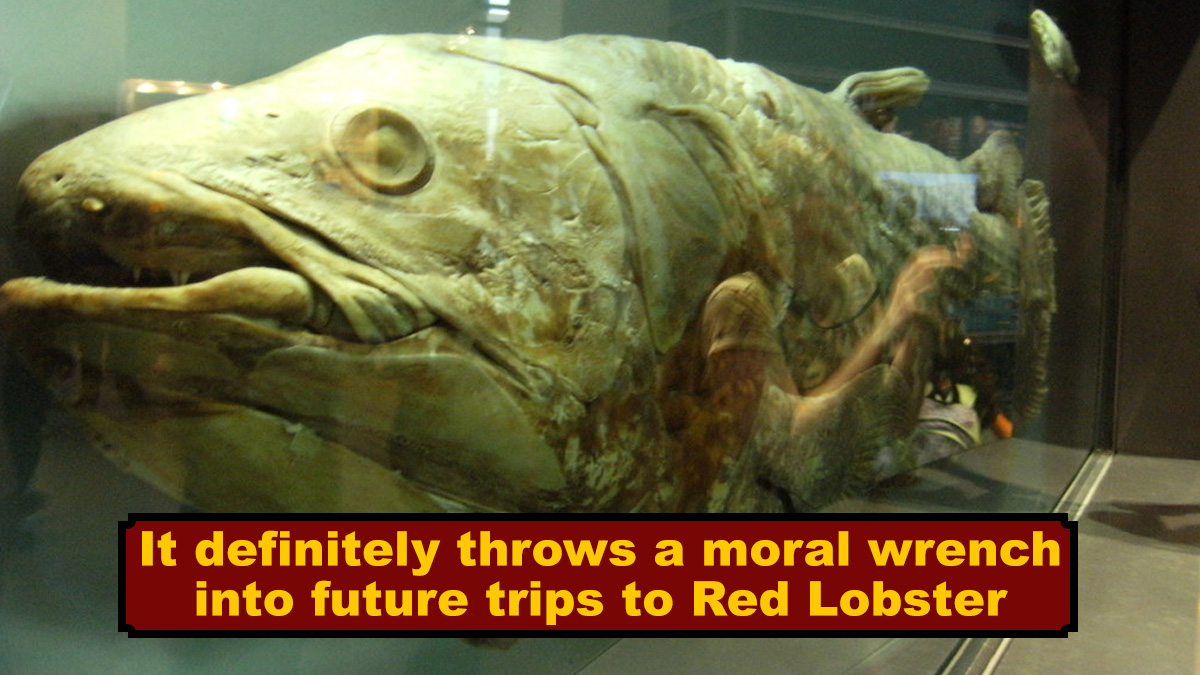
Coelacanths were once famous as the “missing link” poster animals because their fleshy fins seemed to hint at the bridge between aquatic vertebrates and land vertebrates. Later work refined that story, but coelacanths remain crucial because they sit on the lobe-finned side of the vertebrate tree, much closer to the tetrapod story than your average tuna ever dreamed of being.
Lungfish: the closer cousins
Lungfish push the issue even further. They are among the closest living relatives of tetrapods. They also carry the kind of biological details that make old-school “fish” definitions look flimsy. Some breathe air. Some survive extreme conditions in ways that feel less like a tidy category and more like evolution free-styling with full confidence.
Tiktaalik: the celebrity with a wrist
Then there is Tiktaalik, the fossil superstar that looks as if someone built a vertebrate out of fish parts and a prototype leg kit. It is often described as a “fishapod” because it preserves a striking mix of fish-like and tetrapod-like features. It had fins, but also structures that foreshadowed wrists and weight-bearing anatomy. It did not stroll onto land with a suitcase and a long-term plan, but it shows how blurry the line between fish and early tetrapods really was.
Once you place creatures like these in the story, the neat divide between “fish” and “everything with limbs” stops looking natural. It starts looking like a shortcut humans invented because body shape is easier to teach than ancestry.
Why This Weird Claim Actually Makes Sense
The scientific case against fish as a formal group is not about being difficult. It is about refusing to let surface appearance overrule descent. Sharks look fishy. Salmon look fishy. Lungfish look fishy. But evolutionary relationships are not determined by who has the most convincing fins. They are determined by branching ancestry.
Think of it this way: if a group contains an ancestor but excludes some of that ancestor’s descendants just because those descendants later evolved legs, feathers, fur, or an alarming ability to file taxes, the group is telling an incomplete evolutionary story.
Modern classification tries to reduce that kind of distortion. That is why cladistics has been so influential. It forces biologists to ask not, “Which animals look alike?” but, “Which animals belong together because of shared ancestry?” That shift changes everything. Suddenly, “fish” looks less like a biological truth and more like a useful nickname for a huge assortment of aquatic vertebrates.
So Should We Stop Using the Word “Fish”?
No, and this is where common sense gets its revenge. Most scientists still use the word fish all the time. Ichthyologists still study fish. Fisheries still manage fish. Museums still label fish exhibits as fish exhibits, because “Aquatic Non-Tetrapod Vertebrates Hall” is accurate but absolutely terrible marketing.
The point is not that the word must disappear. The point is that its limits should be understood. In everyday language, fish is perfectly useful. In cooking, fishing, pet care, and conservation outreach, it is indispensable. In rigorous phylogenetic classification, however, it is too loose to count as a natural clade.
So the smartest position is not “never say fish again.” It is “know when fish is a practical label and when it is a misleading scientific category.” That is less catchy than “fish are fake,” but far more helpful.
Why the Debate Matters Beyond Biology Class
This is not just taxonomy showing off. The way scientists classify life affects research, education, and how people think about evolution. When students learn that familiar categories can be misleading, they start seeing the tree of life as a branching history rather than a shelf of separate boxes. That is a major conceptual upgrade.
It also matters because fish are absurdly diverse. Ray-finned fishes alone make up the largest and most diverse vertebrate radiation alive today. Treating all fish as one obvious biological unit can flatten that diversity and hide the deep evolutionary differences among jawless fishes, cartilaginous fishes, ray-finned fishes, and lobe-finned lineages.
And then there is the public image problem. Fish have long been treated as the bland wallpaper of animal life: cold, simple, forgettable, interchangeable. But research and reporting over the last decade have continued to chip away at that stereotype. Fish can navigate, learn, solve tasks, recognize social partners, and in some cases even distinguish quantities. The old three-second-memory joke has aged about as well as dial-up internet.
In that sense, the “fish are not a real group” argument does something unexpectedly useful. It makes people pause. It reminds us that the animals we lump together under one small word are not one simple thing. They are a sprawling evolutionary archive full of bizarre bodies, ancient branches, and clever behaviors.
Experiences That Make the Whole Idea Click
One of the funniest things about this topic is how often people understand it emotionally before they understand it technically. You can watch the shift happen in real time. Someone hears, “There is no such thing as a fish,” and reacts as if science has finally become too online. Then a few examples land, and suddenly the joke turns into a genuine lightbulb moment.
A classic version happens in classrooms. A student learns that whales are mammals, not fish, and that part is easy. The categories seem neat. Then the lesson keeps going, and the student discovers that tetrapods came from lobe-finned ancestors nested inside the larger vertebrate story that once got lumped into fishes. At that point the old cartoon layout of nature breaks. Instead of separate bins marked fish, amphibians, reptiles, birds, and mammals, the student starts seeing branches, side branches, nested branches, and descendants carrying ancient anatomy into new environments. It feels less like memorizing labels and more like reading a family drama written over hundreds of millions of years.
Aquariums do this to people too. You walk in expecting one general category with fins. Then you notice that sharks, rays, lungfish, and ray-finned species are doing very different evolutionary things. One tank is basically a streamlined predator showroom. Another contains animals whose nearest storytelling value lies in helping explain how vertebrates eventually got onto land. By the time you reach the coelacanth display or a panel about lungfish, “fish” starts to feel more like an umbrella term than a biological home address.
Museum fossils make the point even harder. Creatures like Tiktaalik do not politely respect the categories people bring with them. It looks fishy, yet not entirely. It hints at wrists, weight support, shallow-water experimentation, and the evolutionary creativity that later makes limbs possible. That experience can be oddly unsettling in the best way. You realize nature does not care how tidy your textbook chapter titles were.
Then there are the everyday language experiences. Someone says, “Fish and animals,” and you realize that sentence is biologically nonsense. Someone else says, “Fish don’t really think,” and modern research nudges back. Or a person says, “Humans are nothing like fish,” which is emotionally understandable and evolutionarily hilarious. These moments are small, but they expose how much hidden theory is packed into casual language.
Even cooking culture accidentally teaches the lesson. We happily group cod, salmon, tuna, and halibut together because the kitchen is solving a practical problem, not an evolutionary one. That is perfectly reasonable. But it also shows why the word survives. Humans keep categories that are useful, even when they are scientifically imperfect. “Fish” works beautifully for menus, markets, and everyday conversation. It just gets wobbly when asked to serve as a formal evolutionary unit.
And perhaps that is why the idea sticks. It is not merely a technical correction. It is an experience of watching a familiar word become more interesting, more limited, and more revealing all at once. You do not end the journey believing fish are fake. You end it realizing that nature is stranger than the label, ancestry is more informative than appearance, and the tree of life is vastly more entertaining than the old boxes ever were.
Conclusion
So, no, fish are not a myth in the “Bigfoot but wetter” sense. The myth is the assumption that fish form one clean, natural, formally valid evolutionary group. In modern cladistics, they do not. Some lineages we call fish are more closely related to tetrapods than to other fish, which means the old category leaves out major descendants and fails the clade test.
That sounds strange because the word fish is still practical, familiar, and useful. We should keep using it in ordinary life. But when the goal is to describe the tree of life accurately, “fish” becomes less like a scientific destination and more like a conversational shortcut. A good shortcut, sure. Just not a perfect map.
And that is the real charm of this whole debate. It takes one of the most ordinary words in biology and turns it into a surprisingly elegant lesson: evolution cares about ancestry, not first impressions. Nature, as usual, refuses to stay inside our neat little boxes.












