
Finding the best science kits for kids can feel a little like walking into a mini laboratory where every box promises exploding volcanoes, glowing slime, robot arms, dinosaur bones, and “educational fun” in very large letters. The good news? Some kits really do deliver. The less-good news? Some are basically three plastic cups, a vague instruction sheet, and a parent quietly Googling “why did this not fizz?”
A great kids science kit should do more than keep a child busy for twenty minutes. It should invite questions, encourage hands-on discovery, build confidence, and make STEM learning feel less like homework and more like a Saturday adventure. Whether your child loves rocks, rockets, chemistry, electronics, astronomy, or taking apart every household object “for research,” there is a kit that can turn curiosity into real learning.
This guide reviews seven standout science kits for kids in 2024, chosen for their educational value, age suitability, variety, replay potential, safety-minded design, and overall fun factor. Prices can change, and availability may vary, but the picks below represent strong choices across chemistry, physics, electronics, engineering, geology, astronomy, and general STEM exploration.
How to Choose the Best Science Kit for Kids
Match the Kit to the Child, Not Just the Age Label
Age recommendations matter, especially when a kit includes small parts, chemicals, circuits, or detailed building steps. But age is only one part of the decision. A careful 7-year-old who loves instructions may enjoy a kit labeled for older kids with adult help, while a busy 10-year-old may prefer a faster, messier experiment that produces instant results.
Before buying, think about your child’s learning style. Do they like building models? Choose engineering or physics. Do they love sparkly rocks and outdoor exploring? Go for geology. Are they always asking how lights, buzzers, and switches work? Electronics kits are a fantastic fit. The best science kit is the one your child actually wants to open, not the one that looks most impressive on a gift guide.
Look for Real Tools and Clear Instructions
Good science kits usually include more than ingredients. Look for manuals, experiment cards, durable pieces, safety gear when needed, and explanations that connect the activity to a real scientific concept. A volcano is fun. A volcano that explains chemical reactions, gas formation, pressure, and observation skills is even better. Also, yes, it still gets bonus points if it erupts dramatically enough to make the dog suspicious.
Consider Mess, Time, and Adult Supervision
Chemistry, crystal-growing, and excavation kits can be amazing, but they are not always “open the box and walk away” toys. Some projects need several days, repeated steps, or a parent nearby. That is not a downside; it just means expectations matter. If you want a low-mess option, circuits and model-building kits are usually cleaner. If your child lives for goo, foam, fizz, and “look what happened!” moments, chemistry kits may be worth the paper towels.
The 7 Best Science Kits for Kids in 2024
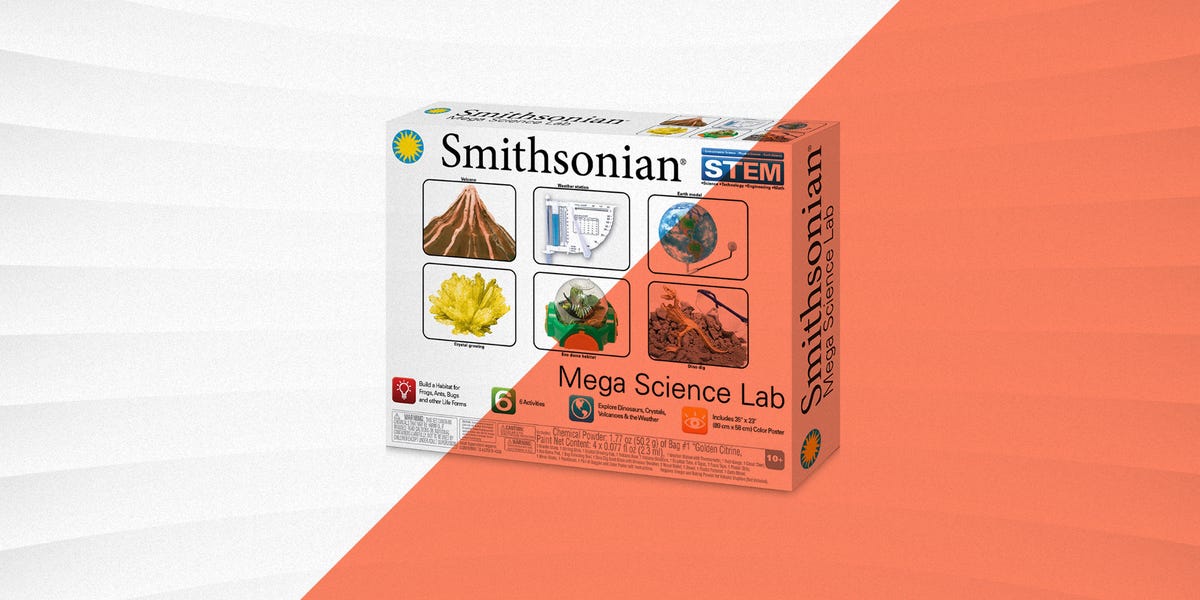
1. Best All-Around: Smithsonian Mega Science Lab Kit
The Smithsonian Mega Science Lab Kit is a strong choice for families who want one box with several different science experiences. Instead of focusing on only one subject, this kit brings together activities related to earth science, weather, dinosaurs, crystals, volcanoes, insects, and space-themed modeling. For kids who bounce from one interest to another, this variety is a major advantage.
Typical activities include building and erupting a model volcano, growing crystals, creating a weather station, excavating dinosaur fossils, studying bugs, and assembling an Earth-and-moon model. That makes it especially useful for children who are still discovering what kind of science excites them most. One day they are a geologist. The next day they are a meteorologist. By Friday, they may be yelling “I found a fossil!” from the kitchen table.
Best for: kids who want variety and parents who want good value in one kit.
Recommended age: generally 10 and up.
Why it stands out: it covers multiple STEM areas, making it a good starter kit for curious kids who are not ready to commit to one scientific obsession yet.
2. Best Physics Kit: Engino Discovering STEM Physics Laws Set
The Engino Discovering STEM Physics Laws Set is made for kids who enjoy building things that move, launch, roll, spin, or otherwise behave like they have a tiny engineering degree. It introduces concepts such as inertia, friction, circular motion, energy conversion, and mechanical forces through hands-on models.
Children can build working assemblies such as a rubber band car, a rocket launcher, a crash-test-style platform, and other physics-based models. The big win here is that kids are not just reading about forces; they are watching those forces cause motion right in front of them. When a model does not work perfectly the first time, that becomes part of the lesson. Adjust, test, repeat. Congratulations, you are now doing science instead of simply “playing with parts.”
The kit is especially good for kids who like LEGO-style building, machines, and cause-and-effect learning. Younger children may need adult guidance because the builds can be more detailed than simple snap-together toys.
Best for: kids interested in physics, motion, machines, and problem-solving.
Recommended age: generally 8 and up.
Why it stands out: it turns abstract physics ideas into working models that kids can test and modify.
3. Best Chemistry Kit: Thames & Kosmos Ooze Labs Chemistry Station
The Thames & Kosmos Ooze Labs Chemistry Station is one of the most engaging chemistry kits for kids because it looks and feels like a miniature lab. It includes kid-friendly lab equipment such as test tubes, pipettes, beakers, racks, and an Erlenmeyer-style flask. In other words, it gives children the thrilling feeling of being “real scientists” without turning your dining room into a questionable research facility.
The kit includes about 20 experiments and introduces basic chemistry concepts through activities like slime, fizzing reactions, chromatography, pH testing, filtering, colorful mixtures, and other hands-on demonstrations. The experiments use non-hazardous materials, but adult supervision is still smart, especially for younger kids or children who believe “more powder” is a valid scientific method.
What makes this kit shine is its balance of structure and fun. The station helps organize the tools, and the experiments are visual enough to keep children engaged. It is a good pick for kids who love mixing, observing, comparing, and asking why something changed color, bubbled, stretched, separated, or became gloriously weird.
Best for: kids who love slime, reactions, colors, and hands-on lab play.
Recommended age: generally 6 and up.
Why it stands out: it offers a real lab-style setup with enough experiments to keep chemistry exciting beyond one afternoon.
4. Best Electronics Kit: Snap Circuits Beginner Electronics Exploration Kit
The Snap Circuits Beginner Electronics Exploration Kit is a favorite for introducing kids to circuits without loose wires, soldering, or parental panic. Its snap-together pieces make electricity visible and understandable. Children can build projects with lights, sounds, switches, and moving parts while learning how circuits connect and function.
This beginner version typically includes 14 parts and more than 20 projects, making it approachable for younger learners. The instructions rely heavily on diagrams, which is helpful for children who are still building reading confidence. Kids can see immediately whether their circuit works. If the light turns on or the sound plays, success. If not, they learn to troubleshoot: check the switch, follow the path, flip the part, try again.
That kind of troubleshooting is the secret educational magic of electronics kits. Children practice patience, logic, sequencing, and attention to detail. Also, they get to make noise, which is apparently a key learning objective in many households.
Best for: younger kids interested in electricity, lights, switches, and beginner engineering.
Recommended age: generally 5 and up.
Why it stands out: it makes basic circuitry safe, visual, and satisfying for early STEM learners.
5. Best Geology Kit: National Geographic Geology Bundle Science Kits
The National Geographic Geology Bundle is a treasure chest for kids who collect rocks from sidewalks, parks, beaches, driveways, and possibly your washing machine. This type of kit usually combines several geology experiences, such as crystal growing, gemstone excavation, rock and mineral identification, fossils, geodes, and specimen collections.
Geology kits are excellent because they slow children down in a good way. They invite observation: color, texture, hardness, shape, layers, shine, and pattern. A child learns that a rock is not just “a rock.” It may be quartz, jasper, pumice, rose quartz, a fossil, or a geode hiding crystals inside like nature’s surprise cupcake.
The bundle format is useful because it provides both active projects and collectible materials. The excavation activities create excitement, while the guides help children understand what they have found. This is a particularly strong choice for kids who enjoy nature, museums, dinosaurs, treasure hunts, or sorting tiny objects into very serious categories.
Best for: kids who love rocks, fossils, crystals, dinosaurs, and natural history.
Recommended age: generally 8 and up.
Why it stands out: it combines collection, excavation, identification, and display-friendly discoveries.
6. Best Engineering Kit: Thames & Kosmos Simple Machines Science Experiment and Model Building Kit
The Thames & Kosmos Simple Machines Kit is perfect for kids who like to build, test, disassemble, rebuild, and then casually explain pulleys to relatives at dinner. It focuses on the six classic simple machines: wheels and axles, levers, pulleys, inclined planes, screws, and wedges. Many versions also explore gears and compound machine ideas.
Through 26 model-building exercises, kids can investigate how simple machines make work easier. This is practical STEM at its best. Children see how lifting, pushing, pulling, rolling, and balancing can change depending on design. A lever is no longer just a vocabulary word; it is something they can build and test.
This kit may require more patience than a one-step experiment, but that is part of its value. It teaches planning, following diagrams, fine motor skills, persistence, and mechanical thinking. It is especially helpful for children who enjoy construction toys and want a deeper challenge than free building alone.
Best for: kids who enjoy building models, machines, and mechanical experiments.
Recommended age: generally 8 and up.
Why it stands out: it teaches real engineering concepts through reusable models and guided experiments.
7. Best Astronomy Kit: Abacus Brands Bill Nye’s VR Space Lab Science Kit
Abacus Brands Bill Nye’s VR Space Lab Science Kit is the most tech-forward option on this list. It blends physical activities with virtual reality and augmented reality experiences, making it a strong pick for kids who love space but also want something more interactive than a standard book or poster.
The kit includes VR goggles and an interactive guide, with space-focused lessons and activities that explore astronomy topics in a visual way. For children who are fascinated by planets, astronauts, rockets, gravity, and the mysteries of the universe, this kit can feel like a guided field trip beyond Earth. No actual rocket fuel required, which is convenient for both safety and parking.
Because the experience uses digital elements, parents should check device compatibility before buying. It is also worth balancing screen-based learning with the hands-on activities included in the kit. Used thoughtfully, this kit can make big astronomy concepts feel more vivid and memorable.
Best for: space-loving kids who enjoy immersive digital learning.
Recommended age: generally 8 and up.
Why it stands out: it combines astronomy, VR, AR, guided activities, and a familiar science communicator in one package.
Quick Comparison: Which Science Kit Should You Buy?
| Science Kit | Best For | Main STEM Area | Typical Age Range |
|---|---|---|---|
| Smithsonian Mega Science Lab Kit | Variety and all-around discovery | Earth science, chemistry, weather, fossils | 10+ |
| Engino Discovering STEM Physics Laws Set | Kids who love moving machines | Physics | 8+ |
| Thames & Kosmos Ooze Labs Chemistry Station | Messy, colorful chemistry fun | Chemistry | 6+ |
| Snap Circuits Beginner Electronics Exploration Kit | First circuits and electronics | Electronics | 5+ |
| National Geographic Geology Bundle | Rock, fossil, and crystal lovers | Geology | 8+ |
| Thames & Kosmos Simple Machines Kit | Building and engineering concepts | Engineering and physics | 8+ |
| Bill Nye’s VR Space Lab | Space fans and immersive learners | Astronomy | 8+ |
What Makes Science Kits Worth Buying?
The best science kits for kids create a bridge between curiosity and understanding. Children naturally ask questions: Why does this bubble? Why does that float? Why did the light turn on? Why is this crystal taking forever? A good kit gives them tools to explore the answer instead of simply being told.
Hands-on STEM activities also teach soft skills that matter far beyond science class. Kids learn to follow instructions, make predictions, observe results, handle mistakes, and try again. These are the building blocks of critical thinking. When an experiment does not work, the child has a chance to troubleshoot instead of quitting. That moment is powerful, even if it arrives with a little dramatic sighing.
Science kits can also be excellent family activities. Parents do not need to be scientists. In fact, it can be fun when adults and kids discover something together. Saying “I don’t know; let’s test it” is one of the most scientific sentences in the world. It turns the home into a learning space where curiosity is welcome and mistakes are part of the process.
Safety Tips for Using Kids Science Kits
Always follow the manufacturer’s age recommendations and instructions. For chemistry kits, keep materials away from eyes and mouths, use goggles when provided, wash hands after experiments, and cover the workspace. For electronics kits, use only the recommended batteries and parts. For excavation and geology kits, supervise tools such as small hammers or digging pieces.
It is also wise to read the instructions before presenting the kit to a child. This helps you know whether you need household items, water, batteries, food ingredients, extra containers, or several days for the results. Nothing ruins the mood faster than announcing “science time!” and then discovering you need vinegar, three AA batteries, and the patience of a monk.
Real-Life Experiences: What Families Notice When Kids Use Science Kits
One of the best parts of science kits is that they create stories. A child may not remember every technical term from a chemistry card, but they will remember the day their slime stretched across the table like a neon alien. They will remember cracking open a geode, watching a circuit light up, or seeing a model car zoom forward because of stored energy in a rubber band. Those memories matter because they attach emotion to learning.
Parents often notice that children become more confident when a kit gives them a clear path from setup to result. The first project might require help, but by the second or third step, many kids start taking ownership. They line up pieces, check the manual, pour carefully, compare outcomes, and explain what they think is happening. That explaining part is important. When a child teaches the adult what they just learned, the concept becomes stronger in their mind.
Another common experience is that science kits reveal a child’s natural interests. A child who seems uninterested in school science may suddenly become obsessed with circuits because the result is immediate. Another child may love crystal growing because it rewards patience and observation. A third may prefer building machines because they enjoy structure and problem-solving. The right kit can uncover a learning doorway that worksheets never found.
Science kits also teach families about pacing. Not every experiment needs to be finished in one sitting. In fact, some of the best learning happens when children return to a project the next day. Crystal kits, plant-related experiments, weather stations, and longer engineering builds help kids understand that science is not always instant. Sometimes discovery requires waiting, measuring, checking, adjusting, and waiting again. This can be a useful antidote to the “I clicked once, where is my result?” rhythm of modern life.
Of course, there will be messes. There may be spilled water, lost pieces, overexcited mixing, and one mysterious stain that nobody admits creating. That is part of the experience. A simple tray, old towel, labeled storage bag, and clear cleanup rule can make a huge difference. The goal is not a perfect laboratory. The goal is a safe, curious, joyful environment where kids can test ideas without feeling like every mistake is a disaster.
The most rewarding experience is watching a child move from “What does this do?” to “What if I tried this instead?” That shift is the heart of STEM learning. The kit starts the activity, but curiosity keeps it going. Maybe the circuit gets rebuilt in a new pattern. Maybe the rock collection leads to a library book about minerals. Maybe the simple machines kit inspires a homemade pulley for a stuffed animal elevator. At that point, the science kit has done its job: it has opened a door.
Conclusion
The best science kits in 2024 are not just toys with educational stickers slapped on the box. They are hands-on learning tools that help kids explore real concepts in chemistry, physics, electronics, geology, engineering, astronomy, and earth science. The Smithsonian Mega Science Lab Kit is the best all-around pick for broad discovery. Engino’s Physics Laws Set is ideal for motion-loving builders. Thames & Kosmos Ooze Labs makes chemistry exciting and visual. Snap Circuits Beginner is a clean, clever entry into electronics. National Geographic’s geology kits are excellent for young collectors. Thames & Kosmos Simple Machines supports mechanical thinking, while Bill Nye’s VR Space Lab brings astronomy into an immersive format.
Choose the kit that matches your child’s personality, patience level, and favorite type of “wow.” Some kids want fizz. Some want fossils. Some want lights and buzzers. Some want to build a machine and explain why it works while everyone else is trying to eat dinner. All of those are valid scientific pathways. The real goal is simple: give kids a reason to ask better questions, test their ideas, and enjoy the wonderfully messy process of learning how the world works.
Note: This HTML article is written for web publishing, rewritten in original language, and based on real product information without inserting source links or content reference markers inside the article body.












