
Note: This article is for educational purposes only and is not personal financial advice. Always read an ETF’s prospectus and consider your goals, risk tolerance, tax situation, and time horizon before investing.
Exchange-traded funds, better known as ETFs, have become the “Swiss Army knife” of modern investing. They are flexible, transparent, relatively easy to trade, and available in more flavors than the cereal aisle after a marketing team drank too much coffee. Broad U.S. stocks? There is an ETF for that. Short-term Treasury bills? Also an ETF. International bonds, covered-call income, dividend strategies, active management, factor investing, thematic trends, and even niche ideas that sound like they were invented during a very enthusiastic whiteboard session? Yes, ETFs have entered the chat.
The title Talk Your Book: J.P. Morgan’s Guide to ETFs points to a bigger conversation happening across the investment world: ETFs are no longer just cheap index trackers. They are now portfolio building blocks, trading tools, income engines, tax-aware wrappers, and sometimes complicated products that deserve more than a casual “looks good, buy it” click. J.P. Morgan Asset Management’s ETF research emphasizes the mechanics behind the wrapper: liquidity, premiums and discounts, primary and secondary markets, total cost of ownership, fixed income ETF behavior, and the growth of active ETFs.
In plain English, this guide explains what investors should know before buying ETFs, how J.P. Morgan fits into the ETF boom, and why the smartest ETF investors do not simply chase the hottest ticker. They ask better questions. And ideally, they do it before the market teaches the lesson with a baseball bat.
What Is an ETF?
An ETF is a pooled investment fund that trades on an exchange like a stock. Inside the ETF, you may find stocks, bonds, short-term instruments, commodities exposure, options strategies, or a mix of assets depending on the fund’s objective. Each ETF share represents partial ownership of the fund’s portfolio and any income generated by that portfolio.
The magic of ETFs is that they combine features investors already understand. Like mutual funds, they offer diversified exposure and professional management. Like stocks, they trade throughout the day at market prices. That combination makes ETFs useful for long-term investors, financial advisors, institutions, and tactical traders. In other words, ETFs are the investing world’s crossover SUV: practical, popular, and somehow available in 4,000 versions.
Why ETFs Became So Popular
ETF growth has been powered by several major advantages: accessibility, diversification, trading flexibility, transparency, cost efficiency, and tax efficiency. For many investors, one ETF can provide exposure to hundreds or thousands of securities. Instead of buying every stock in the S&P 500, for example, an investor can buy one ETF that tracks the index. That does not make investing risk-free, but it does make portfolio construction simpler.
ETFs also fit the way modern investors behave. People want real-time pricing, easy access through brokerage platforms, and clear information about what they own. Most ETFs publish holdings regularly, which is especially useful for advisors and investors who want to understand portfolio overlap. Nobody wants to discover that five “different” funds all own the same mega-cap technology stocks wearing fake mustaches.
J.P. Morgan’s ETF Perspective: The Wrapper Matters
J.P. Morgan’s ETF education focuses heavily on the ETF wrapper itself. That may sound boring until you realize the wrapper affects trading, taxes, liquidity, transaction costs, and investor behavior. A strong ETF strategy is not only about what the fund owns. It is also about how the fund operates.
One important concept is the creation and redemption process. Authorized participants can create new ETF shares or redeem existing shares by exchanging baskets of securities with the ETF issuer. This process helps keep the ETF’s market price close to its net asset value, or NAV. It also supports liquidity and can contribute to tax efficiency because many transactions happen “in kind” rather than through forced sales inside the fund.
That does not mean every ETF always trades perfectly at NAV. Premiums and discounts can happen, especially in international ETFs, fixed income ETFs, or during periods of market stress. But understanding the mechanism helps investors avoid panic when an ETF’s market price temporarily moves away from its underlying value.
ETF Liquidity: More Than Trading Volume
A common mistake is judging ETF liquidity only by average daily trading volume. Trading volume matters, but it is not the full picture. ETF liquidity comes from two layers: the secondary market, where investors trade ETF shares with each other, and the primary market, where authorized participants create or redeem shares based on demand.
This matters most when evaluating newer, smaller, or fixed income ETFs. An ETF may appear lightly traded, yet the underlying securities may be highly liquid. Conversely, an ETF may trade frequently but still carry hidden costs through wider bid-ask spreads or less efficient execution. Smart investors look at the bid-ask spread, underlying holdings, premium or discount behavior, and order type. Market orders can be convenient, but limit orders are often the adult in the room.
Premiums and Discounts: The Price Tag Can Wiggle
Because ETFs trade on exchanges, their market prices can differ from their NAV. When an ETF trades above NAV, it is at a premium. When it trades below NAV, it is at a discount. For large U.S. equity ETFs, these differences are often tiny. For bond ETFs, international funds, or less liquid strategies, they can be more noticeable.
Premiums and discounts do not automatically mean something is broken. Sometimes the ETF price reflects where the market believes the underlying securities would trade if they were open or more liquid. For example, an international ETF may trade in the U.S. while its local foreign markets are closed. The ETF price may adjust to new information even though the NAV is based on stale closing prices from overseas markets.
The practical takeaway is simple: do not trade blindly. Check spreads, avoid trading during the market’s opening and closing minutes when spreads can be wider, and use limit orders when execution price matters. In ETF investing, “close enough” can become expensive if you repeat it often.
ETFs vs. Mutual Funds
ETFs and mutual funds are cousins, not enemies. Both pool investor money into a professionally managed portfolio. The key difference is trading. Mutual funds usually trade once per day after the market closes at NAV. ETFs trade intraday on exchanges at market prices.
ETFs often have lower expense ratios, fewer capital gains distributions, and more trading flexibility. Mutual funds may be better for automatic investment plans, fractional reinvestment, or investors who prefer end-of-day pricing. The right choice depends on how the investor uses the product. A hammer is useful, but not for brushing your teeth.
Passive ETFs: The Classic Building Block
The original ETF success story was passive indexing. Passive ETFs typically track a benchmark such as the S&P 500, Russell 2000, Nasdaq-100, Bloomberg U.S. Aggregate Bond Index, or a sector index. These funds are popular because they are relatively simple, low cost, diversified, and easy to compare.
Passive ETFs are often used as portfolio cores. A long-term investor may combine a U.S. stock ETF, international stock ETF, and bond ETF to create a diversified foundation. This approach is not glamorous, but glamour is overrated in investing. Many investors would be better served by a boring portfolio they can stick with than an exciting one that causes emotional whiplash every quarter.
Active ETFs: Where J.P. Morgan Has Made Noise
Active ETFs are one of the fastest-growing areas of the ETF market. Unlike passive ETFs, active ETFs do not simply track an index. A portfolio management team makes decisions about security selection, risk management, duration, credit quality, income generation, or other portfolio characteristics.
J.P. Morgan has become especially visible in active ETFs, including equity income, premium income, and fixed income strategies. Funds like JPMorgan Equity Premium Income ETF, commonly known by its ticker JEPI, helped bring covered-call and equity premium income strategies into mainstream ETF conversations. These strategies typically seek to generate income through a combination of equity exposure and options-related techniques, though they involve trade-offs such as capped upside or exposure to derivatives and counterparty risks.
The key lesson is that active ETFs are not automatically better or worse than passive ETFs. They are different tools. The investor’s job is to understand the objective, costs, risks, portfolio process, and role in the broader allocation.
Fixed Income ETFs: Why Bonds Are Not Always Boring
Bond ETFs deserve special attention because fixed income markets are less transparent and less standardized than stock markets. Many bonds do not trade every day. Indexes such as the Bloomberg U.S. Aggregate Bond Index are useful benchmarks, but they do not include every possible bond opportunity. Some areas, such as high yield, securitized credit, bank loans, or certain short-duration strategies, may give active managers room to add value through research and security selection.
This is one reason J.P. Morgan’s ETF discussions often highlight fixed income. In equities, beating a broad index can be difficult because information is widely available and competition is intense. In fixed income, benchmarks may be more rules-based, issuance-weighted, or incomplete. That does not guarantee active outperformance, but it explains why investors often evaluate active bond ETFs differently than active stock ETFs.
Thematic ETFs: Fun, Flashy, and Sometimes Dangerous
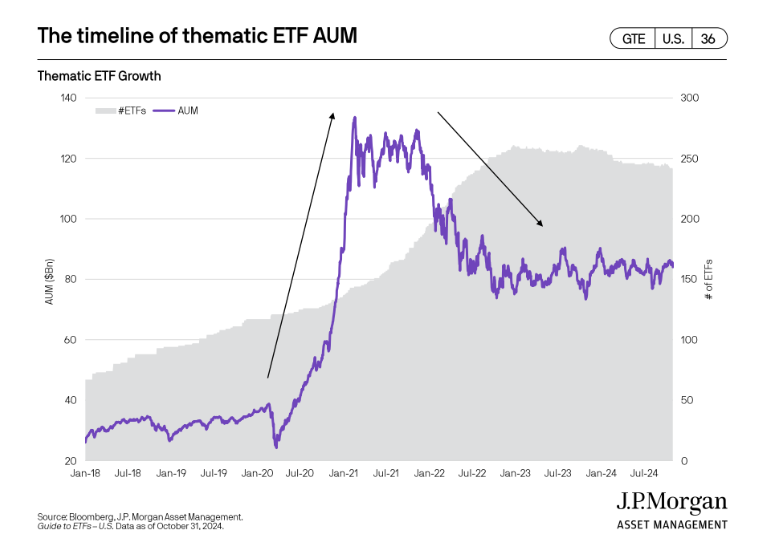
Thematic ETFs package investment ideas around trends such as artificial intelligence, clean energy, cybersecurity, robotics, space exploration, or aging populations. They are exciting because they tell a story. Unfortunately, the market does not pay investors extra just because the story has a cool logo.
Thematic ETFs can be useful satellite positions, but they often come with concentration risk, higher fees, and timing risk. A theme may be real while the investment return is disappointing. For example, the internet changed the world, but buying overvalued internet stocks at the wrong time was still painful. A great story can still be a bad entry price.
Investors should ask: What does this ETF actually own? Is it concentrated in a few stocks? Are the holdings truly tied to the theme? How expensive is the fund? Has the theme already been priced in? The best ETF due diligence often begins by reading the holdings list, not the marketing headline.
Covered-Call and Premium Income ETFs
Income-focused ETFs have attracted major attention, especially strategies that use options to generate premiums. Covered-call ETFs typically sell call options on an index or on portfolio holdings. The option premiums can support higher distributions, but there is no free lunch. The strategy may lag during strong bull markets because upside participation can be limited.
J.P. Morgan’s premium income suite is often discussed because it combines active equity selection with options-related income generation. Investors like the monthly income potential, but they must understand the source of that income. A high distribution rate is not the same thing as a guaranteed return. Options premiums can vary with volatility, interest rates, market direction, and portfolio design.
A sensible way to evaluate these ETFs is to focus on total return, volatility, downside behavior, tax implications, and portfolio role. Chasing the largest yield without understanding the strategy is like choosing a restaurant only because the menu font is confident.
Total Cost of Ownership: Expense Ratio Is Only the Beginning
Expense ratios matter, but they are not the only cost. ETF investors should consider bid-ask spreads, trading commissions if applicable, tracking difference, taxes, premiums or discounts, and market impact for larger trades. A fund with a slightly higher expense ratio may still be attractive if it tracks better, trades more efficiently, or provides exposure that cheaper funds cannot match.
For long-term investors, recurring costs compound over time. For frequent traders, spreads and execution quality matter more. For taxable investors, tax efficiency can be a major advantage. The lowest-cost ETF is not always the best ETF, but unnecessary cost is still a portfolio leak. Plug the leaks before blaming the boat.
How to Choose an ETF
Choosing an ETF should begin with the investor’s goal. Are you building a core portfolio? Seeking income? Reducing volatility? Adding international exposure? Managing cash? Expressing a tactical view? Each goal points to a different type of ETF.
1. Define the Job
Every ETF in a portfolio should have a job. “This looks interesting” is not a job. “This provides low-cost U.S. equity exposure” is a job. “This adds short-duration bond exposure for stability” is a job. “This creates income but may sacrifice upside” is also a job.
2. Look Under the Hood
Review the holdings, sector exposure, geographic exposure, credit quality, duration, options strategy, and concentration. Two ETFs with similar names can behave very differently.
3. Check Costs and Trading Quality
Compare expense ratios, bid-ask spreads, premiums and discounts, trading volume, and assets under management. A tiny ETF is not automatically bad, but investors should understand liquidity and closure risk.
4. Read the Prospectus
The prospectus explains objectives, risks, fees, tax details, and strategy. It is not beach reading, unless your beach vacation has taken a dark turn, but it matters.
5. Understand the Risk
All ETFs carry risk. Stock ETFs can fall with the market. Bond ETFs can lose value when rates rise or credit spreads widen. Options-based ETFs can behave differently than investors expect. Leveraged and inverse ETFs are usually designed for short-term trading, not casual buy-and-hold investing.
ETF Trading Best Practices
Good ETF trading habits can save money. Avoid trading right at the market open or close when spreads may be wider. Use limit orders, especially for less liquid ETFs. Check the indicative value or recent premium/discount behavior. For large trades, consider working with a trading desk or advisor. And never assume that a ticker symbol with three or four letters is simple just because it is short.
Investors should also be careful during market stress. ETFs can provide liquidity when underlying markets are strained, but prices may move quickly. A bond ETF, for instance, may trade at a discount because the ETF market is discovering real-time prices faster than the underlying bond market. That discount may be information, not necessarily dysfunction.
Private Assets in the ETF Wrapper
One of the more interesting debates in ETF innovation is whether private assets belong inside ETFs. Investors want access to private credit, private equity, and alternative strategies, but ETFs are designed for daily trading and transparency. Private assets are often illiquid, harder to value, and less transparent.
This does not mean innovation will stop. It means investors should be skeptical of any product that promises daily liquidity from assets that do not naturally trade daily. The ETF wrapper is powerful, but it is not a magic blender that turns illiquidity into a smoothie.
Where J.P. Morgan Fits in the ETF Market
J.P. Morgan Asset Management brings research, active management, trading knowledge, and product development to the ETF space. Its Guide to ETFs emphasizes education rather than just product promotion, which is useful because investors need more than ticker symbols. They need context.
The firm’s ETF lineup includes equity, fixed income, income-oriented, active, passive, and factor-based strategies. Its presence in premium income and active fixed income has made it a major voice in conversations about where ETFs are heading next. The important point for investors is not that every J.P. Morgan ETF is automatically suitable. The point is that J.P. Morgan’s ETF research highlights the right questions: How does the ETF trade? What is the true cost? What is the underlying exposure? What risks are hidden behind the label?
Common ETF Mistakes to Avoid
The first mistake is buying based on past performance alone. Yesterday’s winner can become tomorrow’s lesson. The second mistake is confusing yield with return. A high yield can be attractive, but it may come with reduced upside, credit risk, option risk, or return of capital considerations.
The third mistake is owning too many overlapping ETFs. A portfolio with 18 funds may look diversified, but if they all own the same large-cap stocks, it is just a costume party. The fourth mistake is ignoring taxes. ETFs can be tax-efficient, but not all ETFs have the same tax treatment. Commodity, currency, options-based, and certain alternative ETFs may have different tax consequences.
The fifth mistake is using complex ETFs without understanding them. Leveraged, inverse, single-stock, crypto-linked, and derivative-heavy products can behave in ways that surprise investors. Surprise is wonderful for birthdays. It is less charming in retirement accounts.
Real-World ETF Portfolio Examples
A simple long-term investor might use a three-fund ETF portfolio: one broad U.S. equity ETF, one international equity ETF, and one broad bond ETF. This setup is easy to manage, low cost, and diversified.
An income-focused investor might combine dividend ETFs, short-duration bond ETFs, and a modest allocation to premium income ETFs. The goal would be income generation while still monitoring total return and risk.
A more tactical investor might use sector ETFs, factor ETFs, or active bond ETFs to express views on value, quality, duration, credit, or market leadership. This approach requires more monitoring and discipline. Tactical investing without discipline is just daydreaming with a brokerage account.
Experience-Based Reflections on ETF Investing
The biggest lesson from watching ETF investors over time is that the wrapper is easy, but behavior is hard. Buying an ETF takes seconds. Holding the right ETF through a full market cycle takes patience, humility, and the ability to ignore dramatic headlines written as if every Tuesday is a financial asteroid strike.
Many investors begin with the right idea and then sabotage it with overactivity. They buy a broad-market ETF for long-term growth, then sell it after a correction. They buy a bond ETF for stability, then get upset when interest rates move. They buy a covered-call ETF for income, then complain when it trails a roaring equity market. In each case, the problem is not always the ETF. Sometimes the ETF did exactly what it said it would do. The investor simply expected it to do three other things as well.
Another experience-based lesson is that ETF names can be misleadingly simple. A fund called “income” may use options, credit, dividends, or a combination. A fund called “growth” may be concentrated in expensive mega-cap stocks. A fund called “low volatility” can still lose money. A fund called “total bond market” may not include every bond exposure an investor imagines. Labels are starting points, not due diligence.
It is also worth noting that boring ETFs often do the heavy lifting. The investing industry loves new products because new products are easier to market than patience. But many successful portfolios are built around broad, low-cost, diversified ETFs that do not make exciting dinner conversation. That is fine. Your portfolio does not need to be entertaining. Netflix has that job.
When investors add specialized ETFs, they should size them honestly. A thematic ETF, premium income ETF, or active credit ETF may make sense as a satellite position, but it should not accidentally become the center of the portfolio unless the investor truly understands the risk. Position sizing is the quiet hero of portfolio management. It keeps a bad idea from becoming a financial soap opera.
The best ETF users tend to follow a repeatable process. They define the purpose, compare alternatives, read the fund documents, evaluate costs, check holdings, understand trading mechanics, and decide how the ETF fits with the rest of the portfolio. They do not need to predict every market move. They need a structure that can survive being wrong sometimes.
J.P. Morgan’s ETF research is useful because it pushes investors beyond the surface. It reminds people that liquidity is layered, trading matters, fixed income ETFs behave differently than stock ETFs, and active management can be more relevant in some markets than others. Most importantly, it encourages investors to focus on total portfolio outcomes rather than shiny product features.
In practice, the ETF revolution is both empowering and overwhelming. Investors have more choice than ever, but more choice does not automatically produce better decisions. A giant menu can still lead to ordering badly. The goal is not to own the most ETFs. The goal is to own the right ETFs for the right reasons at the right size, with realistic expectations.
Conclusion
Talk Your Book: J.P. Morgan’s Guide to ETFs is ultimately a reminder that ETFs are tools, not miracles. They can lower costs, improve access, support diversification, and make portfolio construction more efficient. They can also create confusion when investors chase yield, themes, leverage, or performance without understanding the mechanics underneath.
J.P. Morgan’s ETF framework encourages investors to think about the full picture: structure, liquidity, premiums and discounts, tax efficiency, active versus passive management, fixed income complexity, trading quality, and total cost of ownership. That is the kind of thinking ETF investors need in a market where new funds launch constantly and every product seems to promise a smarter way forward.
The best ETF strategy is not the flashiest. It is the one that matches your goals, fits your risk tolerance, keeps costs reasonable, and remains understandable when markets get messy. Because when volatility arrives, the last thing you want is to discover that your “simple ETF” has more plot twists than a prestige TV finale.











