
Note: This article is written for web publication in standard American English and synthesizes real background from electronics history, maker culture, display technology, and modern Nixie tube art trends.
There are two kinds of people in the world: those who see a glowing orange tube and say, “Nice clock,” and those who immediately start wondering whether it can spell a word, wink like a robot, or become the centerpiece of a moody cyberpunk wall installation. Symbolic Nixie tubes belong to the second group. They are not just dusty old components from laboratory instruments and Cold War-era electronics. In the hands of artists, makers, designers, and collectors, they become tiny glass stages where electricity performs theater.
The title “Symbolic Nixie Tubes Become Useful For Artistic Purposes” sounds almost too practical for such a dreamy technology. After all, Nixie tubes are wonderfully inefficient by modern display standards. They need high voltage, they are fragile, and they are not exactly something you toss into a weekend project without reading the safety notes twice. Yet that is exactly why they are so loved. Their warm glow, layered depth, and mechanical honesty give them a personality that flat screens cannot fake. A modern OLED display may be sharper, but a Nixie tube looks like it has a backstory, a passport stamp, and possibly a favorite jazz record.
What Are Symbolic Nixie Tubes?
A traditional Nixie tube is a cold-cathode display tube. Inside the glass envelope, shaped metal cathodes sit in front of a mesh anode. When the right voltage is applied, gas around the selected cathode glows with that famous orange-red neon light. Most people know Nixie tubes as numeric displays because the common versions show digits from 0 to 9. They appeared in calculators, counters, test equipment, frequency meters, industrial controls, and early digital readouts long before LEDs took over the job with less drama and fewer volts.
Symbolic Nixie tubes are different. Instead of only showing numbers, they contain symbols, letters, units, signs, or special characters. Some may display mathematical marks, electrical units, arrows, plus and minus signs, decimal points, or letter-like shapes. Others were designed for specialized equipment where a number alone was not enough. These tubes were once practical tools. Today, they are increasingly useful for artistic purposes because symbols carry emotional and visual meaning. A glowing “A,” “M,” “K,” arrow, or strange scientific mark can turn a device into a message.
Why Nixie Tubes Still Fascinate Artists
Nixie tubes should have disappeared into the museum cabinet of obsolete electronics. Instead, they became design celebrities. Their revival is driven by a mix of nostalgia, scarcity, craftsmanship, and pure visual charm. Unlike a digital screen, a Nixie tube is not pretending to be anything. The character is physically there, bent from metal and suspended in glass. When it lights up, the glow hugs the shape like neon fog around a tiny sculpture.
This gives Nixie tube art a rare combination of warmth and precision. It feels technical, but not sterile. It feels vintage, but not sleepy. It can sit comfortably in a mid-century modern room, a steampunk studio, a makerspace, a music room, or a gallery installation that smells faintly of solder and ambition. Symbolic Nixie tubes add another layer because they move beyond clocks. They can communicate identity, mood, direction, measurement, humor, or abstract symbolism.
The Shift From Timekeeping To Storytelling
For years, the most popular modern use of Nixie tubes has been the Nixie tube clock. That makes sense. Numeric tubes are available, time is universal, and the glowing digits look ridiculously good on a desk. But the clock format also trapped Nixie tubes in a predictable role. Six digits, maybe a blinking colon, maybe a handsome wood base. Beautiful? Absolutely. Surprising? Not always.
Symbolic tubes break that pattern. They invite makers to think less like clock builders and more like typographers, sign painters, installation artists, and interactive designers. A set of symbolic tubes can spell a short word, suggest a unit of measurement, create an icon, or serve as part of a larger mixed-media artwork. The result is a new creative vocabulary: vintage electronics as language.
A Clever Example: Spelling With Symbols
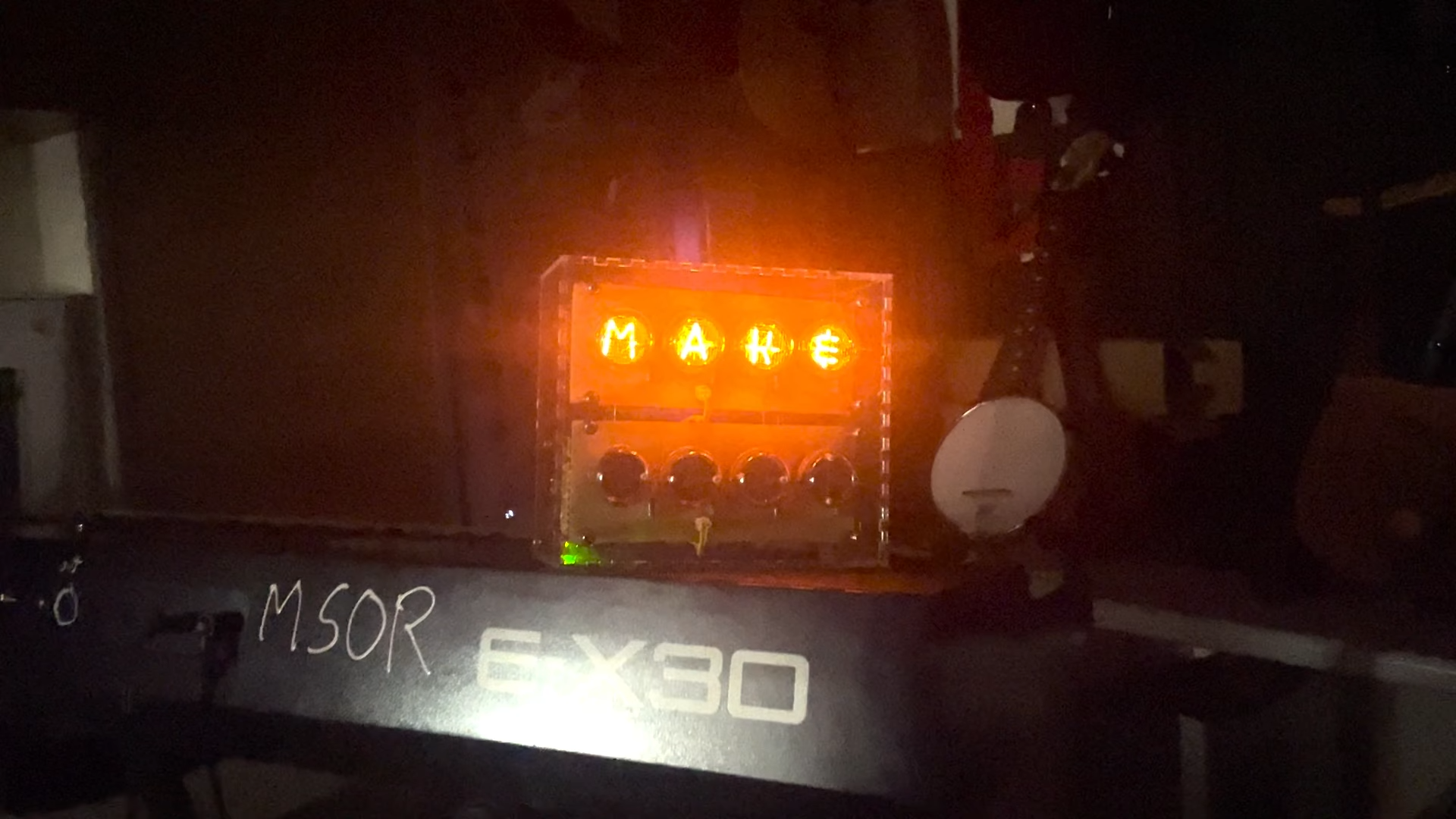
One of the most charming examples of symbolic Nixie tube art is the idea of using symbol tubes to spell words in unexpected ways. Some tubes were never meant to become alphabet displays, but makers are good at politely ignoring what parts were “meant” to do. For example, a symbolic tube containing characters such as M, A, K, or unit symbols can be arranged into a sign. Rotate a tube, reinterpret a mark, combine characters across multiple tubes, and suddenly a technical component becomes visual poetry.
This is where artistic usefulness appears. A symbol tube may be less valuable to someone building a standard clock, but it becomes gold to someone building a makerspace sign, a glowing logo, a wall sculpture, or a kinetic installation. The limitations are not flaws; they are creative prompts. When a symbol does not perfectly match a letter, the artist has to improvise. That small act of improvisation gives the piece personality.
How Symbolic Nixie Tubes Work In Visual Design
Good art direction is not only about what an object says. It is also about how it says it. Symbolic Nixie tubes are visually rich because they combine typography, light, transparency, depth, and physical structure. A glowing character inside glass feels different from a printed symbol or a pixel. It has dimension. You can see the inactive cathodes layered behind the active one. The tube does not simply display a sign; it reveals the machinery of the sign.
That makes symbolic Nixie tubes ideal for projects where the process matters as much as the result. In a gallery, they can suggest memory, measurement, obsolete technology, hidden systems, or the beauty of machines. In home decor, they can create a conversation piece without shouting. In commercial interiors, they can give a brand a handcrafted technical edge. In maker culture, they are a badge of curiosity: “Yes, this sign could have been made with LEDs, but where is the romance in that?”
Artistic Uses For Symbolic Nixie Tubes
1. Glowing Word Art
Short words are a natural fit for symbolic Nixie tubes. Words like MAKE, ON, GO, AMP, LAB, ART, or LIVE work especially well because they connect to the technical personality of the tubes. A symbolic Nixie sign can hang above a workbench, mark the entrance to a studio, or act as a glowing centerpiece in a creative office. The best designs keep the word short and let the tubes breathe. Too many characters can turn a classy piece into a glassy alphabet soup.
2. Maker Space And Workshop Signs
Symbolic Nixie tubes feel right at home in makerspaces because they celebrate the intersection of old hardware and new imagination. A sign made with symbolic tubes can communicate the spirit of building, experimenting, and occasionally discovering that the problem was a loose ground wire all along. Pairing tubes with custom circuit boards, etched panels, wood, brass, acrylic, or 3D-printed mounts can produce a piece that looks both engineered and handmade.
3. Interactive Installations
Because Nixie tubes can be controlled electronically, they can become interactive art elements. Sensors, microcontrollers, switches, rotary encoders, or sound inputs can trigger different symbols. Imagine a wall piece where an arrow glows when someone approaches, a plus sign appears when two people stand together, or electrical unit symbols light up in response to audio. Symbolic Nixie tubes turn interaction into ritual because each change feels physical, not merely digital.
4. Scientific And Mathematical Decor
Symbolic tubes with measurement units, plus/minus signs, or other technical marks are perfect for labs, classrooms, engineering offices, and science-themed interiors. They can add warmth to spaces that are often dominated by whiteboards and fluorescent lights. A glowing symbol can honor the history of measurement technology while also looking stylish enough for modern design. It is science decor with better manners than a motivational poster.
5. Retro-Futuristic Branding
Brands that want to suggest craft, invention, audio culture, electronics, gaming, or vintage futurism can use symbolic Nixie tubes as physical branding elements. They work well in boutique hotels, cocktail bars, record shops, repair studios, design agencies, and tech offices that prefer character over corporate wallpaper. The glow communicates authenticity because the object is genuinely electromechanical and visually distinct.
Why Symbolic Tubes Are Often Underrated
Numeric Nixie tubes get most of the attention because clocks are easy to understand and easy to sell. Symbolic tubes can be more awkward. They may not form complete alphabets. Their symbols may be tied to old equipment standards. Their pinouts may be unfamiliar. Some are surplus from Soviet-era or industrial equipment, and documentation can be inconsistent. For a purely practical builder, that can be annoying.
For an artist, though, awkwardness is useful. A symbolic tube asks, “What can I become?” rather than “What time is it?” Its value is not limited to displaying data. It can become a texture, a mood, a clue, a joke, or a fragment of language. This is why less-popular tubes can suddenly become desirable in creative projects. When everyone is hunting numeric tubes for clocks, symbolic tubes are quietly waiting to become something stranger and more memorable.
Design Considerations Before Building Nixie Tube Art
Creating art with symbolic Nixie tubes is exciting, but it is still electronics work. These tubes generally require high voltage, often around the range associated with Nixie operation, though current is usually low. That does not make them harmless. A responsible build needs proper insulation, current limiting, safe power supply design, enclosed high-voltage areas, strain relief, ventilation where needed, and a layout that keeps curious fingers away from dangerous points.
Artists who are new to electronics should not treat Nixie tubes like ordinary LEDs. LEDs are friendly little dots. Nixie tubes are glamorous divas with electrical boundaries. Use proven driver circuits, study datasheets when available, and consider working with experienced electronics builders if the project will be installed in a public space. Safety is not the unfun part of the artwork. Safety is what allows the artwork to keep glowing without becoming an incident report.
Choosing The Right Tube
The best symbolic Nixie tube for a project depends on the message, viewing distance, availability, and desired character style. Some tubes are small and delicate, ideal for desk objects or intimate sculptures. Others are larger and better suited for signage. The internal symbol shape matters too. A rough, industrial-looking symbol may be perfect for a workshop sign, while a cleaner character may suit a gallery or living room piece.
Pairing Tubes With Materials
The supporting materials can completely change the emotional tone of a symbolic Nixie project. Walnut, maple, and brass lean warm and vintage. Black acrylic, smoked glass, and aluminum feel more cyberpunk. Concrete creates a raw architectural mood. Clear acrylic exposes the electronics and says, “Yes, the circuit is part of the show.” A good enclosure should not hide the tubes’ personality; it should frame it.
Planning The Glow
Nixie tube light is not bright like a modern display. It is atmospheric. That is part of the magic. Designers should think about ambient lighting, viewing angles, reflections, and background contrast. A symbolic tube against a dark panel often looks richer than one placed against a busy surface. Dimming control can also help. Full brightness may work in a workshop, while a lower glow may be better for a bedroom, lounge, or art installation.
The Emotional Power Of Obsolete Technology
One reason symbolic Nixie tubes work so well in art is that they carry history in their bodies. They remind us of a time when digital information still had visible physical form. Before displays became thin, sealed, and disposable, a number or symbol could be made from bent wire inside glass. That is a very different relationship between object and information.
Modern screens are infinitely flexible, but they are also strangely anonymous. A phone can show a clock, a movie, a map, or a grocery list, and the surface remains the same. A Nixie tube, by contrast, is specialized. It was built for a limited purpose. When artists repurpose symbolic Nixie tubes, they are not just using a display. They are rescuing a little artifact of technological history and giving it a second life.
Specific Artistic Concepts Worth Exploring
The “Unit Wall”
A wall installation could use symbolic tubes showing electrical or measurement units such as volts, amps, kilo, mega, or mathematical signs. Each symbol could light in response to sound, motion, or environmental data. The piece would feel like a control panel from a beautiful machine that may or may not control the weather.
The “Word Fragment” Sculpture
Instead of spelling complete words, an artist could use partial symbols to suggest language. A rotated character, an incomplete letter, or a glowing mathematical mark can create ambiguity. Viewers naturally try to decode it, which makes the artwork interactive even before electronics are involved.
The “Analog Notification” Object
A symbolic Nixie tube can become a poetic notification device. Rather than showing a full message, it might glow with a single symbol when a server is online, a studio is open, music is playing, or a package has arrived. It is wildly unnecessary, which is often the first ingredient in delightful design.
SEO And Market Appeal: Why This Topic Matters
Search interest around Nixie tube clocks, retro displays, vintage electronics decor, and maker art continues because these objects sit at the crossroads of several passionate communities. Collectors appreciate the history. Electronics hobbyists enjoy the circuit challenge. Interior design fans love the glow. Artists value the symbolic and sculptural possibilities. That overlap gives symbolic Nixie tube art strong content potential for blogs, galleries, product pages, and DIY guides.
For creators selling Nixie-inspired art, the most effective messaging should avoid treating the tubes as mere novelty. The stronger angle is craftsmanship: real glass, real glow, real electronics, real history. Buyers are not just purchasing a display. They are buying atmosphere. They are buying a small illuminated argument against boring decor.
The Future Of Symbolic Nixie Tube Art
Original Nixie tubes are finite, and some types are becoming harder to find. That scarcity will likely make symbolic tubes more interesting, not less. As common numeric tubes become expensive, artists may explore overlooked stock, unusual symbols, and hybrid designs. At the same time, modern makers are creating Nixie-inspired alternatives using LEDs, acrylic layers, edge lighting, and custom typography. These alternatives do not replace real tubes, but they expand the visual language.
The future may include mixed installations where real symbolic Nixie tubes sit beside LED facsimiles, projection, sound, and interactive code. The contrast between old and new can be powerful. A genuine tube brings texture and historical weight; modern control systems bring flexibility. Together, they can create artworks that feel both ancient and futuristic, like a telegram from a robot ghost.
Common Mistakes To Avoid
Using Too Many Tubes Without A Clear Idea
Nixie tubes are visually strong. Too many glowing symbols can overwhelm the viewer. A focused concept usually works better than a crowded display. Let each tube earn its place.
Ignoring Safety And Enclosure Design
High-voltage electronics need respect. Exposed wiring may look dramatic in photos, but public-facing or home decor pieces should be safely enclosed and built with long-term reliability in mind.
Treating Symbolic Tubes Like Ordinary Letters
Symbolic tubes often look best when their oddness is embraced. If a character is imperfect, use that imperfection as part of the design. The charm is in the translation.
Forgetting The Surrounding Space
A symbolic Nixie piece should be designed for its environment. A bright workshop sign, a quiet bedside sculpture, and a gallery wall installation all require different brightness, scale, materials, and mounting choices.
Experience Section: Living With Symbolic Nixie Tube Art
The experience of symbolic Nixie tube art is difficult to capture in a product photo because the best part happens in person. You do not simply look at the tube; you notice it. The glow has a soft edge that changes with the room. During the day, the glass envelope, metal pins, and internal cathodes make the object feel like a tiny scientific specimen. At night, it becomes warmer and stranger. The symbol appears to float, as if someone trapped a piece of neon handwriting inside a bottle.
In a creative workspace, symbolic Nixie tubes can change the mood of the room. A small glowing sign above a soldering bench or drafting table creates a sense of ceremony. It says the space is not only for work but for invention. The funny thing is that the tube does not have to do much. A single glowing character can be enough. A plus sign near a collaborative table, an arrow near a doorway, or a short word like MAKE can become part of the room’s identity.
There is also a satisfying slowness to Nixie tube projects. Modern displays are often plug-and-play, but symbolic Nixie builds ask for patience. You think about the tube’s orientation. You test the character. You choose the resistor. You decide whether the enclosure should hide the circuit or proudly reveal it. You learn that old components have opinions. Sometimes the symbol you wanted is not available, so you design around the symbol you have. That limitation can lead to better art because it forces the project to become specific rather than generic.
Visitors tend to respond emotionally to these pieces. People who are not electronics fans still understand the glow. They may not know what a cold-cathode display is, but they recognize that the object feels different from a screen. It looks handmade, even when the circuit is precise. It feels alive, even though it is just gas, glass, metal, and electricity doing exactly what physics allows. That is the secret advantage of symbolic Nixie tubes: they make technology feel intimate.
The best experience comes when the artistic purpose and the electronic behavior match. A random glowing symbol is pretty. A symbol that responds to sound, marks a threshold, spells a meaningful word, or reflects the personality of a studio becomes memorable. Symbolic Nixie tubes are useful for art because they do not vanish into the background. They ask to be interpreted. They invite viewers to lean closer, decode, smile, and maybe ask the best question any artwork can inspire: “How did you make that?”
Conclusion
Symbolic Nixie tubes prove that usefulness is not always about efficiency. Sometimes usefulness means creating wonder, giving obsolete parts a new role, or turning a forgotten electronic symbol into a glowing piece of visual storytelling. Numeric Nixie clocks will always have their place, but symbolic tubes open a wider creative door. They can become signs, sculptures, interactive installations, brand pieces, science decor, and deeply personal objects that glow with both history and imagination.
For artists and makers, the lesson is simple: do not overlook the odd parts bin. The tube that cannot display a perfect digit may be the one that gives your project its soul. Symbolic Nixie tubes are not merely retro components. They are tiny illuminated alphabets waiting for someone brave enough to spell something new.











