
Note: This article is original web-ready editorial content based on publicly available technical history, documented Apollo Guidance Computer restoration work, and real information about Hackaday Supercon 2023.
At Hackaday Supercon 2023, one of the most delightfully nerdy stories on stage was not about a brand-new microcontroller, a trendy AI board, or a robot that could make espresso while judging your solder joints. It was about something far older, rarer, heavier, and arguably more glamorous: restoring the Apollo Guidance Computer, the legendary machine that helped send astronauts to the Moon and bring them home.
The talk, “Restoring The Apollo Guidance Computer,” centered on Marc Verdiell, better known online as CuriousMarc, and the wider team that helped bring a genuine Apollo Guidance Computer, or AGC, back to life. For hardware hackers, vintage computing fans, aerospace history lovers, and anyone who has ever whispered “please boot” at a dead circuit board, the story is irresistible. It combines detective work, reverse engineering, rare Apollo hardware, custom-built replacement parts, and the kind of patience usually reserved for restoring a dinosaur skeleton with tweezers.
Why the Apollo Guidance Computer Still Matters
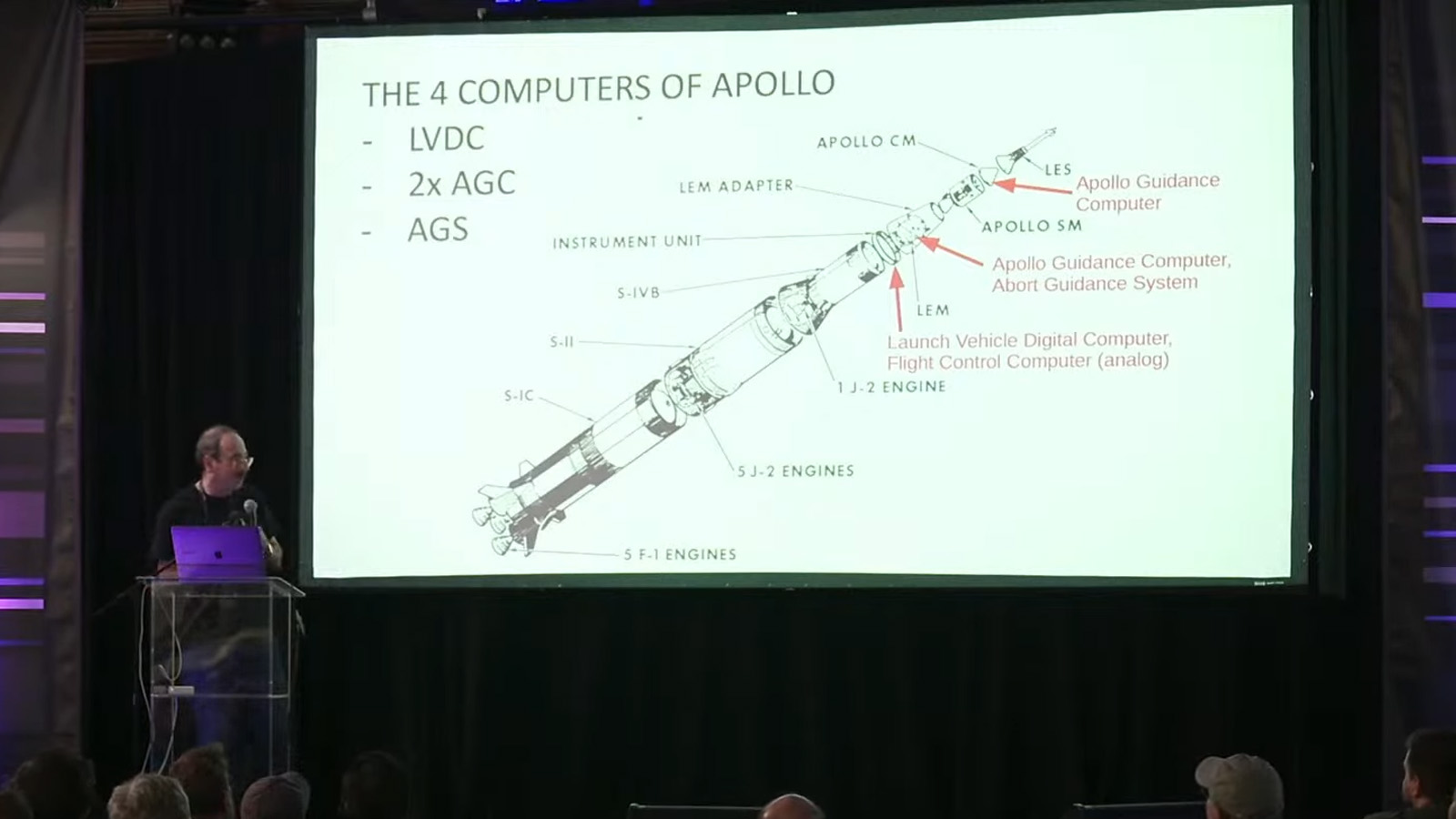
The Apollo Guidance Computer was not just another box of electronics tucked inside a spacecraft. It was the digital brain of the Apollo Command Module and Lunar Module. Each spacecraft carried its own AGC, and each computer helped handle guidance, navigation, control, engine burns, spacecraft orientation, lunar landing tasks, and the tricky business of getting humans safely through space without turning the mission into an extremely expensive fireworks show.
Designed by the MIT Instrumentation Laboratory and manufactured by Raytheon, the AGC was revolutionary for its time. It used integrated circuits when integrated circuits were still considered daring, expensive, and suspiciously futuristic. Today, a smart toaster may have more raw computing power, but that comparison misses the point. The AGC was not designed to stream videos, recommend socks, or ask whether you are still watching. It was designed to do mission-critical work reliably in a hostile environment, with astronauts’ lives depending on it.
The Block II Apollo Guidance Computer used about 2,048 words of erasable magnetic-core memory and 36,864 words of fixed core rope memory. It ran with a clock speed that sounds tiny by modern standards, but its architecture was purpose-built, disciplined, and efficient. There was no microprocessor inside. Instead, the computer was built from thousands of simple integrated circuits, many functioning as NOR gates. In other words, the Moon landings were guided by a machine that looks primitive only if you forget that it had one job and did it in a place where tech support could not exactly open a ticket.
The DSKY: Apollo’s Keyboard Before Keyboards Were Cool
Astronauts interacted with the AGC through the DSKY, short for Display and Keyboard. It had numeric keys, status lights, and displays that made the spacecraft computer feel less like a modern laptop and more like a calculator that had joined the Navy and gone through astronaut training.
Instead of typing plain-English commands, astronauts used a “verb-noun” system. The verb described the action, and the noun described the data or target. This sounds strange now, but it was a compact and efficient interface for a mission environment where every ounce, watt, wire, and second mattered. The DSKY was not pretty in the modern consumer-electronics sense, but it was readable, functional, and unforgettable. It was the human doorway into one of the most important embedded computers ever built.
How One Apollo Computer Survived the Scrap Pile
The restored AGC featured in the Supercon 2023 story had a remarkable second life. After the Apollo era, large quantities of space program hardware were decommissioned, sold, stored, or scrapped. A former NASA technician named Jimmie Loocke acquired a large amount of Apollo-era equipment from a recycler in the 1970s, including a rare Lunar Module Apollo Guidance Computer.
That survival story is almost absurd. One of the machines that helped define modern computing history could have disappeared as scrap metal. Instead, it sat preserved long enough for a later group of restorers to recognize what it was, understand its value, and attempt the nearly impossible: powering up a real AGC after decades of silence.
The Restoration Team: CuriousMarc and Friends
The Apollo Guidance Computer restoration was not a weekend garage project. It involved a team with serious vintage computing experience, including Marc Verdiell, Carl Claunch, Ken Shirriff, and Mike Stewart. These names are familiar in restoration circles for work on historic computers such as the Xerox Alto and other rare machines. That experience mattered because the AGC was not merely old; it was aerospace old. That means custom connectors, undocumented behavior, sealed modules, fragile wiring, scarce schematics, and the constant fear that one wrong move could damage an artifact that cannot be replaced by clicking “add to cart.”
Mike Stewart had already done extensive work on AGC documentation and replicas, including a gate-level FPGA reproduction. That knowledge became essential. If you want to troubleshoot a real Apollo Guidance Computer, having someone who understands the machine down to its logic behavior is not a luxury. It is the difference between “we have a plan” and “we are staring at a 70-pound metal mystery.”
What Made Restoring the AGC So Difficult?
Restoring the Apollo Guidance Computer was difficult because the machine was built in a world that no longer exists. Its connectors, memory systems, logic modules, manufacturing methods, and diagnostic equipment all belonged to a highly specialized 1960s aerospace ecosystem. Modern electronics repair often involves replacing bad capacitors, checking power rails, reading service manuals, and hoping the board has not been attacked by battery leakage. Restoring the AGC required all of that mindset, plus archaeology.
Missing and Damaged Memory
The AGC used two major kinds of memory: erasable magnetic-core memory and fixed core rope memory. Core rope memory is especially fascinating because software was physically woven into the hardware. A wire passing through a magnetic core represented one value; a wire routed around it represented another. Calling it “read-only memory” is technically fair, but emotionally inadequate. It was software you could hold in your hands, assuming you had very steady hands and a healthy fear of breaking history.
The restored AGC had memory challenges, including missing rope-memory modules and problems with the core memory. Because some modules were potted, the team could not simply open them, inspect everything, and repair them like a normal circuit board. When delicate wires are buried inside sealed material, troubleshooting becomes a game of “find the microscopic failure without destroying the evidence.” X-ray and CT-style inspection, signal analysis, and careful electrical testing became part of the process.
Connectors That No Longer Exist
Another restoration challenge was connectivity. The Apollo Guidance Computer relied on connectors built to standards that are no longer common. Some had to be recreated from scratch. This is where Verdiell’s professional background in high-speed interconnects and connector technology became very useful. Rebuilding a connector for a historic spacecraft computer is not the same as ordering a USB-C cable. The physical dimensions, materials, electrical behavior, pin alignment, and mechanical reliability all matter.
The joke hidden inside the seriousness is that a computer famous for going to the Moon can be stopped cold by connectors. But every hardware engineer knows this truth already: civilization is held together by connectors, fasteners, and the hope that nobody bent pin 17.
Reverse Engineering and Safe Power-Up
Powering a vintage computer is always tense. Power it too aggressively and you may turn a historic artifact into a smoky cautionary tale. Power it too timidly and you learn nothing. The AGC team had to understand the original power requirements, module behavior, backplane wiring, memory interfaces, and diagnostic options before attempting meaningful operation.
One clever step involved using modern tools to emulate missing or failed subsystems. FPGA-based memory emulation allowed the team to interact with the AGC without depending on every original memory component being perfect. This was not “cheating.” It was responsible restoration. When working with irreplaceable hardware, modern test equipment can act like scaffolding around an old cathedral: temporary, respectful, and essential.
Why Supercon Was the Perfect Place for This Story
Hackaday Supercon is famous for attracting people who enjoy hardware not only as a product category but as a living, breathing puzzle. Attendees are the kind of people who appreciate a badge hack, a strange sensor, a hand-built synthesizer, and a spacecraft computer restoration all in the same weekend. That made Supercon 2023 an ideal stage for the Apollo Guidance Computer restoration story.
The audience could appreciate both the historical importance and the technical absurdity. They understood why a broken memory wire was dramatic. They understood why custom replacement connectors could become a heroic subplot. They understood why seeing an old machine finally run again feels like a victory lap for every engineer, maker, archivist, and hobbyist who has ever rescued hardware from a dusty shelf.
The AGC Was Small, But Its Ideas Were Huge
The Apollo Guidance Computer helped push forward embedded computing, software engineering, integrated circuits, real-time scheduling, fault tolerance, and human-computer interaction. It was not powerful in the way modern devices are powerful. It was powerful in the way a finely made tool is powerful: focused, reliable, understandable, and designed for a specific mission.
One of the most famous examples of the AGC’s design strength came during Apollo 11’s lunar landing, when the computer produced 1201 and 1202 program alarms. These alarms were related to executive overload conditions. Rather than crashing in confusion, the AGC’s priority scheduling system allowed critical tasks to continue. The astronauts and mission control pressed on, and the Lunar Module landed successfully. That event remains one of the best-known stories in real-time computing because it shows the difference between raw speed and intelligent system design.
Lessons for Modern Engineers and Makers
The Supercon 2023 Apollo Guidance Computer restoration offers several lessons for today’s engineers. First, documentation matters. Without schematics, manuals, diagrams, and the work of people who preserved technical knowledge, the AGC restoration would have been far more difficult. Second, modular design matters. The AGC’s architecture made it possible to isolate subsystems, emulate missing pieces, and test behavior step by step.
Third, restoration is not just repair. Repair asks, “How do we make it work?” Restoration asks a deeper question: “How do we make it work while respecting what it is?” That means avoiding unnecessary modifications, preserving original parts where possible, and making reversible choices when modern substitutes are needed.
Finally, the project reminds us that old technology is not automatically simple. The AGC may look modest compared with a smartphone, but its engineering is sophisticated, deliberate, and deeply optimized. It was built under constraints that modern developers rarely face: tiny memory, limited power, extreme reliability requirements, strict weight limits, and no option to reboot casually while descending toward the Moon.
Experience Notes: What This Restoration Feels Like From a Maker’s Perspective
For anyone who has spent time repairing old electronics, the Apollo Guidance Computer restoration feels familiar and completely alien at the same time. The familiar part is the emotional rhythm. First comes curiosity: “Can this thing still work?” Then comes optimism, usually followed by several discoveries that politely punch optimism in the face. A connector is missing. A module is dead. A signal looks wrong. A schematic is unclear. A previous assumption collapses. Then, after hours or days of careful testing, one tiny sign of life appears, and suddenly everyone in the room is ready to forgive the machine for all its crimes.
The alien part is the scale of historical responsibility. If you fix an old radio and accidentally damage a part, that is unfortunate. If you damage a real Apollo Guidance Computer, you may need to sit quietly in a corner and rethink your relationship with electricity. The restoration team had to balance enthusiasm with discipline. They could not simply “try stuff.” Every test had to be considered. Every interface had to be understood. Every substitute had to be justified.
That is what makes the story so useful for modern makers. It shows that great hardware work is not reckless. It is curious, methodical, and humble. The AGC restoration required modern oscilloscopes, FPGA logic, imaging tools, custom fabrication, historical research, and old-fashioned patience. It also required teamwork. No single person knew everything. One person understood restoration logistics, another understood logic behavior, another knew memory, another knew connectors, and together they built enough shared understanding to revive the system.
There is also a wonderful emotional lesson here: machines carry memory beyond data. The AGC is not just a computer. It represents the engineers who designed it, the technicians who assembled it, the astronauts who trusted it, and the later enthusiasts who refused to let it become forgotten metal. Seeing such a machine run again is not nostalgia for nostalgia’s sake. It is a reminder that technology has lineage. Every modern embedded system, spacecraft computer, flight controller, and safety-critical device owes something to projects like Apollo.
For web readers, students, and young engineers, this experience is especially valuable because it cuts through the myth that innovation is always shiny and new. Sometimes innovation means looking backward with enough care to understand what earlier engineers accomplished. Sometimes the best classroom is a workbench covered with old modules, handwritten notes, test leads, and one stubborn computer that has not booted since before many of us were born.
And yes, there is humor in it too. The Apollo Guidance Computer helped land people on the Moon, yet decades later, its restoration could still be delayed by a bad connection, a missing module, or a tiny component behaving badly. That is hardware in one sentence: majestic goals, microscopic problems.
Conclusion: Restoring More Than a Computer
“Supercon 2023: Restoring The Apollo Guidance Computer” is more than a talk about vintage electronics. It is a story about engineering memory, technical preservation, and the strange joy of making a historic machine breathe again. The AGC was central to the Apollo missions, but its legacy reaches far beyond the Moon. It shaped embedded computing, validated integrated circuits, and proved that carefully designed digital systems could handle life-or-death aerospace tasks.
The restoration led by CuriousMarc and the team shows what happens when curiosity meets skill and respect. They did not simply revive an old computer; they reconnected modern audiences with one of the most important machines in computing history. For makers, it is inspiring. For engineers, it is humbling. For everyone else, it is proof that sometimes the coolest computer in the room is not the newest one. Sometimes it is the 70-pound veteran that once helped humanity aim for another world.












