
Research synthesis drew on reporting and cultural analysis from Bored Panda, Diggit Magazine, The Economist, The New Yorker, Highsnobiety, New East Digital Arce, Russia Beyond, and DeMilked.
eader>
Some internet memes require three paragraphs of context, a flowchart, and a graduate degree in whatever happened on social media last Tuesday. Eastern European memes are usually more efficient. Show someone a tracksuit, a concrete apartment block, a jar without a label, and a grandmother insisting that you look dangerously underfed, and the joke practically writes itself.
The popularity of “Squatting Slavs in Tracksuits” humor comes from this instant recognition. The images exaggerate everyday detailsathletic clothing worn nowhere near a gym, heroic home repairs, suspiciously strong homemade beverages, overprotective grandmothers, aging cars, balcony storage systems, and the mysterious ability to turn any outdoor location into a social club.
For people who grew up in Poland, Ukraine, Serbia, Croatia, Bulgaria, Slovakia, the Czech Republic, Romania, Hungary, the Baltic states, the Balkans, or elsewhere in Central and Eastern Europe, these jokes can feel less like random comedy and more like somebody found the family photo album and added captions.
Of course, Eastern Europe is not a single culture, and not everyone in the region is Slavic. Its countries have different languages, religions, histories, foods, politics, and relationships with the communist past. The best memes acknowledge those differences while playing with shared experiences such as post-socialist architecture, practical household habits, regional foods, family expectations, and a finely developed talent for laughing when life becomes ridiculous.
Squatting Slav Became an Internet Icon
The classic image is beautifully simple: a person in a tracksuit squats close to the ground, heels planted, elbows resting on the knees, often near an apartment block, parking lot, stairwell, or vehicle with an uncertain inspection history. The pose became an internationally recognized meme during the 2010s, inspiring social pages, parody photographs, music videos, travel pictures, and endless debates about whether the heels must touch the ground for the squat to count.
Pages devoted to Slavic and Eastern European humor turned the pose into a reusable character. The squatting figure might be guarding sunflower seeds, inspecting a questionable repair, drinking from a plastic cup, or silently judging a luxury car. Bored Panda’s 2023 collection highlighted posts from the “Squatting Slavs in Tracksuits” community, including jokes about Balkan life, grandmothers, food, improvised engineering, public facilities, and vehicles receiving extremely regional modifications.
Tracksuit Has So Much Cultural Power
A tracksuit is comfortable, durable, affordable, and suitable for almost every activity except, apparently, matching the occasion. It can be worn to buy bread, repair a radiator, visit relatives, negotiate over a used car, attend an informal celebration, or stand outside discussing a neighbor’s renovation for forty-five minutes.
The garment’s symbolism is larger than the meme. Adidas introduced its first branded tracksuit in the 1960s, and the company gained unusual visibility in the Soviet Union when Soviet athletes wore Adidas-manufactured equipment at the 1980 Moscow Olympics. Officials attempted to minimize capitalist branding, but viewers still recognized the design. Over time, authentic and imitation striped sportswear became connected to street culture, working-class fashion, post-Soviet identity, music, and eventually high fashion.
ory helps explain why the tracksuit works so well as visual shorthand. It is practical clothing with layers of meaning: aspiration, comfort, toughness, rebellion, affordability, nostalgia, and the possibility that the wearer knows a man who can obtain replacement car parts at an unbeatable price.
35 Eastern European Pics and Meme Situations That Feel Suspiciously Familiar
-
The Perfect Slav Squat
Heels flat, balance flawless, expression serious. Western fitness influencers call it mobility training. Your uncle calls it waiting for the bus.
-
The Formal Tracksuit
It is the good tracksuitthe one reserved for birthdays, family visits, government offices, and situations requiring a respectable amount of polyester.
-
Grandmother’s Emergency Food Response
You say you are not hungry. Grandma hears that you have not eaten since 1998 and begins deploying soup, potatoes, cutlets, bread, pickles, and emotional pressure.
-
The Refrigerator Full of Unidentified Jars
No labels are necessary. Everyone understands that the red jar contains something preserved, the green jar contains something stronger, and one jar must never be opened indoors.
-
Ice Cream Container Betrayal
You open the freezer expecting dessert. Inside are dumplings, herbs, meat, or an object that has been frozen since three national borders ago.
-
The Plastic Bag Containing Other Plastic Bags
This is not clutter. It is a strategic reserve. Throwing away a perfectly good shopping bag would be an insult to economics and possibly to your ancestors.
-
Balcony Storage Engineering
The balcony contains winter tires, jars, tools, folding chairs, onions, a bicycle, three pieces of lumber, and enough supplies to survive both a renovation and a minor siege.
-
The Panel-Block Skyline
Rows of concrete apartments stretch toward the horizon, each building technically identical yet instantly recognizable to the people who live there.
-
The Elevator With a Personality
It shudders, pauses between floors, and makes a noise suggesting mechanical reflection. Nobody panics because it has behaved like this since childhood.
-
Carpet on the Wall
Outsiders see unusual decoration. Insiders see insulation, soundproofing, family heritage, and a dramatic background for every photograph taken between 1987 and 2004.
-
The Television Covered With Lace
The remote is wrapped in plastic, the cabinet is polished, and the television wears a decorative cloth more elegant than anything owned by the viewers.
-
The Car That Refuses to Retire
It has three original parts, four paint colors, and a dashboard light that has been glowing for twelve years. It still starts every winter, which makes it family.
-
Professional Parking Creativity
The vehicle is on a sidewalk, beside a tree, halfway through a gate, or positioned diagonally across three dimensions. Technically, nobody said it could not be parked there.
-
Improvised Automotive Luxury
A spoiler made from household material, a seat cover resembling a royal carpet, and a sound system worth twice the vehicle create a masterpiece of personal expression.
-
The Relative Who Can Fix Anything
He arrives with one screwdriver, electrical tape, and complete confidence. Building codes become suggestions. Twenty minutes later, the appliance worksbut only when kicked gently.
-
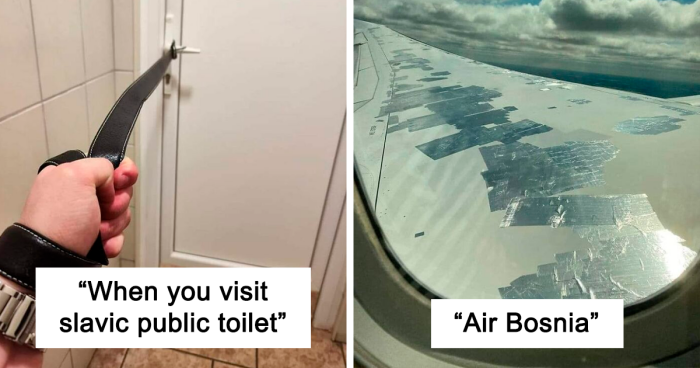
Eastern European Duct-Tape Certification
If the repair looks dangerous but survives three winters, it is no longer temporary. It is proven technology.
-
The Village Internet Solution
A cable travels through a window, over a roof, around a chimney, and possibly across an international border. The connection remains faster than the expensive city package.
-
Homemade Alcohol Without Documentation
It comes in an old mineral-water bottle. The host calls it mild. One sip removes anxiety, weak opinions, and your ability to pronounce consonants.
-
The Pickle Jar as Universal Equipment
It begins as food packaging and is later promoted to drinking glass, storage container, measuring device, flower vase, coin bank, or scientific instrument.
-
Sunflower Seeds at an Industrial Scale
A peaceful conversation produces a mountain of shells large enough to appear on local maps. Nobody remembers opening the second bag.
-
The Outdoor Chess Council
Several older men gather around a board while offering tactical advice, political analysis, medical opinions, and criticism of every move made since 1963.
-
The Bench Intelligence Agency
Nothing enters or leaves the neighborhood without being observed by grandmothers seated near the building entrance. Their information network requires no electricity.
-
The Neighborhood Fashion Review
You can leave home quietly at dawn, but somebody behind a curtain will still notice your shoes and report them to your aunt before breakfast.
-
The Slipper Rule
Outdoor shoes stop at the door. Guests receive house slippers in mysterious sizes, including one pair that appears to have served the family since the Cold War.
-
The Decorative Room Nobody Uses
One room contains the finest furniture, spotless glassware, and a couch protected by fabric. Entering without a major holiday is treated as a security breach.
-
The Apartment Heating Paradox
Outside, snow attacks horizontally. Inside, the central heating is so powerful that everyone opens a window and walks around dressed for July.
-
The Winter Clothing Negotiation
A child says the coat is too warm. A parent responds by adding a sweater, scarf, hat, gloves, and a second layer of concern.
-
The Market Vendor Who Knows Quality
She can judge tomatoes, cheese, mushrooms, and your life choices with one glance. Bargaining is possible, but emotional survival is not guaranteed.
-
The Family Garden Economy
A small plot produces enough potatoes, cucumbers, peppers, fruit, and unsolicited zucchini to supply three households and influence diplomatic relations.
-
The Annual Preservation Marathon
Late summer becomes a factory shift involving jars, boiling water, vinegar, fruit, vegetables, and relatives working with the urgency of a space launch.
-
The Wedding Food Endurance Test
The table is already full when the host announces that the appetizers are nearly finished. Leaving before the fourth major meal may damage international relations.
-
The Toast That Becomes a Speech
A simple “cheers” develops into family history, philosophy, advice for the newly married couple, and a detailed memory involving military service and a missing goat.
-
The Border-Crossing Snack Arsenal
A six-hour trip requires sandwiches, boiled eggs, fruit, cookies, cutlets, mineral water, and enough backup food to survive an unexpected railway strike.
-
The Relative Returning From Abroad
They arrive with coffee, chocolate, perfume, electronics, and strong opinions about local salaries. By dessert, everyone is comparing prices in three currencies.
-
The “Normal Day in Eastern Europe” Finale
A horse waits beside a luxury car, someone transports furniture on public transit, and a man in sandals repairs a roof. Nobody looks surprised except the tourist.
Why These Memes Are Funny Without Being Entirely Fictional
The strongest regional memes use exaggeration rather than invention. A balcony really may function as a storage room. Families really do save containers because they remain useful. Grandparents really may treat feeding guests as a moral responsibility. Old apartment buildings, inherited furniture, market stalls, garden produce, and homemade repairs are recognizable parts of ordinary life for many people across the region.
Post-communist history also matters. Everyday objects often carried unusual value in economies where consumer goods could be limited, inconsistent, or difficult to replace. Saving bags, repairing appliances, preserving food, and reusing containers were not quirky lifestyle trends. They were practical habits, and those habits frequently survived because they still made economic sense.
Museums recreating communist-era homes in countries such as Bulgaria, Hungary, Romania, Croatia, and Poland demonstrate how much cultural memory can be stored in apparently ordinary objects: furniture, packaging, kitchen equipment, clothing, radios, toys, and household decorations. A meme about an old cabinet or unlabeled jar can therefore unlock an entire childhood in a fraction of a second.
y also reflects a style of humor shaped by resilience. When bureaucracy is confusing, infrastructure is unpredictable, and family expectations are intense, sarcasm becomes cheaper than therapy. A joke about an elevator, pothole, or improvised repair transforms frustration into a shared language.
When Cultural Humor Becomes a Lazy Stereotype
Not every meme lands well. Humor becomes shallow when it treats poverty, addiction, violence, or political repression as the natural personality of an entire region. It also fails when “Slavic” is used as a label for every country east of Germany. Romanians, Hungarians, Estonians, Latvians, Lithuanians, Albanians, and several other Eastern European peoples are not Slavic, even though their experiences may overlap with themes found in regional meme culture.
Context matters. A person joking about their own grandmother’s food, apartment block, or unreliable family car is usually sharing recognition. An outsider presenting millions of people as permanently drunk, criminal, backward, or interchangeable is doing something far less interesting.
Commentary about Slavic meme communities has noted this tension. Many followers see the jokes as affectionate self-parody or a way of expressing dissatisfaction with local life. Others worry that the same images can attract audiences who enjoy mocking poverty or attaching hostile political messages to cultural humor. The difference often lies in whether the subject is treated as a participant in the joke or merely as its target.
xperiences Behind the Memes: A 500-Word Cultural Snapshot
Imagine arriving at your grandparents’ apartment on a cold afternoon. Before you can remove your coat, you are accused of being too thin. This accusation may be made regardless of your age, size, or recent consumption of an entire lunch. Within minutes, the kitchen table disappears beneath soup, bread, potatoes, pickled vegetables, meat, cake, fruit, and a bowl of candy that has somehow survived since the previous government.
You explain that you ate before coming. This information is dismissed as either false or medically irrelevant. A plate is placed in front of you. Refusing it would cause more emotional damage than eating three dinners, so you begin.
After the meal, someone asks whether you can look at a computer problem. The “computer problem” turns out to involve a printer, a television remote, an internet router, and a password written on the back of an electricity bill. While you investigate, an older relative explains that technology was better when machines had fewer buttons and lasted thirty years.
Outside, several neighbors are standing near a parked car. Nobody is going anywhere. The open hood has transformed the vehicle into a community forum. One man believes the battery is responsible. Another blames imported fuel. A third does not own a car but speaks with the authority of a Formula One engineer. Eventually, somebody produces a tool from an unexpected pocket and the engine starts.
Back upstairs, the balcony door is difficult to open because a sack of potatoes has shifted against it. The balcony contains winter tires, empty jars, flowerpots, a folding table, old newspapers, and a chair awaiting repair. Every item has a future purpose, though that purpose may not be revealed during your lifetime.
Later, tea is served in glasses that previously held jam. A homemade drink appears in a reused bottle. The person who made it insists that it is weak and medicinal. Everyone else treats this claim with the caution normally reserved for unexploded devices.
Conversation moves from family news to food prices, road repairs, football, immigration, politics, weather, and the neighbor’s suspiciously expensive renovation. Opinions become louder, but plates keep circulating. Someone tells a story that everyone has heard many times. Everyone interrupts to correct the details, yet nobody asks for a different story.
When it is finally time to leave, you are given food for the journey, food for tomorrow, and a jar that must be returned. Your coat pockets acquire candy and folded cash despite your protests. At the door, you are reminded to dress warmly, call upon arrival, visit more often, and stop losing weight.
This is why the best Eastern European memes feel so personal. Beneath the tracksuits, concrete buildings, aging cars, and recycled containers is a recognizable system of care. Affection may arrive disguised as criticism. Hospitality may resemble forced feeding. Practicality may look like clutter. Family debates may sound like international summits. The details are exaggerated for comedy, but the emotional center is real: people make do, keep everything, fix what breaks, feed whoever visits, and laugh at the chaos together.
Conclusion: The Meme Is Bigger Than the Squat
“Squatting Slavs in Tracksuits” began with a memorable visual formula, but its staying power comes from everything surrounding the pose. The squat is only the doorway. Behind it are grandmothers guarding kitchens, apartment blocks full of stories, indestructible cars, mysterious jars, garden harvests, informal repair experts, and families who communicate love through food, worry, teasing, and instructions to wear another layer.
The funniest Eastern European memes do not claim that everyone in the region lives the same life. Instead, they find small points of recognition across borders and generations. They turn practical habits into punchlines and difficult history into shared cultural shorthand. Most importantly, they prove that a tracksuit does not need to visit a gym to achieve greatness.
Note: This article discusses affectionate internet humor and cultural stereotypes. Eastern Europe is highly diverse, and no single meme, image, or regional label represents every country, community, or individual.












