
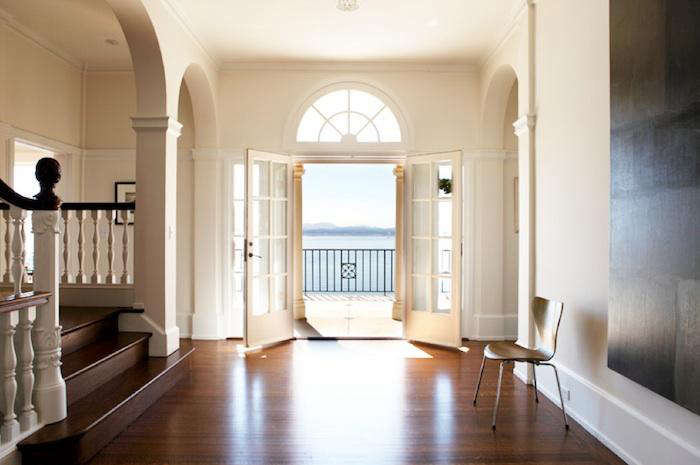
Some houses age gracefully. Others age like a movie star who has had one too many “refreshing updates” and now looks startled by its own light fixtures. A Julia Morgan house, however, deserves better than panic renovation and trendy demolition. It deserves patience, scholarship, restraint, and just enough courage to make the place livable without turning it into a museum where no one is allowed to sit down.
That is exactly what makes the Belvedere restoration behind Splendor by the Bay so compelling. The house at the center of the story was designed by Julia Morgan in 1913 for Gordon Blanding’s estate on Belvedere Island, with views stretching across the bay toward the Golden Gate Bridge and San Francisco. Over time, the architecture remained impressive, but the interiors had drifted into that familiar old-house predicament: lots of charm, uneven functionality, and the faint sense that several decades had happened to it all at once. The eventual renovation took a thoughtful route, preserving historic detail while adapting the house for modern family life.
And that, in a sentence, is why this restoration matters. It is not merely a beautiful Bay Area home with excellent light and enviable views, though it is certainly both of those things. It is a lesson in how to approach the work of restoring a Julia Morgan house: keep the soul, fix the problems, respect the site, and resist the urge to “improve” the building into blandness. In preservation terms, this kind of project often lands closer to rehabilitation than pure restoration, because the goal is not to freeze time but to let the architecture keep living.
Why Julia Morgan Still Matters
Julia Morgan remains one of the most significant architects in American history, and not simply because she smashed barriers on her way in. She was the first woman licensed as an architect in California, one of the first women admitted to the architecture program at the École des Beaux-Arts in Paris, and the designer of more than 700 buildings across California. That résumé alone would make her notable. What makes her unforgettable is the work itself.
Morgan combined formal training, engineering rigor, and a rare sensitivity to place. She could design at the grandest scale, as she did at Hearst Castle, while also creating intimate residential spaces that feel settled into their landscapes rather than imposed on them. Her buildings often carry the warmth of handcraft, the discipline of sound structure, and the practical intelligence of someone who understood that beauty and durability should not be strangers.
Her work at Asilomar is one of the clearest examples. There, Morgan designed a collection of buildings that seem to belong to the dunes, trees, and ocean light around them. At Mills College, her structures helped cement her reputation after surviving the 1906 earthquake. At Hearst Castle, her command of materials, ornament, engineering, and site planning became almost mythic. Across all of these projects, the common thread is not one style but one attitude: architecture should respond to climate, land, use, and human experience.
That is why restoring a Julia Morgan house is never just a matter of replacing finishes and picking paint. It means entering a design conversation that began more than a century ago. The question is not, “How can we make this old house act like a new one?” The better question is, “How can we solve modern needs without silencing the original intelligence of the building?”
The Belvedere House: A Real Restoration by the Bay
The house featured in Splendor by the Bay began as the Blanding Casino, built in 1913 as part of a larger Belvedere estate. It was designed by Julia Morgan as guest quarters, and it occupied a remarkable perch near the top of Belvedere Island. Even before you get to the architecture, the setting does a lot of heavy lifting: bay views, Angel Island, the Bay Bridge, the Golden Gate Bridge, and the kind of shimmering Northern California atmosphere that makes ordinary people briefly believe they should take up watercolor.
Architecturally, the house is notable for its Mediterranean and Italian Renaissance flavor, its loggia, arched openings, and its deliberate orientation toward the water. Morgan was too smart to waste a site like that. She positioned the home to capture the panorama, which is exactly the sort of move that separates thoughtful design from expensive square footage. The restoration respected that original logic.
According to the renovation profile, the owners undertook an 18-month transformation that preserved historic details while turning the house into a comfortable family home. This was not preservation by embalming. The kitchen was moved to the front of the house, narrow oak planks were chosen to match the original flooring, surviving original door knobs were reused where possible, and new hardware was selected to closely match what remained. In the primary bath, a tile pattern inspired by Hearst Castle nodded to another Morgan masterpiece without descending into theatrical imitation.
Just as important, the landscape was treated as part of the historic experience rather than leftover space around the building. An old magnolia tree was saved during construction, and that detail tells you almost everything about the project’s priorities. Good restoration does not only protect walls and windows. It protects relationships: house to garden, terrace to view, building to site, old material to new intervention.
What the Restoration Got Right
1. It preserved character-defining features instead of sanding the house into generic luxury
The smartest historic renovations know what not to destroy. That sounds obvious, yet it is where many projects go spectacularly wrong. Original hardware disappears. Floor plans are flattened into one giant “great room.” Windows are swapped out because someone declared them “inefficient” while standing next to a seventy-year-old thermostat and a badly insulated roof.
The Belvedere project avoided that trap. Matching the original flooring, retaining surviving knobs, and maintaining the house’s essential architectural personality align with the central principles of preservation practice: retain historic character, repair rather than replace when possible, and make changes that do not erase the features that define the building.
2. It adapted the house for real life
Here is where restoration gets interesting. Houses are not paintings. They are used, inhabited, argued in, cleaned badly after dinner parties, and occasionally asked to accommodate three children, a serious art collection, and an alarming number of charging cords. Historic preservation standards recognize this reality. Rehabilitation, in particular, allows alterations and upgrades for contemporary use as long as the building’s significant materials, spaces, and features are preserved.
That is why moving the kitchen or combining rooms can be defensible in the right context. A house that cannot function is a house at risk. Thoughtful adaptation keeps a building occupied, loved, and funded. Empty reverence is cheaper in the short term, but it rarely pays for roof repairs.
3. It honored Morgan’s relationship to landscape
One of Julia Morgan’s greatest strengths was her ability to make buildings feel natural within their surroundings. She did not treat the land as scenery pasted behind architecture. She used views, topography, materials, and planted environments as part of the design itself. That is visible at Asilomar, where her buildings feel inseparable from the coastal site, and it is visible in the Belvedere restoration’s respect for terraces, outlooks, and mature planting.
Preserving the magnolia was more than a sentimental choice. It was an architectural one. Mature trees, approach sequences, and outdoor rooms shape how a house is experienced. Remove them carelessly and the building may survive, but the composition weakens.
4. It used inspiration without sliding into imitation
Borrowing a bath tile pattern inspired by Hearst Castle is a clever move because it recognizes Morgan’s vocabulary without turning the home into a theme park. Good restoration is not cosplay. You do not need to make every room whisper, “Welcome to 1913.” You need the new work to feel compatible, respectful, and coherent.
The result, by all accounts, was a house where old and new coexist gracefully: heirlooms, modern furniture, contemporary art, restored architectural details, and family use all sharing the same envelope. That mix feels very right for Morgan, whose work was often highly refined but never emotionally chilly.
Why Restoring a Bayfront Historic House Is So Hard
Bay Area restorations come with their own special flavor of difficulty. Salt air, wind, shifting moisture, seismic demands, aging systems, and code requirements are not exactly passive observers. Add in custom windows, historic plaster, original millwork, and landscape protection, and suddenly every decision has three structural implications, two aesthetic consequences, and one contractor sighing into the middle distance.
That is one reason Julia Morgan’s engineering background matters so much. Her architecture was not decorative bravado sitting on wishful thinking. She understood structure, materials, and resilience. That legacy should shape any contemporary restoration. Seismic strengthening, mechanical upgrades, insulation strategies, and energy improvements all matter, but they must be handled in a way that preserves historic character rather than bulldozing it in the name of performance.
National Park Service guidance on rehabilitation makes this point clearly: historic buildings can be updated for modern use, but the work should protect significant materials, features, spaces, and landscape relationships. Even sustainability upgrades need careful placement and reversibility where possible. In other words, yes, the house can join the twenty-first century. No, it does not need to show up dressed as a speculative condo.
What This Restoration Teaches Homeowners, Designers, and Preservation Fans
First, historic houses are not problems to be solved; they are compositions to be understood. Before moving walls or replacing windows, figure out what gives the house its identity. In a Morgan building, that might mean proportions, views, built-ins, materials, circulation, or the subtle ways the house opens toward light and landscape.
Second, authenticity is not the same as rigidity. A successful restoration can include new kitchens, updated baths, safer systems, seismic work, and family-friendly layouts. The point is compatibility, not paralysis. If the new work supports the original architecture rather than shouting over it, the building can evolve without losing itself.
Third, restoration is often a long game. The best results do not usually come from speed. They come from archival digging, material matching, selective repair, and a willingness to choose restraint over spectacle. That may not make for the most dramatic television reveal, but it makes for a much better house.
Finally, a Julia Morgan restoration reminds us that preservation is not nostalgia. It is stewardship. These buildings matter not only because they are old or beautiful, but because they embody design intelligence that still feels fresh. Morgan’s work shows how architecture can be site-specific, durable, elegant, and humane all at once. In an age that often confuses bigger with better and shinier with smarter, that lesson is worth keeping.
Experience by the Bay: What a Julia Morgan Restoration Feels Like
To understand the appeal of a restoration like this, it helps to imagine not just the floor plan or the before-and-after photos, but the lived experience of the house. A Julia Morgan restoration by the bay is rarely about one dramatic “wow” moment. It is about a sequence of quieter pleasures that accumulate until you realize the building has been charming you for hours.
It starts with approach. Historic houses often know how to make an entrance without acting smug about it. The path slows you down. The garden frames the walls. The front door feels placed, not merely installed. Even before you step inside, there is a subtle sense that the house understands where it is. In a bayfront Morgan design, views are not treated like accidental bonuses. They are part of the choreography. A terrace, a stair, a loggia, or an upper hall may suddenly deliver a sheet of blue water, a bridge in the distance, or a flash of silver light bouncing across the bay.
Inside, the pleasures become tactile. Old woodwork has a depth that new millwork rarely achieves. Floors carry the small irregularities that remind you real boards were laid by real hands. Door hardware has weight. Windows frame the outdoors instead of flattening it. Even the rooms often feel slightly different from contemporary construction in ways that are hard to quantify but easy to notice. They tend to have proportion, enclosure, and transition. One room opens into the next with intention. You feel guided, not shoved.
In a successful restoration, modern comfort slips in without stealing the spotlight. The kitchen works. The plumbing behaves. The lighting is better. The structure is safer. But none of it barges into the room announcing, “Good news, everyone, I am new!” The upgrades serve the architecture rather than competing with it. That balance creates a peculiar luxury, and it is not the obvious kind. It is the luxury of ease inside character.
Then there is the emotional experience. Houses like this often carry a powerful sense of continuity. You are aware that the building has lived other lives before yours and may live many more after. That does not make the house feel precious. It makes it feel grounded. Breakfast in a restored bay-view kitchen, a foggy afternoon in a room full of soft light, children running past original details that somehow survived a century of weather and taste cycles, an evening on the terrace watching the skyline fadethese experiences are what preservation is really for.
There is also a useful humility in a Julia Morgan house. It gently reminds occupants that good design is not measured only by novelty. Sometimes the smartest room is the one whose window was placed exactly right in 1913. Sometimes the best renovation decision is the one that leaves the right thing alone. Sometimes the most luxurious feature in the entire house is not the bath tile or the art collection or the view, but the feeling that the building still knows what it is.
That is the real splendor by the bay. Not extravagance for its own sake. Not historical cosplay. Not sterile perfection. Splendor, in this case, means a house with memory, function, dignity, and delightone restored carefully enough that the architecture still speaks in Julia Morgan’s voice, even as a new family lives fully inside it.
Conclusion
Splendor by the Bay: A Julia Morgan Restoration succeeds as more than a design story because it captures the best possible outcome for a historic home: continuity without stagnation. The Belvedere project respected the original house, understood Morgan’s priorities, and made room for contemporary life without flattening the building’s identity. That balance is the gold standard for restoring important residential architecture.
Julia Morgan designed buildings that responded to their settings, valued craftsmanship, and made beauty feel livable. The Belvedere restoration proves those ideas still work. In fact, they may work better now than ever. When so much residential design feels disposable, a careful Morgan restoration offers something rarer: a home with history, intelligence, and a view worth earning.













