
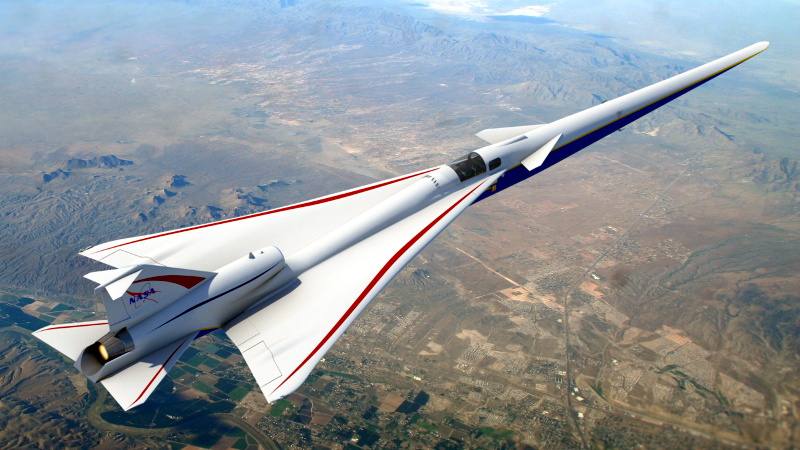
Editorial note: The X-59 was originally discussed in the early 2020s as a quiet supersonic aircraft moving toward flight testing, but its real timeline later shifted. NASA’s X-59 completed its first flight on October 28, 2025, and made its first supersonic flight in June 2026. This article keeps the historical headline while explaining the bigger story accurately.
For decades, the phrase “supersonic flight” has sounded glamorous, expensive, and slightly rude to anyone living underneath it. The dream is simple: fly faster than the speed of sound and cut long trips dramatically. The problem is also simple: sonic booms are not exactly neighborly. They can rattle windows, startle pets, annoy communities, and make regulators reach for the rulebook faster than a pilot can say “Mach 1.”
That is why NASA’s X-59 quiet supersonic aircraft became such a fascinating aviation project. The goal was not merely to build another fast jet. Humanity already knows how to go fast. The goal was to make supersonic flight socially acceptable over land by replacing the classic window-shaking boom with a softer “sonic thump.” In other words, NASA wanted to teach a thunderclap to use its indoor voice.
What Is NASA’s X-59?
The X-59 is a one-of-a-kind experimental aircraft developed for NASA’s Quesst mission, short for Quiet SuperSonic Technology. Built by Lockheed Martin’s Skunk Works in Palmdale, California, the X-59 was designed to demonstrate that an aircraft can fly faster than sound without producing the disruptive sonic boom that made earlier supersonic travel unpopular over land.
Unlike a commercial airliner, the X-59 is not meant to carry vacationers, business travelers, or someone trying to fit a giant roller bag into an overhead bin. It is a research aircraft. Its job is to gather data, prove technology, and help regulators decide whether future commercial supersonic aircraft could be allowed to fly over populated areas.
Why Sonic Booms Became Aviation’s Loudest Problem
A sonic boom happens when an aircraft flies faster than the speed of sound. As the aircraft pushes through the air, pressure waves pile up and form shock waves. When those shock waves reach the ground, people hear a sharp boom. It is not just one cute little pop, either. Depending on the aircraft, altitude, speed, and weather, it can sound like a distant explosion or a very dramatic sky-door being slammed.
The Concorde proved that supersonic passenger travel was possible, but it also showed why the business case was difficult. Because of noise concerns, supersonic civilian flights over U.S. land were heavily restricted. That meant Concorde mainly served ocean-crossing routes such as New York to London and Paris. Fast? Absolutely. Flexible? Not so much.
The X-59 attacks the problem at the source. Instead of accepting the boom as unavoidable, NASA and Lockheed Martin shaped the aircraft so its shock waves do not merge into one loud blast. The result is intended to be a quieter sound on the ground, often described as a thump rather than a boom.
How the X-59 “Shushes” the Boom
A Long, Needle-Like Nose
The first thing anyone notices about the X-59 is its long, slender nose. It looks like the aircraft is trying to point at the future and maybe poke it a little. This shape is not for decoration. The long nose helps spread shock waves along the aircraft instead of letting them combine into one powerful boom.
A Carefully Sculpted Body
The X-59’s fuselage, wings, tail, and engine placement are all part of the low-boom design. Every curve matters. At supersonic speeds, air does not politely flow around an aircraft the way it does at slower speeds. Shock waves form at different points, and the aircraft’s geometry determines how those waves interact. NASA’s engineers used advanced modeling, wind tunnel testing, and decades of supersonic research to shape the aircraft for a quieter acoustic signature.
No Traditional Forward Window
One of the X-59’s strangest features is that the pilot does not have a normal forward-facing cockpit window. The nose is too long and too sharp for that. Instead, the aircraft uses an eXternal Vision System, or XVS, which gives the pilot a forward view through cameras and high-resolution displays. It sounds futuristic because it is. It also sounds slightly terrifying until you remember that modern pilots already rely heavily on instruments, sensors, and displays.
The 2021 Flight Timeline: What Happened?
Early in the program, the X-59 was associated with a first-flight target around the 2021 to 2022 period. That made sense at the time. Major assembly was progressing, hardware was coming together, and NASA was preparing for ground tests, system integration, and flight readiness work. However, experimental aircraft do not follow calendar invitations with perfect manners.
Complex engineering programs often face delays, especially when they involve a new airframe, a unique cockpit visibility system, supersonic aerodynamics, advanced noise goals, safety reviews, and extensive ground testing. The X-59 eventually made its first flight on October 28, 2025, at subsonic speed. That first flight was a cautious and important milestone, focused on verifying aircraft systems, handling, and safety.
In June 2026, the aircraft achieved its first supersonic flight, marking a major step toward the mission’s central goal. The important lesson is not that the early schedule moved. The important lesson is that the mission kept moving. In aerospace, “late but safe” beats “on time and questionable” every single time.
Why NASA Is Doing This Instead of an Airline
NASA is not trying to launch a luxury airline for people who think first class is too slow. Its mission is research. The agency wants to collect the kind of neutral, public data that regulators need before changing rules around supersonic flight over land.
That matters because the future of supersonic travel is not only about engines, wings, and speed. It is also about public acceptance. If a future aircraft can cross the country faster but annoys everyone below it, the technology will remain trapped in a regulatory hangar. If it can fly quietly enough that communities tolerate it, the door opens to a new category of high-speed air travel.
Community Testing: The Public Gets a Vote
One of the most important parts of NASA’s Quesst mission is community response testing. After the X-59 proves its safety and performance, NASA plans to fly it over selected U.S. communities and ask residents what they hear and how they feel about it.
This is where the mission becomes refreshingly practical. Engineers can measure sound levels with microphones, but people do not experience aircraft noise as numbers on a chart. They experience it while drinking coffee, walking the dog, working from home, trying to nap, or explaining to a toddler that the sky is not falling. Community surveys help turn acoustic data into human data.
That information may eventually be shared with U.S. and international regulators. If the data shows that low-boom aircraft are acceptable to the public, future standards could focus less on speed itself and more on the actual noise that reaches the ground.
Why Supersonic Flight Over Land Matters
Supersonic passenger aircraft have always made the most sense over long distances. Over oceans, there are fewer people to disturb. Over land, the rules have been far stricter. This is why the X-59 matters so much. It is not just about making New York to London fast; it is about the possibility of faster routes across continents.
Imagine cutting hours from coast-to-coast trips in the United States. Imagine flying from Los Angeles to New York in a time window that feels closer to a long movie than a full workday. The X-59 will not be the aircraft doing that with passengers, but it could help create the rulebook that allows future commercial designs to try.
What Makes the X-59 Different From Concorde?
Concorde was elegant, fast, and iconic, but it was not designed around low-boom overland operations. Its sonic boom was a major limitation. The X-59, by contrast, is designed almost entirely around reducing that acoustic problem. It is slower than Concorde’s top speed and carries only one pilot, but comparison misses the point. Concorde was a commercial aircraft. X-59 is a scientific instrument with wings.
The X-59’s success will not be measured by ticket sales, passenger comfort, or whether the food service includes tiny warm towels. It will be measured by flight data, acoustic signatures, public response, and regulatory usefulness. That makes it less glamorous than Concorde in one sense, but potentially more important for the next generation of aviation.
Challenges Still Ahead
The path from experimental X-plane to everyday supersonic travel is long. First, the X-59 must complete flight testing and validate its performance. Then NASA must gather community response data. Regulators must review the evidence. Aircraft manufacturers must design commercial jets that can meet future noise, fuel efficiency, emissions, safety, and economic requirements.
That is a lot of homework. Supersonic travel also faces environmental questions, especially around fuel burn and emissions at high altitude. Speed is exciting, but airlines operate on economics, regulations, and public pressure. A future supersonic aircraft must be fast, quiet, efficient, safe, and financially realistic. Aviation does not hand out trophies for “cool shape” alone.
The Bigger Meaning of the X-59
The X-59 represents a classic NASA idea: solve a problem that blocks an entire industry from moving forward. The problem is not whether humans can fly faster than sound. We solved that long ago. The problem is whether we can do it in a way that fits into modern life, modern communities, and modern environmental expectations.
If NASA’s data helps create a new noise-based standard for supersonic flight, the X-59 may become one of the most influential aircraft of the century without ever selling a single ticket. It may be remembered not as the airplane that carried people faster, but as the airplane that made faster flight politically and socially possible.
Experience Section: What the X-59 Teaches Us About Technology, Patience, and the Future of Flight
The story of the X-59 feels especially relatable because it shows how innovation really works. In public, technology often looks like magic. A company or agency announces a bold project, a sleek rendering appears online, and everyone imagines the future arriving next Tuesday. In reality, breakthrough engineering is more like assembling furniture with 40,000 pieces, no missing bolts allowed, and the added pressure that your furniture must fly safely at supersonic speed.
One experience many people can connect with is the frustration of waiting for promised technology. The X-59 was widely discussed as a project nearing flight in the early 2020s, but the aircraft did not make its first flight until 2025. That delay might sound disappointing to casual readers, but in aerospace it is also a sign of seriousness. Experimental aircraft are not smartphone apps. You cannot release a buggy version and patch the wings later. Every system has to be checked, tested, reviewed, and tested again.
There is also a useful lesson in how the X-59 approaches an old problem. The sonic boom issue was not solved by telling people to stop complaining. NASA did not say, “Please enjoy this thunderous blast; it is the sound of progress.” Instead, engineers redesigned the aircraft around the human experience on the ground. That is a powerful model for innovation. The best technologies do not simply ask what is possible. They ask what people will actually accept.
Anyone who has lived near an airport understands that aviation is not abstract. Aircraft noise affects daily life. It can interrupt sleep, conversations, schoolrooms, meetings, and quiet neighborhoods. That is why the X-59’s community testing phase is so important. It treats residents not as obstacles but as part of the research. Their reactions matter because future regulations must work in the real world, not just inside simulation software.
The X-59 also reminds us that the future often arrives in stages. First comes the idea. Then come the computer models. Then wind tunnel tests. Then hardware. Then ground runs. Then taxi tests. Then a cautious first flight with the landing gear down. Then faster flights. Then supersonic flights. Then community studies. The public usually notices only the dramatic milestone, but the quiet progress between milestones is where the real work happens.
For readers interested in aviation, the X-59 is exciting because it connects history with possibility. It echoes the bold X-plane tradition that gave aviation the X-1, X-15, and other experimental legends. But it is not chasing records just for bragging rights. It is trying to make speed usable again. That shift matters. The future of flight may not belong to the loudest machine or the fastest machine, but to the one that balances performance with public comfort.
In a funny way, the X-59 is less like a roaring jet and more like a polite guest. It wants permission to cross the sky quickly without shaking the neighborhood. If it succeeds, future travelers may one day fly across continents at supersonic speeds while people on the ground hear little more than a soft thump, if they hear anything at all. That would be a remarkable achievement: not just breaking the sound barrier, but finally learning how to break it quietly.
Conclusion
NASA’s X-59 is one of the most important experimental aircraft of the modern era because it tackles the biggest barrier to supersonic flight over land: noise. While early expectations placed the aircraft’s first flight around the 2021 period, the real development path took longer, with the first flight arriving in 2025 and supersonic testing following in 2026. That timeline does not weaken the story. It makes the achievement more meaningful.
The X-59 is not a passenger jet, but it may help shape the passenger jets of the future. By proving that sonic booms can be softened into quieter thumps and by collecting community response data, NASA’s Quesst mission could help regulators rethink how supersonic aircraft are judged. Instead of banning speed outright, future rules may focus on what truly matters to people on the ground: how much noise they actually hear.
If the X-59 succeeds, tomorrow’s travelers may enjoy faster flights across land without turning neighborhoods into unwilling drum kits. That is the promise of quiet supersonic technology: not just speed, but speed with manners.











