
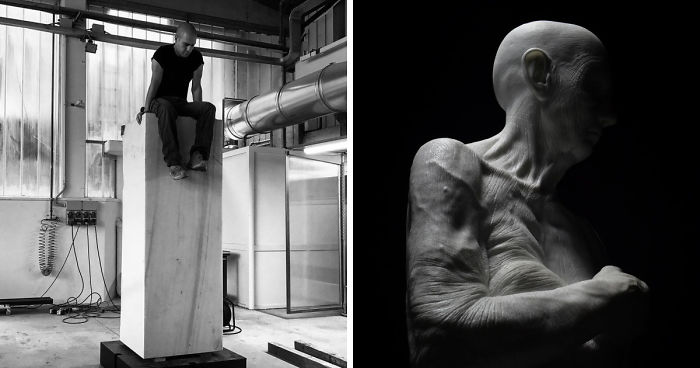
If marble could talk, it would probably ask for a nap after meeting Jago. The Italian sculptor has built a reputation for turning hard stone into skin, sorrow, tension, and silence so convincing that viewers often do a double take. Is that fabric? Is that flesh? Is that a newborn curled in marble? Yes, yes, and somehow yes again.
The headline that made the rounds online calls him a self-taught sculptor who dreams of becoming the modern Michelangelo. That phrasing is catchy, dramatic, and built for clicks. But the deeper story is more interesting than the headline itself. Jago, born Jacopo Cardillo, did study art formally before leaving the academic route behind and building a career on discipline, obsession, public experimentation, and a remarkably direct relationship with viewers. In other words, this is not a fairy tale about a random guy picking up a chisel one Tuesday and accidentally becoming a genius by Friday. It is a story about ambition, craft, reinvention, and the kind of marble confidence that makes most people nervous just looking at it.
What makes Jago’s realistic sculptures so compelling is not only their technical precision. It is the way they bring classical sculpture into a modern emotional world. He works with traditions that go back to the Renaissance, but his subjects often feel startlingly current: vulnerability, grief, identity, public image, human fragility, and the strange tension between beauty and discomfort. That combination is exactly why people keep tossing around the phrase “modern Michelangelo.” It is a big label, of course. In Italy, that kind of comparison is practically the artistic version of being told to casually replace a national monument. Still, the comparison reveals something real: people see in Jago an artist who treats marble not as a museum relic, but as a living language.
Who Is Jago, Really?
Jago was born in Frosinone, Italy, in 1987, and his official biography makes clear that he attended art high school and then the Academy of Fine Arts before leaving in 2010. That detail matters, because it shows that his path was not anti-learning. It was anti-being boxed in. He stepped away from a traditional academic track and developed a practice rooted in old-school carving techniques, relentless self-direction, and a modern instinct for communication. That is one reason some coverage describes him as self-taught: not because he sprang from nowhere, but because much of his artistic identity was forged outside institutional comfort.
He broke through early. While still very young, he was selected for the Venice Biennale, where his marble bust of Pope Benedict XVI helped bring him wider attention. Later, he reworked that same sculpture into Habemus Hominem, a more vulnerable and stripped-down interpretation that shifted the image from papal symbolism to human mortality. That move tells you almost everything about Jago’s artistic personality. He is not satisfied with polish alone. He wants meaning, friction, and a little intellectual trouble.
Over time, his career expanded beyond Italy. He was connected with New York through lectures and exhibitions, created work with American marble, and developed an international audience that follows both the finished sculpture and the making process. That last part is crucial. Jago does not hide the workshop behind a velvet rope. He often shares process, labor, tools, and transformation. In a contemporary art world where some artists present the final object like a magician refusing to reveal the trick, Jago often lets viewers see the sweat behind the miracle.
Why People Call Him the “Modern Michelangelo”
He Uses Marble Like It Is Still the Ultimate Test
Michelangelo remains the standard because marble remains unforgiving. One wrong strike and the whole dream gets very expensive, very fast. Michelangelo built his reputation in part through a lifelong devotion to marble sculpture, working with stone from Carrara and approaching sculpture as a primary artistic identity rather than a side hobby squeezed between painting commissions. His David and Pietà are still benchmarks for the impossible-seeming trick of making stone feel alive.
Jago works knowingly within that tradition. He has described a process that begins with drawing, moves to clay, expands into larger modeling, then progresses through plaster before reaching marble. That workflow is deeply rooted in sculptural tradition. In other words, he is not simply making realistic sculptures; he is participating in a historical conversation about how sculptors translate the body into mass, line, proportion, and surface. He is not trying to bully marble into submission. He is negotiating with it, which may be the most Renaissance thing about him.
He Makes Stone Feel Soft, Which Is Basically Sculpture Sorcery
Part of Michelangelo’s lasting mystique comes from his ability to make marble resemble flesh, motion, and emotion. Jago taps into that same wow-factor. His surfaces can read as skin stretched over bone, fabric draped over a body, or muscle tensed under invisible pressure. When people compare him to Michelangelo, they are usually responding first to this physical illusion. They are seeing stone do something their brains insist stone should not be allowed to do.
But the comparison goes beyond technique. Michelangelo’s greatest sculptures are not admired only because they are anatomically impressive. They work because they carry inner life. Jago’s best realistic sculptures do something similar. He is not interested in making a pretty statue that just stands there looking historically expensive. He aims for psychological intensity. His figures seem to think, suffer, endure, or reveal. That emotional charge is what elevates realism from skill to art.
The Sculptures That Made Viewers Pay Attention
Habemus Hominem: Power, Age, and Humanity
This work began as a bust of Pope Benedict XVI and later evolved into a stripped version that emphasized the man rather than the office. It was a bold move, because the transformation changed the sculpture from ceremonial portraiture into something more intimate and unsettling. The wrinkles, the bare chest, the sense of vulnerability, and the removal of ecclesiastical grandeur all make the piece feel less like institutional image-making and more like a meditation on mortality. It is marble with the suit jacket removed.
That willingness to revisit and transform an already successful sculpture says a lot about Jago. Many artists would frame the medal, smile politely, and leave the work alone. Jago went back in and altered the meaning. That takes nerve, and probably a personality type that does not enjoy being told “good enough.”
Veiled Son: The Flex Heard Round the Art World
If you want to understand why viewers lose their minds over realistic sculpture, start with Veiled Son. The work clearly enters into dialogue with the long tradition of veiled sculpture in Italian art, especially the famous Veiled Christ. Jago’s version uses that visual language in a contemporary way, creating an image that feels both reverent and freshly unsettling. The veil is the whole show and also not the show at all. You notice the translucent illusion first, then realize the deeper effect comes from the body beneath it.
It also reveals something smart about Jago’s career. He knows art history, but he does not treat it like a dusty shelf of sacred references. He uses it. He responds to it. He argues with it. He borrows the emotional electricity of the past and plugs it into the present.
The First Baby and Look Down: Classical Material, Contemporary Nerves
Jago’s modern edge becomes even clearer in works like The First Baby and Look Down. The First Baby, a tiny marble sculpture of a fetus-like newborn form, became notable for being sent to the International Space Station. That alone sounds like a sentence invented by a screenwriter who got too excited, but it is real, and it fits Jago’s blend of ancient material and contemporary ambition. Marble is one of the oldest sculptural languages in Western art, yet here it was traveling into space. That is either brilliant symbolism or the fanciest baby shower gift in human history.
Look Down, meanwhile, pushes the emotional charge in another direction. The work depicts a newborn with a chain as an umbilical cord, creating a visual metaphor that is impossible to ignore. It is tender, disturbing, beautiful, and confrontational all at once. This is exactly where Jago stops being merely a technically gifted sculptor and becomes a contemporary artist with something to say.
Pietas: Grief Reimagined for the Present
Jago’s Pietas is another important piece in the “modern Michelangelo” conversation, because it directly engages one of the most iconic sculptural subjects in Western art. Rather than reproducing old formulas, he reworks the emotional core of the theme. The result is not imitation. It is reinterpretation. You can feel the historical echo, but you can also feel the modern emotional weight: raw grief, bodily collapse, private suffering placed in public view.
This is where Jago’s art becomes most convincing. He understands that the point of referencing a masterpiece is not to cosplay the Renaissance. It is to ask whether those older visual languages can still carry the pain, beauty, and contradiction of contemporary life. His answer seems to be yes, provided the sculptor is brave enough to risk sentiment, seriousness, and scale.
Why Jago Feels Contemporary, Not Just Traditional
It would be easy to file Jago under “young Italian marble prodigy” and move on, but that would miss the more modern dimension of his appeal. He is deeply invested in the process of public engagement. He shares making, not just mastery. He treats social media not as a marketing afterthought but as part of the artwork’s life in the world. That openness has helped him build a following that includes people who may never have cared about marble sculpture until they saw a block of stone slowly turn into a body on their screens.
His museum presence also reflects this blend of old and new. The Jago Museum in Naples, housed in a restored church setting, connects sacred architecture, neighborhood history, and contemporary sculpture in one space. It is a fitting home for an artist whose work constantly moves between tradition and disruption. Add to that the documentary Jago: Into the White, which premiered at Tribeca in 2024, and you get a clearer picture of why he resonates now. He is not only carving figures. He is building a public narrative around what it means to make sculpture seriously in the 21st century.
Does He Actually Want to Be Michelangelo?
Here is the twist: the most interesting thing about Jago may be that he does not really need the comparison. Public fascination with “the new Michelangelo” is understandable because audiences love shortcuts, and history’s biggest names make convenient measuring sticks. But comparison can also shrink an artist. Jago himself has pushed back on the idea of a literal parallel, suggesting that the label is more an explanatory tool than a true equivalence. That is the mature answer, and frankly, the only survivable one.
No serious artist wins by becoming an impersonation of a dead genius. The better route is what Jago appears to be doing: absorb the lessons of Renaissance sculpture, respect the discipline of the medium, then build a voice that belongs unmistakably to your own century. Michelangelo did not become Michelangelo by trying to be someone else. The same rule applies here. The real success story is not that Jago might become the modern Michelangelo. It is that he is increasingly becoming unmistakably Jago.
Experiences That Make This Story Hit Harder
There is a specific kind of experience that comes with standing in front of a realistic marble sculpture, and it is very different from glancing at a photo online for three seconds before your brain wanders off to lunch. In person, the first shock is scale. A sculpture occupies your space. It shares your air. You walk around it, and it walks around your mind right back. What looked impressive on a screen suddenly becomes almost rude in person, like it has no business being that detailed, that quiet, or that alive.
That is part of why artists like Jago fascinate people. Realistic sculpture creates a weird emotional double exposure. Your rational brain knows you are looking at stone, but your body reacts as if presence is standing in front of you. You read weight, temperature, vulnerability, posture, tension, and skin. When a sculptor is good enough, your response becomes almost social. You do not merely observe the work. You encounter it.
The experience is even more powerful when the subject carries emotional tension. A veiled figure does not just showcase technical brilliance; it creates a feeling of distance and intimacy at the same time. A mourning figure does not simply represent grief; it makes grief occupy space. A newborn rendered in marble does not just show fragility; it traps fragility inside permanence. That contrast is the emotional engine of realistic sculpture. Hard material, soft meaning. Cold stone, warm human response. It is an old trick, but when it works, it still feels like witchcraft with a chisel.
There is also a very human experience behind the making of work like this. People love the myth of natural talent because it is tidy and cinematic. But sculpture, especially marble sculpture, is stubbornly physical. It involves repetition, correction, patience, dust, fatigue, and the willingness to spend unreasonable amounts of time refining something most people would have already declared finished. The romantic image of the lone genius survives because it sounds good. The actual experience is closer to a long argument between vision and resistance. The artist says, “I see the form.” The stone says, “Prove it.”
That is why Jago’s journey resonates with so many aspiring artists, especially those building careers outside perfect systems. His story suggests that formal training can matter, but so can refusing to let institutions define the ceiling of your ambition. The relevant experience here is not just sculpting. It is self-direction. It is the experience of leaving a prescribed path, trusting your own standard, and then working hard enough to make that decision look wise in hindsight.
For viewers, the experience can be oddly personal too. Realistic sculpture slows you down. It asks you to stay longer than you planned. It makes you notice contour, pressure, stillness, sorrow, tenderness, and the labor hidden in finish. In a culture built on speed, that feels almost rebellious. A marble sculpture does not care about your scrolling habits. It does not blink for attention. It just stands there, impossibly patient, waiting for you to become the slower and more serious version of yourself.
And maybe that is the deepest reason a headline like this works. People do not only want to admire skill. They want to believe that mastery is still possible. They want to see that in an age of shortcuts, someone is still willing to pursue difficulty on purpose. They want proof that old materials can still say new things. They want to stand before stone and feel, however briefly, that human effort can still produce awe. Jago’s realistic sculptures tap into exactly that hunger. Not because they imitate the past, but because they remind us that excellence never really goes out of style.
Conclusion
So, does Jago deserve the “modern Michelangelo” label? As a headline, sure, it works. As a final artistic verdict, it is too small and too simple. What makes his work worth watching is not that it revives a Renaissance fantasy. It is that it proves marble sculpture can still feel urgent, emotional, and vividly modern. Jago’s realistic sculptures connect old mastery with present-day tension, turning stone into something that feels startlingly human.
That is the real achievement. He is not merely chasing Michelangelo’s shadow. He is carving his way out of it. And when an artist can make marble feel like breath, grief, skin, and memory, the smart response is not to argue about the nickname for too long. The smart response is to look closer.












