
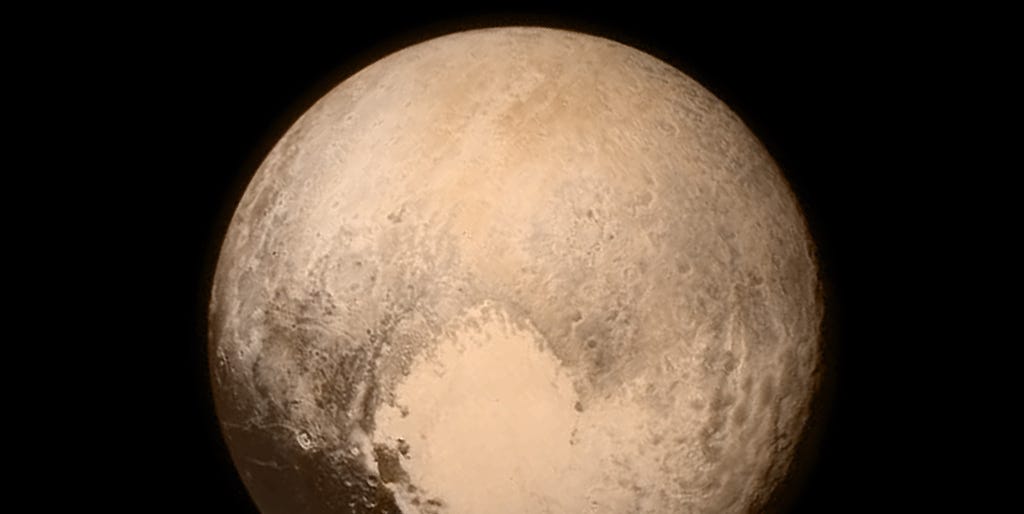
Pluto’s most famous feature looks romantic from a distance, but its origin story may be less “cosmic valentine” and more “ancient collision with terrible insurance coverage.” A detailed impact study suggests that the bright western half of Pluto’s heart formed when a large ice-and-rock body struck the dwarf planet at a slow speed and shallow angle billions of years ago.
Three-dimensional simulations suggest that part of the impactor may still be buried inside Pluto. That dense remnant could explain the basin’s equatorial location and reduce the need for a global subsurface ocean.
Pluto’s Heart Was the Surprise Nobody Expected
Before NASA’s New Horizons spacecraft flew past Pluto on July 14, 2015, the distant world was little more than a blurry disk. The encounter revealed mountains, glaciers, fractures, dark plains, bright ice and unexpectedly young terrain.
The celebrity feature was a vast, pale region shaped like a heart. Scientists named it Tombaugh Regio in honor of Clyde Tombaugh, who discovered Pluto in 1930. It quickly became Pluto’s visual signaturethe planetary-science equivalent of showing up to every photograph wearing the same unforgettable hat.
Tombaugh Regio and Sputnik Planitia Are Not the Same Thing
The entire heart is Tombaugh Regio, but its two lobes have different properties. The western lobe is Sputnik Planitia, an enormous pear-shaped basin filled mainly with bright nitrogen ice. It stretches roughly 1,200 by 2,000 kilometers and sits about 3 to 4 kilometers below much of the surrounding terrain.
The eastern lobe is higher and carries a thinner coating of volatile ice. Its origin remains less certain. That distinction matters because the new collision model primarily explains Sputnik Planitiathe deep, brilliant “left ventricle” of Pluto’s heartrather than every bright patch in Tombaugh Regio.
The Leading Idea: A Giant, Slow, Sideways Impact
Planetary scientists have long suspected that Sputnik Planitia began as an impact basin. The difficulty was reproducing its unusual elongated shape, its great depth and its location near Pluto’s equator. A simple head-on collision tends to create something more circular. Sputnik Planitia looks as though the universe pressed a pear-shaped thumb into Pluto.
Researchers led by Harry Ballantyne of the University of Bern, with collaborators at the University of Arizona, tested many scenarios using smoothed-particle hydrodynamics. The method models how ice and rock deform, heat and move during a collision.
An Impactor About 700 Kilometers Wide
The best-matching simulations involved a differentiated body roughly 700 to 730 kilometers wide, with a rocky core wrapped in an icy mantle. Its mass may have been comparable to Vesta, one of the asteroid belt’s largest objects.
The preferred models used a low relative velocity and an impact angle of about 15 to 30 degrees. Instead of drilling straight down and making a round crater, the body swept across Pluto and excavated an elongated cavity.
Pluto May Still Contain the Other World’s Core
The impactor’s icy exterior struck first and shielded much of its rocky center. The core penetrated Pluto’s mantle but did not fully mix into Pluto’s own core.
Instead, the model suggests that the rocky material flattened and settled near the boundary between Pluto’s mantle and core. Researchers have described it as a buried “splat”not the most dignified technical image, perhaps, but an effective one. Somewhere beneath Sputnik Planitia may lie the remains of another ancient world that Pluto never fully digested.
Why the Shape of Sputnik Planitia Matters
A credible theory must reproduce the basin’s geometry. Head-on impacts were too symmetrical, while faster collisions were too destructive. Slow oblique impacts created an elliptical basin and left foreign material both in the cavity and at depth.
The preferred model also placed the densest rocky remnant beneath the narrower southern portion of Sputnik Planitia. That detail is important because the hidden mass could influence how Pluto reoriented after the collision. In other words, the impact model connects the heart’s shape, depth and present-day position through one physical event rather than treating them as three unrelated mysteries.
How a Violent Scar Became a Brilliant White Heart
The impact itself did not necessarily paint a white heart onto Pluto. It created a low basin, and Pluto’s climate did the decorating.
Nitrogen is a gas on Earth, but near Pluto’s minus-390-degree-Fahrenheit surface it freezes. Carbon monoxide and methane also form ices. Sputnik Planitia’s low elevation makes it a cold trap where these volatile materials accumulate.
Bright nitrogen ice gradually filled the basin. Its low elevation and reflective surface favored continued deposition, turning an impact scar into the smooth, high-albedo region seen by New Horizons.
A Glacier That Behaves Like a Cosmic Lava Lamp
Sputnik Planitia is not static. New Horizons revealed polygonal cells, flowing ice, glacier-like channels and few obvious craters, signs that the surface has been renewed recently in geological terms.
Pluto’s internal heat warms nitrogen ice at depth. Warmer ice rises while cooler ice sinks, producing cells tens of kilometers wide and refreshing the surface. It is a lava lamp operating at glacial speed nearly 40 times farther from the Sun than Earth.
Water ice, which is extremely rigid at Pluto’s temperatures, can form mountains and floating blocks along the margins. Nitrogen ice is softer and can creep around those obstacles. The result is a landscape that combines the behavior of bedrock, glaciers and frozen atmosphere.
Why Is Pluto’s Heart Near the Equator?
Sputnik Planitia lies close to the axis connecting Pluto and its largest moon, Charon. Scientists do not think that alignment is random. A large concentration of mass can cause a rotating world to shift its outer shell relative to its spin axis, a process called true polar wander.
Pluto did not flip like a pancake. It gradually reoriented so that a heavy region moved toward a dynamically stable position. Nitrogen ice contributes mass, but scientists have debated whether it is sufficient.
The Buried Rocky “Mascon” Could Supply the Missing Weight
A deep basin would normally represent missing mass and tend to migrate toward a pole. Yet Sputnik Planitia remained near the equator. Earlier models solved this puzzle by proposing that the impact thinned Pluto’s ice shell, allowing denser liquid water from a subsurface ocean to bulge upward beneath the basin. That uplift would create a positive gravity anomaly.
The newer impact model offers another possibility. The impactor’s rocky core may have formed a mass concentration, or mascon, beneath Sputnik Planitia. Combined with nitrogen ice in the basin, that hidden rocky deposit could have made the region heavy enough to drive reorientation without requiring a thick global ocean.
Does the New Theory Mean Pluto Has No Ocean?
Not necessarily. Evidence for an internal ocean also comes from Pluto’s tectonic fractures and thermal evolution. The new model mainly challenges the gravity argument by offering another source of hidden mass.
A cold, solid Pluto could preserve the basin and buried remnant, making an oceanless Plutoor one with only a thin oceanplausible. Yet Pluto’s interior temperature is not directly known, and radioactive heat plus an insulating ice shell could still maintain liquid water.
So the responsible conclusion is not “Pluto definitely has no ocean.” It is “Sputnik Planitia may no longer be proof that Pluto has one.” Planetary science often advances by replacing a necessary explanation with several testable alternatives. Mystery reduced; suspense retained.
What the Simulations Canand CannotProve
Scientists cannot stage dwarf-planet collisions in a laboratorythe neighbors would object. Simulations let them vary speed, angle, size, composition and internal temperature, then compare the results with New Horizons observations.
The successful models reproduce several important features at once: Sputnik Planitia’s elongated shape, its excavated mantle, the presence of impactor material and a dense remnant at depth. That makes the hypothesis compelling.
Still, a simulation is not a time machine. Pluto’s ancient internal structure, ice thickness and the impactor’s composition remain uncertain, and later geological changes may blur the original result.
Testing the theory would benefit from detailed gravity measurements, global high-resolution imaging, radar sounding and topographic data from a future Pluto orbiter. New Horizons transformed Pluto from a dot into a world, but it performed a fast flyby and could not map every hemisphere or measure the interior in the detail an orbiter could.
Experiencing Pluto’s Mysterious Heart From Earth
No human has stood beside Sputnik Planitia, and no spacecraft has landed there. Still, the New Horizons archive offers an unusually vivid way to experience the discovery. Begin with the global portrait of Pluto and resist zooming in immediately. The bright heart dominates the disk so completely that it is easy to understand why the public adopted it as an emblem. Then remember that the image is not a neatly designed icon. It is a continent-scale arrangement of basins, mountains and mobile ice.
Next, move to the close views of Sputnik Planitia. The smooth-looking white lobe breaks into polygonal convection cells. Their boundaries curve, merge and sometimes form Y- or X-shaped junctions. At first glance they can resemble dried mud, except this “mud” is solid nitrogen at temperatures cold enough to turn familiar atmospheric gases into glaciers. The scale is disorienting: individual cells can span distances comparable to a metropolitan area.
A useful mental exercise is to trace the basin’s western edge, where rugged water-ice mountains border softer nitrogen ice. On Earth, rock walls confine glaciers. On Pluto, water ice effectively plays the role of rock, while nitrogen behaves as the flowing material. That reversal turns an ordinary landscape concept inside out and makes the dwarf planet feel less like a frozen copy of Earth than a world with its own geological vocabulary.
Then imagine the proposed impact without turning it into a Hollywood fireball. The collision may have been comparatively slow, oblique and mechanically messy. An icy body hundreds of kilometers wide approached at a shallow angle. Its mantle struck first, its rocky core stayed partly intact, and the target’s frozen layers deformed into an elongated basin. The event was catastrophic, yet its low speed may be exactly what preserved the impactor’s identity deep inside Pluto.
The most rewarding part of following this research is watching the meaning of the same image change. In 2015, the heart was an astonishing visual feature. Later it became a nitrogen glacier, a climate trap, a possible sign of an ocean and evidence that Pluto had reoriented. The newer model adds another interpretation: it may be a geological fossil containing the core of a lost Kuiper Belt body.
This sequence captures the real experience of planetary exploration. A spacecraft sends back a photograph; the photograph raises questions; competing models fight politely through equations; and a familiar landscape becomes strange again. There is no final dramatic reveal in which every scientist agrees and the credits roll. Instead, each answer sharpens the next question.
For students, astronomy clubs or curious readers, a rewarding hands-on activity is to compare the full-disk image, a topographic map and close-up convection-cell imagery side by side. Mark the western and eastern lobes, identify the basin rim and note where smooth plains meet rugged mountains. Then sketch how a head-on impact and an oblique impact might differ. The exercise makes the study’s logic tangible: the basin’s asymmetry is not decorative; it is evidence.
That is ultimately why Pluto’s heart remains so compelling. It connects a beautiful image with deep physical reasoning. The feature is easy to recognize, but difficult to explainand science is often at its best when the postcard turns into a crime scene.
Conclusion: Pluto’s Heart Is a Scar With a Memory
The strongest new explanation for Pluto’s mysterious heart begins with a low-speed, oblique collision early in the dwarf planet’s history. A roughly 700-kilometer ice-and-rock object carved Sputnik Planitia, left much of its material in the basin and may have deposited a dense rocky remnant near Pluto’s core-mantle boundary.
The depression then collected brilliant nitrogen ice, which continues to flow and convect, renewing the surface. The buried mass and the ice load may have helped reorient Pluto, placing Sputnik Planitia near its current equatorial position. This mechanism can explain the basin without demanding a deep global ocean, although it does not eliminate the possibility that some liquid water remains below.
Pluto did not get its heart through romance. It got it through impact physics, climate and billions of years of geological remodeling. Somehow, that story is even better.












