
Note: This article is for educational and editorial purposes only. It discusses biomedical research, organ transplantation, stem cells, and ethics in plain American English for a general audience.
It sounds like the opening scene of a science-fiction movie: scientists create human-pig chimera embryos in a laboratory. Cue the dramatic music, the flickering fluorescent lights, and someone whispering, “What have we done?” But the real story is far more careful, far less monster-movie, and much more medically important.
In a landmark experiment, researchers showed that human stem cells could survive inside early-stage pig embryos. These embryos were not allowed to grow into animals, and they were not “half-human, half-pig” creatures roaming a barn with philosophical opinions. They were early embryos containing mostly pig cells with a very small number of human-derived cells. Still, the achievement marked a major step in regenerative medicine because it suggested that one day scientists might be able to grow transplantable human organs inside animals.
That possibility matters because the United States continues to face a serious organ shortage. More than 100,000 people are waiting for lifesaving transplants, and kidneys make up the largest share of that need. Even with record transplant numbers in recent years, demand still outruns supply. Human-pig chimera research is one of several bold strategies scientists are exploring to close that gap.
What Is a Human-Pig Chimera Embryo?
A chimera is an organism or embryo made up of cells from more than one genetic source. The word comes from Greek mythology, where the Chimera was a fire-breathing creature made of several animals. Fortunately, modern biomedical researchers are not in the fire-breathing business. They are in the business of understanding how cells grow, specialize, and potentially form tissues or organs.
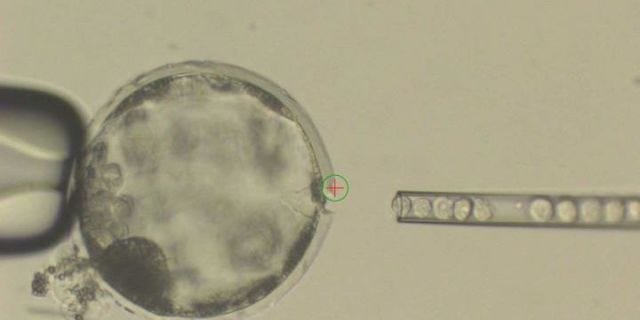
A human-pig chimera embryo is an early pig embryo into which scientists introduce human pluripotent stem cells. Pluripotent stem cells are special because they can develop into many different cell types, such as muscle, liver, heart, or kidney cells. In the Salk Institute-led study, researchers used human induced pluripotent stem cells, often called iPS cells. These are adult human cells that have been reprogrammed into a more flexible, embryonic-like state.
The goal was not to create a new animal species. The goal was to answer a basic but enormous question: can human cells survive, integrate, and begin developing inside a large animal embryo such as a pig? The answer was yes, but with a giant asterisk. The human-cell contribution was extremely low, and the technique remains inefficient.
How Scientists Created the Human-Pig Chimera Embryos
The process began with early-stage pig embryos. Researchers injected a small number of human pluripotent stem cells into those embryos, then transferred the embryos into surrogate sows. The embryos were allowed to develop for only three to four weeks, roughly the first trimester of pig pregnancy, before the experiment was stopped and the embryos were analyzed.
That limited development window was important. It gave researchers enough time to study whether human and pig cells could coexist during early development, but it avoided the ethical concerns that would come with allowing mature chimeric animals to be born. In other words, the scientists were not trying to raise a barnyard philosopher named Hamlet. They were testing early cell behavior under strict experimental limits.
The results were scientifically exciting but technically humbling. Some embryos did contain human-derived cells, and those cells began moving toward tissue-forming pathways. However, the contribution was tiny: roughly one human cell among many thousands of pig cells in later-stage embryos. Researchers also reported that the human cells did not appear to become precursors of brain cells in the central nervous system, a key ethical concern in chimera research.
Why Pigs?
Pigs are not chosen for this research because they are cute, intelligent, or suspiciously good at finding truffles. They are chosen because their organs are relatively similar to human organs in size and function. A pig heart, kidney, liver, or pancreas is much closer to human scale than a mouse organ. That makes pigs attractive candidates for research into organ growth and xenotransplantation.
Scientists have long studied pigs as potential sources of transplantable organs. In modern xenotransplantation research, pig organs are genetically edited to reduce immune rejection and improve compatibility with human bodies. Human-pig chimera research is different but related: instead of transplanting a modified pig organ, the dream is to grow an organ made largely from a patient’s own cells inside a pig host.
The Big Medical Dream: Growing Human Organs
The ultimate vision is easy to understand. Imagine a patient with kidney failure. Doctors could take cells from that patient, reprogram them into induced pluripotent stem cells, and guide them toward forming a kidney inside a pig embryo engineered not to grow its own kidney. In theory, the human cells would fill the developmental gap and produce a human kidney genetically matched to the patient.
If that sounds like science fiction, that is because it still sits closer to the “ambitious future” shelf than the “available at your local hospital” shelf. But the concept is powerful. A patient-specific organ could reduce the need for lifelong immunosuppressive drugs, lower rejection risk, and shorten transplant wait times. For people spending years on dialysis or waiting for a liver, heart, lung, or pancreas, that is not an abstract dream. It is survival with a calendar attached.
The 2017 human-pig chimera embryo study was not a finished solution. It was a proof of concept. It showed that human cells can enter the developmental environment of a pig embryo and survive for a limited period. That is like proving a seed can sprout in unfamiliar soil. The next challenge is growing the right plant, in the right place, without weeds, storms, or scientific chaos taking over.
Why the Breakthrough Was So Difficult
Human and pig cells do not naturally operate on the same biological schedule. Embryonic development is a highly choreographed dance, and each species hears the music at a different tempo. Human cells develop more slowly than pig cells, so placing them into a pig embryo is like asking one dancer to waltz while the rest of the room is doing salsa.
Researchers tested different types of human pluripotent stem cells to find which were most likely to survive in the pig embryo environment. Intermediate-state cells appeared to perform better than some other types, but even the best-performing cells contributed at low levels. This is one reason scientists caution against exaggerated headlines. The experiment was historic, but it did not produce transplant-ready organs.
Another challenge is controlling where the human cells go. For organ-growing purposes, scientists want human cells to develop mainly into a targeted organ, such as a pancreas or kidney. They do not want human cells spreading unpredictably into tissues such as the brain or reproductive system. Precision matters. A lot.
The Ethics: Promise Meets Goosebumps
Human-animal chimera research raises serious ethical questions, and those questions deserve more than nervous jokes and movie references. The main concerns include animal welfare, human-cell contribution to the brain, human cells entering the germline, and whether chimeric animals could develop traits that change their moral status.
One major worry is the possibility of human cells contributing significantly to an animal’s brain. If that happened at a high enough level, would the animal think or feel differently? Would it deserve different protections? Scientists do not have simple answers, which is why responsible chimera research includes oversight, limits, and careful monitoring.
Another concern is germline contribution. Researchers want to avoid creating animals whose sperm or eggs contain human cells. That is why guidelines often focus on preventing chimeric animals from breeding and ensuring human cells do not contribute to reproductive tissues in ethically troubling ways.
Animal welfare is also central. Pigs are intelligent animals, and biomedical research involving them must be justified, regulated, and designed to minimize suffering. The medical goal may be noble, but noble goals do not give science a free pass. Ethical research must ask not only “Can we do this?” but also “Should we, how, under what limits, and for whose benefit?”
What Oversight Looks Like
Chimera research does not happen in a lawless basement with beakers labeled “Do Not Touch.” It is subject to institutional review, stem cell research oversight, animal care rules, and evolving scientific guidelines. Organizations such as the International Society for Stem Cell Research have developed recommendations for handling human stem cells in animal embryos and animal hosts.
Guidelines generally distinguish between in vitro experiments, where embryos are cultured in a lab for limited periods, and experiments involving transfer into an animal uterus. The more development involved, the more oversight is needed. Research that introduces human pluripotent stem cells into nonhuman embryos and allows gestation raises higher ethical stakes than short-term lab culture.
Public transparency also matters. People are more likely to support controversial research when scientists clearly explain the purpose, limits, safeguards, and medical need. “Trust us, we have lab coats” is not enough. The public deserves plain-language explanations, especially when research touches deep questions about life, identity, and the boundaries between species.
Human-Pig Chimeras vs. Xenotransplantation
Human-pig chimera research is often confused with xenotransplantation, but they are not the same. Xenotransplantation means transplanting living cells, tissues, or organs from one species into another. For example, a genetically modified pig kidney transplanted into a human patient is xenotransplantation.
Human-pig chimera research aims for something different: using human stem cells inside an animal embryo to grow tissue or organs that are human-derived. In the ideal version, the organ would be made mostly from the recipient’s own cells. That could reduce rejection compared with a pig organ, even a genetically edited one.
Meanwhile, xenotransplantation is moving faster clinically. In 2025, the first U.S. human clinical trials of gene-edited pig kidney transplants began, testing whether modified pig kidneys can safely function in people with kidney failure. These studies are experimental, but they show how urgently researchers are searching for solutions to the organ shortage.
What This Breakthrough Does Not Mean
Let’s clear the fog. Scientists did not create a half-human pig. They did not grow a human brain in a pig. They did not produce a transplantable organ. They did not bring a human-pig creature to term. The embryos were mostly pig, contained only a tiny fraction of human cells, and were stopped early in development.
The breakthrough means something more precise: human cells can survive and begin integrating in early pig embryos under experimental conditions. That may sound less dramatic than a viral headline, but it is exactly the kind of incremental discovery that real medicine is built on. Penicillin, organ transplantation, IVF, and CRISPR all began as science that sounded strange before it became transformative.
Why the Public Reaction Is So Mixed
People react strongly to chimera research because it touches several emotional buttons at once: animals, embryos, human identity, organ failure, disability, death, and hope. That is a full buffet of moral complexity, and nobody should pretend it is simple.
For patients waiting for organs, the research may look like a lifeline. For ethicists, it may look like a field that needs bright lines before technology outruns reflection. For animal advocates, it raises concerns about using sentient animals as biological factories. For scientists, it is both a thrilling technical challenge and a reminder that biology does not hand out shortcuts like coupons.
A balanced view recognizes both sides. The medical promise is real. So are the ethical concerns. The best path forward is not panic or hype, but careful research, strong oversight, public dialogue, and a commitment to animal welfare.
The Future of Human-Pig Chimera Research
To move from early embryos to useful organs, scientists must solve several problems. First, they need to improve efficiency so human cells contribute far more to the target tissue. Second, they need to direct human cells toward one organ and away from sensitive tissues such as the brain and germline. Third, they need to ensure that any organ grown this way is structurally normal, functional, safe, and free of dangerous infections.
Researchers may use CRISPR and other gene-editing tools to create “developmental niches” in pig embryos. For example, if a pig embryo is edited so it cannot form its own pancreas, human stem cells might be more likely to fill that missing role. This approach has worked more convincingly in rodent experiments, such as growing rat organs in mice. Translating it to humans and pigs is far harder because of greater evolutionary distance and developmental timing differences.
Even if the science improves, society must decide what limits are acceptable. Should chimeric animals ever be born? Under what conditions? Should certain species be off-limits? How much human-cell contribution is too much in the brain? Who monitors the research? These are not side questions. They are part of the technology itself.
Experience Lens: What This Topic Feels Like in the Real World
For many readers, human-pig chimera embryos sound like something happening far away in a polished laboratory where everyone speaks in acronyms. But the emotional center of this topic is not the petri dish. It is the transplant waiting room.
Imagine being told your kidney function is failing and dialysis is now part of your weekly life. Suddenly, your calendar is not organized around vacations, birthdays, or dinner reservations. It is organized around treatments, lab results, fatigue, and the hope that a phone call might come. Every unknown number could be spam, or it could be the call that changes everything. That is the human experience behind organ shortage research.
Families living with transplant uncertainty often describe a strange emotional split. On one hand, they are grateful that transplantation exists at all. On the other, they know that receiving an organ usually means another family has experienced loss. That reality can be heavy. It makes scientific alternatives feel both hopeful and complicated. A lab-grown organ or a safely engineered animal organ could one day reduce that burden, but getting there requires patience and proof.
There is also the experience of ordinary people trying to understand the science without getting trapped by headlines. The phrase “human-pig chimera” practically begs the internet to overreact. It is easy to picture something bizarre because the language is vivid. But learning the details changes the reaction. These were not creatures with mixed identities. They were early embryos used to test whether human cells could survive in a pig developmental environment. The difference matters.
For scientists, the experience is often one of slow frustration mixed with flashes of wonder. Years of experiments may produce results that look tiny to outsiders: a few cells survived, a marker appeared, a pathway activated. But in developmental biology, tiny signs can matter. A single successful integration can reveal which door to knock on next. Research rarely moves like a superhero landing. It moves like someone trying 500 keys on a locked door and celebrating when key number 382 jiggles the handle.
For ethicists and oversight boards, the experience is different again. Their job is to slow the conversation down when excitement runs too hot. They ask uncomfortable questions: What happens to the animals? Where do the human cells go? Who benefits if the technology succeeds? Who bears the risk? Could profit pressure push the science faster than the evidence allows? These questions can sound like obstacles, but they are actually guardrails.
For the public, the best experience is informed curiosity. It is perfectly reasonable to feel both amazed and uneasy. Science at the edge of possibility often feels that way. The responsible response is not to reject the research because it feels strange, nor to embrace it just because it promises miracles. The responsible response is to keep asking for evidence, oversight, transparency, and compassion for both patients and animals.
In the end, the story of human-pig chimera embryos is not about creating something weird for the sake of weirdness. It is about a painfully practical problem: people need organs, and there are not enough available. The science is early, imperfect, and ethically demanding. But it also carries a kind of stubborn human hopethe belief that with enough care, humility, and intelligence, medicine might someday turn today’s impossible waiting list into tomorrow’s solvable challenge.
Conclusion
The successful creation of human-pig chimera embryos was a milestone in stem cell research and regenerative medicine. It proved that human cells can survive in early pig embryos, even if only at very low levels. The study did not create transplantable organs, and it did not produce mature human-animal hybrids. What it did create was a new scientific path worth studying carefully.
The promise is enormous: future organs grown from a patient’s own cells, shorter transplant waiting lists, better disease models, and more precise drug testing. The challenges are equally serious: inefficient cell contribution, developmental mismatch, immune safety, animal welfare, public trust, and ethical oversight.
Human-pig chimera research sits at the intersection of hope and caution. It asks society to imagine a future where organ failure is less deadly, while also insisting that scientific ambition remain accountable. That balance may not make for the loudest headline, but it makes for better medicineand far fewer mad-scientist misunderstandings.












