
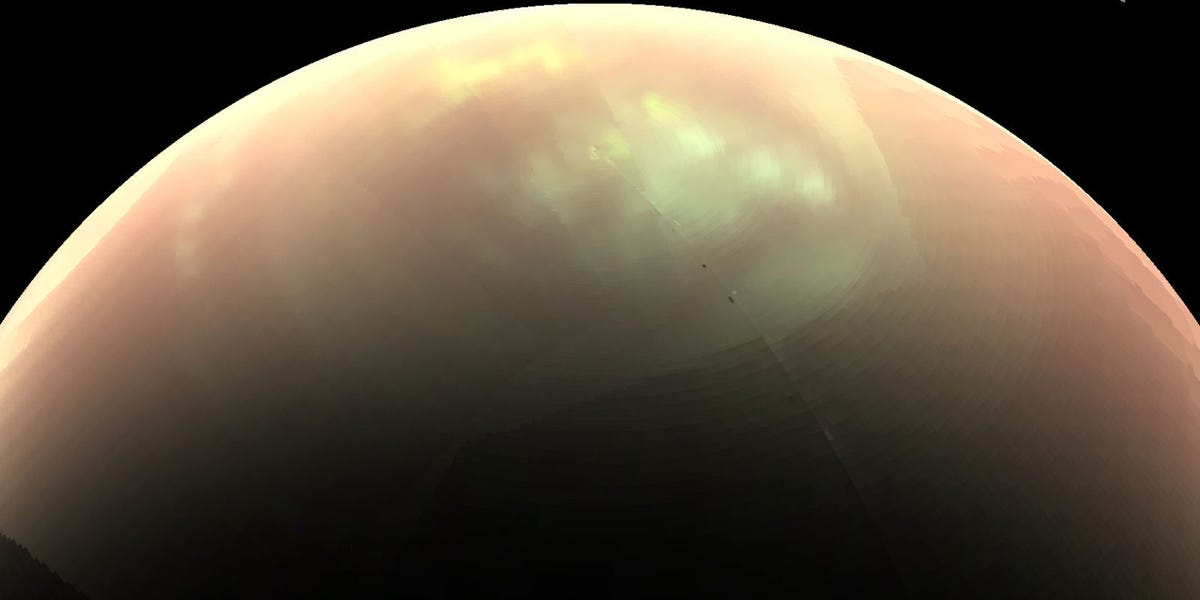
Saturn’s moon Titan already sounds like science fiction that refused to stay inside a paperback: orange skies, methane rain, rivers of natural gas, seas bigger than Earth’s Great Lakes, and a surface so cold that water ice behaves more like stone than slush. Then came one of its strangest tricks. In radar images from NASA’s Cassini spacecraft, bright island-like shapes appeared in Titan’s hydrocarbon seas, changed over time, disappeared, and in some cases showed up again. Scientists nicknamed them “magic islands,” because apparently “highly suspicious space blobs” was not formal enough.
One fascinating explanation is that these features may not be islands at all. They may be enormous patches of bubblesnitrogen gas fizzing out of liquid methane and ethane, creating temporary radar-bright areas on the surface of Titan’s alien seas. Think of a soda bottle opening in slow motion on a moon nearly a billion miles from the Sun. Except the “soda” is liquid natural gas, the bubbles are nitrogen, and the bartender is Saturn’s largest moon.
The phrase “Saturn’s Moon Titan has islands of giant bubbles” is catchy, but the truth is even better: Titan may host dynamic, seasonal, chemically active seas where bubbles, waves, floating organic solids, and methane weather all compete to explain a mystery Cassini left behind.
Why Titan Is the Solar System’s Weirdest Beach Destination
Titan is Saturn’s largest moon and the second-largest moon in the solar system. It is bigger than Mercury, wrapped in a thick nitrogen-rich atmosphere, and covered in a golden-orange haze made by complex organic chemistry. If Earth is the blue marble, Titan is the smoky tangerine with secrets.
What makes Titan extraordinary is that it is the only world besides Earth known to have stable liquid on its surface. But instead of oceans made of water, Titan’s lakes and seas are filled mostly with methane and ethanehydrocarbons that are gases on Earth but liquids on Titan because the moon is brutally cold. Surface temperatures hover around minus 290 degrees Fahrenheit, cold enough that familiar chemistry puts on a fake mustache and acts completely different.
On Earth, sunlight powers a water cycle: oceans evaporate, clouds form, rain falls, rivers flow, and lakes fill. On Titan, the same basic idea exists with methane. Methane clouds gather, methane rain falls, channels carve the icy ground, and liquid hydrocarbons collect in polar lakes and seas. It is an Earthlike system built with alien ingredients.
What Are Titan’s “Magic Islands”?
The mystery began with Cassini, the NASA spacecraft that explored Saturn and its moons for 13 years. Titan’s haze blocks ordinary visible-light views of the surface, so Cassini used radar to peer through the smog. In the large northern sea called Ligeia Mare, Cassini detected bright patches that looked a little like islands. The problem? They were not always there.
These radar-bright features appeared in some observations and vanished in others. They were not permanent mountains, ordinary shorelines, or simple instrument glitches. They were transient featurestemporary events happening in Titan’s seas. That alone changed the way scientists thought about Titan. The moon’s seas were not frozen, sleepy puddles of methane. They were active environments.
Ligeia Mare is huge, roughly 50,000 square miles in area, making it larger than Lake Superior. Imagine a sea that size on a moon where the rain is methane, the beach sand may be organic particles, and the “rocks” are water ice. Now imagine parts of that sea suddenly brightening on radar, like ghostly islands surfacing from nowhere. That is the Titan puzzle.
The Giant Bubble Theory: Titan as a Cosmic Soda Bottle
One of the most compelling explanations comes from laboratory experiments that recreated Titan-like conditions. Researchers found that nitrogen can dissolve in extremely cold liquid methane. Under the right conditions, small changes in temperature, pressure, or chemical composition can make that nitrogen rapidly come out of solution. This process is called exsolution, but “space fizz” is the version your inner eight-year-old will remember.
The key ingredient is mixing. Titan’s lakes and seas do not all have the same composition. Some reservoirs may be richer in methane, while others contain more ethane. When methane-rich rain or river runoff meets an ethane-rich sea, nitrogen may suddenly become less soluble. The gas separates from the liquid and forms bubblespossibly lots of them.
If enough bubbles rise together, they could roughen the surface or create a temporary patch that reflects Cassini’s radar differently from the surrounding sea. To Cassini, that fizzy patch might appear as a bright island. It would not be land. It would be a bubbling, shifting, temporary disturbance on a sea of liquid hydrocarbons.
Why Would Bubbles Look Like Islands?
Radar does not “see” the way the human eye sees. It sends radio waves toward a surface and measures what bounces back. Smooth liquid can look dark because it reflects radar away from the spacecraft, much like a calm lake reflecting sunlight away from your eyes. A rougher areacaused by waves, floating material, or bubblescan scatter radar back more strongly. That stronger return can appear bright.
So Titan’s bubble islands may be more like shimmering patches than solid islands. They could be temporary areas where the sea is foaming, churning, or sparkling in radar language. If this sounds like the universe invented a science fair volcano using methane and nitrogen, that is not far off.
Are the Bubbles Really “Giant”?
The word “giant” can be tricky. Individual nitrogen bubbles may not be the size of skyscrapers. Some models suggest bubbles could be centimeters across, not city blocks wide. The “giant” part refers to the scale of the bubble fieldsthe broad patches of fizz that could cover areas large enough for Cassini to detect from orbit.
In other words, Titan’s seas may not be launching cartoon bubbles the size of hot-air balloons. Instead, massive collections of smaller bubbles could create an island-like radar signature. A bathtub full of bubbles can look white from across the room even if each bubble is tiny. Titan simply takes the bathtub, fills it with liquid methane, drops it under Saturn’s orange light, and makes the whole thing planetary science.
The Case Is Not Closed: Waves and Floating Organic Solids
The bubble theory is exciting, but science is not a mystery novel where the detective announces the culprit and everyone claps. Other explanations remain possible. Cassini scientists also considered waves, floating solids, suspended solids, and surface roughening. In some early analyses, waves were considered a strong candidate because changing winds and seasonal sunlight could disturb Titan’s seas.
More recent research has added another elegant possibility: floating chunks of porous organic solids. Titan’s atmosphere constantly produces organic molecules. These particles can drift downward like alien soot and collect on the surface. Some may end up near lakes and seas. If they form porous, icy clumps, liquid methane could seep into them slowly, allowing them to float temporarily before sinking.
This idea is similar to pumice floating on water after volcanic eruptions on Earth. The material stays afloat not because it is magically weightless, but because it contains tiny holes and trapped gas. On Titan, porous organic “rafts” could gather near shorelines, break away, and drift across hydrocarbon seas. That could also create bright, changing radar features.
So what are Titan’s magic islands: bubbles, waves, floating organic icebergs, or a mix of all three? The honest answer is that researchers are still working it out. The best current view is that Titan’s seas are dynamic, and the magic islands are evidence of active processes rather than permanent geography.
Why Titan’s Bubble Islands Matter
At first glance, Titan’s bubble islands may sound like cosmic trivia: fun at parties, alarming in crossword puzzles, and excellent for making Saturn seem even more dramatic than it already is. But the mystery matters because it reveals how liquids behave in environments very different from Earth.
On our planet, water dominates climate, erosion, weather, biology, and habitability. On Titan, methane and ethane play many of those surface roles. Studying Titan helps scientists ask a bigger question: which parts of geology and climate are universal, and which depend on the chemistry of the world?
If Titan’s seas fizz with nitrogen, that affects how they mix, how they exchange gases with the atmosphere, how they reflect radar, and how a future floating probe might behave. A robotic boat or submarine sent to Titan would need to deal with bubbles forming around its instruments or propulsion system. Nobody wants to send a billion-dollar explorer across the solar system only for it to wobble around like a rubber duck in a shaken soda can.
Titan’s Seas Are Not Still, Silent Pools
Recent analysis of Cassini radar data has also shown that Titan’s seas vary in composition and may have active currents and ripples, especially near estuaries where rivers enter seas. Kraken Mare, Ligeia Mare, and Punga Mare are not identical bowls of liquid. Their chemistry changes with location, and their surfaces may respond to tides, wind, and inflowing methane rivers.
This matters because Titan is often described as Earthlike, but that word can be misleading. Titan is not a second Earth. It is a world that rhymes with Earth in a different language. It has rain, rivers, seas, dunes, weather, and possibly a subsurface water-rich layer, but it runs on colder chemistry and slower seasons. A single Titan day lasts about 16 Earth days. A Titan season lasts more than seven Earth years. Everything has time to be weird at a dignified pace.
Could Titan’s Bubble Islands Tell Us Anything About Life?
No evidence of life has been found on Titan. That point deserves a flashing neon sign, preferably one that works at minus 290 degrees Fahrenheit. Still, Titan is a major target for astrobiology because it has complex organic chemistry, a dense atmosphere, surface liquids, and possibly water-rich environments beneath its icy crust.
The magic islands themselves are not signs of life. They are signs of chemistry and physics in motion. But that motion matters. Worlds that exchange material between atmosphere, surface, and interior are more interesting than worlds where nothing changes. Titan’s methane cycle, organic snowfall, hydrocarbon seas, and possible interactions with water ice make it one of the best natural laboratories for studying prebiotic chemistrythe chemistry that may precede biology.
NASA’s Dragonfly Mission: The Next Chapter
Cassini ended its mission in 2017, but Titan’s story is not over. NASA’s Dragonfly mission is planned as a rotorcraft that will fly across Titan’s surface, landing at multiple sites to study chemistry, geology, and habitability. It is scheduled to launch no earlier than July 2028 and arrive in late 2034.
Dragonfly is not designed to splash down in Titan’s seas, so it will not directly sail through the magic islands. However, the mission will investigate Titan’s surface materials, organic chemistry, weather, and geologic history. Its findings may help scientists understand where Titan’s organic solids come from, how they move, and how they interact with the landscape. That could indirectly sharpen the debate over whether magic islands are bubbles, floating organic rafts, waves, or some wonderfully Titan-ish combination.
Experience: Imagining a Day Beside Titan’s Bubbling Sea
Picture yourself standing safely inside a futuristic heated exploration suit on the shore of Ligeia Mare. You are not actually “at the beach” in the vacation sense. There is no sunscreen, no volleyball, and absolutely no coconut drink with a tiny umbrella unless the umbrella is rated for cryogenic methane. The sky above you is a thick amber haze. Saturn hangs somewhere beyond it, mostly hidden, like a celebrity avoiding photographers.
The ground beneath your boots is water ice as hard as rock. Pebbles may be made of frozen organics. The air is mostly nitrogen, familiar in composition but not in mood. Every breath would be deadly without equipment, and every exposed surface would lose heat with alarming enthusiasm. The sea in front of you looks dark, broad, and strangely calm. It is not water. It is a cold mixture of methane, ethane, dissolved nitrogen, and other compounds that would be gases back home.
At first, the scene seems quiet. Titan is famous for low gravity and a dense atmosphere, so motion might feel strangely slow and graceful. Then, far offshore, a patch of the sea changes. It brightensnot to your eyes necessarily, but on your instrument display. Radar returns grow stronger. A temporary “island” appears where no landmass was mapped before.
Your first instinct might be to imagine something rising from the deep, because human brains are dramatic and have watched too many monster movies. But the more likely explanation is chemistry. Methane-rich liquid has mixed with ethane-rich liquid. Nitrogen, once dissolved, is now escaping. Bubbles rise through the alien sea in a broad field. The surface roughens. Radar sees the disturbance as a bright patch.
It would be like watching a lake burp politely in another language. Not a single bubble, not a cartoon explosion, but a spreading region of fizzan island made of activity rather than land. Minutes, hours, or weeks later, the patch could fade. The “island” would be gone, leaving only data and questions.
That experience captures why Titan is so addictive to scientists and space fans. It is familiar enough to invite comparison with Earth but strange enough to break every easy assumption. You can say “lake,” but you must change what lake means. You can say “rain,” but not water rain. You can say “island,” but maybe it is bubbles. Titan teaches humility with a smirk.
For writers, educators, and curious readers, the magic islands are a perfect doorway into planetary science. They show that discovery is not always a clean answer. Sometimes it is a radar image, a disappearing shape, a lab experiment with chilled methane, and a debate that keeps getting more interesting. The real experience of Titan is not just imagining what it looks like; it is learning how nature invents new versions of familiar things when the ingredients change.
Conclusion: Titan’s Bubble Islands Are a Beautiful Warning Against Boring Space
Saturn’s moon Titan has never been content to be just another icy satellite. It has weather, rivers, seas, dunes, organic chemistry, and mysterious radar features that appear and disappear like the moon is playing hide-and-seek with scientists. The idea that Titan’s magic islands may be giant patches of nitrogen bubbles gives the mystery a wonderfully vivid explanation: alien seas fizzing under orange skies.
But the most important lesson is not that bubbles win and every other theory loses. The lesson is that Titan is active. Its seas can change. Its chemistry can shift. Its atmosphere and surface interact in ways that are still being decoded. Bubbles, waves, and floating organic solids may all be part of the story.
As Dragonfly prepares for a future journey to Titan, the moon remains one of the most exciting places in the solar system. It is not Earth, but it echoes Earth in strange and revealing ways. If Titan truly has islands of giant bubbles, then the solar system has once again proven that reality is better than the weirdest headline we could invent.
Note: This article is written for web publication in standard American English and synthesizes established scientific information about Titan, Cassini observations, nitrogen bubble experiments, magic island research, and future exploration plans. It avoids unsupported claims of life and presents the bubble-island idea as a leading scientific explanation rather than a final certainty.











