
Seinfeld is the rare sitcom that can make a parking garage, a soup line, a puffy shirt, and a single marble rye feel like national emergencies. Created by Jerry Seinfeld and Larry David, the NBC comedy ran for nine seasons and turned everyday social irritation into a precision instrument. It was famously called “a show about nothing,” which is funny because few sitcoms have ever been so specifically about everything: awkward dating rules, petty grudges, fake jobs, bad table manners, doomed friendships, and the ancient human question of whether anyone has a square to spare.
But not every season of Seinfeld is built the same. Some seasons are lean, experimental, and a little nervous. Some are perfectly engineered joke machines. Others are so confident they practically kick open the apartment door like Kramer entering Jerry’s living room. This power ranking of the best Seinfeld seasons considers consistency, classic episodes, character development, cultural impact, writing structure, rewatch value, and how much each season captures the deliciously selfish spirit of Jerry, George, Elaine, and Kramer.
So grab a bowl of cereal, avoid low talkers, and do not lick any wedding envelopes. Here is the definitive ranking of Seinfeld seasons from best to worst.
How This Seinfeld Season Ranking Works
Ranking Seinfeld is tricky because even a “weaker” season can include an episode that most sitcoms would frame and hang above the couch. This list weighs several factors: the number of iconic episodes, the strength of season-long arcs, the balance among the four main characters, the freshness of the comedy, and whether the season feels like essential Seinfeld rather than merely good television.
The best seasons are not just collections of famous catchphrases. They are seasons where the plots interlock, the characters behave terribly in beautifully logical ways, and the comedy lands without needing sentimentality. In other words, no hugging, no learning, and definitely no sincere group lesson at the end.
1. Season 5: The Perfect Seinfeld Machine
Best episodes: “The Puffy Shirt,” “The Sniffing Accountant,” “The Stall,” “The Marine Biologist,” “The Hamptons,” “The Opposite”
Season 5 is the best Seinfeld season because it has everything: absurdity, tight plotting, unforgettable guest characters, and George Costanza operating at peak human disaster. This is the season where the show fully understands its own chemistry. Jerry is the amused observer, Elaine is socially fearless, Kramer is a walking physics experiment, and George is what would happen if anxiety got a driver’s license.
“The Marine Biologist” is the season’s crown jewel. It begins with a small lie and escalates into one of the most famous closing monologues in sitcom history. George pretending to be a marine biologist is already funny. George being forced to save a whale because Kramer hit golf balls into the ocean is comedy architecture. The episode’s final reveal is so clean it feels less written than discovered by archaeologists.
Season 5 also gives us “The Puffy Shirt,” which turns a misunderstanding with a low talker into a fashion catastrophe. “The Opposite” may be the ultimate George episode: he realizes that every instinct he has is wrong, so he does the reverse and becomes successful. The joke works because it is ridiculous and psychologically accurate. George is not transformed by wisdom; he is transformed by choosing the opposite of himself. That is not self-improvement. That is self-sabotage with better timing.
Season 5 wins because it is wildly funny without becoming too cartoonish. The stories are big, but the motivations remain tiny. That is Seinfeld at its best: enormous consequences caused by microscopic selfishness.
2. Season 4: The Breakthrough Season
Best episodes: “The Bubble Boy,” “The Contest,” “The Airport,” “The Pick,” “The Outing,” “The Junior Mint,” “The Pilot”
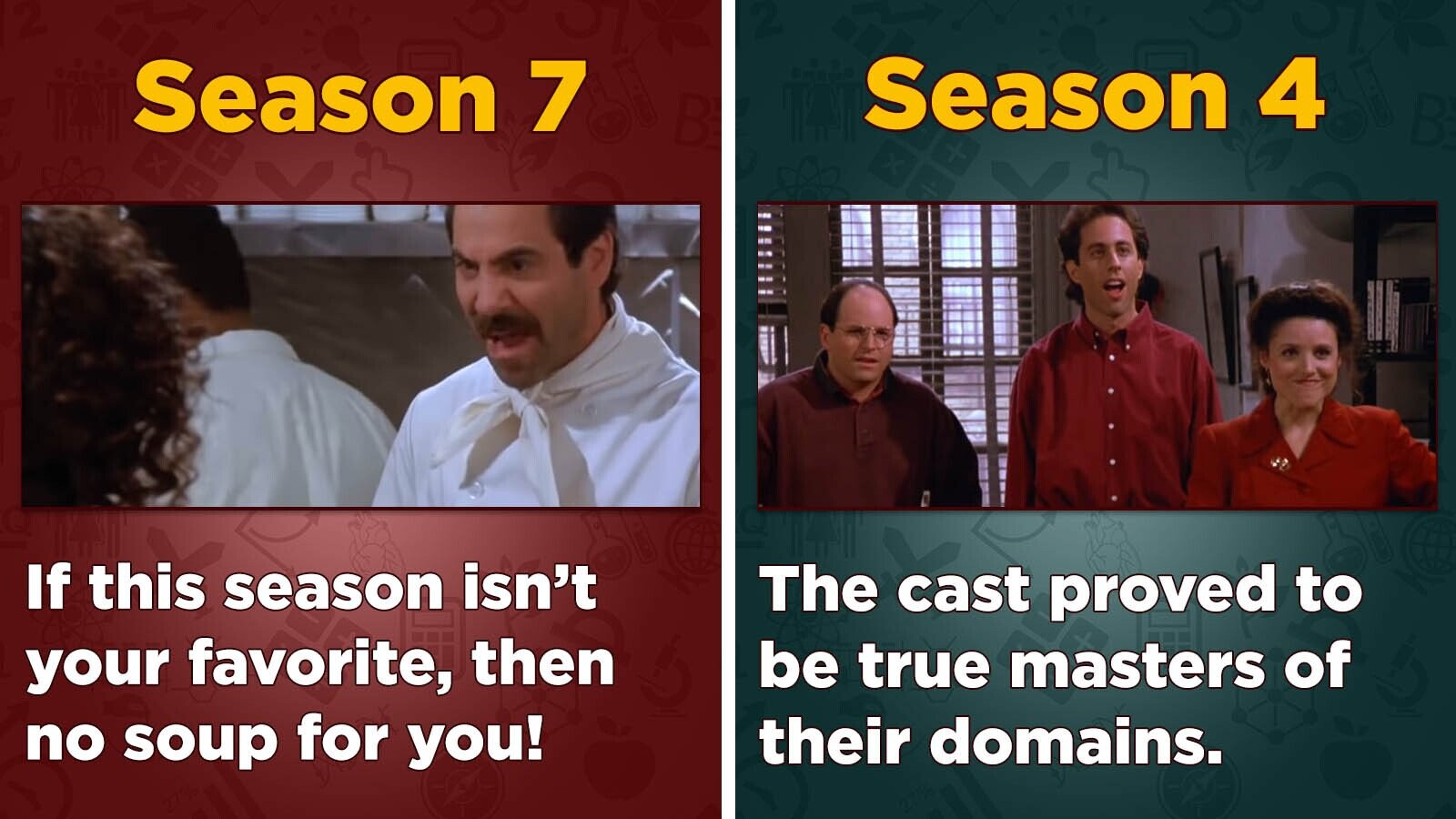
Season 4 is where Seinfeld becomes more than a clever sitcom. It becomes a cultural force. The season-long arc of Jerry and George pitching a sitcom to NBC is meta-comedy before meta-comedy needed a name tag. The characters are making a show about nothing inside a show that was famously described the same way. It is like watching a snake eat its own tail, except the snake is complaining about restaurant seating.
“The Contest” is the obvious heavyweight. It took a subject that network television would normally treat like radioactive waste and turned it into one of the smartest, cleanest, funniest scripts of the 1990s. The episode never needs to say the forbidden word. The euphemisms do all the work, and the audience does the rest. That kind of restraint is a writing flex.
Season 4 also has “The Outing,” with the endlessly repeated line “not that there’s anything wrong with that,” and “The Bubble Boy,” where George’s argument over a Trivial Pursuit card becomes a full-contact sport. “The Junior Mint” turns a candy accident into medical chaos. It sounds stupid. It is stupid. It is also brilliant.
If Season 5 is the show’s smoothest engine, Season 4 is the engine catching fire in a way that somehow makes the car faster. It is bold, experimental, and packed with episodes that helped define the series.
3. Season 7: Big Arcs, Bigger Laughs
Best episodes: “The Soup Nazi,” “The Secret Code,” “The Rye,” “The Cadillac,” “The Gum,” “The Invitations”
Season 7 is the last full season with Larry David as a central creative force before the show changes gears, and it goes out with a wonderfully dark bang. The major storyline is George’s engagement to Susan, a plot that turns commitment into a slow-motion horror film with snack breaks.
“The Soup Nazi” is one of the most quoted episodes of the entire series. Its premise is simple: the best soup in town is controlled by a terrifyingly strict vendor, and the gang is too hungry and too self-involved to behave properly. The episode is a perfect example of how Seinfeld could transform a tiny urban ritual into a battlefield of rules, pride, and punishment.
“The Rye” is another Season 7 classic. George’s parents take back a marble rye from Susan’s parents, forcing Jerry to steal a replacement loaf and Kramer to turn a horse-drawn carriage into digestive warfare. The episode is ridiculous, but it is also a masterclass in escalation. Nobody on Seinfeld can simply apologize. That would end the episode in four minutes, and worse, it would require maturity.
The season finale, “The Invitations,” remains one of the darkest sitcom endings ever aired. Susan dies after licking cheap wedding invitation envelopes, and the gang reacts with a horrifying lack of emotional depth. For some viewers, it is too cold. For others, it is the show’s mission statement carved in stone: these people will not grow, and the universe may punish them, but they will still find a way to complain about parking.
4. Season 6: The Deep Bench Season
Best episodes: “The Gymnast,” “The Mom & Pop Store,” “The Race,” “The Label Maker,” “The Fusilli Jerry,” “The Understudy”
Season 6 is sometimes overshadowed by Seasons 4, 5, and 7, but that is like being the fourth-best sandwich at a deli where everything is excellent. This season has a deep bench of strong episodes and shows the ensemble operating with relaxed confidence.
“The Race” is one of the best Jerry-focused episodes, giving him a Superman-style myth around a childhood footrace he may or may not have cheated to win. “The Label Maker” introduces the idea of regifting and degifting, proving that Seinfeld did not just reflect language; it created language people still use. “The Fusilli Jerry” is pure Kramer weirdness, with pasta sculptures and an ending that is both painful and inevitable.
Season 6 also benefits from the expanding world around the main four. Frank and Estelle Costanza become even more essential. J. Peterman is on the horizon. The show’s supporting characters are no longer decorations; they are dangerous comedy devices waiting to explode.
The only reason Season 6 does not rank higher is that its most famous episodes are slightly less towering than the peaks of Seasons 4 and 5. Still, for overall consistency, it is a terrific season and one of the easiest to binge.
5. Season 8: The Wild Post-Larry David Experiment
Best episodes: “The Bizarro Jerry,” “The Little Kicks,” “The Chicken Roaster,” “The Comeback,” “The Van Buren Boys,” “The Muffin Tops”
Season 8 is where Seinfeld becomes faster, broader, and stranger. Larry David had left the day-to-day writing staff, and Jerry Seinfeld took on greater creative responsibility. The result is a season that feels less like social satire and more like a live-action cartoon about urban lunatics. That may sound like criticism. It is also a compliment.
“The Bizarro Jerry” is the season’s defining episode. Elaine meets a group of men who are polite, generous, and emotionally healthy versions of Jerry, George, and Kramer. Naturally, this is treated like a supernatural event. “The Little Kicks” gives Elaine her famously terrible dancing, a physical comedy moment so strange it could be studied by scientists and still not explained.
“The Chicken Roaster” is another gem, with Kramer and Jerry effectively switching personalities after a neon sign ruins Kramer’s sleep. The episode is goofy in the best way. It is also evidence that Season 8 understands how much fun can be had by bending the show’s reality without completely breaking it.
Season 8 is not the purest version of Seinfeld, but it is one of the most entertaining. It may not have the surgical precision of the Larry David years, yet it has manic energy, big swings, and some of the show’s most rewatchable moments.
6. Season 3: The Show Finds Its Voice
Best episodes: “The Pen,” “The Library,” “The Parking Garage,” “The Subway,” “The Pez Dispenser,” “The Limo”
Season 3 is the moment when Seinfeld stops feeling like an interesting experiment and starts feeling like itself. The characters are sharper, the premises are bolder, and the writers begin trusting that an entire episode can be built around frustration rather than plot in the traditional sense.
“The Parking Garage” is a perfect example. The gang spends the episode wandering through a parking garage looking for Kramer’s car. That is the whole thing. On paper, it should not work. On screen, it is painful, hilarious, and weirdly suspenseful. “The Subway” splits the characters into separate stories across New York’s transit system, expanding the show’s world while keeping its small-stakes anxiety intact.
Season 3 also includes “The Pen,” notable because George and Kramer are absent. Jerry and Elaine visiting Jerry’s parents in Florida could have been a simple side trip, but it becomes a sweaty nightmare of sofa beds, old grudges, and astronaut pens. Elaine yelling “Stella!” after taking muscle relaxers remains one of the show’s funniest early physical performances.
Season 3 ranks below the golden middle years only because the show is still refining its formula. But the confidence is arriving, and once it arrives, it parks badly and refuses to move.
7. Season 9: The Victory Lap With a Strange Finish
Best episodes: “The Merv Griffin Show,” “The Slicer,” “The Betrayal,” “The Strike,” “The Frogger,” “The Serenity Now”
Season 9 is divisive, and understandably so. By this point, Seinfeld is enormous. The ratings are huge, the characters are cultural icons, and the writers are pushing the show into increasingly surreal territory. Sometimes that produces magic. Sometimes it produces a finale people still argue about like it is a legal case.
“The Merv Griffin Show” is one of the best late-period episodes, with Kramer turning his apartment into a talk show set. “The Strike” introduces Festivus, a fake holiday that somehow became a real annual ritual for people who enjoy aluminum poles and emotional damage. “The Betrayal,” told backward, shows that even in its final season, the show was willing to experiment with structure.
The finale is the complication. Bringing back a parade of past characters for a trial of the gang’s moral failures is conceptually clever, but it is not as funny or satisfying as the best episodes. Still, Season 9 deserves more credit than it gets. Even when the show is uneven, it remains inventive, quotable, and unmistakably itself.
8. Season 2: The Clever Early Prototype
Best episodes: “The Pony Remark,” “The Jacket,” “The Phone Message,” “The Chinese Restaurant,” “The Deal”
Season 2 is early Seinfeld, which means it is quieter, smaller, and less explosive than the later classics. But it is also the season that proves the show’s central idea can work. “The Chinese Restaurant” is the breakthrough. Jerry, George, and Elaine wait for a table. That is it. Kramer is not even there. Yet the episode becomes a study in impatience, entitlement, social rules, and George’s inability to use a phone without turning it into a courtroom drama.
“The Phone Message” is another early winner, built around George leaving a disastrous series of answering machine messages. It captures one of the show’s great themes: modern life gives people new technology, and they immediately use it to embarrass themselves.
Season 2 is not as packed with classics as the seasons above it, and some episodes still feel like the writers are adjusting the temperature. But the DNA is there. The pettiness is there. The refusal to become warm and fuzzy is definitely there. It is a very good season that had the misfortune of being followed by even better ones.
9. Season 1: The Necessary Warm-Up
Best episodes: “The Seinfeld Chronicles,” “The Stake Out,” “The Stock Tip”
Season 1 ranks last, but that does not mean it is bad. It means the show is still finding the apartment lights. The first season is short, tentative, and noticeably different from what Seinfeld would become. Elaine is not yet fully integrated into the dynamic, Kramer is still more mysterious neighbor than full chaos agent, and George is not yet the Olympic-level panic machine he becomes later.
Still, Season 1 is fascinating because you can see the idea forming. “The Stake Out” establishes Jerry and George’s obsessive conversations about dating strategy. “The Stock Tip” shows the show’s interest in small choices spiraling into regret. The pilot, originally titled “The Seinfeld Chronicles,” is not great in the way later episodes are great, but it is historically important.
Season 1 is like seeing a restaurant before the menu is finished. The chairs are there. The soup is not ready. The owner has not yet yelled at anyone. But the place has potential.
Larry David Seasons vs. Later Seinfeld Seasons
The biggest dividing line in Seinfeld history is the shift after Season 7. During the Larry David years, the show often feels like a moral trap. Characters make tiny selfish decisions, and those decisions snap shut around them. The plots are intricate, but the comedy remains rooted in social behavior: lying, avoiding, boasting, bargaining, and refusing to admit fault.
In Seasons 8 and 9, the show becomes louder and more surreal. Kramer’s schemes get bigger. Elaine becomes more aggressive. George turns from neurotic schemer into near-mythic coward. Jerry, once the observational center, sometimes becomes the straight-faced participant in pure absurdity. Some fans prefer the precise cruelty of the earlier years. Others love the anything-goes energy of the later run.
The truth is that both versions matter. Without the disciplined middle seasons, Seinfeld would not be considered one of the greatest sitcoms ever made. Without the later seasons, we would not have Festivus, Elaine’s dancing, Bizarro Jerry, or Kramer hosting a fake talk show in his apartment. That would be a sad world, and frankly, not sponge-worthy.
Best Seinfeld Season for New Viewers
If you are new to the show, start with Season 4 or Season 5. Season 4 shows the series becoming bold and influential, while Season 5 delivers the most polished version of the formula. If you want the most famous catchphrases, Season 7 is essential. If you want weird late-period chaos, Season 8 is your friend. If you want to understand how the whole thing evolved, begin at Season 2 and let the awkwardness become art.
The beauty of Seinfeld is that it rewards both casual sampling and obsessive rewatching. You can watch “The Contest” as a standalone masterpiece or study how Season 4 builds toward the fictional NBC pilot. You can laugh at “The Marine Biologist” once, then watch it again to admire how every subplot clicks into place. Like George’s wallet, the show is overstuffed, dangerous, and somehow still functional.
Rewatching Seinfeld: A 500-Word Experience From the Couch
Rewatching Seinfeld today is a strange experience because the show feels both old and weirdly current. The clothes are dated, the answering machines belong in a museum, and everyone makes plans as if smartphones were never coming to rescue humanity from miscommunication. Yet the emotional problems are completely modern. People still overthink texts the way George overthought phone messages. People still pretend to know more than they do. People still get offended over tiny etiquette violations and then turn those violations into courtroom arguments inside their own heads.
The best way to experience a Seinfeld rewatch is not to treat it like homework. Do not begin by declaring that you are studying the greatest sitcom structure in television history. That is how people become insufferable at dinner parties, and Seinfeld would absolutely mock you for it. Instead, watch one episode while eating something simple: cereal, a sandwich, maybe soup if you are emotionally prepared. Suddenly, you remember how fast the show moves. A line lands, then another, then a physical bit, then a callback from a subplot you forgot was even connected.
Season 5 is especially satisfying on rewatch because it has the rhythm of a band that knows exactly when to let each instrument play. Jerry underreacts. George panics. Elaine attacks. Kramer enters like gravity has resigned. Nobody needs to explain who they are because every scene reveals it. George does not simply lie; he builds a little house inside the lie and then complains about the plumbing. Elaine does not merely dislike someone; she turns annoyance into a sport. Kramer does not have ideas; he has weather systems.
What makes the rewatch experience so fun is noticing how often the show turns nothing into momentum. In most sitcoms, characters learn lessons. In Seinfeld, they learn loopholes. They interpret every social rule as something to exploit, dodge, or litigate. That makes the show feel refreshingly unsentimental. It does not ask viewers to admire the characters. It asks viewers to recognize them, laugh at them, and maybe quietly admit, “I have done a smaller version of that.”
Some episodes also hit differently with time. “The Chinese Restaurant” may feel even funnier now because waiting without a phone seems like psychological warfare. “The Parking Garage” becomes a horror story for anyone who has ever lost a car in a mall lot. “The Opposite” becomes motivational in the most backwards way possible: maybe your instincts are wrong, but please do not use George Costanza as a life coach unless you have legal protection.
The longer you rewatch, the more you appreciate the show’s confidence. Seinfeld trusted that tiny annoyances were big enough. It trusted silence, awkward pauses, and selfish reactions. It trusted that a marble rye could carry an episode if everyone wanted it badly enough. That is why ranking the seasons is so entertaining. Each one captures a different stage of the same comic philosophy: life is absurd, people are petty, and sometimes the smallest inconvenience is the only plot you need.
Final Verdict: What Is the Best Season of Seinfeld?
The best season of Seinfeld is Season 5. It combines the structural confidence of the show’s peak years with some of the most memorable episodes in sitcom history. Season 4 is close behind because of its ambition and cultural impact, while Season 7 remains the darkest and boldest of the later Larry David era.
Still, the real answer is that Seinfeld has no truly disposable season. Even Season 1 matters as a blueprint. Even Season 9, with its controversial finale, contains episodes that became permanent parts of pop culture. The show’s greatness lies in how much comedy it found in tiny human failures. It turned waiting, lying, ordering food, choosing clothes, making phone calls, and buying bread into epic struggles.
That is why Seinfeld still works. It is not just nostalgia. It is recognition. We may not all pretend to be marine biologists, but we have all exaggerated, panicked, doubled down, and hoped the universe would not call our bluff. Unfortunately, on Seinfeld, the universe always calls. And it usually does so at the worst possible time, in front of the wrong person, while Kramer is somehow involved.












