
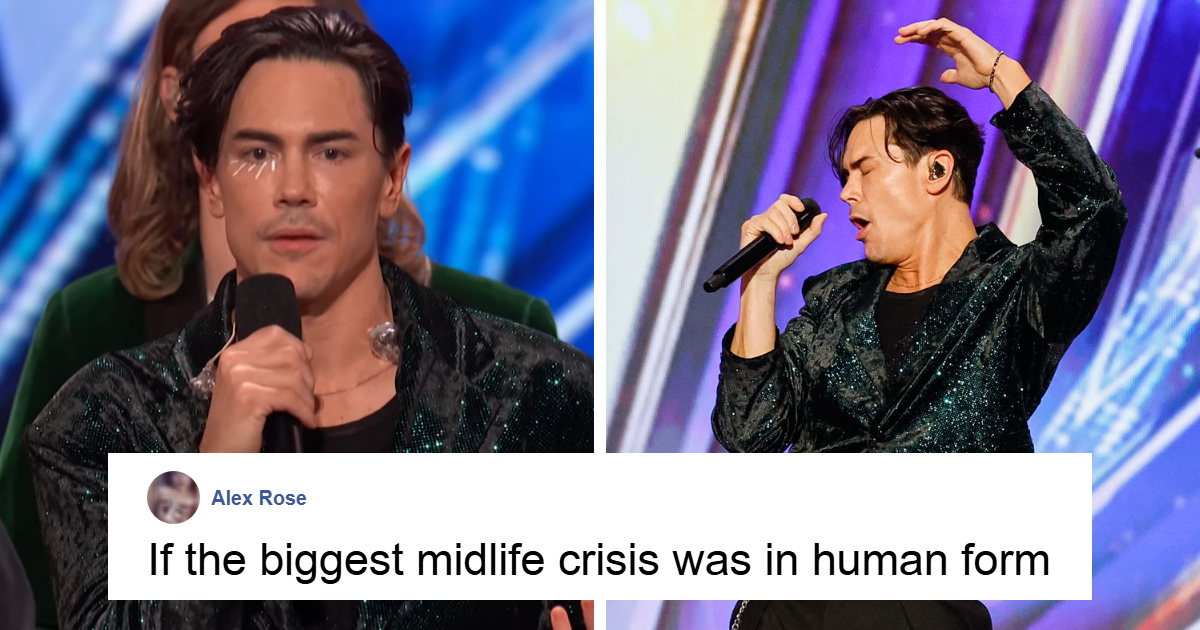
Tom Sandoval walked onto the America’s Got Talent stage with a sparkly jacket, a cover band, and enough public baggage to fill an entire Bravo reunion couch. Within minutes, the Vanderpump Rules alum had managed to do what reality TV stars are genetically engineered to do: split the internet into people cheering, people cringing, and people typing faster than their thumbs could emotionally process.
Sandoval and his band, Tom Sandoval & The Most Extras, auditioned for Season 20 of America’s Got Talent with a high-energy cover of A-ha’s “Take On Me.” On paper, that sounds like harmless fun: big hair energy, nostalgic synth-pop, and a frontman who knows how to work a room. In practice, it became one of the most talked-about celebrity-adjacent AGT auditions of the season because Sandoval is not just any guy with a microphone. He is the guy still attached to “Scandoval,” the cheating scandal that turned a Bravo breakup into a national pop-culture weather event.
Tom Sandoval’s AGT Audition: What Actually Happened?
Sandoval appeared before judges Simon Cowell, Sofía Vergara, Howie Mandel, and Mel B with his cover band, hoping to prove that he could be viewed as a musician rather than only as a controversial reality TV personality. Before the music even started, the panel was already reacting to his reputation. Howie Mandel quietly explained the scandal to Sofía Vergara, while Simon Cowell made it clear that he cared less about Bravo drama and more about whether the act could entertain.
That created the strange tension at the heart of the audition. The judges were not watching a total unknown chase a dream. They were watching a reality TV figure attempt a public-image reset in front of millions. Sandoval knew it, the audience knew it, and social media definitely knew it. The moment had the emotional temperature of karaoke night after someone says, “Before I sing, I just want to address a few things.”
Once the band launched into “Take On Me,” the room shifted. The performance was upbeat, theatrical, and unapologetically extra. Sandoval danced, sang, smiled, and leaned fully into the frontman role. The crowd cheered. Mel B seemed charmed by the energy. Sofía praised the fun factor. Howie called him a showman. Simon, however, delivered the most Simon Cowell response imaginable: he admitted the vocals were not great but still gave him a yes because the act felt authentic.
Why the Judges Were Left Speechless
The “speechless” part was not simply about vocal technique. Nobody confused the audition with a secret lost Freddie Mercury tape. What stunned the judges was the package: a scandal-marked Bravo star arriving with a full band, owning his reputation, and somehow turning a potentially awkward TV moment into a crowd-pleasing spectacle.
Sandoval did not perform like someone trying to disappear from public criticism. He performed like someone who had decided that if the internet was going to roast him anyway, he might as well bring stage lights. That is what made the audition fascinating. It was not just a song. It was a redemption pitch, a branding exercise, a concert preview, and a reality TV cliffhanger wearing glitter.
AGT has always rewarded personality as much as precision. The show is not a conservatory exam; it is a prime-time entertainment machine. A technically flawless singer can lose the room, while a chaotic, colorful performer can win it by making people feel something. Sandoval’s audition landed directly in that messy middle: not vocally perfect, but impossible to ignore.
The Internet Was Not So Easily Impressed
While the judges gave Tom Sandoval & The Most Extras four yes votes, many viewers online had already pulled out the digital tomatoes. Critics mocked the performance as glorified karaoke, questioned whether a cover band belonged on a talent competition stage, and joked that the whole thing felt like a Bravo crossover episode that wandered into the wrong studio.
Some comments focused on the singing. Others focused on Sandoval’s reputation. And plenty focused on the strange spectacle of watching a man once labeled one of reality TV’s biggest villains ask America for applause. The jokes practically wrote themselves. For a certain corner of the internet, Sandoval singing “Take On Me” was less a musical audition and more a group therapy session with a drum kit.
That reaction says a lot about modern celebrity culture. When a public figure becomes known for scandal, every new project is judged through that lens. A simple performance is no longer simple. The outfit becomes symbolic. The song choice becomes suspicious. The smile becomes evidence. The high note becomes a referendum on accountability, fame, forgiveness, and whether America should be allowed to vote after eating dinner too quickly.
Was the Backlash About Talent or Reputation?
The honest answer is both. Some viewers genuinely did not like the vocals. Simon Cowell himself said the singing needed work, even as he advanced the band. Others seemed less concerned with pitch and more irritated by the idea of Sandoval receiving another platform. After “Scandoval,” many fans felt he had already been given too much screen time, too many confessionals, and too many opportunities to explain himself.
That is why the AGT audition caused such a strong reaction. It was not simply “Did he sing well?” It was “Why is he here?” and “Should this be rewarded?” and “Is this redemption, or just another camera angle?” Those questions are bigger than one A-ha cover.
At the same time, it is difficult to deny that Sandoval understands performance. He may not be the strongest vocalist in the competition, but he knows how to command attention. His band is built around party energy, not stripped-down vocal purity. The Most Extras are exactly what their name promises: loud, flashy, unserious in the right places, and allergic to subtlety.
Simon Cowell’s Reaction Became Its Own Mini-Drama
Simon Cowell’s critique may have been the most important part of the audition. He did not pretend Sandoval had delivered a perfect vocal. Instead, he separated technical singing from entertainment value. That distinction helped explain why the judges advanced the act despite obvious imperfections.
For AGT, the question is often not “Who is the best singer?” but “Who can hold a Vegas stage?” Sandoval’s cover-band concept makes more sense under that standard. A Vegas-style party act does not need to reinvent music theory. It needs to get people clapping, laughing, singing along, and maybe buying one more overpriced beverage in a plastic cup shaped like regret.
Still, Simon’s honesty gave online critics fresh ammunition. If even Simon said the vocals were not great, viewers who disliked the performance felt validated. The yes vote, meanwhile, gave others a reason to accuse the show of prioritizing celebrity recognition over undiscovered talent.
Claims of “Special Treatment” Added Fuel to the Fire
After the audition aired, additional chatter emerged around whether Sandoval had benefited from his NBC and Bravo connections. Reports discussed claims that he may have received an easier path to the stage or used backing support during the performance. AGT representatives pushed back on the idea that the show treated him unfairly, saying acts are allowed to use backing tracks if they choose.
For viewers already skeptical, that explanation did not fully calm the waters. Talent competitions depend on the feeling that anyone can walk in from ordinary life and earn a shot. When a familiar reality TV personality appears, especially one connected to a major network ecosystem, the “ordinary dreamer” fantasy gets complicated.
But from a producer’s perspective, Sandoval was always going to be valuable television. He brought built-in drama, name recognition, controversy, curiosity, and a ready-made online debate. That does not mean the audition was fake. It means AGT understood what reality television has always understood: people may complain, but they will keep watching.
Tom Sandoval’s Redemption Arc Is Still Complicated
Sandoval framed the band as something that helped him through a dark period after the scandal. That is a sympathetic angle, but public redemption is rarely clean. Audiences do not forgive on command, especially when the original controversy played out in such a public and emotionally charged way.
For some fans, his AGT appearance looked like resilience. For others, it looked like image rehabilitation with a lighting rig. Both readings can exist at the same time. That is the strange reality of post-scandal fame: every appearance becomes a test, and every test has different graders.
His ex, Ariana Madix, became one of the biggest breakout figures from the fallout, landing major hosting, Broadway, and brand opportunities. Sandoval, meanwhile, leaned into the reality competition circuit, appearing on shows that let him reintroduce himself in new formats. AGT was another stop on that road, but it came with a higher degree of public voting and public roasting.
Why This Audition Went Viral
The audition had all the ingredients of a viral entertainment story: a polarizing celebrity, a familiar song, skeptical judges, enthusiastic applause, online backlash, and a built-in debate over whether the performance was fun or cringe. It was not just a clip; it was a content buffet.
Fans of Vanderpump Rules watched for the drama. AGT fans watched for the talent. Critics watched for the stumble. Supporters watched for the comeback. Casual viewers watched because the algorithm placed it in front of them while they were trying to look up dinner recipes. That is how modern pop culture works: one minute you are searching for chicken tacos, the next you are emotionally invested in Simon Cowell’s facial expression during a Tom Sandoval cover song.
The performance also tapped into the internet’s favorite sport: public evaluation. Viewers did not merely watch the audition; they judged the judges for judging it. They debated whether Mel B was too generous, whether Simon was too soft, whether Howie’s Bravo knowledge mattered, and whether Sofía was simply enjoying the chaos. AGT became a courtroom, and the comment section appointed itself jury, bailiff, and snack vendor.
What Happened After the Audition?
Tom Sandoval & The Most Extras advanced beyond the audition round, but the road did not lead to an AGT crown. The band later performed The Weeknd’s “Blinding Lights” during the live shows, where Simon Cowell buzzed the act and offered a much harsher assessment. The group was eliminated during the quarterfinal stage.
Sandoval later joked about Simon’s buzzer haunting him, showing that he understood the absurdity of the moment. That reaction may have helped soften the landing. If you are going to be publicly roasted, being in on the joke is often the best available life raft.
The elimination also clarified something important: celebrity recognition can get attention, but it cannot guarantee votes forever. Once AGT enters the live-show phase, America’s patience becomes the real judge. And America, as every reality TV veteran knows, can be less predictable than a Bravo cast trip with an open bar.
The Bigger Lesson: Fame Is Not Forgiveness
Sandoval’s AGT audition shows the difference between being watched and being forgiven. He was absolutely watched. The clip traveled widely, entertainment outlets covered it, and fans argued about it across platforms. But attention is not the same thing as approval. In fact, sometimes attention is just disapproval wearing better shoes.
For entertainers trying to recover from scandal, that distinction matters. A comeback cannot rely only on visibility. It needs consistency, humility, better choices, and, ideally, performances that make even skeptics pause before typing. Sandoval’s audition succeeded at visibility. Whether it succeeded as redemption depends on which corner of the audience you ask.
Experiences Related to the Topic: What the Roast Reveals About Watching Public Comebacks
Anyone who has ever watched a public figure try to come back from embarrassment knows the feeling: you want to look away, but the spectacle has installed a tiny folding chair in your brain. Tom Sandoval’s AGT audition created exactly that kind of viewing experience. It was awkward, energetic, funny, uncomfortable, and strangely fascinating all at once.
Part of the experience comes from secondhand embarrassment. We have all seen someone overestimate how ready the room is for their big moment. Maybe it was a coworker singing too confidently at a holiday party. Maybe it was a cousin giving a wedding toast that somehow became a TED Talk about crypto. Maybe it was you, bravely attempting karaoke after insisting you “kind of sound like Journey.” Public performance is risky because enthusiasm and ability do not always arrive in the same Uber.
Sandoval’s audition hit that nerve. Viewers saw a man who clearly believed in the performance, surrounded by a band committed to the bit, walking into a room where his reputation arrived before he did. That is a tough setup. Even a great performance would have been judged skeptically. A merely decent one was guaranteed to become roast material.
Another relatable part is the way people respond to reinvention. In normal life, reinvention happens quietly. Someone changes jobs, starts therapy, joins a gym, takes guitar lessons, or decides to stop texting their ex after midnight. There is room to be clumsy. Celebrities do not get that privacy. Their reinvention happens under lights, with close-ups, headlines, and strangers ranking their sincerity from one to ten.
The online roasting also reflects how audiences use humor to process discomfort. Many people did not want to write a full essay about reality TV accountability, gender dynamics, fame cycles, and network incentives. So they made karaoke jokes. They compared the act to a bar band. They questioned the song choice. Humor became the shortcut for a much bigger reaction.
At the same time, there is a small lesson in bravery hiding under the glitter. Performing after public humiliation takes nerve. That does not erase past behavior, and it does not require anyone to applaud. But it does explain why the judges may have responded to the act’s energy. Sandoval showed up knowing many viewers were waiting to mock him. He sang anyway. In entertainment, that kind of shamelessness can be a liability, a survival skill, or both depending on the lighting.
The best way to understand the audition is as a messy case study in modern fame. Talent mattered. Reputation mattered. Editing mattered. Social media mattered. The judges’ reactions mattered. The memes mattered almost as much as the music. Sandoval may have hoped AGT would help people see him differently, but the response proved that public perception changes slowly, especially when the internet still has screenshots, opinions, and unlimited battery life.
Conclusion
Tom Sandoval’s America’s Got Talent audition was not just a musical performance. It was a pop-culture stress test. The judges saw enough entertainment value to send Tom Sandoval & The Most Extras forward, while the internet saw enough awkwardness to roast the moment into trending-topic territory. Some viewers called it fun. Others called it cringe. Many called it karaoke with better lighting.
In the end, the audition worked because people talked about it. That may not satisfy vocal purists, but it is exactly what reality TV is built to do. Sandoval did not leave AGT as the season’s strongest singer, but he did leave with one undeniable achievement: he made America look up from its phone, open a second app, and argue. For a reality TV veteran, that is practically a standing ovation.
Note: This article is a fully rewritten synthesis based on publicly reported entertainment coverage, judge reactions, social media response, and verified timeline details surrounding Tom Sandoval’s America’s Got Talent appearance.











