
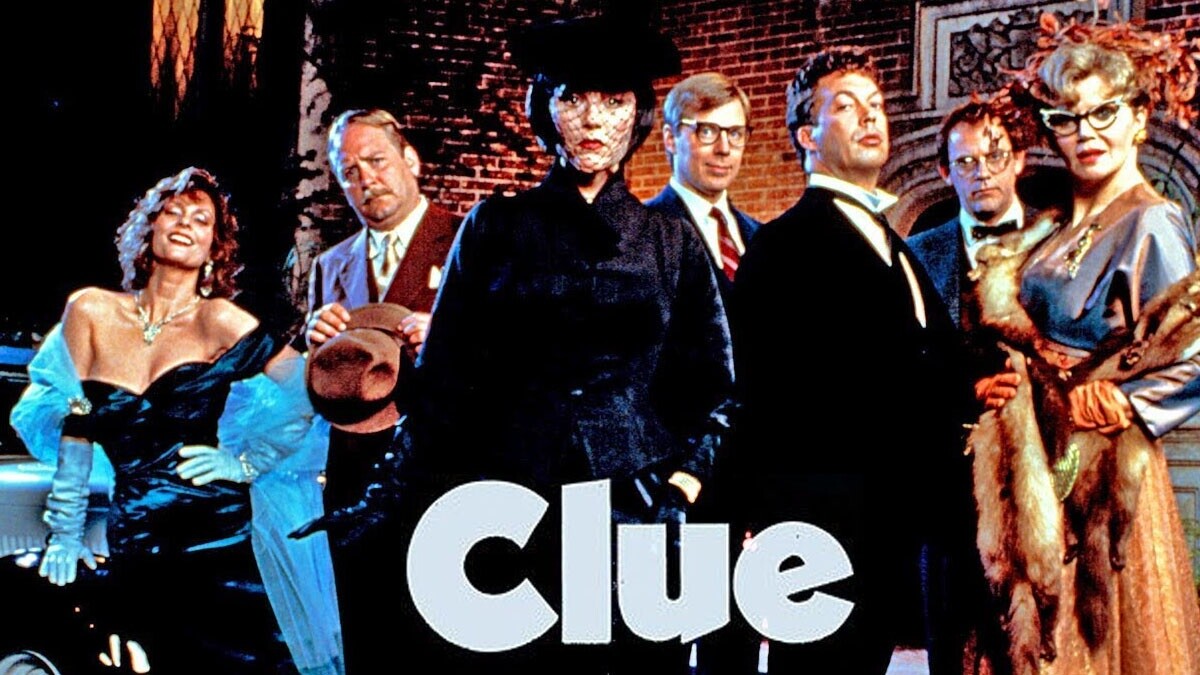
Few movies have aged as strangely, joyfully, and murderously well as Clue. Released in 1985, Jonathan Lynn’s black-comedy mystery took a board game about suspicious people, sharp objects, and questionable real estate decisions, then turned it into a lightning-fast farce full of slammed doors, secret passages, political blackmail, and Tim Curry running through a mansion as if cardio were part of the police investigation.
At first, Clue looked like a risky experiment that had rolled snake eyes. Critics were divided, audiences were confused by the multiple endings, and the box office did not exactly scream “future cult classic.” But home video changed everything. Once viewers could watch all three endings together, the film’s bizarre structure finally made sense. The result is now one of the most beloved mystery comedies ever made, quoted by fans who know that “communism was just a red herring” and that flames can, in fact, appear on the side of one’s face.
Behind the scenes, the making of Clue was nearly as odd as the movie itself. Princess Leia almost played Miss Scarlet. Norman Bates nearly helped write the script. A fourth ending existed. Some cast members did not know all the secrets until late in production. And somewhere in the middle of all that, a movie based on colored pawns became a masterclass in comic timing.
Why Clue Still Works as a Mystery Comedy
The magic of Clue is not just that it is funny. Plenty of comedies are funny once. Clue is funny on repeat because it behaves like a puzzle box with a whoopee cushion inside. Every line, glance, exit, and entrance has to support several possible solutions. That means the actors must play the story seriously while the movie around them spins faster and faster into absurdity.
Jonathan Lynn, who wrote and directed the film, understood that the only way to make a ridiculous premise work was to treat the mechanics with almost theatrical discipline. The characters may be named Mustard, Peacock, Plum, Green, White, and Scarlet, but the plot is built with the precision of a clock. A very silly clock, yes, but one with murder weapons hidden inside the gears.
16 Bits of Trivia About the Making of Clue
1. The movie began as an idea that sounded almost impossible
Turning a board game into a movie is normal today, but in the early 1980s it sounded like the kind of pitch someone might make after losing a bet. The original game had suspects, rooms, and weapons, but no fixed plot, no real character arcs, and no single solution. Lynn’s challenge was to create a story that honored the game while also functioning as a real farce. His breakthrough was simple and brilliant: the color names could not be real names. They had to be aliases. And aliases meant secrets.
2. John Landis was originally attached to direct
Before Jonathan Lynn became the film’s director, John Landis was connected to the project and helped develop the story concept. Landis had a big, playful idea for a movie that would mimic the replayability of the board game by offering multiple endings. Eventually, Lynn took over directing duties, bringing a British stage-comedy sensibility to an American studio comedy. That combination gave Clue its unusual flavor: part drawing-room mystery, part screwball farce, part haunted-house sprint.
3. Anthony Perkins was considered as a screenwriter
Here is where Norman Bates enters the conservatory with the typewriter. Anthony Perkins, forever linked to Alfred Hitchcock’s Psycho, was among the names approached during the project’s long development. Perkins was not just an actor; he had screenwriting experience and had co-written the mystery film The Last of Sheila with Stephen Sondheim. Imagine the alternate universe where the man most famous for cinematic motel management helped crack a board-game murder mystery. Hollywood is weird. Sometimes wonderfully weird.
4. Stephen Sondheim and Tom Stoppard were also part of the early conversation
The list of writers connected to the project at different points reads like someone spilled a theater program into a murder file. Stephen Sondheim, Anthony Perkins, and Tom Stoppard were all associated with early attempts to solve the screenplay problem. That history explains why Clue feels unusually literate for a studio comedy based on a family game. The finished film belongs to Lynn, but the development process shows how difficult the premise was. Everybody had the weapons. Nobody could quite find the body of the story.
5. Carrie Fisher was originally cast as Miss Scarlet
Before Lesley Ann Warren turned Miss Scarlet into a smoky, dangerous, green-dressed delight, Carrie Fisher was set for the role. Fisher’s wit would have fit the movie beautifully, and it is easy to imagine her slicing through the dialogue with Princess Leia-level authority. However, Fisher entered rehab shortly before filming, and the production’s insurance situation forced a recast. Warren stepped in quickly and made the role completely her own. It is one of those Hollywood what-ifs that is fascinating without diminishing the final result.
6. Lesley Ann Warren arrived late and still owned the room
Warren had to join an ensemble that had already been shaped around fast timing, tight choreography, and a very specific comic rhythm. That is not easy. Farce is unforgiving; if one actor misses a beat, the whole machine starts coughing smoke. Yet Warren’s Miss Scarlet feels fully formed from the moment she appears. She is glamorous, sarcastic, suspicious, and clearly three steps ahead of everyone unless she is four steps behind on purpose.
7. Tim Curry was the perfect Wadsworth, but he was not the only possibility
Tim Curry’s Wadsworth is one of the great comic ringmasters of 1980s film. He is polite, panicked, sinister, breathless, and somehow elegant even while sprinting through a mansion explaining homicide logistics. Other casting possibilities were discussed before Curry took the role, but it is difficult now to imagine anyone else making the final act work. Wadsworth has to be host, narrator, suspect, detective, victim-adjacent chaos goblin, and human stopwatch. Curry manages all of it with eyebrow control alone.
8. The cast rehearsed like they were preparing for a stage farce
Lynn came from theater, and that background shaped the production. The cast rehearsed for weeks, developing rhythm, movement, and character relationships before cameras rolled. Lynn reportedly wanted the pace of classic screwball comedy, especially the verbal velocity associated with His Girl Friday. That is why Clue rarely feels loose, even when it looks chaotic. The actors are not wandering through confusion; they are executing confusion at Olympic speed.
9. The film was shot mostly on Paramount soundstages
With the exception of some exterior and limited interior material, much of Clue was filmed on soundstages. That allowed the production to shoot in a more continuous, play-like manner than most movies. For a story with so many entrances, exits, secret passages, and suspicious absences, continuity mattered. The actors had to remember not only where they were, but why they were there, what they knew, what they were hiding, and whether they might be guilty in one ending but not another. Easy. Just a normal day at the murder office.
10. The mansion layout echoes the board game
The movie’s mansion was not just a generic spooky house with rich-person wallpaper. Its layout was designed to reflect the logic of the game, including familiar rooms such as the study, library, conservatory, billiard room, and kitchen. That gives fans the satisfying feeling of watching the board come alive. The film also uses secret passages, room-to-room movement, and weapon reveals in ways that reward viewers who know the game. It is fan service before fan service needed a marketing department.
11. The costumes deliberately avoid obvious color matching
You might expect Miss Scarlet to wear red or Professor Plum to show up looking like a walking eggplant. Instead, the film often avoids dressing characters directly in their alias colors because, within the story, they did not know what aliases they would receive. That choice makes the world feel more logical and less cartoonish. Miss Scarlet’s famous green dress, for example, is both glamorous and narratively sensible. It also proves that murder-mystery fashion can be practical, provided your definition of practical includes corsets and danger.
12. Colleen Camp fought hard for Yvette
The role of Yvette may seem small on paper, but it attracted serious interest. Colleen Camp made a bold impression by leaning fully into the character, complete with a French maid persona. Yvette is crucial because she is both comic decoration and plot machinery. She listens, moves through the house, triggers suspicion, and becomes part of more than one ending’s murder logic. In other words, she is not just dusting furniture. She is dusting the crime scene with pure chaos.
13. Madeline Kahn expanded Mrs. White into comedy history
Mrs. White could have been a smaller part, but once Madeline Kahn joined the cast, the role gained electricity. Kahn had a gift for making stillness feel dangerous and nonsense feel profound. Her most famous moment, the “flames” speech about hating Yvette, was improvised from a much simpler scripted idea. The result became one of the most quoted comedy monologues of the decade. It is strange, breathy, furious, and perfect. Many actors can say funny lines. Kahn could make the air around a line funny.
14. Tim Curry’s final explanation was physically exhausting
The late-film sequence in which Wadsworth explains the murders is a comic marathon. Curry races from room to room, recounting events, redirecting suspicion, and pulling the whole plot into a frenzy. The scene is funny because it is performed with total commitment. Curry is not winking at the audience; he is dragging them through the evidence at butler speed. The sequence was so demanding that stories from the production recall how physically taxing it became. Watching it now, you can practically hear the cardio instructor whispering, “Again, but with more murder.”
15. There were three theatrical endings, but a fourth ending was written and filmed
The most famous Clue trivia is the multiple-ending release. In theaters, different locations showed different endings, labeled in some markets as versions A, B, or C. But there was also a fourth ending that did not make the final theatrical release. Accounts of the discarded version describe a darker and more cartoonish scenario involving Wadsworth and poisoned champagne, with the escape turning into something closer to a wild chase. Lynn ultimately cut it because it did not work as well as the others. Sometimes the best clue is the one left in the envelope.
16. The multiple endings hurt the box office but saved the legacy
In 1985, asking audiences to choose between endings was a bold gimmick, but it also created confusion. Some people did not know which version to see. Others did not want to buy multiple tickets. Critics were not always charmed by the experiment. The film earned less than its budget during its original run, making it a disappointment at the time. Yet home video transformed the gimmick into the movie’s greatest strength. By stitching all three endings together, the film became more playful, more complete, and more rewatchable. The failure became the feature.
How the Endings Changed the Way Fans Watch Clue
The endings are not just alternate solutions; they are alternate jokes. Ending A lets Miss Scarlet become the mastermind. Ending B gives Mrs. Peacock the spotlight. Ending C turns the whole ensemble into a murder buffet, with nearly everyone responsible for something dreadful. Each version forces the viewer to reinterpret the same evidence differently. That is why the film feels alive after repeat viewings. You are not merely waiting for the punchlines. You are tracking who leaves the room, who lies too smoothly, who panics too loudly, and who looks like they would absolutely murder someone with a candlestick if dinner got awkward.
Modern audiences are used to alternate cuts, bonus scenes, streaming extras, and branching narratives. But Clue tried something theatrically strange before the culture had a comfortable box for it. In that sense, the movie was ahead of its time. The theatrical strategy may have confused 1985 audiences, but the home-video version predicted the way fans now enjoy media: comparing versions, debating canon, ranking endings, and quoting every suspicious line until friends beg for mercy.
Why the Cast Makes the Movie Rewatchable
A lesser cast would have turned Clue into a costume party with corpses. This ensemble turns it into controlled detonation. Eileen Brennan gives Mrs. Peacock the brittle panic of a senator’s wife whose secrets are trying to crawl out of her pearls. Martin Mull makes Colonel Mustard both pompous and hilariously useless. Christopher Lloyd brings twitchy moral rot to Professor Plum. Michael McKean’s Mr. Green is a masterpiece of nervous physical comedy. Lesley Ann Warren smolders through every doorway. Madeline Kahn bends reality. And Tim Curry holds the entire structure together like a butler who has personally alphabetized hysteria.
The performances also work because everyone commits to the stakes. Nobody behaves as if they are in a sketch. They behave as if murder, blackmail, and embarrassment are all equally catastrophic. That balance is the soul of farce. The characters are ridiculous, but their fear is real to them. The audience laughs because the cast refuses to.
Experience: Watching Clue Like a Fan, Not a Detective
The best way to experience Clue is not to treat it like a solemn mystery where you sit in silence, stroke your chin, and pretend you noticed the revolver before everyone else. The best way is to watch it with people who are willing to talk back to the screen. Clue is a party movie disguised as a murder mystery. It wants laughter in the room. It wants someone to gasp when the cook falls out of the freezer. It wants someone else to yell, “That is suspicious!” every time a character walks through a doorway, which is often, because this movie has more doorway activity than a furniture catalog.
For first-time viewers, the fun comes from surrendering to the pace. The film moves quickly, and trying to solve everything on the first pass can feel like chasing Tim Curry through six rooms while holding a notebook. Let the jokes land first. Let the absurdity build. Notice how the actors overlap, interrupt, and collide. Then, on a second viewing, start paying attention to the engineering. Who is absent when a murder happens? Who knows too much? Why does a line sound like a joke in one ending and a confession in another?
For longtime fans, Clue becomes a comfort movie, which is admittedly funny for a film involving blackmail and multiple bodies. Its comfort comes from rhythm. The rain, the mansion, the dinner, the weapons, the panic, the ending cards: everything snaps into place like a familiar game board. You know where the secret passages lead, but you still enjoy going through them.
It is also a great reminder that cult classics are not always born from perfect releases. Sometimes they are rescued by the audience. Clue failed to become a mainstream hit because its big idea was difficult to sell. But the same idea made it irresistible later. Viewers could pause, rewind, compare endings, memorize lines, and introduce it to friends. That is how a box office disappointment becomes a living-room legend.
Watching Clue today also makes you appreciate practical comedy. People run. People fall. People slam doors. People hold corpses upright and pretend everything is fine. The humor has a physical snap that does not need digital assistance. It is old-fashioned in the best sense: actors, timing, blocking, wardrobe, props, and one extremely stressed butler turning plot exposition into jazz.
If you are planning a movie night, pair Clue with snacks, dim lighting, and friends who do not mind repeated quotes. Hand everyone a character name. Award bonus points for correctly predicting which ending is “really” true, then remove the points immediately because the movie itself is proudly unserious about certainty. That is part of the charm. In Clue, truth is flexible, guilt is contagious, and the butler may or may not have done it. Either way, dinner is ruined.
Conclusion
Clue remains special because it solved a problem that should have been unsolvable. A board game with no fixed story became a movie with too many endings, too many suspects, and exactly the right amount of madness. Its original release may have baffled audiences, but its afterlife proved that clever structure, perfect casting, and fearless comic timing can outlive a weak opening weekend.
The trivia behind Clue is not just cute background material. It explains why the movie feels so unusually alive. The almost-cast stars, the discarded ending, the stage-style rehearsals, the soundstage mansion, the improvised Kahn monologue, and the home-video resurrection all point to the same conclusion: Clue was not a simple adaptation. It was an experiment. And like the best experiments, it looked messy until the results came in.
Note: This article is original editorial content synthesized from documented film-history records, cast and director interviews, box-office reporting, and reputable entertainment sources. It is prepared for web publication without external source links in the body.











