
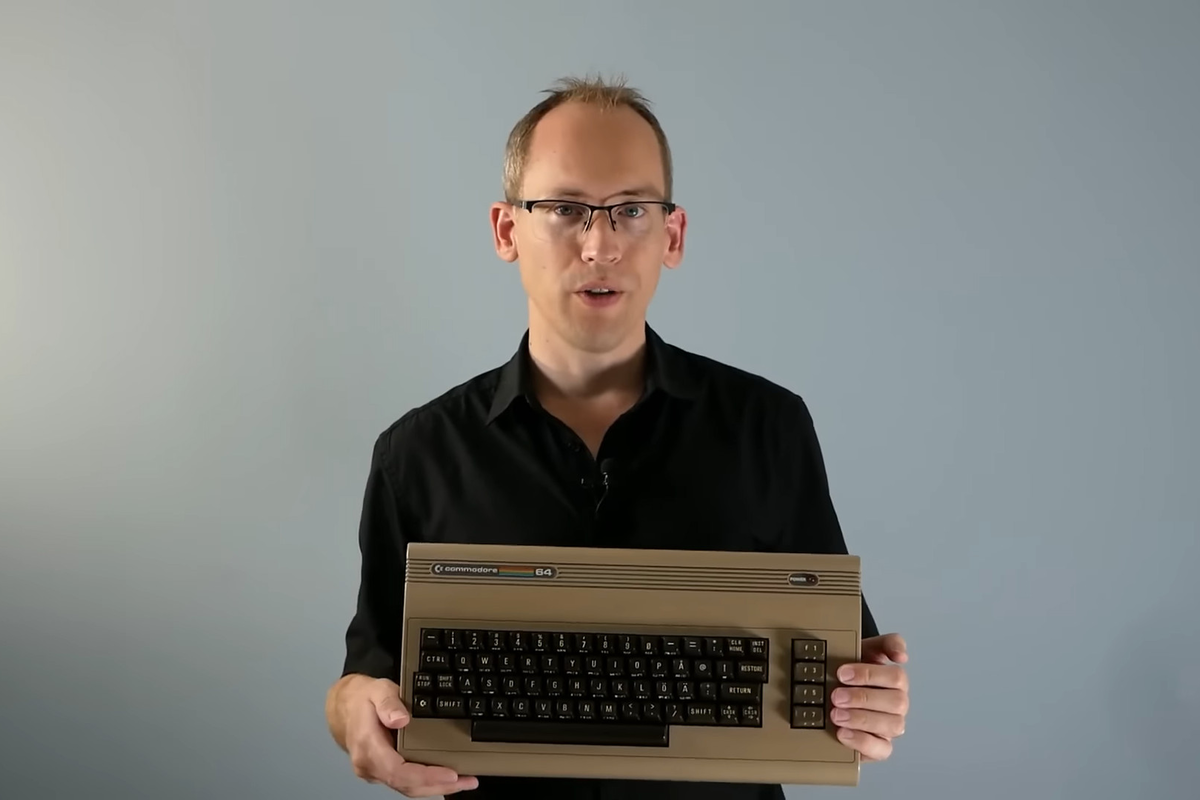
The phrase “live-codes music on the Commodore 64” sounds like something a time traveler would shout while running out of an electronics store in 1983. Yet that is exactly what makes Linus Åkesson’s Commodore 64 music experiment so fascinating. Instead of opening a modern digital audio workstation, browsing a library of polished synth presets, and dragging notes around with a mouse, Åkesson sits down at a classic C64 and builds music from the ground up using BASIC, memory addresses, hardware registers, and a heroic amount of patience.
This is not simply retro nostalgia with a beige keyboard. It is a demonstration of how deeply music, programming, and hardware can be connected when the machine is small enough to understand. The Commodore 64, released in the early 1980s, became one of the most beloved home computers ever made. Its 64 kilobytes of memory, MOS 6510 processor, and famous SID sound chip turned bedrooms, basements, and school desks into tiny creative laboratories. For many people, the C64 was not just a computer. It was a game console, a music box, a programming teacher, and occasionally a plastic rectangle that made adults ask, “Why is the television making robot noises?”
Linus Åkesson, also known in the demoscene as lft, understands this machine at a level that feels almost unfair. His work often explores the boundary between limitation and expression: tiny demos, handmade instruments, SID compositions, and projects that squeeze surprising beauty out of old hardware. In his live-coded Commodore 64 music session, the magic is not that the machine can make sound. The magic is watching a complete musical system appear line by line, number by number, directly at the BASIC prompt.
What Does “Live-Coding Music” Mean?
Live coding is the practice of creating or modifying code while a program is running, often as a performance. In modern electronic music scenes, live coders may project their screens so audiences can watch rhythms, patterns, and sound rules change in real time. Instead of hiding the machinery behind the music, live coding makes the machinery part of the show. The audience hears the result and sees the instructions that generate it.
On a modern laptop, this might involve specialized environments designed for algorithmic music. On a Commodore 64, it means something more primitive and more charming. There is no luxurious interface, no undo history, and no glowing waveform display. There is just the screen, the keyboard, BASIC, and the willingness to speak directly to the hardware.
Åkesson’s approach is especially striking because he uses the Commodore 64’s built-in environment rather than relying on a polished music tracker. Trackers are wonderful tools, and they helped define the sound of chiptune and demoscene music for decades. But here, the point is different. The performance shows how a synthesizer, sequencer, and editor can be invented from almost nothing. The code does not merely play the music. The code becomes the instrument.
The Commodore 64: A Tiny Computer With a Giant Musical Personality
The Commodore 64 earned its reputation by being affordable, widely available, and unusually capable for its time. It could connect to a television, load software from cartridges, disks, or cassette tapes, and run programs written by ordinary users. For a generation of young programmers, typing commands into BASIC was the first taste of controlling a machine with language.
But the C64’s secret weapon was sound. Inside the machine lived the SID chip, short for Sound Interface Device. Designed by Bob Yannes, who later helped found the synthesizer company Ensoniq, the SID was far more expressive than many competing sound chips of the era. It offered three independent voices, multiple waveforms, ADSR envelope control, ring modulation, oscillator sync, noise generation, and filtering. In plain English, it was not just a beep generator. It was a compact synthesizer with attitude.
That attitude matters. The SID chip has a sound people can recognize almost instantly: bright, buzzy leads; rubbery basses; crunchy percussion; shimmering arpeggios; and filters that can feel smooth, gritty, or gloriously unstable depending on the chip revision. The older 6581 and later 8580 SID models are similar in concept but have different quirks. Modern C64 musicians often care deeply about those quirks because the imperfections are part of the instrument’s personality. A perfectly clean SID would be like a perfectly polite punk band. Technically impressive, perhaps, but missing the grin.
Why POKE Matters: Talking Directly to the Machine
A key part of Åkesson’s live-coding session is the use of POKE. In Commodore BASIC, POKE writes a value directly into a memory address. That may sound dry, but on a machine like the C64, memory addresses are not only storage locations. Some addresses are connected to hardware. Write the right number into the right location, and you can change the screen color, move sprites, or control the SID chip.
This makes POKE feel like a tiny command spell. A modern musician might turn a filter knob. A C64 programmer might POKE a number into a SID register. A modern producer might choose a synth preset called “Cyber Pluck Dream 07.” A C64 coder might set a waveform bit, define an envelope, adjust frequency bytes, and hope the speakers respond with something more musical than a caffeinated fax machine.
In Åkesson’s performance, the audio is generated by writing values to SID registers. Frequencies, waveforms, note triggers, and rhythmic changes are handled through code. The process reveals a wonderful truth about old computers: they do not hide much. The distance between idea and hardware is short. If you know where to write, the machine answers.
Building a Synthesizer From Scratch
The first major idea in the session is synthesis. A synthesizer needs a way to produce sound, shape it, and control how it changes over time. On the Commodore 64, the SID chip provides the raw ingredients, but the programmer still has to organize them into something usable.
A basic SID voice needs frequency values to determine pitch, waveform settings to determine tone, and envelope settings to determine how the sound begins, sustains, and ends. The ADSR envelope is especially important. Attack controls how quickly a note starts. Decay and sustain shape the middle of the sound. Release controls how it fades after being turned off. With different settings, the same oscillator can behave like a plucked string, a soft pad, a sharp beep, or a bass note with enough bounce to make an office chair dance.
Åkesson’s live coding demonstrates the logic behind these choices. Instead of presenting the finished instrument as a mysterious black box, he exposes the structure. The viewer sees how a sound engine can be assembled piece by piece. The educational value is enormous because it shows the relationship between musical concepts and computer operations. Pitch is not abstract; it is stored as values. Rhythm is not abstract; it is timing. Timbre is not abstract; it is waveform selection, filtering, and modulation.
Creating a Sequencer Inside BASIC
Once there is a way to make sound, the next challenge is sequencing. A sequencer stores musical events and plays them back in order. In modern music software, this usually appears as a grid, piano roll, or timeline. On the C64, Åkesson does something more delightfully strange: he turns the BASIC editing environment into part of the music editor.
Commodore BASIC already allows users to type, list, edit, and rerun program lines. Åkesson uses that interactive environment as the interface for entering musical data. In other words, the editor is not a separate application. The code itself becomes the place where the composition lives. LIST is not merely a command for viewing code; it becomes part of the workflow for composing.
This is where the project becomes wonderfully recursive. He is writing a program that helps him write music, and the music is stored in the same textual environment as the program. Code becomes data, data becomes music, and the C64 calmly continues blinking its cursor as if this sort of wizardry happens every Tuesday.
The Beauty of Constraints
The Commodore 64 is limited by modern standards. It has little memory, modest processing power, and only three SID voices. Yet those limitations are exactly what make the result compelling. Constraints force decisions. With only three voices, composers learn tricks: fast arpeggios can imply chords, noise can become percussion, and careful envelope changes can make one channel feel like several instruments taking turns.
This is one reason C64 music still has such a loyal following. The machine invites cleverness. A composer cannot simply stack unlimited tracks until the mix becomes a digital lasagna. Every sound needs a reason to exist. Every byte matters. Every timing decision affects the groove.
Åkesson’s live-coded session captures that spirit beautifully. He is not fighting the limitations so much as negotiating with them. The C64 says, “You get three voices.” The programmer says, “Fine, I’ll make them count.” The SID says, “My filter is weird.” The musician says, “Excellent, weird is a color.”
Why This Feels Different From Modern Music Production
Modern music production is incredibly powerful, but it can also separate artists from the mechanics of sound. Many producers work with presets, sample packs, templates, and visual interfaces. That is not a bad thing. Great music can come from any tool. But the Commodore 64 approach makes the mechanics impossible to ignore.
When Åkesson creates music at the BASIC prompt, every note feels earned. The process is transparent. You can see how the machine is instructed, how a pattern is stored, and how timing creates rhythm. There is no illusion that the computer is doing all the creative work by itself. Instead, the performance becomes a conversation between human intention and machine behavior.
That conversation is the heart of live coding. The performer changes the rules, the machine responds, and the result becomes music. Sometimes the response is elegant. Sometimes it is unexpected. Sometimes it is probably a bug wearing sunglasses. But even the surprises are part of the creative process.
Linus Åkesson and the Demoscene Mindset
Åkesson’s work fits naturally into the demoscene tradition. The demoscene is a computer art culture built around real-time audiovisual programs, often created under extreme technical constraints. Demos are not games and not videos. They are executable artworks that make hardware perform tricks it was never politely asked to perform by its manufacturer.
The C64 demoscene has long celebrated programmers and musicians who can squeeze astonishing results out of tiny amounts of memory and processing power. Åkesson’s earlier projects, including compact demos and SID compositions, show a consistent fascination with using limitations as creative fuel. His live-coded music session is less about showing off a finished product and more about revealing the thinking process behind such work.
That makes the performance valuable for programmers, musicians, retro-computing fans, and curious beginners. A viewer does not need to understand every address or decimal machine-code value to appreciate the larger lesson. The lesson is that creative tools are not fixed. You can build them. You can bend them. You can turn a 1980s home computer into a live performance environment with enough knowledge and mischief.
Specific Example: Turning Numbers Into a Beat
Consider a simple percussion sound on the SID. The chip includes a noise waveform, which can be shaped with a short envelope to create a snare-like or hi-hat-like burst. A programmer can trigger that sound at specific time intervals, creating a rhythm. Add a bass voice on another channel and a fast arpeggiated lead on the third, and suddenly three limited voices begin to feel like a miniature band.
The clever part is not simply producing the sounds. It is organizing them so they happen at the right time. A sequencer can step through pattern data, read note values, translate them through a pitch table, and send the correct register values to the SID. The listener hears music. The computer sees loops, counters, addresses, and bytes. The artist lives between those worlds.
That is why Åkesson’s demonstration resonates. It turns invisible musical infrastructure into something visible. You are not just hearing a chiptune. You are watching the skeleton of the chiptune assemble itself, then start dancing.
Why the Commodore 64 Still Matters
The Commodore 64 remains relevant because it is understandable in a way many modern devices are not. Today’s computers are faster by absurd margins, but they are also layered with operating systems, drivers, frameworks, permissions, and abstractions. The C64 is closer to the metal. A curious person can learn where the sound registers live, what values they expect, and how the machine behaves when those values change.
This makes the C64 a powerful teaching tool. It demonstrates core ideas in computing: memory mapping, timing, loops, data representation, binary thinking, and hardware control. It also teaches musical ideas: pitch, rhythm, timbre, envelope, repetition, variation, and arrangement. Few machines make the connection between programming and sound so immediate.
In that sense, Åkesson’s project is not merely a retro stunt. It is a reminder that computers were once widely sold as programmable creative machines. You were expected to type. You were expected to experiment. You were expected, at some point, to make a horrible noise and then figure out why.
Experience Section: What It Feels Like to Try Commodore 64 Music Coding
Trying to make music the Commodore 64 way is both inspiring and humbling. The first experience is usually confusion. You read about SID registers and think, “Sure, three voices, waveforms, envelopes. How hard can it be?” Then you type a few commands, POKE a few values, and the machine produces a sound that can best be described as a toaster discovering jazz. It is funny, but it is also addictive. The moment you realize that a number you typed directly changed the sound coming from the speaker, the whole computer feels alive.
The second experience is respect. Modern tools hide enormous complexity, which is convenient until you want to understand what is really happening. On the C64, there is nowhere to hide. If the note is wrong, your frequency value may be wrong. If the sound clicks strangely, your envelope or gate timing may be wrong. If the rhythm drifts, your loop timing may be wrong. The machine is not cruel, but it is honest. It gives you exactly what you asked for, even when what you asked for was accidentally ridiculous.
After a while, the limitations become less frustrating and more musical. Three voices begin to feel like a puzzle instead of a punishment. You start thinking in roles: one voice for bass, one for melody, one for percussion or harmony. You learn that a fast arpeggio can suggest a chord. You learn that noise is not just noise; with the right envelope, it becomes a drum. You learn that repetition is useful, but small changes keep a loop alive. The process feels less like arranging tracks and more like training a tiny electronic trio with very strong opinions.
There is also a special joy in using the BASIC prompt as a creative space. It feels immediate, almost conversational. Type, run, listen, adjust, repeat. The screen becomes a notebook, a score, a control panel, and a workshop bench at the same time. Mistakes are common, but they are often interesting. A wrong value might create a harsh buzz, a strange wobble, or a rhythmic hiccup that suggests a new idea. On a modern system, you might delete that mistake. On the C64, you might build a chorus around it.
Watching Linus Åkesson live-code music on the Commodore 64 captures that experience at an expert level. He shows what happens when deep technical knowledge meets playfulness. The performance is not impressive only because it is difficult. It is impressive because it makes difficulty feel inviting. It suggests that old computers are not museum pieces sealed behind glass. They are instruments waiting for someone curious enough to press the keys, poke the registers, and listen carefully when the past starts singing back.
Conclusion
“Linus Live-Codes Music On The Commodore 64” is more than a clever retro-computing headline. It is a compact lesson in creativity under constraint, a celebration of the SID chip’s enduring personality, and a reminder that programming can be a performing art. By building sound, sequencing, and editing directly inside the C64’s BASIC environment, Linus Åkesson turns a familiar old computer into a transparent musical laboratory.
The result is charming because it is technical, and technical because it is charming. Every POKE, every register value, every loop, and every musical pattern shows how much can happen when a programmer understands the machine deeply enough to play it like an instrument. In an age of endless plugins and invisible automation, the Commodore 64 still has something important to teach: limitations are not the enemy of creativity. Sometimes they are the rhythm section.
Note: This article is original, publication-ready HTML synthesized from reputable public information about Linus Åkesson’s Commodore 64 music work, the SID chip, retro-computing history, and live-coding culture.












