
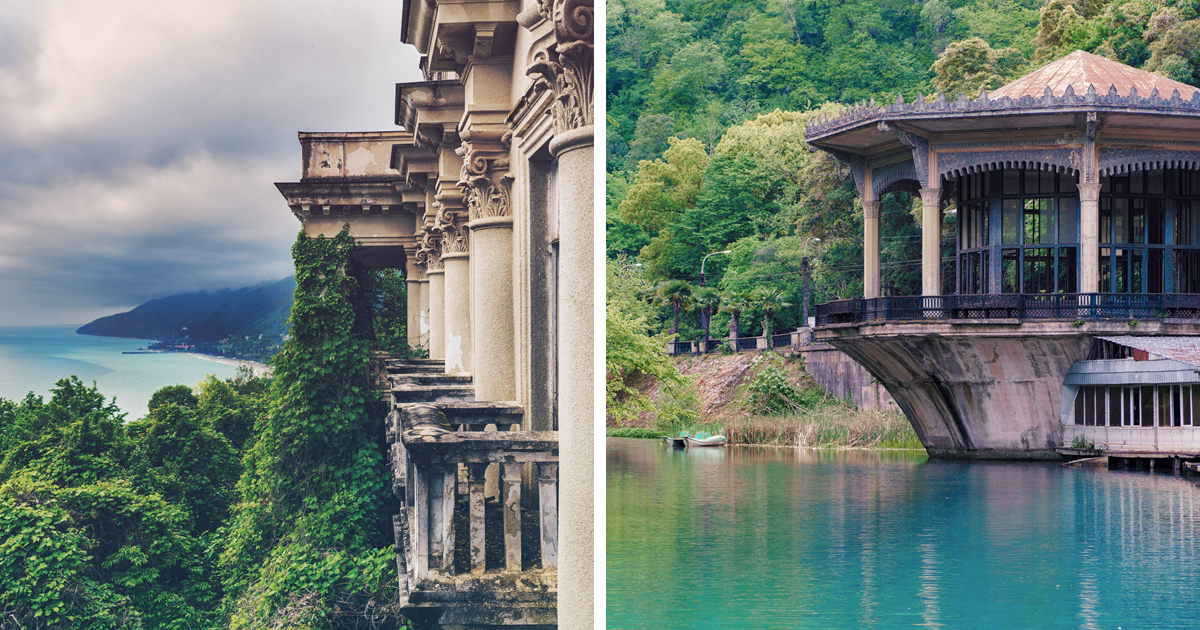
Some places look abandoned. Abkhazia looks like history hit pause, dropped the camera, and walked away.
Stretching along the Black Sea with mountains looming behind it, this disputed region has a strange visual power that is hard to shake. One minute you are imagining glamorous Soviet seaside holidays, grand columns, polished lobbies, and pier-side evenings. The next, you are staring at hollow windows, cracked concrete, rusted railings, and trees that have casually moved into apartment blocks like they signed a lease years ago. It is beautiful, unsettling, and almost absurdly photogenic in the way only places shaped by both ambition and catastrophe can be.
This is the written companion to a 23-photo-style gallery of Abkhazia’s ruins: the kind of collection that makes you zoom in on every staircase, every broken balcony, every vine-wrapped facade, and every corridor that still looks like it is waiting for someone who never came back. And while the scenery is undeniably dramatic, these ruins are not just moody backdrops for social media. They are tied to conflict, displacement, lost tourism, broken civic life, and a region whose political status remains deeply contested.
So yes, the visuals are jaw-dropping. But the real story is bigger than decay. Abkhazia’s ruins are part ghost story, part architecture lesson, part cautionary tale, and part memory palace built from concrete, sea salt, and silence.
Why Abkhazia’s ruins hit so hard
Ruins are everywhere in the world, but Abkhazia has a particular vibe that feels almost cinematic. That is because the contrast is so extreme. This is a land of palms, beaches, subtropical air, mountain rivers, and lush hillsides. In most places with this kind of scenery, the real estate brochures would be shouting in all caps. In Abkhazia, nature and damaged architecture share the stage in a way that feels eerie and strangely elegant.
A big part of that comes from the region’s past. During the Soviet era, Abkhazia was known as a resort destination. Sanatoriums, hotels, civic buildings, rail infrastructure, and public spaces were built with real confidence. These were not shy structures. They were designed to impress, to frame the coastline, and to announce that leisure, health, and state power could all wear the same stylish concrete suit.
Then came war, isolation, economic decline, and years of unresolved political tension. The result is a landscape where grandeur never fully disappeared, but maintenance absolutely did. And that makes the ruins feel more emotional than merely old. They are not ancient leftovers. They are the visible remains of a very modern collapse.
The ruins that define the Abkhazia aesthetic
1. Akarmara: the ghost town that looks like nature won the argument
If Abkhazia has a poster child for post-apocalyptic beauty, it is Akarmara. Once a coal-mining town, it now reads like a collaboration between Soviet urban planning and an overachieving forest. Apartment blocks stand with their shells intact, but life has drained out of them. Streets that once carried workers and families now feel like film sets waiting for a director to yell, “More fog, less hope.”
What makes Akarmara so unforgettable is scale. This is not one lonely building in the woods. It is an entire settlement where homes, offices, and public buildings sit in various stages of surrender. Vegetation creeps over facades, windows gape open, and the mountains around it make the whole place feel both protected and forgotten. It is haunting, but not sterile. The landscape keeps insisting on life, even as the architecture keeps reminding you what was lost.
2. The Council of Ministers building in Sukhumi: ruin as historical witness
Some ruins whisper. This one absolutely does not. The former Council of Ministers building in Sukhumi is one of those places that stops being a building and starts becoming a symbol. Scarred by the conflict of the early 1990s, it still carries the physical evidence of violence in a way that no polished museum label ever could.
From a distance, it has the stern presence of a government block built to last forever. Up close, the damage tells a different story. Burn marks, empty openings, crumbling interiors, and the sheer exposed mass of the structure turn it into something larger than architecture. It represents a city center where politics, war, and memory collided head-on. It is ugly in places, grand in others, and impossible to dismiss.
3. Amra Pier: faded glamour over the Black Sea
If Akarmara is the mountain ghost, Amra Pier is the seaside melancholic. The structure still reaches into the water with a kind of stubborn theatricality, as if it remembers exactly how stylish it used to be and refuses to fully let go of the performance. Built as a social spot in the Soviet period, it now stands as one of the most striking examples of leisure architecture gone threadbare.
The magic of Amra Pier is in the contradiction. The sea is still beautiful. The light is still lovely. The setting still looks like it should host cocktails, music, and dramatic sunglasses. But the deterioration is part of the scene now. Missing supports, peeling surfaces, and visible wear give the place a romantic sadness that photographers understandably cannot resist. It is the kind of ruin that makes you think not only about what it was, but about how confidently it once expected a future.
4. The sanatoriums: where health, luxury, and decline all share the same staircase
Abkhazia’s abandoned or damaged sanatoriums may be the most visually rich ruins of the bunch. They are packed with the features urban explorers love: sweeping staircases, columns, long corridors, faded ornament, empty halls, and giant windows framing absurdly beautiful views. Some were once meant for rest, rehabilitation, and carefully managed Soviet leisure. Now they feel like cathedrals of interrupted comfort.
That is what makes these sites so compelling. They were designed around wellness and grandeur, not military drama. Yet conflict and abandonment transformed them anyway. You can almost picture the past lives layered inside them: guests arriving with suitcases, staff opening tall doors, sea air drifting through lobbies, and conversations echoing in dining rooms. Then the sound cuts out, and all that remains is dust, damage, and the architecture itself trying very hard to remember its lines.
5. Railway relics and stations: travel dreams gone still
Every region with a complicated history seems to have one abandoned transport site that punches above its weight emotionally. In Abkhazia, decaying stations and rail-adjacent spaces do exactly that. Train infrastructure always carries a special symbolism because it is about movement, connection, commerce, and ordinary life. When it falls silent, the silence feels bigger than the building.
That is why abandoned station scenes in and around Sukhumi hit so hard in photographs. Platforms, signs, kiosks, waiting areas, and tracks belong to a world built around coming and going. In a territory marked by separation and unresolved status, those details feel almost cruelly poetic.
What the 23 pictures would really show
If this gallery had 23 images lined up in sequence, here is the kind of story they would tell.
- A facade that still looks proud, even with half its windows missing.
- A balcony where plants have achieved better occupancy rates than people.
- A corridor with perfect symmetry and absolutely no practical future.
- A staircase that somehow remains elegant while surrounded by ruin.
- Faded Soviet design details that refuse to stop being stylish.
- An empty hall where the silence feels louder than a crowd.
- A train platform that makes you think of departures that never happened.
- A broken sign that once promised convenience, order, and destination.
- A view of the Black Sea that feels almost rude in its beauty.
- A shell of a sanatorium framed by palms and sunlight.
- A government building that now reads like a lesson in permanence failing.
- A town street where the mountains look more alive than the windows.
- A room stripped to concrete but still holding onto decorative flourishes.
- A pier that seems torn between collapse and one last glamorous summer.
- A roofline softened by time, weather, and opportunistic greenery.
- A doorway that invites curiosity and immediately raises your blood pressure.
- A courtyard where nature has started redecorating without permission.
- A wall marked by age, conflict, and the occasional stubborn shadow.
- An interior so empty it feels staged, except nothing about it is fake.
- A streetlamp or railing that somehow survived, quietly doing its best.
- A hotel or health complex that still hints at coastal glamour.
- A panoramic shot where mountains, sea, and ruin all compete for attention.
- A final frame that leaves you wondering whether you just looked at decay or memory.
Why these ruins matter beyond the visual drama
It would be easy to turn Abkhazia into nothing more than “look at this eerie abandoned place” content. The internet loves a good ruin, after all. But Abkhazia deserves more care than that. These sites are bound up with war, displacement, unresolved identity, and a long political dispute that still shapes daily life and outside access. Even now, the region sits in a tense geopolitical reality that makes any conversation about travel, sovereignty, or redevelopment more complicated than a typical destination article.
That is why the best way to look at these ruins is with two lenses at once. The first lens appreciates the architecture, atmosphere, texture, and sheer visual force of the places. The second remembers that broken buildings are often the easiest part of a conflict to photograph. Human consequences are harder to capture, but they are the real story underneath the concrete.
There is also something revealing about how these ruins continue to fascinate people. They remind us that architecture is not neutral. Buildings record ambition. They record ideology. They record money, optimism, vanity, and power. And when they fall apart, they also record neglect, violence, and historical rupture. In Abkhazia, the ruins are not random leftovers. They are the region’s unofficial archive, written in cracked plaster and sea-weathered steel.
500-word experience: what it feels like to move through Abkhazia’s ruined landscape
The experience of looking at Abkhazia’s ruins is not like flipping through ordinary travel photos. It feels closer to entering a conversation halfway through and realizing the other speaker is history itself. Nothing looks fully dead, yet nothing looks comfortably alive either. The buildings seem suspended between memory and disappearance, which gives every image a strange emotional delay. You do not just see a ruin. You feel the before-and-after at the same time.
Imagine standing near the coast with the Black Sea light bouncing off a weathered facade. The air suggests vacation. The building suggests evacuation. Your brain tries to choose one mood and fails. That clash is the defining experience. Abkhazia’s ruins are so visually rich because they constantly force beauty and damage into the same frame. Palm trees do not care about geopolitics. Sunlight does not pause for unresolved conflict. Vines happily climb over whatever humans leave behind. The result is scenery that feels almost too symbolic to be real.
Then there is the scale of emptiness. In many abandoned places, one room or one structure carries the atmosphere. In Abkhazia, entire districts and towns can feel like they have drifted a few inches out of time. A staircase is not just a staircase; it feels like an invitation to imagine the footsteps that once used it. A broken pier is not just a broken pier; it becomes a stage where leisure, status, and decline all take a final bow together. Even a corridor can feel dramatic, because it hints at routines that once made the place ordinary. And ordinary life, once lost, is often more haunting than any collapse.
There is also an odd dignity to many of these ruins. They do not all look defeated. Some still look theatrical, proud, even a little vain. A sanatorium lobby can still appear grand. A government building can still loom. A seaside structure can still flirt with elegance. That lingering self-importance is part of what makes the experience so memorable. The buildings have not fully accepted that their era is over.
Emotionally, the strongest impression is not fear. It is tension. You feel curiosity, admiration, sadness, and caution all at once. The photographer in you wants to study every angle, line, and shadow. The historian in you wants context. The human in you remembers that ruins like these are never just aesthetic accidents. They are connected to real upheaval, real departures, and real unfinished stories.
And maybe that is why Abkhazia lingers in the mind longer than many other abandoned places. It is not only the decay that stays with you. It is the contradiction. The sea is still gorgeous. The mountains are still magnificent. The architecture is still impressive. But the silence inside the frame keeps changing what beauty means. By the time you finish the gallery, you are not just impressed. You are a little unsettled, a little reflective, and very aware that some landscapes do not merely show history. They absorb it.
Conclusion
Abkhazia’s ruins are jaw-dropping for the obvious reasons: the scale, the scenery, the architecture, the almost unbelievable contrast between subtropical beauty and structural collapse. But what makes them truly unforgettable is that they are not empty spectacle. They are visual evidence of a region shaped by conflict, contested identity, interrupted tourism, and a past that still refuses to stay politely in the background.
That is why a gallery of 23 pictures from Abkhazia would never be just a collection of “cool abandoned places.” It would be a portrait of grandeur after fracture, beauty after upheaval, and memory after the crowd has gone home. The ruins are dramatic, yes. They are also deeply human. And that combination is exactly what makes them impossible to scroll past.












