
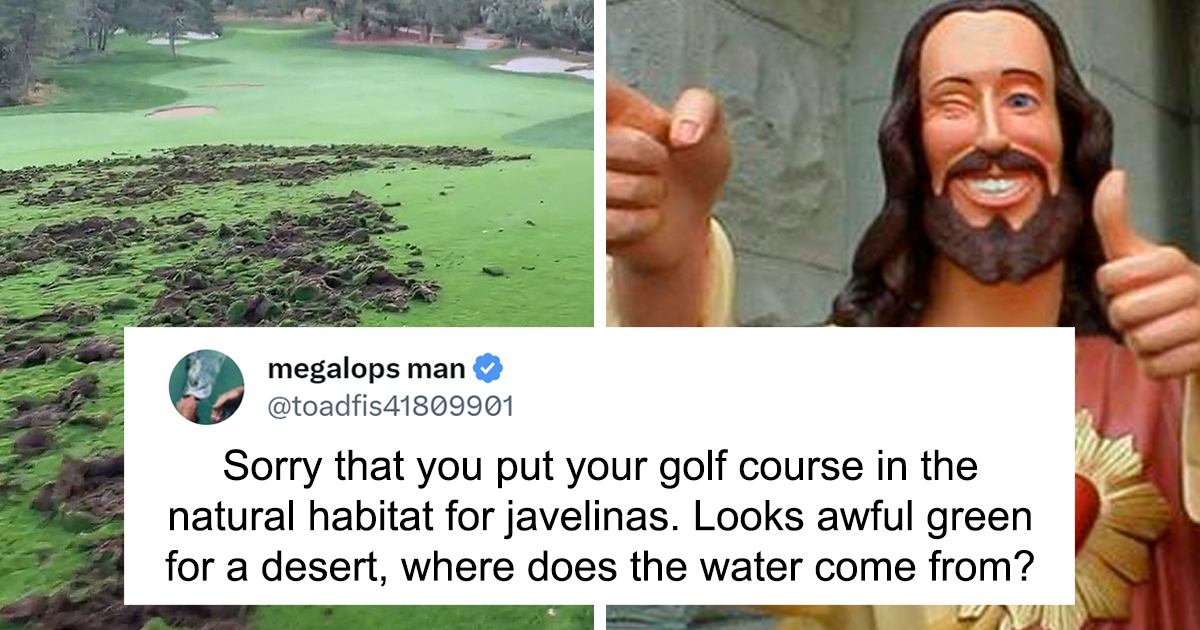
In the polished world of golf, divots are supposed to be small, accidental, and follf grass. At one Arizona course, however, the divots looked less like golf etiquette failures and more like the aftermath of an overnight landscaping rebellion.
A herd of javelinas had arrived, lowered their sturdy snouts, and treated the fairways like an all-you-can-dig buffet. By sunrise, carefully maintained turf had been peeled back, churned up, and scattered across the ground. The course crew saw an expensive repair job. Millions of people online saw furry little revolutionaries striking a blow against manicured lawns.
The incident became much more than a funny wildlife video. It sparked arguments about desert water use, natural habitat, private recreation, responsible golf-course management, and the increasingly complicated relationship between humans and animals in the American Southwest.
The Night Javelinas Redesigned an Arizona Golf Course
The viral scene unfolded at Seven Canyons Golf Club near Sedona, Arizona. In October 2023, assistant superintendent Emily Casey posted a video showing long stretches of damaged turf. The footage followed the course’s rolling landscape as Casey documented patch after patch of grass that had been ripped open during the night.
The original post quickly attracted tens of millions of views. Local reporting later indicated that some of the heaviest damage occurred around holes nine through twelve and hole sixteen. Course managers estimated that the animals were disturbing thousands of square feet on active nights, while repair work had already cost tens of thousands of dollars. the dramatic visuals, the javelinas had not actually destroyed the entire golf course. Casey later explained that the damaged area represented less than 10% of the property. Another estimate placed the affected turf at roughly half an acre out of approximately 54 maintained acres. In other words, the video showed a serious maintenance headache, not the total collapse of Arizona golf as civilization knew it. unds Crew’s Recurring Nightmare
For the maintenance team, the incident was not a one-night surprise. Javelina activity had been occurring for weeks, with workers repeatedly arriving in the morning to replace displaced turf, smooth the soil, and repair areas that had been rooted up.
Casey said the crew encountered this kind of damage almost daily during certain parts of the year. Earlier reports also noted that employees were spending dozens of labor hours each week cleaning and repairing affected areas. The viral video merely gave the rest of the internet a front-row seat to a problem the crew already knew very well.
What Exactly Is a Javelina?
Javelinas look like compact wild pigs designed by someone who wanted maximum attitude in a medium-sized package. They have short legs, coarse grayish hair, powerful snouts, sharp canine teeth, and a pale band around the neck that gives them their other common name: the collared peccary.
They are not true pigs or feral hogs. Javelinas belong to the peccary family, an evolutionary branch native to the Western Hemisphere. Although pigs and peccaries share an ancient ancestor, the two groups have followed separate evolutionary paths for millions of years. age adult javelina stands about 18 inches tall, measures roughly 32 to 36 inches long, and weighs approximately 40 to 60 pounds. That may not sound enormous, but a coordinated group equipped with strong noses, hooves, determination, and absolutely no respect for tee-time schedules can accomplish impressive amounts of excavation. Prefer to Travel With Backup
Javelinas are highly social animals. They commonly travel in herds that may contain anywhere from a few individuals to more than 20. Group living helps them defend territory, avoid predators, regulate body temperature, and maintain social bonds. They also share a distinctive musky scent, creating what could generously be described as a recognizable team fragrance. veral javelinas discover a productive feeding site, the result can resemble a miniature agricultural operation. Unfortunately for property managers, their preferred equipment includes noses rather than precision tools.
Why Were the Javelinas Digging Up the Turf?
The animals were not conducting an ideological protest against golf. They were searching for food.
Course managers believed the javelinas were digging for earthworms and other protein-rich organisms living beneath the healthy, irrigated turf. The soft soil made the food easier to reach than it was in the surrounding dry landscape. To a hungry javelina, the fairway was less a recreational surface and more a refrigerated snack drawer that somebody had carelessly left unlocked. , Dry Summer Changed the Menu
The timing mattered. Seven Canyons managers linked the unusually heavy damage to a particularly hot and dry summer. The Sedona area reportedly received less than two inches of monsoon-season rain that year, compared with approximately 18 inches during the previous summer. When natural sources of food and moisture became scarce, irrigated turf offered an attractive alternative. b had experienced similar incursions during previous dry cycles, although the 2023 damage was unusually visible and persistent. This pattern suggests the javelinas were responding to environmental conditions rather than suddenly developing a personal grudge against putting greens.
The course sits amid extensive forest and wildlife habitat, so encounters with animals are part of operating in the area. The challenge is that a golf course creates a concentrated patch of green vegetation, damp soil, insects, roots, and water in a landscape that may be struggling through drought. Wildlife does not recognize the boundary between native habitat and a privately maintained sporting facility. It recognizes opportunity.
The Course Tried Some Creative Deterrents
Seven Canyons worked with the Arizona Game and Fish Department to explore ways of reducing the damage while continuing to coexist with local wildlife. Possible long-term measures included improving fencing around vulnerable areas. In the short term, the course experimented with several repellents. lier attempt involved granules made with coyote urine. In theory, the scent of a predator should have encouraged the javelinas to leave. Instead, the animals apparently found the treatment interesting. The club’s general manager joked that it was like sprinkling bacon bits on their salad.
Chili oil proved more promising. Managers found that the javelinas appeared to dislike the spicy treatment, although developing a mixture strong enough to repel animals without harming the grass required experimentation. The situation became an unusual balancing act involving turf health, wildlife behavior, chemistry, fencing, weather, and the discovery that even Southwestern animals may object to Southwestern seasoning.
Why the Internet Joined Team Javelina
The internet did not react as a neutral committee of wildlife-management professionals. Many users immediately declared their allegiance to the animals.
Comments framed the javelinas as ecological heroes, labor organizers, anti-golf activists, or determined rewilding consultants. Some people argued that golf courses occupy large areas of land and require resources that could support native vegetation. Others simply enjoyed watching a group of determined mammals create chaos in a space associated with wealth and exclusivity.
Environmental coverage of the incident observed that the javelinas were native wildlife responding to available resources, while the golf course represented a human-created landscape within their broader environment. This framing helped fuel the popularity of “Team Javelina,” especially among people already concerned about habitat loss and water consumption in the Southwest. Courses Are Easy Targets Online
Golf has a complicated public image. Supporters see courses as recreational spaces, employers, tourism assets, and carefully managed landscapes. Critics see private acreage, intensive turf maintenance, chemical use, and irrigation in regions where water is limited.
Arizona’s golf industry has made measurable efforts to reduce its environmental footprint. State research has documented increased use of treated wastewater, irrigation audits, turf removal, and other conservation practices. One state-supported study found that treated effluent accounted for 34% of the water used to irrigate Arizona golf courses at the time of the research. courses are also experimenting with native grasses and low-water ground covers. Research supported by the USGA and the University of Arizona found that replacing some managed turf with native plants can reduce irrigation, fertilizer, pesticide use, mowing, and labor while improving habitat for insects and other wildlife. ntext makes the debate more complicated than “golf bad, javelina good.” Some courses are resource-intensive. Others are actively removing turf, using reclaimed water, protecting wildlife corridors, and adopting more sustainable maintenance practices. A viral clip rarely pauses long enough to examine an irrigation audit.
Were the Javelinas the Villains?
Calling the animals destructive is understandable from the grounds crew’s perspective. The damage required money, labor, equipment, and repeated repairs. Workers who had spent months maintaining the turf were not unreasonable for feeling frustrated when an overnight herd converted it into green confetti.
Still, the javelinas were behaving naturally. They were not invading a conference room, stealing golf carts, or selling unauthorized memberships. They were following scent, moisture, and food through a landscape where natural resources had been reduced by heat and drought.
Arizona wildlife officials advise people to discourage javelina visits by securing trash, removing accessible food, cleaning outdoor feeding areas, protecting gardens, and avoiding deliberate feeding. The animals should be observed from a distance, particularly when young javelinas are present or when a herd appears defensive. e principle applies on a larger scale. Human developments in wildlife habitat need barriers, waste controls, landscape planning, and realistic expectations. A green space surrounded by dry terrain will attract animals. Calling them rude does not make the worms beneath the grass less delicious.
What the Viral Javelina Incident Actually Teaches Us
Wildlife Will Exploit Artificial Oases
Irrigated landscapes create concentrated resources. During dry periods, animals may enter neighborhoods, parks, farms, resorts, and golf courses because those spaces contain water and food that are no longer easy to find elsewhere.
Coexistence Requires More Than Removing Animals
Relocating one herd may provide temporary relief, but another group can eventually discover the same food source. Durable solutions are more likely to involve fencing, habitat-sensitive design, targeted repellents, reduced attractants, and continued consultation with wildlife specialists.
Sustainable Golf Is More Practical Than Perfect Turf
Golf courses in arid regions may need to reconsider how much uniformly green turf is necessary for enjoyable play. Native grasses, narrower irrigated corridors, drought-tolerant landscaping, reclaimed water, and realistic aesthetic standards can reduce both environmental pressure and maintenance costs.
Viral Stories Prefer Heroes and Villains
Online audiences wanted the javelinas to be fearless environmental warriors. Some headlines portrayed them as destructive pests. Reality was less theatrical: hungry animals found worms beneath soft grass, and tired workers had to repair the damage. Both sides were responding logically to the same landscape.
A 500-Word Experience-Based Perspective: The Morning After the Javelinas
The following composite scenario reflects the practical experiences reported by golf-course employees, Arizona residents, wildlife agencies, and property managers who regularly share space with javelinas.
Imagine arriving at a desert golf course shortly after sunrise. From a distance, everything still appears perfect. Red-rock formations catch the morning light, sprinklers finish their final cycles, and the first fairway looks smooth enough to iron a shirt on.
Then the maintenance cart rounds a bend.
A broad strip of grass has been folded backward like someone tried to open the fairway with a giant can opener. Nearby, smaller sections of turf lie upside down. Soil covers the pathway. Hoofprints disappear toward a patch of native vegetation, where the overnight landscaping department has clocked out without leaving a forwarding address.
The first emotional reaction is disbelief. The second is frustration. The third is practical calculation: How many workers are available? Can the turf be replaced? Is the irrigation system damaged? Will the repaired area remain playable? Are the javelinas likely to return tomorrow night?
Repairing the surface is slow, physical work. Crews lift displaced pieces, restore the soil beneath them, fit the turf back into place, add sand or seed where necessary, and water the area carefully. The process resembles rebuilding a puzzle after somebody has buried half the pieces.
Meanwhile, golfers begin arriving. Most are curious. Some take photographs. A few offer theories with the confidence of people who have never personally negotiated with a nocturnal peccary. One golfer recommends brighter lights. Another suggests an electronic noise machine. Someone inevitably proposes a fence as though fencing miles of rugged terrain were equivalent to closing a backyard gate.
Residents in Arizona communities describe a similar mix of irritation and fascination. Javelinas may overturn trash cans, eat decorative plants, investigate pet food, or wander across driveways in groups. They can appear comical when viewed through a window and considerably less comical when standing between a person and a parked car.
The most useful experience is learning not to treat them like oversized neighborhood pets. They should not be fed, approached, cornered, or encouraged to associate people with food. Dogs should be controlled because javelinas may interpret them as predators. Trash and outdoor food must be secured, and safe distance matters more than obtaining an impressive phone video.
For a course manager, coexistence eventually becomes part of routine operations. Wildlife tracks are checked alongside irrigation lines. Staff identify vulnerable entry points. Repellents are tested. Fencing is improved where practical. Native vegetation may be used to create transitions between intensively managed turf and the surrounding habitat.
The experience also changes how a person sees the landscape. A fairway is not only a playing surface. It is moist soil, shelter, insects, roots, water, and scent. To humans, it has boundaries, ownership records, maintenance budgets, and numbered holes. To a javelina, it is simply the most promising patch of ground encountered that night.
That realization does not make the repair bill disappear. It does, however, replace the idea of a wildlife “attack” with a more useful question: How can a human-designed landscape function without becoming an irresistible buffet for every hungry animal nearby?
Conclusion: The Javelinas Won the Internet, but Coexistence Is the Real Prize
The javelinas of Seven Canyons Golf Club became internet celebrities because their work was visual, chaotic, and wonderfully easy to turn into a metaphor. To some viewers, they were heroes reclaiming desert land. To course employees, they were powerful animals creating expensive damage during already demanding workdays.
Both reactions contain part of the truth. Golf courses in dry regions must continue reducing unnecessary turf, improving irrigation, using reclaimed water, and integrating native habitat. At the same time, wildlife conflicts require responsible deterrence rather than romanticizing property damage or treating native animals as enemies.
The javelinas were not seeking political victory. They were seeking breakfast. The internet supplied the revolution, the jokes, and the cheering section.
Note: This article is an original synthesis based on reporting from U.S. national and Arizona news organizations, wildlife guidance from the Arizona Game and Fish Department and National Park Service, local coverage of Seven Canyons Golf Club, and research on sustainable golf-course management. id=”seo-tags”>













