
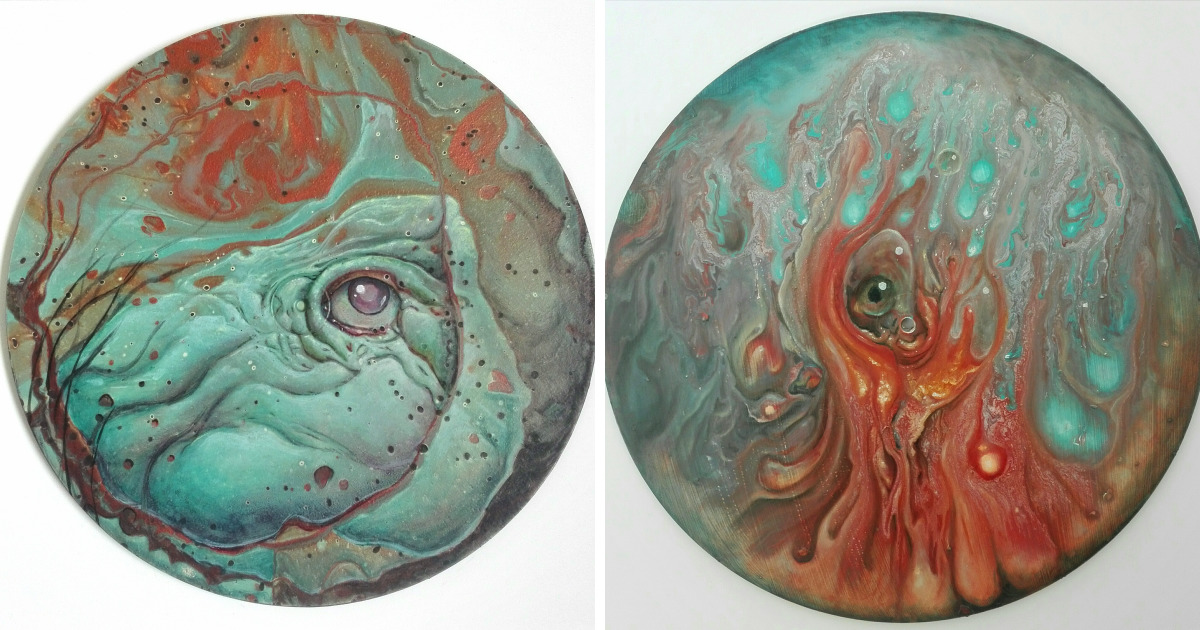
Some art begins with a sketchbook. Some begins with a museum visit. And some, apparently, begins when somebody looks at a vinyl record, a Ouija board, and a fidget spinner and says, “Yes, these three obviously belong together.” That odd little collision of objects is exactly what makes this idea so irresistible. It sounds like the punchline to a joke told at an art school Halloween party, yet the finished work can be stunning: swirling paint, ghostly shapes, deep shadows, and record-sized worlds that feel half accidental and half summoned.
The title “I Paint Records With A Ouija Board And Fidget Spinner” grabs attention because it sounds impossible, silly, spooky, and creative all at once. But beneath the unusual setup is a very real lesson about modern art: people are drawn to process as much as product. We don’t just want to see a finished painting anymore. We want to know how it was made, what unusual materials were used, and why the result feels unlike anything else hanging on a wall. In a digital world packed with polished sameness, weird process has become its own kind of authenticity.
That is why this kind of vinyl record painting sticks in the mind. It combines recycled materials, acrylic pouring, spin art, horror-inspired imagination, and a little wink of pop-culture absurdity. It turns a forgotten record into a canvas, turns motion into a brush, and turns randomness into a creature, a face, or a surreal vision. Honestly, it is part studio practice and part controlled chaos. And that is a very fun neighborhood for art to live in.
What This Record-Painting Idea Actually Is
At its core, the concept is surprisingly simple. Paint is poured onto a vinyl record while the record is mounted to a spinning base. As it rotates, the paint is pushed outward and stretched into rings, ripples, and organic shapes. After the surface dries, the artist can go back in with brushes and additional paint to refine the forms that seem to appear naturally. What begins as a fluid-art experiment can end as a fully realized surreal painting.
That second step matters. Without it, the piece might remain an abstract swirl. With it, the painting becomes something else entirely. A smudge becomes a haunted eye. A burst of crimson becomes the ribs of a monster. A splash of blue turns into the jawline of some sea-creature that looks like it pays taxes in the underworld. The spinning stage creates possibility; the hand-painted stage creates meaning.
This is what makes the method more than a gimmick. Yes, the tools are unusual. Yes, the setup sounds delightfully ridiculous. But the final work depends on artistic judgment: knowing when a random form is worth developing, knowing which areas need contrast, and knowing how to guide the viewer’s eye across a round composition. That is not luck. That is craft wearing a weird hat.
Why Painting on Vinyl Records Works So Well
The Circle Does Half the Job
A vinyl record is already a dramatic surface. It is black, glossy, circular, and loaded with cultural baggage in the best way. Even before the paint goes on, the format suggests music, nostalgia, collecting, and physical touch. Unlike a blank square canvas, a record has a personality. It arrives with history baked into its grooves.
The round shape also flatters spin-based painting. Paint radiates outward naturally, forming rings, halos, and bursts that feel intentional even when they begin as chance. The eye loves symmetry, and a spinning circle delivers it without trying too hard. This is why painted records look so satisfying on a wall. The format frames the motion for you.
Fluid Paint Loves Motion
Fluid acrylics and pouring mediums are made to move. They slide, pool, stretch, and settle in ways thicker paint does not. Once a record starts spinning, the paint reacts to motion and gravity at the same time, producing feathery edges, marbled streaks, and layered bands of color. It feels part science experiment, part magic trick, and part “please don’t bump the table right now.”
This is one reason acrylic pour art on records feels alive. The image is not merely painted onto the surface; it is physically shaped by motion. The record becomes both canvas and machine. The artist does not fully control every line, but that loss of control is exactly where the visual excitement lives.
Why the Ouija Board and Fidget Spinner Make the Idea Unforgettable
The Ouija Board Adds Theater
Let’s be honest: a Ouija board is doing more than holding the record in place. It adds narrative. It pulls in folklore, mystery, kitsch, spiritualist history, and just enough spooky energy to make people lean in. Even viewers who do not believe in anything supernatural understand the reference instantly. The board signals mood before the painting says a word.
That mood matters when the finished images suggest faces, monsters, shadows, and creatures emerging from the paint. The tool becomes part of the storytelling. Suddenly the artwork feels “summoned,” even if the real explanation is physics, imagination, and a studio full of paint cups. It is branding, symbolism, and visual humor wrapped into one object.
The Fidget Spinner Adds Pop-Culture Mischief
If the Ouija board brings the séance vibes, the fidget spinner brings the meme energy. It takes a very ordinary pop object and upgrades it into an art mechanism. That contrast is hilarious and smart. One object carries old-world mystique. The other screams modern fad. Together, they create a setup that sounds like the result of a dare and looks like the start of a clever art series.
And that combination is exactly why people remember it. Strange tools create a strong mental image. In the crowded online world of DIY art and studio videos, memorability is currency. A record spinner made from everyday objects is not just a technique; it is a story people want to retell.
From Spin Art to Surreal Painting
The most compelling part of this process is the shift from chaos to image. The spinning paint creates shapes that no one could draft with absolute precision beforehand. Those forms may look like smoke, wings, teeth, roots, or underwater tendrils. Once the paint dries, the artist studies the surface the way some people study clouds. The imagination starts connecting dots. A face appears. A creature emerges. A mood takes hold.
This approach taps into a much older artistic instinct: seeing images hidden inside texture and accident. Painters, printmakers, and surrealists have long used stains, drips, and chance effects as prompts. What makes this version feel modern is the material mash-up. Instead of ink blots or weathered plaster, the prompt comes from a spinning vinyl disc and a gloriously strange rig.
The result often has a cinematic quality. Because the forms begin in motion, they rarely feel stiff. They feel like they are arriving, dissolving, lunging, melting, or turning toward the viewer. That sense of movement gives the paintings energy even after they are completely dry. The record may stop spinning, but the image still looks like it remembers the spin.
Why This Style Fits the Current Art Moment
It Turns Upcycling Into Aesthetic Value
Art lovers and everyday shoppers alike are more interested than ever in reused materials. A painted record is not just a painting; it is a transformation. Something old becomes something newly display-worthy. That alone makes the concept attractive. It taps into the larger appeal of recycled record art and creative reuse without sounding preachy.
There is also a practical charm to it. Old records have visual character. They are durable enough for decorative art. They carry music history and design nostalgia. Even people who do not own a turntable understand that a record is an object with emotional weight. Using it as a canvas gives the artwork an instant backstory.
It Celebrates Process in a Video-Friendly Era
A huge reason this idea catches attention is that the process is extremely watchable. Paint pours. The spinner turns. The colors fling outward. Shapes appear. The artist rotates the piece, squints, and starts painting details over the abstract pattern. It is basically a built-in before-and-after transformation story, and audiences love those. The method creates its own behind-the-scenes content.
That does not make the art shallow. It makes the art legible. People are often more willing to engage with visual art when they can witness its construction. A strange tool lowers the intimidation level. Suddenly the conversation is not “Do I understand this painting?” but “Wait, you made that with what?” Curiosity opens the door that theory sometimes leaves shut.
It Connects to Vinyl’s Ongoing Comeback
There is another reason record-based art feels timely: vinyl still carries cultural heat. Records are not dead museum pieces. They remain collectible, displayable, and emotionally loaded. That gives vinyl art a double appeal. It speaks to music lovers and art lovers at the same time. A painted record can feel nostalgic without being dusty, contemporary without being cold, and playful without losing seriousness.
In other words, the material choice is not random. The medium already has an audience. People enjoy seeing records on shelves, on walls, and in carefully curated spaces. Turning them into surreal paintings expands that appeal rather than fighting it.
Specific Reasons the Finished Work Stands Out
It Balances Control and Surprise
One of the hardest things in art is making a piece feel intentional without making it feel overworked. Spin-based record art gets a head start because it contains genuine surprise. The artist cannot micromanage every mark during the spinning stage. That unpredictability gives the surface freshness. Later, the brushwork adds structure and storytelling. The combination is compelling because it mirrors how creativity often works in real life: accident first, decisions second.
It Makes Texture Feel Emotional
Swirls, puddles, streaks, and ripples are not just decorative here. They can become skin, mist, smoke, fur, scales, or atmosphere. That ability to convert texture into feeling gives the work depth. The viewer sees paint doing two jobs at once: functioning as material and pretending to be something else. Good art loves that trick.
It Has a Built-In Conversation Starter
Very few paintings come with a sentence as effective as, “This was made on a record with a Ouija board and a fidget spinner.” You do not need a long curatorial essay to get people interested. The setup makes strangers ask questions. And in the world of online publishing, galleries, craft markets, and social sharing, that kind of curiosity is powerful.
What Artists Can Learn From This Approach
Even if nobody reading this plans to build a spinning paint rig in the garage, the bigger lesson is useful: memorable art often comes from combining familiar things in unfamiliar ways. A record is familiar. A Ouija board is familiar. A fidget spinner is familiar. Put them together and suddenly the idea feels new again. Creativity does not always require expensive tools. Sometimes it requires strange chemistry between objects, references, and moods.
There is also a lesson here about permission. Many artists wait for a “serious” idea before beginning. But serious art can absolutely begin with a ridiculous sentence. In fact, that may be an advantage. Humor lowers fear. Oddness invites experimentation. And experimentation is where original style usually starts stretching its legs.
Most importantly, this method reminds us that technique should support identity. The spinning process is not interesting by itself forever. It becomes truly engaging when paired with a point of view: dark surrealism, eerie creatures, dream logic, odd beauty, retro symbolism. Tools get attention. Vision keeps it.
Conclusion
I Paint Records With A Ouija Board And Fidget Spinner works as a title because it sounds impossible, but it works as art because the idea behind it is surprisingly strong. This is not just novelty for novelty’s sake. It is a smart fusion of vinyl record art, acrylic pouring, spin-based motion, found materials, and surreal imagination. The record’s circular format enhances the movement. The fluid paint captures chance. The hand-painted finish turns that chance into image. And the bizarre combination of tools gives the whole project a personality that standard canvas work often lacks.
In a crowded creative landscape, originality often comes from the brave little decision to follow a weird instinct all the way to the wall. Painting records with a Ouija board and fidget spinner may sound like an idea invented at 2 a.m. after too much coffee and one excellent Halloween playlist. But that is part of its charm. It proves that unusual materials, playful experimentation, and genuine artistic skill can meet in one spinning, glossy, gloriously strange piece of art.
Extended Experiences Related to “I Paint Records With A Ouija Board And Fidget Spinner”
What makes this topic linger is not just the finished artwork, but the experience surrounding it. Imagine standing in a studio with an old record set in place, paint already mixed, colors waiting in cups like tiny potions with better branding. The room is quiet for a second, then the spinner starts, and suddenly everything becomes motion. The record hums. The paint slides. The first drops hit the center and race outward. In that moment, the process feels less like ordinary painting and more like collaborating with momentum itself.
There is also a strange thrill in not fully knowing what will happen next. Traditional painting often rewards planning, but this method rewards alertness. You are not only making marks; you are watching for opportunities. A streak forms unexpectedly. A ring breaks open on one side. Two colors collide and produce a shape that looks suspiciously like a mouth, a wing, or the profile of some elegant little nightmare. The excitement comes from recognition. You do not force the image into existence right away. You notice it arriving.
That experience can be surprisingly addictive because every record behaves a little differently. The amount of paint matters. The speed matters. The angle matters. The timing matters. Even a tiny change can produce a completely different result. One piece may bloom into something cosmic and beautiful, like a painted eclipse wearing jewelry. Another may turn feral and chaotic, all sharp edges and moody shadows. That unpredictability keeps the process fresh. It feels like opening a gift from your own experiment.
For viewers, the experience is just as memorable. People rarely walk past work like this without reacting. First they laugh at the materials, because honestly, who would not? Then they look closer. They start noticing the details inside the swirls, the way the shapes seem to emerge from the black record surface, the way the circular format makes everything feel pulled by invisible force. Curiosity quickly replaces amusement. That is a wonderful shift to witness. The joke gets people in the door; the painting convinces them to stay.
There is also something satisfying about the emotional contradiction built into the process. A fidget spinner is light, playful, and a little ridiculous. A Ouija board carries mystery, folklore, and theatrical darkness. A vinyl record brings nostalgia and music history. Put them together, and the experience becomes oddly layered: playful but eerie, mechanical but expressive, retro but internet-friendly. It feels like three cultural moods crashing into each other and deciding to make art instead of trouble.
In a deeper sense, the process offers a reminder that creativity is often less about pristine conditions and more about bold combinations. The best part of the experience may be realizing that art can begin with what is already around you: old objects, odd ideas, and the willingness to try something that sounds a little absurd out loud. Some people meditate. Some people journal. And some people stare at spinning paint on a record until a monster politely introduces itself. Creativity contains multitudes.
By the end, the record no longer feels like a discarded object. It feels transformed, almost theatrical, as if it has gone from being a carrier of sound to being a keeper of image. That is the real experience at the heart of this idea: the joy of watching something familiar become strange, and then watching that strangeness become beautiful. Not every artwork gives you that kind of journey. This one does, and it does it with a wink.












