
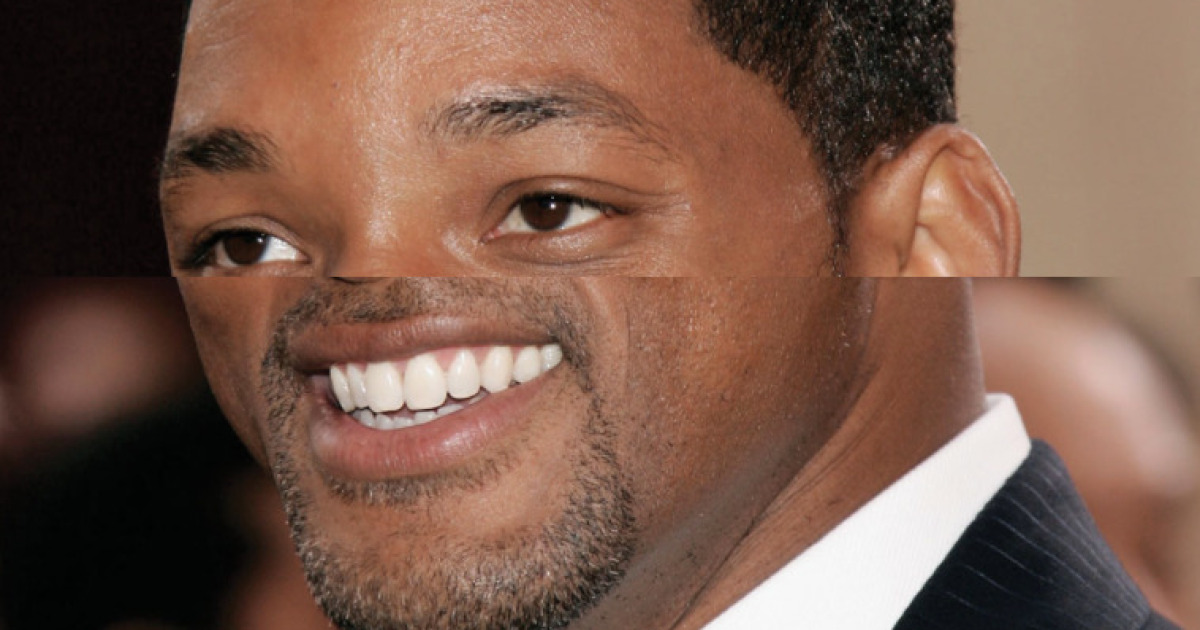
Remove a nose from a familiar face and something wonderfully strange happens. The person is still recognizable, the expression is still there, and yet the portrait suddenly looks as though reality forgot to finish loading. That simple visual joke powers this collection of 18 nose-free celebrity photo edits: a deliberately low-tech experiment in digital collage, facial perception, and the kind of humor that makes you laugh first and ask, “Why?” several seconds later.
Why Nose-Free Portraits Look So Unreasonably Funny
A face is not merely a checklist of two eyes, one nose, and one mouth. Human perception reads the entire arrangement as a connected system, using the spacing, proportions, and relationships among features to recognize identity. Studies of face processing show that we perceive faces holistically, although individual features contribute in different ways. Removing the nose does not usually erase identity, but it disrupts the expected structure just enough to make the image feel both familiar and impossible.
That contradiction is excellent fuel for comedy. The benign-violation theory of humor proposes that something can be funny when it breaks a rule or expectation while still feeling safe. A digitally erased nose is a tiny visual violation with no real-world injury attached. The result lands in the sweet spot between harmless nonsense and low-grade nightmare fuel.
The original online project was posted in 2022 by community creator Katie Nelson, who explained that the edits were made with ordinary MacBook skills rather than professional photo-editing wizardry. That roughness is part of the charm. These images are not trying to pass as flawless movie effects. They look like someone noticed a ridiculous possibility, opened an editing tool, and immediately committed to the bit.
A Tiny Digital Joke With a Surprisingly Long Art History
Cutting, rearranging, and altering photographs has deep roots in modern art. Dada artists used photomontage to disrupt polished media images and expose the absurdity of politics, advertising, and social conventions. Hannah Höch assembled fragments from magazines and fashion publications into sharp, unstable compositions. Raoul Hausmann pieced together words and photographs to create deliberately explosive visual collisions, while John Heartfield turned photomontage into political satire.
Later artists pushed collage into new emotional and cultural territory. Romare Bearden cut photographs, newspapers, prints, and painted shapes into layered scenes of Black American life. John Stezaker created uncanny portrait hybrids from old publicity photographs. Kensuke Koike rearranged vintage faces without adding or discarding material, transforming ordinary portraits into visual puzzles. Daniel Gordon built three-dimensional figures from printed images and then photographed the resulting paper constructions.
Nose removal is much sillier than most of those projects, of course. Nobody is claiming that deleting Tom Cruise’s nostrils will resolve the great artistic questions of the century. Still, the same basic mechanism is present: take a familiar image, interrupt its logic, and force the viewer to see it again. Photomontage can build utopias, dystopias, political arguments, dream worlds, orin this casea parade of people who appear to breathe entirely through confidence.
The 18 Favorite Nose-Removal Photo Edits
Each subject reacts differently to the missing-feature treatment. Some faces become cartoonish, some become oddly elegant, and a few look so natural that the edit raises uncomfortable questions about what the nose was contributing in the first place.
-
1. Voldemort: The Control Group
Starting with Voldemort is scientific honesty. There is nothing meaningful to remove, so he serves as the nose-free baseline against which all other contestants must be judged. He also proves that a missing nose can become a brand if you commit hard enough.
-
2. Dwayne Johnson
Dwayne Johnson’s strong jaw and expressive eyebrows do most of the structural work. Without a nose, his face becomes even more streamlined, like a motivational action figure designed in a wind tunnel.
-
3. Marilyn Monroe
Marilyn Monroe remains instantly recognizable because the hair, eyes, smile, and classic pose carry so much visual identity. The missing nose turns old-Hollywood glamour into elegant surrealism with a faint hint of haunted department-store mannequin.
-
4. Hugh Jackman
Hugh Jackman’s edit has the energy of Wolverine after a very specific special-effects budget cut. The smile survives, the charisma survives, and the middle of the face quietly leaves the production.
-
5. Will Smith
Will Smith’s highly expressive features make the alteration especially noticeable. His face still communicates a full emotional sentence, but the punctuation has been removed.
-
6. Tom Holland
Tom Holland already has the wide-eyed, slightly surprised expression of someone who has discovered an unexpected plot twist. Removing his nose makes the twist look personal.
-
7. Abraham Lincoln
Historical portraits carry a serious visual authority, which makes them ideal targets for harmless absurdity. Lincoln’s beard, deep-set eyes, and famous silhouette preserve the statesman while the central edit introduces a baffling alternate timeline.
-
8. Anna Kendrick
Anna Kendrick’s compact features produce one of the cleaner transformations. The result looks less like a dramatic accident and more like an oddly convincing design choice from an animated movie.
-
9. Drake
Drake’s beard supplies a sturdy lower border, so the erased nose creates an unusually smooth stretch between the eyes and mustache. It is minimalism, but applied where minimalism was never requested.
-
10. Snoop Dogg
Snoop Dogg’s relaxed expression barely acknowledges the edit. The portrait suggests that losing a major facial feature is inconvenient, perhaps, but certainly not worth interrupting the vibe.
-
11. Lin-Manuel Miranda
Lin-Manuel Miranda’s expressive eyes and signature facial hair keep the face animated. The missing nose creates the visual equivalent of a lyric with one important syllable cut out: technically incomplete, yet somehow still performing at full speed.
-
12. Donald Trump
The familiar hair, mouth, and facial proportions make the identity immediately readable even after the edit. The result demonstrates how recognition can survive a major alteration when the remaining features are visually distinctive.
-
13. Nancy Pelosi
This edit leans into the uncanny side of the experiment. The polished public portrait remains composed, while the missing nose introduces a silent surreal detail that the brain keeps tryingand failingto repair.
-
14. Lady Gaga
Lady Gaga has worn enough avant-garde looks that a nose-free portrait almost feels like a plausible editorial concept. What would look bizarre on anyone else reads here as, “Perhaps the theme was post-nasal futurism.”
-
15. Penélope Cruz
Penélope Cruz’s eyes and hair remain so visually dominant that the portrait keeps much of its elegance. The edit is still strange, but it becomes a polished kind of strangethe red-carpet version of a visual glitch.
-
16. Lewis Hamilton
Lewis Hamilton’s facial hair and strong styling preserve the overall balance of the image. The nose disappears, but the portrait keeps moving with the efficiency of a pit stop nobody remembers scheduling.
-
17. Tom Cruise
Tom Cruise’s famous smile handles most of the recognition work. Without a nose, the intensity remains untouched, which somehow makes the edit funnier. The face looks prepared to perform its own stunt and explain nothing afterward.
-
18. Madonna
Madonna closes the list with a portrait that is glamorous, familiar, and thoroughly rearranged by one missing feature. Like the best edits in the series, it occupies a narrow border between a pop-art experiment and an image your cousin sends without context at 2 a.m.
How to Make a Nose-Free Portrait Without Overcomplicating It
The easiest digital method is to select the nose, remove it non-destructively with a layer mask, and rebuild the missing area using nearby skin texture. A clone tool, healing brush, or content-aware fill can help, but perfection is optional. In fact, slightly awkward results often make the joke better because viewers can sense the handmade decision behind the edit.
Start with a front-facing, well-lit portrait. Duplicate the original layer, make a rough selection around the nose, and hide rather than permanently erase it. Sample skin from the cheeks and bridge area, then blend carefully while preserving natural shadows. Zoom out often. A technically perfect patch can still look wrong at normal viewing size, while a crude patch may become funnier when the whole face is visible.
For physical collage, print a copy, remove the nose with scissors or a craft knife, and slide another piece of matching paper behind the opening. That method produces real edges and shadows that digital tools often imitate. Modern editing software makes photomontage faster, but traditional cut-and-paste techniques can create a tactile, deliberately imperfect result.
Use Images Responsibly
For personal practice, your own photographs are the safest source material. For public or commercial use, choose public-domain images, licensed stock, or photographs you have permission to alter. In the United States, fair use depends on multiple factors and is evaluated case by case; simply changing a photograph does not automatically make every reuse lawful. Credit, permission, licensing, and the commercial purpose of the final work all deserve attention.
The Experience of Making a Nose-Removal Series
The first experience is usually disbelief at how quickly a face becomes strange. You begin with a portrait you have seen dozens of times. You make one simple selection, hide a few pixels, and suddenly the image appears to belong to a parallel universe where noses were removed during a routine software update.
The second surprise is that not every face responds equally well. Some people remain instantly recognizable because their hair, eyebrows, smile, jawline, or facial hair carries most of their visual identity. Other portraits collapse into anonymity. This turns the editing session into an accidental lesson in portrait design. You start noticing which features dominate a face, where the viewer’s attention goes first, and how much expression survives after the center has been flattened.
Then comes the temptation to over-edit. Once the nose is gone, you may want to smooth every trace of the original shape until the skin looks perfectly continuous. That can produce a technically impressive result, but it often removes the humor. A little clumsiness signals that the image is a joke, not an attempt to deceive. The best version may be the one that looks polished enough to read clearly but imperfect enough to retain the energy of a spontaneous experiment.
Choosing subjects also becomes part of the game. Serious portraits are especially effective because the source image carries dignity and control. A historical photograph, a formal headshot, or a glamorous publicity image offers a strong setup; the missing nose supplies the punchline. Expressive celebrities work for the opposite reason. Their smiles, poses, and recognizable styling continue performing even after the edit, as though nobody informed the rest of the face that a department had closed.
Sharing the finished images creates another layer of experience. Viewers tend to react in stages: recognition, confusion, close inspection, and laughter. Some immediately notice what is missing. Others know that the portrait is wrong but cannot explain why. That delayed discovery is often the funniest response because it reveals how confidently the brain accepts a familiar face before checking the details.
The project also changes the way you look at ordinary photographs. Portraits stop feeling like fixed records and begin to look like raw material. A face can become a collage, a puzzle, a visual gag, or a surreal character through one small intervention. That mindset is useful beyond comedy. It encourages experimentation without requiring expensive equipment, professional credentials, or a grand artistic statement.
Finally, the experience is a reminder that creative ideas do not have to arrive wearing a serious expression. A ridiculous question“What would this person look like without a nose?”can lead to observations about recognition, composition, editing, and visual culture. It can also lead to 18 deeply unnecessary portraits that make people laugh. Both outcomes are valid. Art history has room for radical political photomontage, intricate museum pieces, and a digitally noseless Dwayne Johnson staring into the middle distance.
Conclusion: Sometimes the Missing Piece Is the Whole Joke
These 18 funny celebrity photo edits work because they make a tiny change to images we think we already understand. The nose may not be the most important feature for recognizing every face, but its absence disrupts the portrait’s internal logic. What remains is familiar enough to identify and strange enough to demand a second look.
The series also shows why digital collage remains so accessible. You do not need elaborate software, perfect technique, or a manifesto. You need a clear visual idea, a willingness to experiment, and perhaps the judgment to stop before removing everyone’s eyebrows too.
Note: Any accompanying portraits intended for public or commercial publication should use creator-owned, licensed, or public-domain images.











