
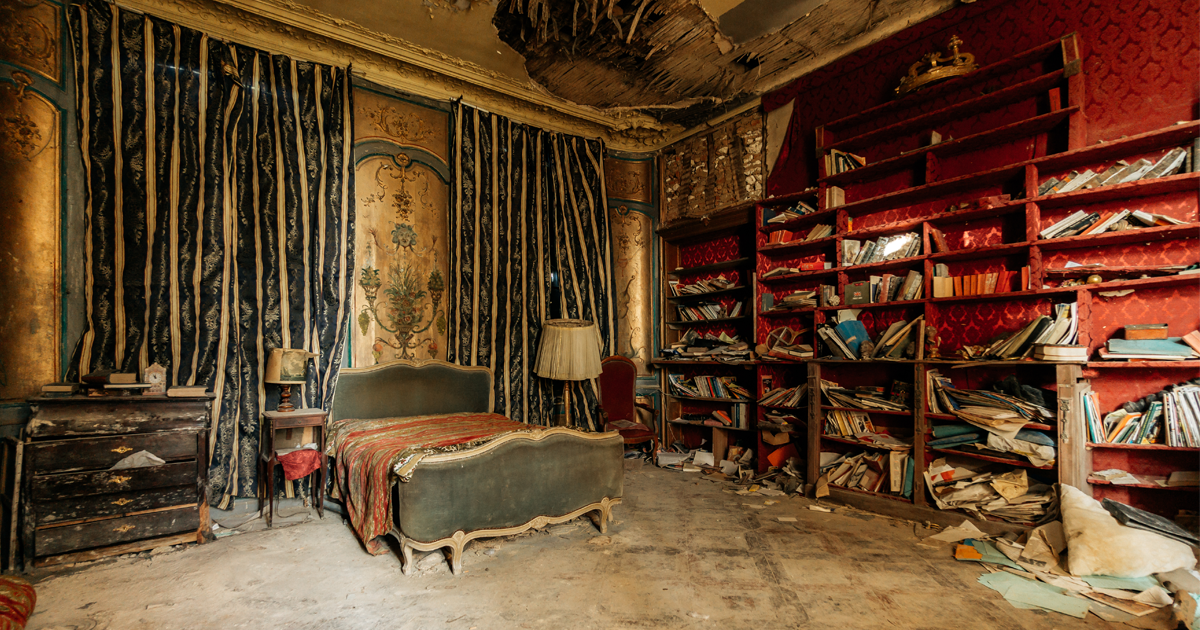
Some abandoned places whisper. Others creak, groan, and make you wonder whether the staircase is being dramatic or actively negotiating with gravity. Château de Le Quesnel, an abandoned French castle in the Somme department of northern France, belonged to the second category. Before a devastating fire destroyed it in 2018, this weathered 18th-century château stood like a beautiful old book left open in the rain: damaged, elegant, and still trying to tell its story.
Known among urban exploration photographers as Château Secession, the castle had all the ingredients of a haunting travel tale: stone walls, wartime scars, peeling rooms, a silent piano, and the kind of dusty atmosphere that makes every footstep sound like breaking news. It was not simply a ruin. It was a layered piece of French heritage, a former noble residence, a war-marked landmark, and finally, a cautionary example of how quickly neglected history can vanish.
This article explores the story of the abandoned French castle before the flames, why photographers were drawn to it, what made its interiors so powerful, and why responsible urban exploration matters more than ever.
The Forgotten Beauty of Château de Le Quesnel
Château de Le Quesnel was not the kind of castle with souvenir shops, guided tours, and a café selling tiny espressos at heroic prices. It was a private, abandoned estate with a long and complicated past. Historical accounts place its construction in the mid-18th century, with the building later expanded in the 19th century. Built of stone and set above old underground refuges known locally as “muches,” it had the sturdy presence of a structure designed to outlast generations.
But “designed to last” and “actually maintained” are two very different things. Ask any homeowner who has ignored a leaky gutter for three winters and accidentally invented an indoor waterfall. Over time, the château suffered from abandonment, structural decline, and the slow violence of weather. A section reportedly collapsed in the late 1990s, and the once-grand building became a destination for urban explorers, photographers, and lovers of forgotten architecture.
The castle’s location in Le Quesnel also gave it historical gravity. The village sits in the Somme, a region deeply marked by World War I. The château itself was damaged during the First World War, restored afterward, and eventually left uninhabited after the Second World War. Its empty rooms were not merely photogenic; they were part of a landscape where European history had left fingerprints everywhere.
Why This Abandoned French Castle Felt Different
There are plenty of abandoned buildings in Europe, but Château de Le Quesnel had a rare emotional texture. It did not feel like a place that had ended suddenly. It felt like a place that had been slowly dimmed, room by room, until silence took over the lease.
The walls were scarred by age. Floors were dusty and unstable. Windows filtered soft northern light into rooms that looked suspended between elegance and collapse. In one space, the presence of an abandoned piano turned the château from a simple ruin into something almost theatrical. A piano in a ruined castle is not just furniture. It is a character. It sits there, dignified and doomed, like it missed the evacuation memo but still intends to play Chopin at 7 p.m.
This is exactly why the site caught the attention of photographer Romain Thiery, an artist known for documenting abandoned pianos in forgotten buildings. His project, “Requiem pour Pianos,” explores the relationship between music, memory, architecture, and decay. Instead of staging objects or rearranging scenes, Thiery’s approach focuses on preserving the atmosphere as he finds it. That matters. In abandoned places, authenticity is fragile. Move one chair for a “better shot,” and suddenly the room becomes a set rather than a witness.
The Piano: A Silent Witness in a Burned Castle
The abandoned piano became one of the most memorable features of the castle. Pianos carry a strange emotional weight because they require human touch. A chair can simply exist, but a piano suggests practice, discipline, family evenings, lessons, mistakes, applause, and someone yelling, “Again from the beginning!” from another room.
Inside Château de Le Quesnel, the piano symbolized cultural memory. It stood in contrast to broken plaster, cracked flooring, and empty windows. The instrument was no longer serving music in the ordinary sense, yet it still performed visually. It gave the room a pulse.
That is the power of abandoned castle photography. It does not merely show decay. It asks what survives when people leave. In this case, what survived was mood, proportion, light, and the suggestion of sound. The piano made the silence louder.
A Castle Shaped by War, Neglect, and Time
The story of this abandoned French château cannot be separated from war. During World War I, Le Quesnel and the surrounding Somme region were drawn into the violence of the Western Front. The village was occupied during the conflict, and the château was damaged. After the war, restoration work helped return the building to dignity, but restoration is not immortality. Buildings require continuous care, and historic buildings require even more.
By the late 20th century, the château had entered a more precarious chapter. It changed hands, remained unused, and deteriorated. Abandonment is not a single event. It is a chain reaction. First, a property is left empty. Then maintenance slows. Water enters. Wood weakens. Vandals arrive. Metal disappears. Vegetation gets ambitious. Before long, nature and neglect form a demolition team, and neither one sends invoices.
When the fire came in December 2018, it did not simply damage the château. It ended the possibility of seeing those rooms as they had been. The building that had survived war, restoration, abandonment, and partial collapse was finally consumed by flames. For a village, that kind of loss is not abstract. It is the disappearance of a landmark from the shared mental map.
Why Abandoned Buildings Burn So Easily
The destruction of Château de Le Quesnel reflects a broader risk faced by vacant historic buildings. Abandoned structures often have open access points, broken windows, damaged wiring, dry timber, missing security, and no daily occupants to notice smoke or suspicious activity. In other words, they are vulnerable in exactly the ways fire enjoys. Fire is not picky, but it does appreciate opportunity.
Vacant-building fire reports in the United States show how serious this risk can be. Fires in empty residential structures often cause higher property loss than fires in occupied homes, partly because detection can be delayed. Intentional actions are also a major cause of vacant-building fires. While those statistics come from the U.S., the lesson travels well: empty buildings are not passive. They are exposed.
Historic buildings add another layer of difficulty. Their materials may be old, their structural systems may be compromised, and modern fire protection can be expensive or complicated to install without harming historic character. Preservation experts often emphasize regular maintenance because stopping decay early is far cheaper and more effective than trying to rescue a building after major damage has spread.
The Ethics of Urban Exploration
Urban exploration, or urbex, is often romanticized online. A flashlight, a camera, a crumbling staircase, and suddenly everyone thinks they are Indiana Jones with a backpack full of granola bars. But abandoned places are dangerous, legally complicated, and culturally sensitive. Responsible exploration means respecting property laws, never forcing entry, never revealing sensitive locations, never taking objects, and never damaging what remains.
The best rule is simple: take photographs, leave nothing behind, and avoid turning someone else’s neglected property into your personal theme park. This is especially important with abandoned castles, churches, hospitals, schools, and homes because they often contain traces of real lives. A cracked portrait, a child’s desk, a piano, or a handwritten note is not a prop. It is evidence of memory.
In places like Château de Le Quesnel, the photographer’s role becomes delicate. A good image can preserve awareness of a site that may otherwise disappear. A careless visit can speed up the loss. The difference is respect.
What the Castle Looked Like Before the Fire
Before it burned, the château’s rooms held a fragile visual poetry. The architecture still showed signs of former grandeur: tall windows, generous proportions, decorative details, and spaces that suggested a once-comfortable life. But the decay was impossible to ignore. Ceilings sagged. Paint peeled in long curls. Dust gathered like it had been promoted to management.
Bookshelves and furniture gave some rooms the feeling of interrupted domestic life. The abandoned piano added a dramatic centerpiece, and natural light softened the damage. That combination explains why the château became so compelling to photographers. It was not pristine, but it was emotionally complete. Every surface seemed to say, “I was something once.”
Photographs taken before the fire now serve as a visual archive. They preserve not only the building’s appearance but also its atmosphere. This matters because once a historic structure is destroyed, documentation becomes part of its afterlife. Images cannot replace stone, wood, or rooms you can stand inside, but they can keep a lost place from becoming merely a footnote.
Why We Are Drawn to Abandoned Castles
Abandoned castles fascinate people because they compress time. In one room, you can see aristocratic design, wartime damage, post-war decline, modern neglect, and nature’s slow comeback. It is history without a glass case. It is also a reminder that wealth, beauty, and status do not guarantee permanence. Even castles can become homeless.
There is also a strange comfort in ruins. They show failure, but not only failure. They show endurance. A cracked wall still standing after decades of weather has a stubborn charm. A staircase with missing railings is dangerous, yes, but also oddly brave. Ruins make us think about what we keep, what we discard, and what future generations may wish we had protected.
Château de Le Quesnel had that effect. Its loss feels larger than one building because it represents a pattern. Across Europe and beyond, many historic properties sit vacant because restoration is expensive, ownership is complicated, and practical reuse is difficult. Without a plan, “later” becomes the most destructive word in preservation.
Lessons From a Castle That Could Not Be Saved
The story of Château de Le Quesnel offers several lessons. First, historic buildings need purpose. A castle without use is vulnerable. It may be privately owned, locally loved, and historically interesting, but if no one maintains it, the building is living on borrowed time.
Second, documentation matters. The photographs taken before the fire are now part of the castle’s surviving legacy. They allow people to see what was lost and to understand why the loss mattered. In preservation, images can create public memory, and public memory can create pressure to save other endangered places.
Third, neglect is not neutral. Leaving a building alone may feel like doing nothing, but time is always doing something. Rain, frost, plants, animals, vandals, and fire risks keep working. Buildings are not preserved by admiration. They are preserved by maintenance, funding, access control, and realistic plans for reuse.
Additional Experience: Walking Through a Place That Would Not Survive
The most unforgettable part of exploring an abandoned French castle like Château de Le Quesnel is not the fear, although fear definitely attends the party and brings snacks. It is the awareness that you are walking through a place balanced on the edge of disappearance. Every room feels temporary. Every beam looks like it has been thinking about retirement. Every photograph becomes a small argument against forgetting.
At the entrance, the first sensation is usually the smell: old wood, damp stone, dust, and the mineral coldness of a building that has not been properly heated in years. It is not unpleasant exactly, but it is honest. Modern buildings smell like paint, coffee, and Wi-Fi. Abandoned castles smell like weather and consequences.
Inside, the silence changes from room to room. In a hallway, it feels narrow and alert. In a large salon, it expands, almost becoming elegant. You notice small details before grand ones: a hinge hanging loose, a curve of molding still intact, a patch of wallpaper refusing to surrender. The mind begins reconstructing what the eye cannot see. Where there is dust, you imagine polished floors. Where there is a broken window, you imagine curtains. Where there is a piano, you imagine hands.
The piano is the emotional trap. You can prepare yourself for cracked plaster and fallen stone, but an abandoned piano feels personal. It suggests that the building was not only occupied; it was lived in, heard, and filled with repetition. Someone once practiced scales badly enough to annoy another human being. Someone may have played for guests. Someone may have closed the lid for the last time without knowing it was the last time. That is how abandoned places get you. They turn ordinary objects into tiny ghosts.
Moving through such a castle also teaches humility. You quickly understand that ruins are not adventure playgrounds. A beautiful staircase can be rotten. A photogenic ceiling can be one vibration away from becoming a very aggressive hat. The smartest explorers are not the boldest; they are the ones willing to turn back. No photograph is worth a broken leg, a trespassing charge, or becoming the subject of a rescue operation that starts with, “So, I had this idea…”
What stays with you afterward is not just the beauty. It is the unfairness of beauty being temporary. Château de Le Quesnel survived centuries, wars, ownership changes, and decay, only to disappear in a single catastrophic fire. That makes the pre-fire photographs feel almost sacred. They are proof that the rooms existed, that the piano waited, that light once entered those windows in exactly that way. The building is gone, but the act of careful witnessing remains.
Conclusion
Château de Le Quesnel was more than an abandoned French castle. It was a historic structure shaped by noble ambition, regional memory, war, restoration, neglect, and finally fire. Before it was burned to the ground, photographers captured its fading interiors and helped preserve a visual record of a place that can no longer be explored.
The castle’s story is beautiful, eerie, and deeply practical. It reminds us that heritage is not protected by nostalgia alone. Historic buildings need care, security, funding, and a future use. Without those, even the grandest château can become smoke, rubble, and a handful of haunting photographs.
Note: This article is written for historical, cultural, and SEO editorial purposes. It does not encourage trespassing, unsafe entry, vandalism, or revealing sensitive abandoned locations. Explore heritage responsibly, legally, and respectfully.












