
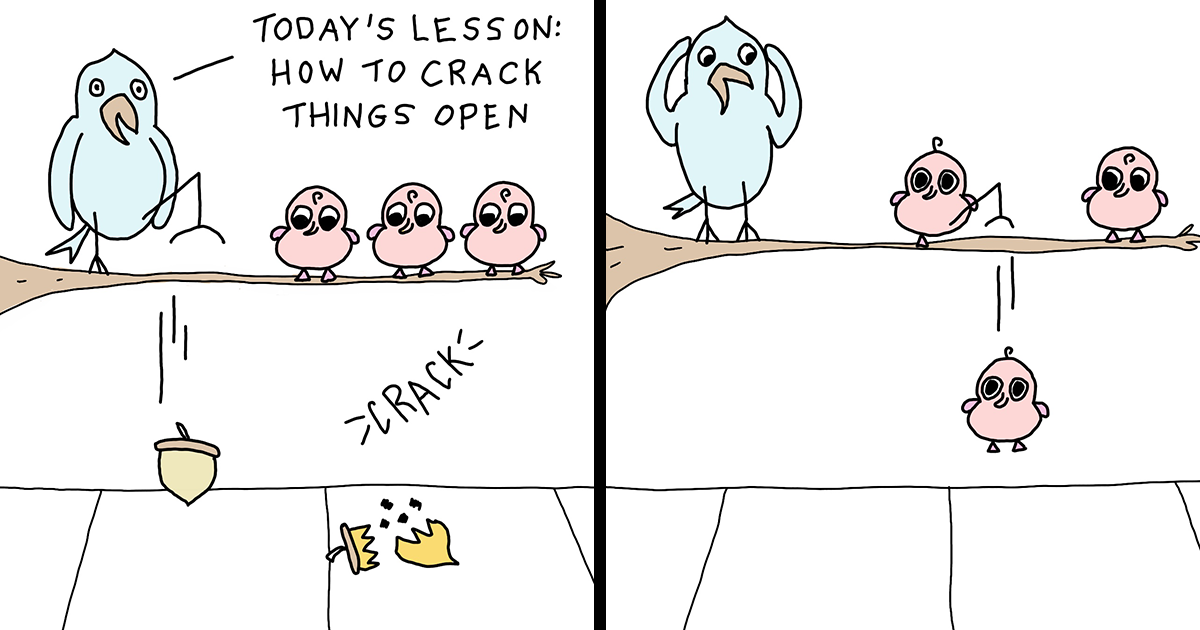
There are two kinds of city dwellers: people who rush past pigeons without making eye contact, and people who secretly know those pigeons are running a tiny sidewalk government. This collection, I Create Funny Comics About Urban Birds And Other Critters With Unexpected Endings (28 Pics), belongs firmly to the second camp. It turns the scrappy, noisy, weirdly charismatic animals of everyday urban life into stars of compact, clever comics that feel both ridiculous and oddly familiar.
That is exactly why these strips land so well. They are not just jokes with feathers. They are mini social comedies built around birds, squirrels, and other city survivors that already act like they own the block. The creator behind StarPurpleComics has explained that the goal is to make each strip a small story with a twist at the end, and that approach gives the comics their snap. You are not simply looking at a funny drawing. You are walking into a setup, absorbing the mood, and then getting hit with a final beat that changes the whole scene.
It is a smart formula, especially for urban wildlife. City birds already feel like comedians who never asked for a stage. Pigeons strut like underpaid landlords. Crows behave like they know your secrets. Grackles sound as if they are workshopping experimental jazz in a parking lot. Squirrels make dramatic choices every day for free. When a cartoonist turns these creatures into characters, the leap does not feel forced. It feels like someone finally wrote down what the rest of us were thinking.
Why Urban Birds Make Perfect Comic Characters
Urban birds are ideal for humor because they are visible, expressive, and instantly recognizable. You do not need a long explanation to understand the comedy of a pigeon looking offended, a crow acting superior, or a squirrel making a terrible decision with full confidence. In one glance, readers understand the social energy of the character. That makes comics faster, cleaner, and funnier.
It also helps that birds already come loaded with personality. Pigeons are more impressive than their public reputation suggests. Crows are famously clever. Mockingbirds can identify individual humans. Some city birds even adjust the pitch of their songs in noisy environments. In other words, urban wildlife is not background decoration. It is adaptable, alert, theatrical life in motion. When a comic artist builds stories around these animals, the humor feels grounded in reality rather than floating in cute nonsense.
That realism matters. Funny animal comics work best when the behavior is just believable enough to feel true. A bird with human worries is amusing. A bird with human worries that still behaves like a bird is even better. That tension between the familiar and the absurd is where the magic happens.
Pigeons: The Most Underestimated Stars in the City
If one creature deserves a comic career comeback, it is the pigeon. Pop culture has spent years acting as if pigeons are just gray clutter with wings, but that is lazy writing from humans who are jealous of superior neck shimmer. In reality, pigeons are intelligent, agile, and deeply suited to city life. Their original cliff-dwelling ancestry even helps explain why buildings, ledges, and bridges feel so natural to them. They are not randomly haunting downtowns. They are thriving in a concrete remake of an ancient habitat.
That makes pigeons especially funny on the page. Their public image is humble, but their posture says otherwise. They look like birds who would absolutely file a complaint, steal your snack, and then judge your shoes. A good comic can take that body language and turn it into instant character design. No extra work needed. The bird is already halfway written.
Crows, Grackles, and the Chaos Department
Crows bring a different flavor to comedy. They are not the lovable underdogs of the bird world. They are the clever observers. The plotters. The ones who look like they have formed a committee and decided not to tell you the agenda. Because corvids are associated with problem-solving, memory, and social intelligence, they naturally fit stories built around schemes, misunderstandings, and dramatic overreactions.
Then there are grackles, those gloriously divisive urban loudmouths. Their success in parking lots, medians, and city trees says a lot about how adaptable birds can be. They are part nuisance, part performance art, and completely impossible to ignore. In comic form, that makes them perfect scene stealers.
What Makes These 28 Comics So Effective
The best thing about this collection is that it does not treat humor like a one-note gag machine. The strips work because they combine observation, pacing, and surprise. Each comic behaves like a tiny short story. There is a setup, a mood, a direction your brain starts following, and then a turn. Sometimes the turn is verbal. Sometimes it is visual. Sometimes it is just a perfectly timed reveal that makes the whole setup funnier in retrospect.
That structure mirrors what humor research has said for years: people laugh when expectations get bent without completely breaking the logic of the scene. The comic does not need to be random. It needs to be unexpected in a way that suddenly feels inevitable. That is a harder trick than it looks, and it is one reason these animal strips stand out.
Birds as Stand-Ins for Human Behavior
Another reason the comics click is that the creator has openly treated birds as stand-ins for people. That is not a weakness. It is the whole engine. Anthropomorphism works because readers naturally assign motives, moods, and social roles to animals. We see a suspicious crow and think, “That guy knows something.” We see a cluster of pigeons and think, “Office gossip.” We see a squirrel freeze mid-crime and think, “Caught in 4K.”
That impulse lets comics move fast. Human social dynamics can be compressed into animal shapes, and the joke often gets sharper in the process. A bird can be vain, dramatic, lonely, smug, jealous, or confused without a single speech bubble doing all the work. The pose does half the job. The species does the rest.
Unexpected Endings Are the Secret Sauce
The title promises unexpected endings, and that promise matters. Lots of animal comics are cute. Fewer are genuinely structured around a payoff. A surprise ending gives a strip re-read value. Once you know the twist, you go back and notice how the setup quietly prepared you for it. That little delayed click is satisfying. It turns a pleasant comic into a memorable one.
In practical storytelling terms, surprise also keeps sweetness from becoming mush. The animals may be charming, but the punch line prevents the strip from floating away on vibes alone. The comic earns its laugh. It does not just hope readers will smile because a bird is wearing an expression that looks like Monday.
The City Itself Is a Supporting Character
One overlooked strength of urban animal comics is setting. The city is not just a backdrop. It is part of the joke. Sidewalks, wires, ledges, trash cans, crosswalks, gutters, rooftops, and patches of sad municipal landscaping all create instant story possibilities. A puddle becomes a lake. A french fry becomes treasure. A security camera becomes a witness. A traffic light becomes theater lighting.
Real urban ecology makes this even richer. City animals constantly adapt to human-built spaces, from scavenging routines to nesting strategies to changes in song. That means cartoonists have an endless supply of believable absurdity. The humor is not disconnected from the real world. It is rooted in the strange overlap between human infrastructure and animal improvisation.
That overlap is why these comics feel familiar even when they are surreal. Most readers have seen some version of the source material in daily life: birds bickering on a wire, a squirrel acting like a burglar with no fear of consequences, or a crow staring with the intensity of a detective in a low-budget thriller. The comic simply captures that feeling and pushes it one step further.
From Doodles to Distinctive Voice
Part of what makes this collection appealing is its origin story. The creator has said the work began with short stories and doodles in the margins, until the drawings gradually took over. That evolution makes perfect sense. Comics sit in the sweet spot between writing and visual timing. They allow a joke to be built not only with dialogue, but with pause, framing, expression, and silence.
The birds reportedly stayed because drawing people was less appealing, and honestly, that was a lucky break for everyone. Choosing birds over humans was not a compromise. It gave the comics a voice. It made the work stranger, lighter, and more visually memorable. Plenty of artists can draw people arguing in a kitchen. Fewer can make a city bird look like a disappointed uncle, a gossip columnist, and a neighborhood philosopher all at once.
The discipline behind the humor matters too. Working on a regular schedule, using prompts, and building standalone strips with occasional story arcs creates the kind of consistency that webcomic audiences love. Even when a comic lasts only a few panels, readers can sense when a creator respects structure. These strips feel playful, but they are not careless.
Why Readers Keep Coming Back
Funny urban animal comics are sticky for a simple reason: they reward recognition. Readers laugh because they know these creatures. Not personally, although some crows would absolutely insist otherwise. They know them as recurring pieces of city life. The joke lands because the animals are already part of the audience’s mental neighborhood.
There is also something comforting about making city wildlife legible. Urban life can feel impersonal, noisy, and repetitive. Comics like these turn that same environment into a cast of recurring weirdos with motives, grudges, and unfortunate timing. Suddenly the morning walk has narrative texture. The pigeon on the bench is no longer random. He is between scenes.
That is the deeper pleasure of the collection. It encourages readers to look again at the animals they usually ignore. Not in a preachy way. In a playful one. It suggests that a city is not only made of people, traffic, and bad coffee. It is also made of feathered opportunists, tiny scavengers, rooftop romantics, and sidewalk philosophers who have been doing silent crowd work for years.
Experiences That Make Urban-Bird Comics Hit Even Harder
If you have ever lived in a city, you already know why comics like these feel so accurate. Urban wildlife does not behave like background scenery. It behaves like it pays rent. You are walking to work, half awake, holding a coffee that is too hot, and there is a pigeon standing in the middle of the sidewalk with the confidence of a nightclub bouncer. He does not move. You move. That tiny exchange lasts two seconds, but it contains an entire social hierarchy. A comic artist sees that and immediately understands the joke.
The same thing happens with crows. You hear them before you see them, like a neighborhood argument that started before sunrise. Then you look up and there they are, lined along a wire, giving the impression that they have assembled for a quarterly review. Nobody trained us to think of them that way. We just do, because their behavior feels weirdly organized. They do not seem decorative. They seem informed.
Squirrels bring a different experience. They are less like moody city intellectuals and more like improvisational stunt performers. Every person who has watched a squirrel attempt a reckless leap, freeze in embarrassment, and then continue as if that was definitely the plan has already seen a comic panel in real life. The humor is not invented from scratch. It is extracted from the daily theater of urban survival.
There is also the emotional side of it. City life can be repetitive enough to blur together: same route, same buildings, same notifications, same errands. Then a tiny animal does something ridiculous, and the day suddenly has a plot. A bird steals a crumb with military precision. A raccoon looks personally offended by a locked bin. A grackle screams from a parking lot tree like it is auditioning for heavy metal. These moments feel small, but they reset your attention. They remind you that the city is alive in more ways than one.
That is why the best urban-bird comics do more than deliver a laugh. They recreate the exact sensation of noticing. They return readers to the odd intimacy of sharing space with creatures that have adapted to our habits while refusing to be controlled by them. The birds are not side props in a human world. They are co-stars with their own agendas. Once you start seeing them that way, it becomes almost impossible to unsee it. Every telephone wire becomes a panel border. Every alley looks like a setup. Every pigeon huddle feels like a writers’ room.
And maybe that is the most enjoyable experience of all. After reading a collection like this, you step outside and the city feels funnier. Not because anything changed, but because your attention did. The ordinary gets sharper. The critters get cast. The next unexpected ending is probably already happening on the curb.
Final Thoughts
I Create Funny Comics About Urban Birds And Other Critters With Unexpected Endings (28 Pics) works because it understands both animals and people, and more importantly, the ridiculous overlap between them. These comics are light on their feet, sharp in their structure, and observant in a way that makes even familiar city wildlife feel newly entertaining.
At a glance, the collection looks like simple fun. And it is fun. But underneath the punch lines is a smart creative premise: use animals we already half-humanize, place them in tiny urban dramas, and end each scene with a twist that feels surprising but earned. That combination gives the comics charm, replay value, and personality. It also gives readers a better gift than a quick laugh. It gives them a new way to look at the creatures they pass every day.
In a world full of disposable online humor, that is no small thing. A comic that makes you laugh once is nice. A comic that makes you laugh, then notice your local pigeon differently for the rest of the week, is doing excellent work.











