
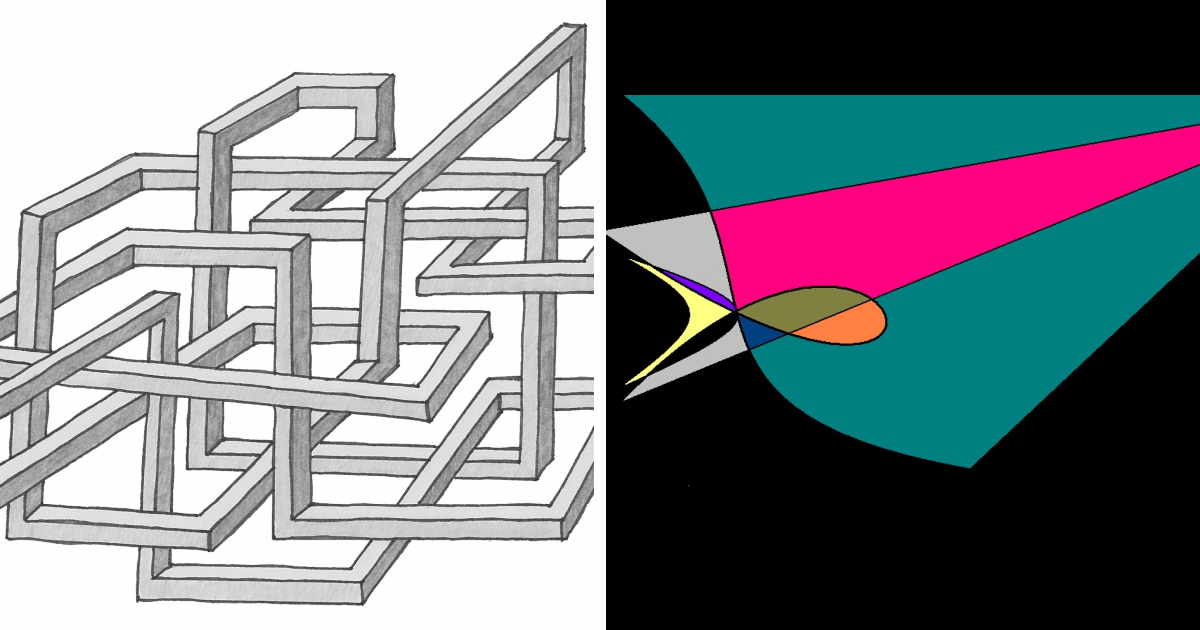
Here is a friendly challenge for every Panda with a pencil, paintbrush, stylus, coffee-stained notebook, or suspiciously artistic collection of highlighters: draw something abstract. Not a perfect face. Not a realistic tree. Not a horse that accidentally becomes a large dog halfway through. Make an image built from color, line, shape, rhythm, texture, movement, and whatever your imagination decides to release into the room.
Abstract drawing can look spontaneous, but it does not have to be meaningless. An abstract artwork may begin with an emotion, a memory, a sound, a landscape, or an ordinary object that has been simplified, distorted, rearranged, or transformed beyond immediate recognition. The Whitney Museum of American Art uses a similarly broad explanation, emphasizing that abstraction may grow from sensations and real-world subjects even when the finished picture no longer resembles a person, place, or thing.
What Does It Mean to Draw Something Abstract?
Abstract art shifts attention away from accurate representation and toward visual relationships. Instead of asking, “Does this look like a house?” you ask, “Does this red triangle feel balanced against that nervous black line?” The basic ingredients remain familiar: line, shape, color, value, texture, form, and space. The Getty’s formal-analysis resources treat these elements as the vocabulary artists use to organize and communicate visual ideas.
Some abstract drawings are geometric, using circles, grids, polygons, straight edges, and carefully measured intervals. MoMA describes geometric abstraction as art combining geometric, hard-edge, or linear forms. Other works are organic and loose, filled with curves, stains, scribbles, drips, and shapes that resemble cells, clouds, roots, or microscopic creatures planning a tiny revolution.
Why This Drawing Challenge Works
It Removes the Pressure to Be Realistic
Many people stop drawing because they think every picture must prove technical skill. Abstract drawing changes the assignment: a shaky line can communicate tension, an uneven circle can feel human, and a smudge can become atmosphere instead of evidence that your sleeve attacked the page.
It Turns Feelings Into Visual Decisions
Try drawing excitement without a face, heart, or familiar symbol: use sharp diagonals, expanding shapes, repeated bursts, and high contrast. For calm, try horizontal lines, open space, and soft transitions. Getty education materials connect line, color, shape, and space with emotional communication.
It Encourages Experimentation
Abstract artists often treat process as part of the subject. MoMA notes that Abstract Expressionists experimented with floor-mounted and unprimed canvases, while the Met highlights spontaneity, gesture, improvisation, and color fields. You do not need a warehouse-sized canvas to borrow that adventurous spirit.
How to Begin an Abstract Drawing
Choose One Emotional or Sensory Anchor
Start with a word such as “restless,” “bright,” “crowded,” “weightless,” or “late Sunday afternoon.” You can also begin with a sound, taste, temperature, memory, or physical movement. Wassily Kandinsky famously pursued connections between painting and music, seeking a visual language that did not depend on copying nature. Smithsonian art lessons inspired by Alma Thomas similarly invite learners to explore color, pattern, line, rhythm, and music together.
Do not illustrate the anchor literally. Translate it. What kind of line sounds like a trumpet? What shape tastes sour? Does “weightless” need pale colors, floating forms, or a nearly empty page? There is no official answer guarded by a committee of stern people in black turtlenecks.
Make a Bold First Mark
The blank page feels important only because it has not yet been inconvenienced. Break the spell with one decisive line, stain, shape, or block of color. Once the page contains a problem, you are no longer facing infinity; you are having a conversation.
Build Through Contrast and Repetition
Repeat a shape while changing its size, density, or direction. Contrast creates energy; repetition creates rhythm. The color units of Alma Thomas and the dots associated with Yayoi Kusama show how a simple motif can grow powerful through variation.
12 Abstract Drawing Ideas for Pandas
1. Draw a Song Without Drawing Instruments
Play a favorite track. Turn bass into thick arcs, percussion into dots, and vocals into ribbons; change the marks when the music changes.
2. Make a Map of Your Mood
Build emotional regions with pathways, borders, crowded zones, and quiet areas. It may resemble a map drawn by a cartographer having a complicated week.
3. Create a One-Line Drawing
Keep the pencil on the paper for three minutes. Loop, cross, compress, and stretch; then fill selected spaces with color or pattern.
4. Stage a Geometric Argument
Give circles, triangles, and lines different personalities. Perhaps peaceful circles gather while one enormous triangle interrupts everyone.
5. Invent an Organic Micro-World
Combine curves inspired by seeds, shells, cells, coral, and water until the page contains an ecosystem nobody has officially discovered.
6. Let Gravity Help
Tilt diluted watercolor or ink and let gravity draw. Morris Louis used pouring to shape flowing bands of color. Protect the table unless “abstract kitchen renovation” is also on today’s schedule.
7. Draw With the Non-Dominant Hand
Switch hands to interrupt familiar control and produce marks your practiced hand would automatically correct or avoid.
8. Work in One Color
Use one hue but vary pressure, opacity, texture, value, and density. One color can contain more moods than a group chat.
9. Transform an Everyday Object
Take one curve from a key, spoon, sneaker, or plant; repeat, enlarge, rotate, and overlap it until the source disappears.
10. Make Texture the Main Character
Mix shading, crosshatching, rubbings, dots, dry brush, and scratched marks to suggest age, speed, softness, or friction.
11. Use Chance, Then Edit
Drop scraps, roll dice for colors, or close your eyes briefly. Chance creates raw material; editing gives it structure.
12. Draw the Same Idea Three Ways
Make three versions of “celebration,” “silence,” or “traffic” using geometry, gesture, and pattern. Comparison teaches more than polishing one supposedly perfect image.
How to Make an Abstract Composition Feel Intentional
Freedom does not require visual chaos. Pause occasionally and view the drawing from a distance. Notice where your eye lands first, where it travels, and where it gets trapped. Rotate the page. Cover one section with your hand. Ask whether every area has the same density, scale, and contrast. If so, introduce variation.
Most importantly, revise. Joan Mitchell’s energetic paintings can appear explosively spontaneous, yet the Art Institute of Chicago describes her marks as the result of a steady, deliberate process. Abstract work can be intuitive and carefully edited at the same time. Move a shape, mute a color, erase a line, repeat a pattern, or leave the drawing overnight before deciding what it needs.
Common Abstract Art Mistakes
Trying Too Hard to Look “Artistic”
Do not add random swirls merely because swirls have excellent public relations. Every mark need not carry a grand philosophical burden, but it should participate in the composition. Ask what changes when the mark appears.
Using Every Color at Full Volume
A rainbow palette can work, but constant maximum saturation often makes all colors compete equally. Let some colors dominate and others support. Include neutrals, dull mixtures, pale passages, or dark anchors.
Stopping at the First Pleasant Accident
An interesting drip is a beginning, not always a finished artwork. Respond to it. Echo its direction, contrast its texture, frame it with space, or partly cover it. Process-based abstraction becomes stronger when chance meets judgment.
Sharing Your Abstract Drawing With the Panda Community
When posting your drawing, include a brief description of the process rather than declaring what everyone must see. Mention the starting idea, tools, limitations, or surprising accident. You might write, “I translated the sound of a summer storm into layered graphite lines,” or “I used three shapes to represent Monday morning.” This gives viewers an entry point without closing the door on their interpretations.
When responding to another artist, go beyond “nice” or “I do not get it.” Mention a repeated shape, strong contrast, tension, or movement, then ask a curious question. Discussion should feel like exploration, not a courtroom deciding whether the squiggle is guilty of being art.
A supportive creative environment matters. The National Art Education Association emphasizes spaces that value exploration, new ideas, creativity, critical thinking, and problem-solving. An open drawing prompt works best when beginners and experienced artists can experiment without being mocked for taking a risk.
A 500-Word Studio Experience: One Hour, No Subject, No Eraser
Imagine setting aside one hour for this challenge with a sheet of mixed-media paper, a black brush pen, two colored pencils, and one rule: the drawing cannot depict a recognizable subject. The first five minutes are unexpectedly difficult. Without a face, flower, or landscape to organize the page, every mark seems overly important. The brush pen hovers like it is waiting for legal advice.
The breakthrough comes from choosing a simple anchor: “crowded but hopeful.” A thick black line enters from the lower left, bends twice, and stops near the center. Smaller lines gather around it. Some follow its direction; others collide with it. Yellow pencil marks appear in the open spaces, initially as small dashes and later as repeated ladder-like forms. Blue shapes accumulate near the upper edge, creating weight where the page previously felt empty.
At fifteen minutes, the drawing looks chaotic. The natural temptation is to add more detail everywhere, but stepping back reveals that the problem is not a lack of marks. It is a lack of hierarchy. Every section is shouting. Several blue forms are softened with the side of the pencil, and a large empty area is preserved near the right edge. Suddenly, the black path feels more active because it has somewhere to travel.
Halfway through, an accidental ink blot appears where the brush pen pauses too long. The blot is ugly in a very confident way. Instead of hiding it, three smaller blots are added nearby, turning the mistake into a family. This is one of abstraction’s most useful lessons: repetition can transform an accident into a decision. The original blot remains the darkest, so it becomes a focal point rather than an apology.
At forty minutes, rotating the page changes everything. What had looked like a path now resembles a wave, although it is still not quite a wave. The yellow ladders seem to climb into the blue mass. The drawing begins to suggest a story without illustrating one. That ambiguity feels satisfying because the image can hold the original phrase“crowded but hopeful”while allowing other interpretations.
The final ten minutes are spent subtracting rather than adding. A few weak lines are covered with blue pencil. One yellow cluster is reduced because it competes with the ink blot. The page is turned in all four directions before the original orientation is chosen. A small mark is added near the lower edge to prevent the composition from feeling top-heavy, and then the tools are put down before “one final improvement” becomes thirty-seven unnecessary improvements.
The finished drawing is not a masterpiece, and that is not the point. The useful experience lies in noticing how quickly judgment changes during the process. A mark that seems disastrous at minute twenty may become essential at minute fifty. A crowded area may need empty space, not decoration. A limited palette may create more invention than a box containing sixty-four colors and several shades apparently named by poets.
The exercise also creates a focused break from ordinary problem-solving. Research on art-making and stress is still developing, and drawing is not a substitute for professional care, but studies have reported promising effects. One pilot study found reduced cortisol after a short art-making session, while Harvard Health notes that creative activity can support stress relief and communication, especially in therapeutic settings. Even without making medical claims, many people recognize the simple value of concentrating on marks, materials, and decisions for a while.
Most of all, the hour demonstrates that abstract drawing is not the absence of skill. It is the practice of choosing, observing, responding, and revising without relying on a recognizable subject to do the communicating. The artist leaves with a finished page, a slightly ink-stained finger, and several new ideas for the next experiment.
Conclusion: Make the First Mark
“Hey Pandas, Draw Something Abstract” is an invitation to stop waiting for the perfect subject and start exploring the visual ingredients already available to you. Use a restless line, an awkward shape, an unexpectedly elegant smear, or two colors that behave like old rivals at a family dinner. Begin with music, memory, movement, emotion, or chance. Then make deliberate choices about contrast, repetition, balance, texture, and space.
Your abstract drawing does not need to resemble anything, impress everyone, or arrive with a twelve-page manifesto. It needs curiosity. Make the first mark, respond to what happens, and share the result. Someone may see a city, a storm, a dance, or a sandwich experiencing an existential crisis. That variety is not a failure of communication; it is part of the fun.
Note: This article synthesizes established museum, art-education, and health-research guidance. The studio narrative is an illustrative scenario designed to demonstrate a realistic abstract drawing process, not a claim of the writer’s personal physical experience.












