
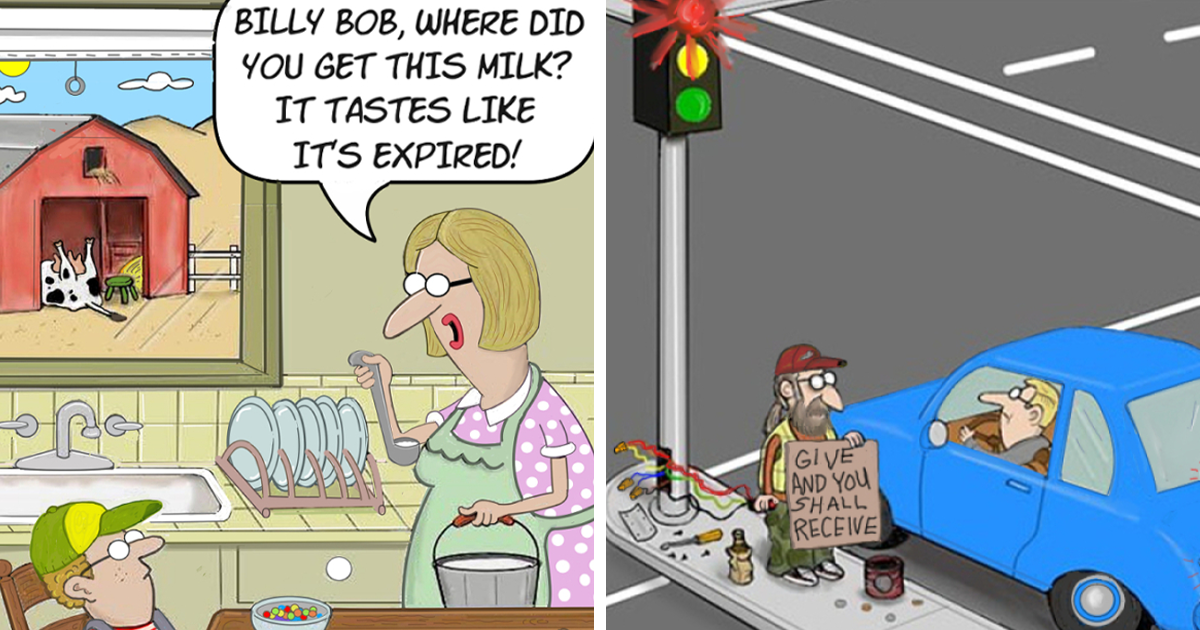
Some people keep a diary. Some people meditate. I draw tiny characters having very specific emotional breakdowns over office printers, talking vegetables, judgmental cats, and suspiciously confident pigeons. This collection, “Here Are 26 Funny Cartoons Featuring Various Characters Facing Witty Situations I Created,” is my cheerful attempt to turn everyday awkwardness into something you can laugh at without needing to schedule a meeting about it.
Funny cartoons have a special kind of magic. They do not need a thousand words, a dramatic soundtrack, or an actor staring meaningfully into the rain. A raised eyebrow, a badly timed speech bubble, and one character who is completely unaware of the chaos they caused can do the job beautifully. The best cartoon humor often begins with a familiar situation, then tilts it just far enough that the reader thinks, “That is ridiculous,” followed immediately by, “Actually, that is exactly my life.”
In these 26 cartoons, I created a cast of different characters facing witty situations: office workers fighting invisible deadlines, animals with better boundaries than humans, fantasy creatures stuck with modern problems, and everyday people trying their best while reality throws banana peels under their shoes. The goal was simple: make each cartoon quick to understand, fun to revisit, and just strange enough to earn a second look.
Why Funny Cartoons Still Work So Well
Cartoons remain one of the most shareable forms of visual humor because they are fast, expressive, and emotionally direct. A good cartoon does not politely knock on the door of your attention; it climbs through the window wearing a fake mustache. With one image, it can capture frustration, irony, embarrassment, surprise, or that universal human experience of opening the fridge for the fifth time and expecting a new personality to appear.
What makes cartoon comedy powerful is the combination of image and text. The drawing sets up the world, while the caption or dialogue twists the meaning. A business meeting becomes funny when everyone is serious except the intern who brought a medieval sword as a “conversation starter.” A dragon becomes relatable when it complains about burnout from being “emotionally available and fire-breathing.” Humor grows from contrast: serious faces in silly situations, tiny problems treated like global disasters, or huge problems solved with absurd confidence.
The Idea Behind These 26 Witty Cartoon Situations
For this series, I wanted each cartoon to feel like a tiny comedy scene. Instead of relying only on punchlines, I focused on character behavior. Who is overreacting? Who misunderstands the situation? Who thinks they are helping but is absolutely not helping? That is where many funny cartoons begin: not with a joke, but with a personality collision.
The cartoons feature a mix of humans, animals, imaginary creatures, and everyday objects acting like they have opinions. I like that kind of humor because it gives ordinary life a playful second layer. A coffee mug can be passive-aggressive. A cactus can have social anxiety. A ghost can be terrible at haunting because it keeps apologizing for being “too present.” When characters are exaggerated but emotionally recognizable, readers connect with them quickly.
26 Funny Cartoons and the Witty Situations Behind Them
1. The Overprepared Office Worker
This cartoon shows an employee arriving at a five-minute meeting with a suitcase, three charts, emergency snacks, and a printed backup plan for the backup plan. The joke is about workplace anxiety disguised as professionalism. We all know someone who treats a casual update like a congressional hearing.
2. The Cat Who Charges Emotional Rent
A cat sits on its owner’s laptop and announces, “You may use this workspace after paying the attention fee.” The humor comes from turning typical cat behavior into a business model. Honestly, many cats already run the household like landlords with fur.
3. The Dragon in Customer Service
A dragon works behind a complaint desk while a customer says the refund process is “a little heated.” The dragon, breathing smoke, replies, “That is part of the brand experience.” This cartoon mixes fantasy with modern service frustration.
4. The Plant With Boundaries
A houseplant tells its owner, “I need sunlight, water, and less of your relationship drama.” It is a funny twist on plant care, but it also pokes fun at how people overshare with anything that cannot run away.
5. The Pigeon Life Coach
A pigeon stands on a park bench giving motivational advice: “Walk with confidence. People move faster when they fear you.” The joke works because city pigeons already behave like tiny fearless executives.
6. The Haunted House With Reviews
A ghost checks online ratings and complains, “Three stars? I screamed in Latin for this family.” This cartoon takes a classic spooky setup and drags it into the review economy, where even ghosts apparently need reputation management.
7. The Wizard Who Forgot His Password
A wizard cannot unlock his spellbook because he forgot whether his password included “one uppercase rune.” The joke blends ancient magic with modern digital inconvenience. Even sorcerers are powerless before password requirements.
8. The Dog at a Strategy Meeting
A dog sits at a conference table and suggests, “What if we simply bark at the problem until it leaves?” The rest of the team looks impressed. It is silly, but also suspiciously close to how many meetings end.
9. The Mermaid With Wi-Fi Problems
A mermaid surfaces holding her phone above the waves and says, “I have full ocean coverage but no emotional coverage.” The cartoon uses wordplay while giving the character a modern, slightly dramatic personality.
10. The Skeleton at the Gym
A skeleton lifts tiny dumbbells while a trainer says, “Great bone structure, but we need to work on mass.” This one is pure visual comedy, built on the obvious contrast between fitness goals and a character who is already just bones.
11. The Coffee Cup Intervention
Several coffee cups gather around a tired person and say, “We think you are becoming too dependent on us.” The tired person replies, “I organized this meeting.” The joke flips the intervention format and gives caffeine the role of concerned friend.
12. The Alien Tourist
An alien visits Earth and says, “Your species invented both taxes and bubble wrap. I cannot classify you.” This cartoon plays with human contradictions: brilliant, chaotic, practical, and weirdly obsessed with popping plastic bubbles.
13. The Medieval Knight in Therapy
A knight in armor tells a therapist, “I keep building emotional walls, but everyone calls them castles.” The humor comes from turning a psychological phrase into a literal medieval image.
14. The Fish Who Hates Small Talk
Two fish pass each other in a bowl. One says, “Wet enough for you?” The other stares in silent despair. It is a tiny joke about repetitive conversation, proving that awkward small talk can ruin any environment, even underwater.
15. The Smartphone With Attitude
A phone looks at its owner and says, “Your screen time report asked me not to judge, but I have thoughts.” This cartoon gives technology a voice and lets it say what many people secretly fear their devices already know.
16. The Superhero With a Calendar Conflict
A superhero checks a planner while a villain waits patiently. “Can we reschedule world domination? I have dentist at four.” The joke works because even dramatic lives are vulnerable to ordinary appointments.
17. The Bear Trying Minimalism
A bear sits in an empty cave and says, “I kept only what sparks joy: salmon, naps, and mild intimidation.” This cartoon borrows the language of lifestyle trends and applies it to a creature with very clear priorities.
18. The Robot Learning Sarcasm
A robot says, “Wonderful. Another software update. My joy circuits are overheating.” Its human friend replies, “You are learning.” The humor comes from watching a machine master the most human survival skill: sarcasm.
19. The Snail With Ambition
A snail stands before a motivational poster reading “Move Fast.” It says, “I prefer emotionally sustainable progress.” This cartoon turns slow movement into a philosophy, and frankly, the snail has a point.
20. The Vampire at Brunch
A vampire sits in sunglasses at an outdoor café and asks if the Bloody Mary can be “less symbolic.” The scene mixes gothic identity with casual dining, because even creatures of the night deserve brunch.
21. The Penguin Office Dress Code
A penguin in a room full of other penguins says, “I wore the same tuxedo again. Nobody noticed.” This cartoon uses the penguin’s natural appearance as a workplace fashion joke.
22. The Time Traveler in Line
A time traveler stands at the DMV and says, “I have seen the future. We are still waiting.” The joke works because some human systems feel powerful enough to defeat science fiction.
23. The Moon Feeling Overworked
The moon tells the sun, “Everyone romanticizes me, but nobody talks about my night shift.” It is a gentle joke about overlooked labor, with celestial bodies acting like tired coworkers.
24. The Cactus on a Date
A cactus says, “I am emotionally available, but physically complicated.” This cartoon uses a simple visual gag to talk about vulnerability, dating, and personal space.
25. The Bread Slice With Big Dreams
A slice of bread looks into a toaster and says, “This is either transformation or a trap.” The comedy comes from giving dramatic inner life to breakfast. Toast suddenly feels heroic.
26. The Duck Who Refuses Drama
A duck walks away from arguing geese and says, “I am migrating from this conversation.” It is a clean closing cartoon because the line works both literally and socially. Sometimes the healthiest response is to waddle away.
How Character Design Makes the Jokes Funnier
In funny cartoon art, character design is not only about looking cute or polished. It is about making the joke readable at a glance. A nervous character might have tiny shoulders, wide eyes, and hands that seem unsure where to go. A confident character might lean forward, take up space, and smile like they recently sold a bridge. These visual signals help readers understand the joke before they even finish the caption.
I used expressive faces, simple body language, and exaggerated reactions throughout the series. A character does not need a realistic nose to be emotionally devastated by printer toner. In fact, a simpler design often makes the feeling clearer. One raised eyebrow can say, “I object to this nonsense,” while a tiny frown can carry the full emotional weight of Monday morning.
The Role of Witty Captions in Cartoon Humor
A witty caption should feel effortless, even when it took twenty bad drafts, three snacks, and a long stare at the ceiling. The best cartoon captions usually do not explain the image. They add a twist. If the drawing already shows a dragon at a desk, the caption should not say, “I am a dragon at a desk.” The reader can see that. The caption should reveal attitude, conflict, or surprise.
For this collection, I tried to keep the captions short and sharp. Humor often gets weaker when it has to carry too much luggage. A punchline should arrive before the reader starts looking for parking. Short captions also make cartoons easier to enjoy on social media, blogs, newsletters, and mobile screens, where attention spans sometimes behave like squirrels in a thunderstorm.
Why Everyday Situations Make the Best Cartoon Comedy
Many of the cartoons in this series are built around everyday frustrations: meetings, technology, dating, deadlines, bad Wi-Fi, awkward small talk, and the strange pressure to be productive every second of the day. These topics work because they are instantly recognizable. Readers do not need a long explanation. They have lived the setup.
When a cartoon shows a wizard struggling with password recovery, the fantasy element makes it silly, but the frustration is real. When a snail defends slow progress, it becomes funny because many people secretly want permission to move at a more human pace. The more specific the situation, the more universal it can feel.
Why This Collection Connects With Readers
Funny cartoons create a small moment of relief. They give readers permission to laugh at the tiny absurdities that usually feel annoying in real life. A late email is stressful. A cartoon about a pigeon managing your inbox is delightful. That shift is the pleasure of visual humor: it takes pressure and turns it into play.
This collection also works because the characters are not perfect. They are confused, dramatic, overconfident, tired, hopeful, and occasionally shaped like bread. Their flaws make them charming. A perfect character is hard to laugh with. A character trying to maintain dignity while losing an argument with a coffee cup is far more relatable.
My Experience Creating These 26 Funny Cartoons
Creating these 26 funny cartoons taught me that humor is less about forcing jokes and more about noticing where life is already being ridiculous. The process usually began with a simple observation. I would see someone arguing with a printer, watch a cat completely ignore human authority, or catch myself treating a minor inconvenience like a tragic plot twist. From there, I would ask, “What character would make this situation even funnier?”
Sometimes the answer was obvious. A tired office worker belongs in a meeting joke. A cat belongs anywhere it can be inconvenient. Other times, the best choice was unexpected. A dragon in customer service felt funnier than a regular employee because the phrase “heated complaint” suddenly became visual. A wizard forgetting a password worked because magic should solve everything, yet modern life still finds a way to be annoying.
The hardest part was not drawing the characters. It was choosing the exact moment of the joke. In cartoons, timing is frozen into one image. You cannot rely on a long setup or a scene change. The panel must capture the second where the situation becomes funny. Too early, and the reader does not understand the conflict. Too late, and the joke feels explained. The sweet spot is usually the moment of realization: the cat has won, the robot has learned sarcasm, the bread has existential concerns.
I also learned that small changes can completely alter a cartoon’s tone. A character looking directly at the reader can make the joke feel dry and self-aware. A character looking away can make it feel awkward or innocent. A tiny pause before the punchline can make a caption funnier. Even punctuation matters. An exclamation point can make a character sound excited, while a period can make the same line feel hilariously deadpan.
Another big lesson was that not every idea deserves to become a finished cartoon. Some sketches were funny in my head and deeply unemployed on paper. That is normal. Cartooning involves a lot of trimming, testing, and admitting that a joke about a nervous lamp may not be the cultural event one hoped it would be. The trick is to keep drawing anyway. Bad drafts are not failures; they are the compost where better jokes grow.
What I enjoyed most was giving personality to characters who would normally be background objects or side creatures. A cactus became a dating expert with personal space issues. A moon became an exhausted night-shift worker. A slice of bread became a philosopher facing the toaster. Those characters made the work feel playful because they reminded me that humor can come from almost anywhere if you look at it from the right angle.
In the end, this collection is not just about 26 funny cartoons. It is about turning ordinary stress into something lighter. It is about finding comedy in the tiny negotiations of daily life: with pets, coworkers, technology, expectations, and ourselves. If one of these cartoons makes someone laugh, pause, or send it to a friend with the message “this is you,” then the little characters have done their job. They may not be emotionally stable, but they are very committed to the bit.
Conclusion
“Here Are 26 Funny Cartoons Featuring Various Characters Facing Witty Situations I Created” is a celebration of quick laughs, expressive characters, and the strange beauty of everyday absurdity. From sarcastic robots to emotionally complex toast, each cartoon turns a familiar feeling into a playful visual joke. That is the lasting charm of funny cartoons: they make life look a little less heavy and a lot more ridiculous in the best possible way.
Whether you love witty cartoon situations, character-based comedy, visual storytelling, or simply need a break from the serious business of being a person, these cartoons offer a small window into a world where dragons handle refunds, plants request boundaries, and ducks know exactly when to leave the conversation. Honestly, we could all learn something from the duck.
Note: This HTML body is written as original, publication-ready web content in standard American English, with SEO structure, natural keyword use, and a clean metadata block at the end.












