
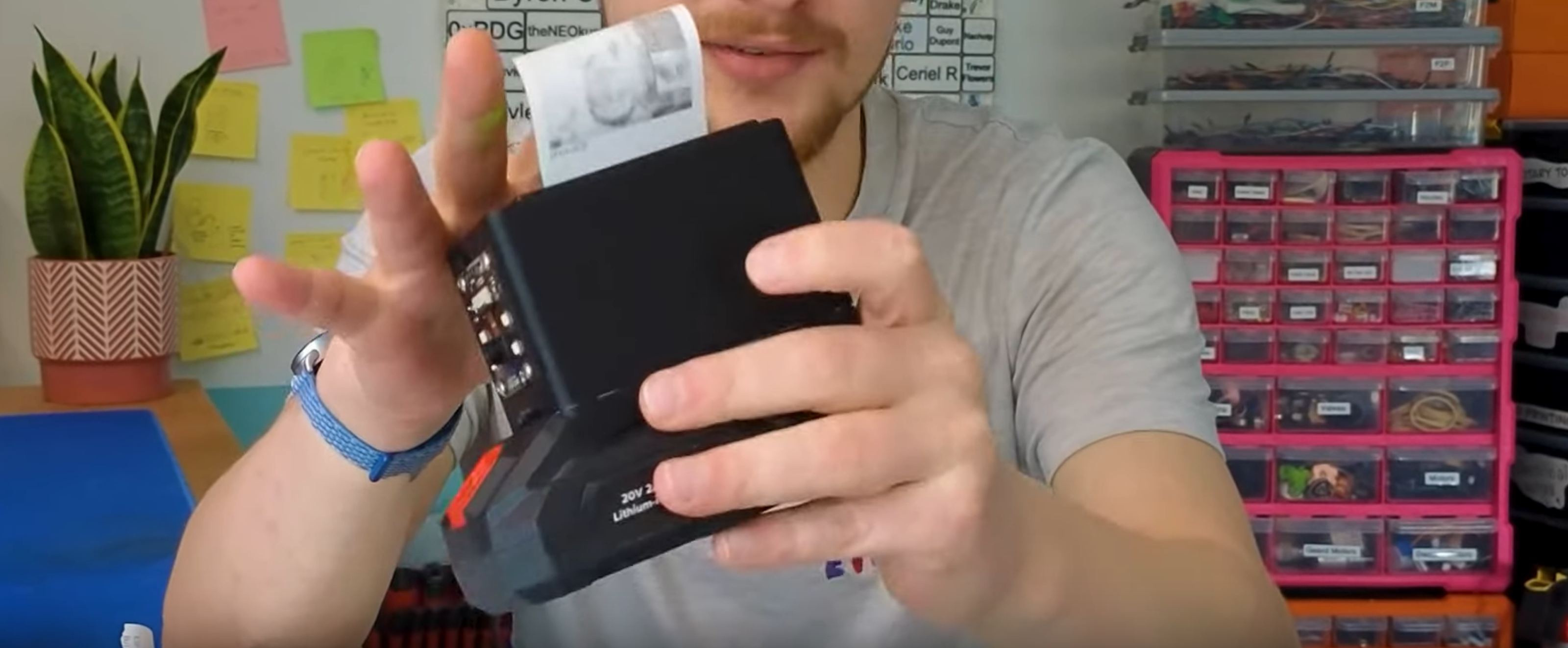
There is a special kind of magic in pressing a button and watching a photo appear in the real world. Not on a phone. Not in a cloud folder named “Camera Roll 7,284.” A real, hold-it-in-your-hand image. That is why instant cameras keep coming back like a catchy 1980s synth riff. They are imperfect, expensive, oddly charming, and absolutely committed to making photography feel like a tiny event.
The project behind “Hack Aims For Polaroid, Hits Game Boy Camera Sweet Spot” begins with that same desire: build a fun, affordable, instant-photo experience without paying instant-film prices every time someone blinks. But while the goal sounds Polaroid-inspired, the result lands beautifully in another nostalgic neighborhood: the Game Boy Camera. Think lo-fi images, thermal paper, black-and-white charm, and a final print that looks like it escaped from a 1998 backpack.
At the heart of the build is a simple and clever recipe: an ESP32 camera module captures the image, a serial thermal printer spits it out, and a custom enclosure turns the parts into a handheld DIY instant camera. The project does not chase glossy perfection. Instead, it embraces the exact thing that made the Game Boy Camera so memorable: limitations with personality. And honestly, in a world of 48-megapixel photos nobody prints, a fuzzy little thermal portrait may have more soul than an entire gallery of over-sharpened brunch pictures.
Why This DIY Instant Camera Feels Familiar
Modern instant photography often borrows from Polaroid’s emotional playbook: snap, wait, reveal, share. The photo becomes a souvenir almost immediately. But this hack takes a different route. Instead of chemical film, it uses thermal printing. Instead of color-rich instant film, it produces rough monochrome prints. Instead of pretending to be premium, it leans into the joy of being wonderfully weird.
That is where the Game Boy Camera sweet spot comes in. Nintendo’s Game Boy Camera, released in 1998, was never designed to compete with serious digital cameras. It captured tiny grayscale images, let users decorate them with stamps and silly effects, and worked with the Game Boy Printer to create small thermal-paper prints. By today’s standards, the resolution is hilariously low. By creative standards, it is perfect. The Game Boy Camera turns every face into a tiny cryptid sighting, and somehow that is the point.
The Mellow Labs-style ESP32 instant camera follows that spirit. It is not trying to make wall-worthy family portraits. It is making pocket-sized artifacts: quick, funny, low-resolution memories. The type of image that looks better because it looks worse. It is photography with the seriousness removed and the fun left intact.
The Core Hardware: ESP32, Thermal Printer, and a Lot of Personality
The build uses an ESP32-based camera board, a compact thermal printer, a voltage step-down converter, a portable battery source, and a 3D-printed case. The ESP32 handles image capture and basic processing, while the printer receives image data and prints it onto thermal paper. That makes the design lighter and simpler than many Raspberry Pi-based instant camera builds, which can be more powerful but often require longer boot times and more system overhead.
The thermal printer is the star of the physical experience. It cannot produce glossy color photographs, but it can print quickly and cheaply. Instead of buying packs of instant film, users can feed in thermal paper and keep going. The tradeoff is obvious: the prints are black and white, relatively low detail, and not archival in the same way a traditional photo might be. But that tradeoff is also the style. The image looks like a receipt from a parallel universe where the cash register had a photography degree.
Why Thermal Printing Works So Well for Retro Photography
Thermal printing is practical, inexpensive, and visually distinctive. It creates images using heat-sensitive paper, which means there is no ink cartridge to replace. For a maker project, that is a huge advantage. Fewer consumables mean fewer headaches. It also means the camera can be used casually at parties, workshops, conventions, or family gatherings without the photographer mentally calculating the price of every shot.
The look is unmistakably lo-fi. Gradients become rough textures. Shadows become dramatic. Fine details may disappear, but faces, shapes, and strong contrast survive. That limitation encourages better composition. You start thinking like a Game Boy photographer: simple backgrounds, bold lighting, expressive subjects, and the occasional acceptance that your dog may print as a haunted potato.
Polaroid Dreams, Game Boy Camera Reality
Polaroid-style instant photography is about immediacy and emotion. Game Boy Camera photography is about play. This hack succeeds because it mixes both. The device gives users the instant gratification of a printed photo while delivering the visual language of early handheld digital imaging.
The result does not feel like a budget Polaroid clone. It feels like a spiritual cousin to the Game Boy Camera and Game Boy Printer combination. That matters because the Game Boy Camera had a special kind of creative honesty. It never promised accurate color, crisp focus, or professional results. It promised fun. It let people take pictures, modify them, add goofy graphics, and print them. It turned photography into a toy without making creativity feel childish.
The ESP32 thermal camera does something similar for today’s hardware hackers. It says: build the thing, press the button, laugh at the output, improve the code, redesign the case, and print another one. It is not just a camera. It is a tiny creative system.
The Game Boy Camera Legacy Still Matters
The Game Boy Camera remains one of Nintendo’s most unusual accessories. It attached to the Game Boy cartridge slot and used a swiveling lens that could face forward or backward. It captured grayscale images at a tiny resolution and displayed them using the Game Boy’s limited palette. Users could save photos, edit them, play built-in mini-games, and print images with the separate Game Boy Printer.
More than 25 years later, photographers, collectors, artists, and hardware tinkerers still use it. Some modify the lens. Some extract images with modern adapters. Some connect the Game Boy to newer printers. Some use emulators, microcontrollers, and web tools to preserve or print old captures. The community has kept the format alive because the limitations are not obstacles anymore; they are the aesthetic.
That is why this newer DIY instant camera feels so right. It does not imitate the Game Boy Camera exactly, but it understands its appeal. The point is not technical superiority. The point is that an image can be small, strange, and unforgettable.
Why Makers Love This Kind of Camera Hack
Hardware hackers are drawn to projects like this because they combine electronics, design, code, and nostalgia in one compact package. A DIY instant camera requires solving real problems: power management, image conversion, printer communication, physical ergonomics, button placement, heat, battery size, and enclosure design. It is a full-stack maker project, but with more adorable paper scraps.
The ESP32 platform is especially attractive because it is affordable, compact, and widely supported by the maker community. It can capture images, communicate with peripherals, and run Arduino-style code. That makes it ideal for a camera that does not need smartphone-level image quality. Pair it with a serial thermal printer, and the build becomes accessible without becoming boring.
The Charm of Imperfect Engineering
Some projects impress because they are polished. This one impresses because it feels alive. A big battery, a custom case, a printer that chatters like a tiny office machine, and a black-and-white image crawling out of the frontthese are not flaws. They are the whole show.
The best retro tech projects often have this quality. They remind people that technology used to be more visible. You could hear it, hold it, take it apart, and understand at least part of what was happening inside. A thermal instant camera restores that feeling. It makes image-making mechanical again. The photo does not simply appear; it emerges.
Creative Uses for an ESP32 Thermal Instant Camera
A camera like this is perfect for events where the print matters more than the resolution. At a birthday party, it can produce quick guest portraits. At a maker fair, it becomes a conversation starter. In a classroom, it can demonstrate embedded systems, image processing, serial communication, and design thinking. At a wedding, it can create a gloriously chaotic guestbook where every print looks like surveillance footage from a charming robot.
Artists can use the camera for zines, collage, street photography, journaling, and experimental portrait work. The low-resolution thermal output forces creative decisions. It rewards contrast, silhouettes, bold facial expressions, and simple shapes. It also makes every print feel slightly unpredictable, which is part of the appeal. Digital photography often tries to remove surprises. This kind of camera invites them back in and offers them a tiny paper chair.
How This Hack Compares With Traditional Instant Cameras
Traditional instant cameras still win in color, chemistry, and emotional nostalgia. A real instant-film print has depth and a specific look that thermal paper cannot fully replace. But the ESP32 thermal camera wins on cost, hackability, and repeatability. You can modify the software, tweak the image processing, change the enclosure, experiment with different printers, and print without treating each shot like a tiny financial decision.
That makes it ideal for people who want the ritual of instant photography without the pressure. Instant film can make every exposure feel precious. Thermal paper makes every exposure feel playful. Both approaches have value. One says, “Capture this moment carefully.” The other says, “Let’s see what happens if Uncle Dave stands under that lamp.”
The Real Lesson: Constraints Create Style
The best part of this project is not the ESP32, the thermal printer, or even the custom case. The best part is the design philosophy. By accepting constraints, the camera gains identity. Low resolution becomes style. Monochrome becomes mood. Thermal paper becomes a format. The printer noise becomes part of the experience.
This is the same reason the Game Boy Camera still has fans. Its images are technically weak but emotionally strong. They are instantly recognizable. They do not compete with modern photos, and they do not need to. They live in their own category: playful, compressed, strange, and strangely beautiful.
Experience Section: Living With a Game Boy Camera-Inspired Instant Hack
Using a Game Boy Camera-inspired thermal instant camera changes how you think about taking pictures. With a phone, the process is almost too easy. You take ten photos, dislike nine, forget all ten, and later discover them while looking for a screenshot of a pizza coupon. With a thermal instant camera, every shot becomes a tiny performance. Someone poses. Someone laughs. The printer wakes up. Then a strip of paper appears like a miniature newspaper announcing, “Breaking news: your face is now pixels.”
The first thing you notice is that lighting matters more than expected. Soft, low-contrast scenes often print as gray mush. Strong light, bold shadows, and clean backgrounds work much better. A face near a window prints with character. A cluttered room prints like a mystery map. Outdoor shots can look fantastic if the subject is close and the contrast is clear. The camera teaches you to simplify. It quietly whispers, “Please stop trying to photograph twelve things at once. I am a tiny thermal printer, not a superhero.”
The second experience is social. People react differently when the result is physical. A phone photo gets a quick glance. A print gets passed around. People hold it closer, laugh at the distortion, compare it with the subject, and often ask for another one. The imperfections become jokes, and the jokes become memories. That is the emotional trick instant photography has always understood: the object matters. Even a tiny black-and-white print can feel more real than a perfect digital image trapped behind glass.
There is also a satisfying maker rhythm to the device. You take a photo, inspect the print, then immediately think of improvements. Maybe the contrast curve needs adjustment. Maybe dithering would improve shadows. Maybe the case needs a better grip. Maybe the battery is overkill, unless you enjoy carrying a camera that looks prepared to jump-start a lawn mower. Each print becomes feedback. The project invites tinkering because the results are visible, fast, and funny.
In daily use, the camera works best as a creative toy rather than a serious documentation tool. It is wonderful for scrapbooks, labels, party favors, field notes, art experiments, and quick portraits. It is less wonderful for photographing receipts, unless you enjoy making receipts of receipts, which may open a philosophical portal no one asked for. The prints may fade over time depending on the paper and storage conditions, so they are best treated as temporary artifacts or scanned if you want to preserve them.
What makes the experience special is the sense of permission. The camera gives permission to make bad photos on purpose. It gives permission to value mood over detail. It gives permission to enjoy the process instead of obsessing over sharpness. That is the sweet spot: not Polaroid exactly, not Game Boy Camera exactly, but a cheerful middle ground where retro hardware energy meets modern maker tools. It is cheap, charming, imperfect, and deeply funthe photographic equivalent of a garage band that only knows three chords but somehow has the best show in town.
Conclusion
“Hack Aims For Polaroid, Hits Game Boy Camera Sweet Spot” captures why retro-inspired maker projects continue to resonate. The build starts with the dream of an affordable instant camera, but its real magic comes from landing in Game Boy Camera territory: playful, lo-fi, physical, and endlessly tweakable. By combining an ESP32 camera module, a thermal printer, and a custom handheld design, the project turns everyday snapshots into tiny paper souvenirs.
It is not a replacement for Polaroid film, and it is not trying to be. It is something more hacker-friendly: a platform for experimentation. The prints are rough. The details are limited. The aesthetic is proudly imperfect. And that is exactly why it works. In a photography world obsessed with more pixels, this little hack reminds us that fewer pixels can have more personality.
Note: This original article synthesizes publicly available information about the ESP32 instant camera build, Game Boy Camera history, thermal printer projects, instant photography culture, and retro hardware hacking. It is written for web publication without source-link markup or citation placeholders.












