
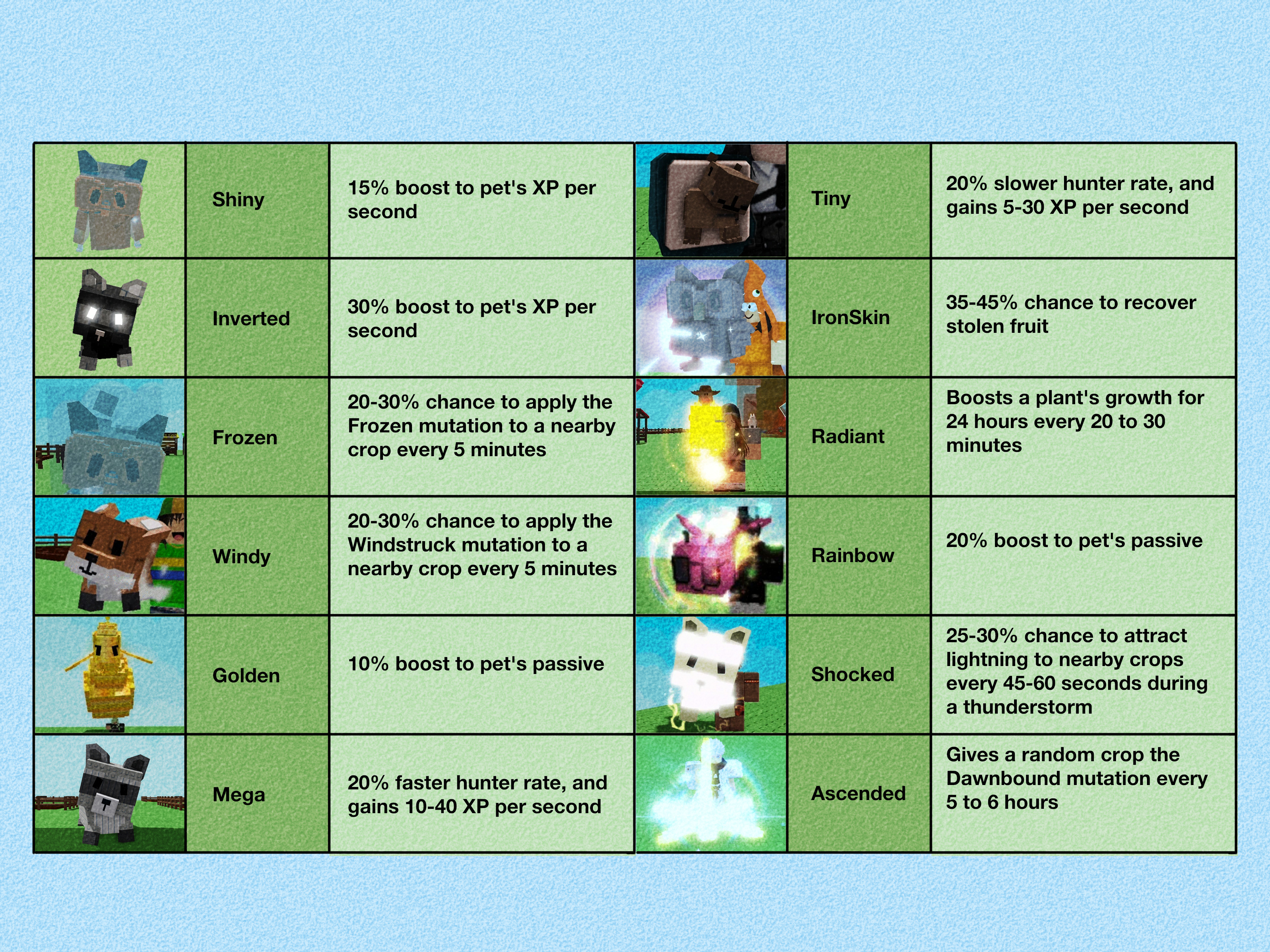
In Grow a Garden, mutations are the glorious little surprises that turn an ordinary crop into something that looks weird, sells higher, and makes you feel like a farming genius. One minute you are staring at a normal fruit. The next minute it is glowing, frozen, shocked, moonlit, drenched, corrupt, or wearing enough particles to look like it just walked out of a Roblox fashion show.
This guide explains how Grow a Garden mutations work, where to find them, how to combine them, and how to plan your garden so you are not just randomly waiting for the sky to do something dramatic. Whether you are hunting Wet, Gold, Rainbow, Shocked, Frozen, Celestial, Corrupt, Amber, Eclipse, or advanced fusion mutations, the key is understanding three things: timing, crop selection, and mutation order.
What Are Mutations in Grow a Garden?
Mutations are special visual and value-changing effects that can appear on crops. A mutated crop usually looks different from its normal version and sells for more Sheckles. Some mutations are simple, such as Wet or Chilled. Others are rarer and much more valuable, such as Shocked, Celestial, Voidtouched, Dawnbound, Disco, and high-tier combination mutations.
The important thing to remember is that mutations are not just cosmetic. They affect crop value, and when you stack the right effects together, a single harvest can become dramatically more profitable. That is why experienced players do not always harvest immediately. Sometimes the smartest move is to let crops sit in your garden and wait for weather, pets, gears, or events to add more value.
The Main Types of Grow a Garden Mutations
Grow a Garden has many mutations, and the list changes as updates add new events, pets, and weather effects. For practical gameplay, it is easiest to group them by how you get them.
1. Crop Variants: Silver, Gold, and Rainbow
The most important crop variants are Silver, Gold, and Rainbow. These are special versions of crops that act as major value boosters. Silver is valuable, Gold is much stronger, and Rainbow is one of the most desirable base variants because it can make stacked crops sell for huge amounts.
Gold and Rainbow crops are especially exciting because they multiply the value of whatever other mutation bonuses your fruit has. In plain English: if a Rainbow crop also gets powerful environmental mutations, that fruit can become the kind of harvest you proudly show off before selling.
2. Weather Mutations
Many mutations come from weather. This is why veteran players treat weather changes like a stock-market alert, except instead of buying shares, they run around staring at fruit.
Common and notable weather-related mutations include Wet from rain-style weather, Windstruck from windy conditions, Chilled from frost, Moonlit from night conditions, Twisted from tornadoes, Sandy from sandstorms, Sundried from heat waves, Acidic from acid rain, Drenched from tropical rain, Aurora from Aurora Borealis, Eclipse or Eclipsed from Solar Eclipse events, Cracked from earthquakes, and Moist from gentle drizzle.
Some weather events happen naturally, while others are tied to limited-time events or admin-controlled chaos. If the server suddenly looks like the sky has joined a dramatic theater club, do not panic. Check your crops.
3. Pet-Applied Mutations
Pets can apply mutations or improve your odds of getting certain variants. For example, some pets can help with Gold or Rainbow chances, while others apply specific effects such as Chilled, Windstruck, Amber, Corrupt, Pollinated, Frozen, or other event-related mutations depending on the pet and update.
The best pet setup depends on your goal. If you are farming for consistent value, use pets that regularly apply common mutations. If you are chasing rare combos, use pets that add hard-to-get mutation ingredients. A pet that looks cute but does nothing for your mutation plan is basically a decorative potato with legs.
4. Gear and Spray Mutations
Gear can help control mutation hunting. Sprinklers, mutation sprays, lightning-related tools, mirrors, fertilizers, and special event gear can increase your odds or apply certain effects. This matters because weather is random, but gear gives you at least some control.
For example, sprinklers can help growth and mutation opportunities, certain fertilizers can help with special variants, and mutation sprays can target specific effects when available. If you are trying to build a combination mutation, gear is often the difference between “I have a plan” and “I am just waiting for the Roblox sky to bless me.”
5. Event and Admin Mutations
Event and admin mutations are usually the rarest and most chaotic. These include mutations connected to special weather, update celebrations, limited-time NPCs, seasonal events, or admin-spawned effects. Examples include Disco, Voidtouched, Dawnbound, Galactic, Alienlike, Heavenly, Fried, Infected, Jackpot, Corrupt, Amber, and other update-specific mutations.
These mutations are not always available through normal gameplay. Some appear only during limited events, some require special items or pets, and some depend on admin events. If a mutation is event-limited, your best strategy is to prepare crops before the event starts, then let the event do its messy, magical work.
How to Find Grow a Garden Mutations
Keep Valuable Crops in the Garden
The biggest beginner mistake is harvesting too quickly. If you harvest every fruit the moment it appears, you reduce your chances of catching extra mutations from weather and events. Instead, keep valuable, multi-harvest, or high-base-value crops in your garden during active weather windows.
Crops that produce repeatedly are especially useful because they give you more chances to receive mutations over time. High-value crops are also better mutation targets because a multiplier on a cheap crop is fine, but a multiplier on an already expensive crop is where the Sheckle fireworks begin.
Watch the Weather and Server Effects
When the sky changes, your plan should change. Rain can help with Wet-style mutations. Frost can lead to Chilled effects. Tornadoes can create Twisted crops. Solar-style events can lead to Eclipse-related mutations. Event weather may apply special effects such as Tranquil, Corrupt, Aromatic, Pollinated, Fall, or other update-specific mutations.
If you notice unusual particles, strange lighting, dark skies, red skies, space effects, heavy wind, or event icons, pause before harvesting. Those moments are mutation windows.
Use Pets for Passive Mutation Pressure
A strong pet lineup works while you are busy planting, selling, or wondering why your inventory is full again. Pets can apply mutations, increase variant odds, or trigger effects after harvesting. Some pets are better for casual farming, while others are built for advanced mutation chains.
If your goal is profit, prioritize pets that apply valuable mutations consistently. If your goal is collecting rare combinations, use pets that provide ingredients for fused mutations. A balanced team usually includes at least one pet for regular value and one pet for rare mutation opportunities.
Save Tools for the Right Crop
Do not waste rare sprays or gear on low-value crops unless you are testing. Use them on crops with strong base value, large weight, desirable variants, or existing mutations. A Gold or Rainbow crop with one or two valuable mutations is usually a better target than a plain crop with no setup.
Think of mutation gear like hot sauce. Yes, you can put it on everything, but it deserves better than a sad little snack.
How Mutation Value Works
Crop value is affected by several factors, including base crop value, weight, crop variant, and environmental mutations. Weight matters because heavier crops can sell for more. Variants such as Silver, Gold, and Rainbow act as major boosters. Environmental mutations add extra value based on the game’s current calculation rules.
The safest way to understand mutation value is this: variants are huge, high-value mutations matter, and stacking multiple effects is usually better than selling too early. A Rainbow crop with strong mutations will almost always be more exciting than a normal crop with one small effect.
However, not every combination behaves like a simple multiplication chain. Some mutation formulas treat environmental mutations as a combined bonus, and some fused mutations replace the ingredients that created them. That is why advanced players focus not only on getting more mutations, but also on getting them in the right order.
How to Combine Mutations in Grow a Garden
Combining mutations means using two or more mutation ingredients to create a stronger mutation, or stacking several compatible effects on the same crop. Some combinations simply coexist, while others fuse into a new mutation and remove the original ingredients.
Beginner Combos
Start with simple combinations that are easy to understand:
- Wet + Chilled = Frozen in many common mutation plans.
- Wet or Drenched + Sandy = Clay.
- Gold + Frozen can create a much more valuable crop than Gold alone.
- Rainbow + Shocked is one of the classic high-value goals.
- Rainbow + Shocked + Frozen is a strong target for profit-focused players.
These combos teach the core rhythm of mutation hunting: get a strong base, add weather effects, wait for the right extra trigger, then decide whether to sell or keep stacking.
Intermediate Combos
Once you understand basic stacking, start looking for fusion-style mutations:
- Clay + heat-style mutations such as Sundried, Fried, Burnt, Molten, or Cooked can lead to Ceramic-style results.
- Windstruck + Twisted can form Tempestuous.
- Aurora + Celestial can form Cosmic.
- Acidic + Toxic can form Corrosive.
- Flaming + Molten can form Blazing.
- Blazing + Meteoric can form Infernal.
The key is to read your crop like a recipe. If a mutation is an ingredient, ask whether adding another mutation will stack with it or transform it into something new.
Advanced Fusion Combos
Advanced combos require more patience because they often involve rare events, pets, or limited mutation windows. Examples include:
- Static + Shocked + Tempestuous = Stormcharged.
- Radioactive + Plagued = Biohazard.
- Corrosive + Biohazard = Contagion.
- Eclipsed + Voidtouched = Abyssal.
- Galactic + Cosmic = Astral.
- Oil + Boil = OilBoil.
- Sauce + Pasta + Meatball = Spaghetti.
- Aromatic + Spaghetti + Sizzled = Gourmet.
- Coin + Jackpot + Fortune = Affluent.
- Spooky + Vamp + Ghostly = Supernatural.
These are not combos you casually complete while half-watching videos. They require preparation, the right crop, and enough patience to survive the game’s favorite mechanic: making you wait.
Best Strategy to Get More Mutations
Plant High-Value, Multi-Harvest Crops
Multi-harvest crops are excellent because they continue producing fruit. More fruit means more chances for weather, pets, and gear to apply mutations. If you are chasing rare effects, a garden full of valuable repeat producers is better than a garden full of one-time crops that disappear before the fun starts.
Do Not Sell Too Early During Events
When an event starts, resist the urge to harvest instantly. Let the event run for a while. Some event weather applies mutations over time, and your crop may catch more than one effect if you are patient.
Use Variants as Your Profit Foundation
Gold and Rainbow crops are the foundation of big profits. If you get a Rainbow crop, treat it like a VIP guest. Keep it available for rare weather, use good gear on it, and try to stack valuable effects before selling.
Target Fusion Ingredients in Order
Some fused mutations remove the ingredients used to create them. For example, certain fusion results replace earlier mutations, meaning the order matters. If you are chasing Clay, Ceramic, Stormcharged, Cosmic, or Abyssal, plan ahead before applying random sprays or harvesting too quickly.
Common Mistakes Players Make
Harvesting Before Weather Ends
A crop cannot catch more weather mutations if it is already in your backpack. During rare weather, leave your best crops planted until the event has finished doing its work.
Using Rare Items on Weak Crops
Save strong mutation gear for valuable crops. Using rare sprays on low-value crops is like putting a diamond necklace on a garden gnome. Funny, but not financially wise.
Ignoring Visual Clues
Mutations usually change a crop’s appearance. Watch for color shifts, particles, glow effects, shells, bubbles, sparks, cracks, smoke, or strange auras. Visual clues tell you whether a crop is ready to sell, worth stacking, or partway through a fusion plan.
Assuming Every Mutation Is Always Available
Some mutations are tied to old updates, admin weather, seasonal events, or limited-time mechanics. If you cannot get a mutation right now, it may not be your fault. The game may simply have rotated that method out.
Best Mutations to Chase for Profit
For everyday farming, chase reliable value first. Gold, Rainbow, Wet, Chilled, Frozen, Shocked, Moonlit, and Pollinated are useful because they appear in many practical farming routes.
For event farming, watch for stronger and rarer effects such as Celestial, Aurora, Eclipsed, Voidtouched, Dawnbound, Disco, Corrupt, Amber, Ancient Amber, Galactic, Alienlike, Jackpot, Radioactive, and Plagued.
For advanced collectors, focus on fusion chains such as Stormcharged, Infernal, Cosmic, Astral, Abyssal, Contagion, Gourmet, and Affluent. These require more setup, but they are the mutations that make your garden look less like a farm and more like a science experiment with a budget.
Quick Mutation Hunting Checklist
- Plant high-value crops before weather or update events.
- Keep multi-harvest crops in your garden for more mutation chances.
- Use pets that match your target mutation route.
- Save sprays and rare gear for Gold, Rainbow, heavy, or already-mutated crops.
- Watch sky color, particles, event icons, and server announcements.
- Do not harvest valuable crops until the event or weather finishes.
- Learn which mutation ingredients fuse and which ones can be reapplied later.
Player Experience: What Actually Works When Hunting Mutations
The best experience I can share about Grow a Garden mutations is this: patience beats panic. New players often treat every fruit like it is about to expire in ten seconds. They plant, wait, harvest, sell, repeat. That works for early Sheckles, but it is not how you get the exciting mutation stacks. Once your farm has decent crops, you should stop playing like a lawnmower and start playing like a weather detective.
A good session usually starts with preparation. Before waiting for weather, fill your garden with crops worth mutating. If you only have cheap crops planted, even a great mutation will feel underwhelming. When you have strong crops ready, weather becomes an opportunity instead of background decoration. Rain is not just rain. Frost is not just frost. A strange sky is not just the game being moody. Every weather change is a chance to improve crop value.
Another useful habit is keeping a few “project crops.” These are crops you do not sell immediately because they already have a good variant or mutation. For example, if you get a Rainbow crop, do not rush to sell it unless you need quick money. Keep it around and try to add a valuable mutation during weather. If it gets Shocked, Frozen, Celestial, or another strong effect, the final value can jump dramatically. This is where the game becomes less about farming and more about building a tiny fruit investment portfolio.
Pets also matter more than many beginners realize. A good pet setup quietly increases your chances over time. You may not notice it every second, but after several harvest cycles, pet-applied effects can make a major difference. The trick is not to use random pets just because they look rare. Use pets that support your goal. If you want common value, pick consistent mutation helpers. If you are chasing a fusion chain, pick pets that help provide the rare ingredient.
The most satisfying moments usually happen when several systems overlap. Imagine you have a valuable crop already sitting with a good variant. Then weather applies one mutation, a pet adds another, and an event gives you a rare third effect. Suddenly, that crop goes from “nice” to “I need to take a screenshot before selling this.” Those are the moments that make mutation hunting fun.
My practical advice is simple: keep your best crops planted during unusual weather, do not waste rare tools on weak crops, and learn the main fusion recipes. Also, accept that luck is part of the game. Sometimes you prepare perfectly and get nothing. Other times, a random crop catches a mutation stack so good it feels personally suspicious. That is Grow a Garden. Half farming simulator, half slot machine, but with fewer regrets and more glowing fruit.
Conclusion
Grow a Garden mutations are the heart of high-profit farming. They make crops more valuable, give your garden personality, and turn simple harvesting into a strategy game. The smartest players know when to wait, when to use gear, when to let pets work, and when to sell before getting greedy.
To find and combine mutations, focus on the basics first: plant valuable crops, watch weather, use helpful pets, save rare tools, and learn which mutation ingredients create fused results. Once you understand that rhythm, you can start chasing advanced combinations like Frozen, Clay, Ceramic, Stormcharged, Infernal, Cosmic, Abyssal, Contagion, and Gourmet.
In short, do not just grow a garden. Grow a garden that looks like it was hit by five weather systems, three pets, one admin event, and a very ambitious profit plan.












