
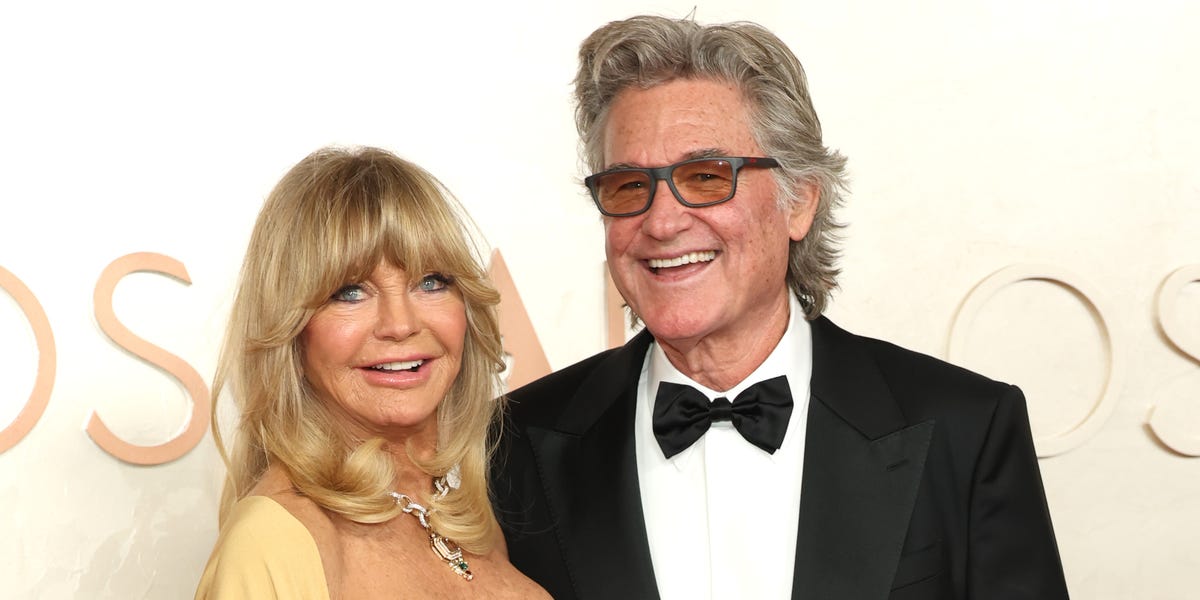
Goldie Hawn and Kurt Russell have done something almost suspiciously rare in Hollywood: they have stayed together for more than four decades without turning their relationship into a courtroom drama, a tabloid countdown, or a heavily sponsored wedding special. No matching monogrammed towels. No “exclusive first-look ceremony photos.” No last-minute vow renewal on a streaming platform. Just two legendary actors, one blended family, a lot of laughter, and one very firm answer to the question people cannot stop asking: Why won’t Goldie Hawn and Kurt Russell get married?
Hawn’s answer has never been about rejecting love. In fact, it is the opposite. Her explanation is built around freedom, daily choice, emotional independence, and the belief that a legal document does not automatically create devotion. She and Russell have been partners since 1983, raised a blended family, worked together on screen, supported each other through aging, fame, parenting, career turns, and public curiosity, and still somehow look like the couple at the party who knows where the good snacks are hidden.
Their relationship has become a cultural case study because it challenges a familiar assumption: that commitment must eventually become marriage to be taken seriously. Hawn and Russell have spent decades quietly arguing otherwise. Their love story says commitment can be legal, spiritual, romantic, practical, private, public, playful, imperfect, and deeply realwithout necessarily involving a wedding ring.
Why Goldie Hawn Says Marriage Is Not Necessary
Goldie Hawn has repeatedly explained that marriage is not the missing piece in her relationship with Kurt Russell. One of her most direct comments is simple and memorable: they want to “choose each other every day.” That idea sits at the heart of their partnership. For Hawn, love works best when it is active, not automatic. She does not want commitment to feel like a locked door; she wants it to feel like a voluntary return home.
In recent interviews, Hawn has also made it clear that she dislikes the feeling of ownership in relationships. She has compared herself to a bird that stays when the cage door is open but resists when the door is shut. It is a charming image, and frankly, very Goldie: sunny, a little whimsical, and sneakily profound. Her point is not that she wants to leave. Her point is that she wants to stay because she is free to leave.
That distinction matters. Many couples confuse security with control. Hawn’s philosophy suggests that real security comes from trust, not from legal pressure. If two people stay loving, respectful, and emotionally available while maintaining individuality, the relationship may become stronger because neither person feels trapped.
A Love Story That Started Long Before the Wedding Questions
Goldie Hawn and Kurt Russell first met in the 1960s while working on the Disney musical The One and Only, Genuine, Original Family Band. At the time, a romance was not in the cards. She was older, he was still very young, and life had other plans. Years later, they reconnected while making Swing Shift, and by 1983 their relationship had begun in earnest.
The timing is important. Both came into the relationship with past marriages behind them. Hawn had been married before, and Russell had also gone through divorce. They were not starry-eyed teenagers imagining that love would solve everything by Tuesday. They were adults with children, histories, careers, and a realistic understanding of how complicated marriage and divorce can become.
That maturity shaped their decision. Instead of rushing toward a traditional script, they built a life that fit the people they actually were. Hawn had children Oliver Hudson and Kate Hudson from her marriage to Bill Hudson. Russell had son Boston Russell with Season Hubley. Together, Hawn and Russell welcomed Wyatt Russell in 1986. Over time, they became one of Hollywood’s most recognizable blended families.
The Divorce Factor: Why They Were Careful
One of Hawn’s most practical arguments against marriage comes from her experience with divorce. She has spoken candidly about how ugly, expensive, and emotionally damaging divorce can be, especially when children are involved. That does not mean she believes all marriages fail. It means she knows that when marriage does fail, the fallout can be brutal.
For Hawn and Russell, the question became: What would marriage add that they did not already have? They already had a household. They already had children. They already had affection, attraction, partnership, and history. If a marriage certificate would not improve the relationship, and might complicate a breakup if one ever happened, they saw little reason to pursue it.
This is not a one-size-fits-all message. For some couples, marriage provides spiritual meaning, legal protection, family clarity, financial structure, and emotional security. For others, including Hawn and Russell, the institution may feel unnecessary. The real lesson is not “never get married.” The lesson is “do not get married just because everyone keeps asking when you will.”
Freedom Is the Main Keyword in Their Relationship
If there is one word that defines Goldie Hawn and Kurt Russell’s unmarried partnership, it is freedom. Not the chaotic freedom of “I do whatever I want and you deal with it,” but the healthier version: freedom to be oneself, freedom to think independently, freedom to disagree, and freedom to keep choosing love without feeling forced into it.
Hawn has said she does not like feeling penned in. That may sound simple, but it reveals a serious emotional truth. Some people flourish when commitment feels spacious. They do not need less love; they need less pressure. They do not want distance; they want oxygen. In a long-term relationship, that oxygen can be the difference between affection and resentment.
Kurt Russell has echoed a similar attitude over the years. He has questioned why people care so much about whether they marry. From his perspective, if the children do not care, the couple does not care, and the relationship is working, the public’s obsession with a wedding becomes more like background noise. Very loud background noise, perhaps, but still noise.
The Role of Family in Their Decision
One reason Goldie Hawn and Kurt Russell’s relationship feels so substantial is that it has never been just about romance. It has also been about family. Hawn has often praised Russell’s devotion to children, and that quality helped convince her he was the right partner. For a mother, charm is nice. Good hair is a bonus. But seeing someone treat your children with love and consistency? That is the emotional equivalent of fireworks, a marching band, and a clean kitchen.
Their blended family includes Boston, Oliver, Kate, and Wyatt, and the family has expanded with grandchildren. Kate Hudson has often spoken warmly about Russell as a father figure, and the family’s public appearances show a group that has created bonds beyond biology and paperwork.
That is a key point: family legitimacy does not come only from legal labels. It comes from showing up. It comes from school events, holidays, hard conversations, inside jokes, shared grief, repaired conflicts, and years of ordinary Tuesday mornings. Hawn and Russell’s family became real through repetition, not ceremony.
Love Without a Marriage Certificate
Many people assume unmarried couples are less committed. Goldie Hawn and Kurt Russell are a walking rebuttal, and they have been walking for a very long time. Their partnership has lasted longer than many celebrity marriages, studio contracts, fashion trends, and probably several brands of yogurt.
Their story reminds us that commitment is behavior. It is not only a title. A husband can be distant; a boyfriend can be devoted. A wife can feel lonely; an unmarried partner can be deeply present. Marriage can be beautiful, but the beauty comes from the people inside it, not from the stationery.
Hawn’s view is especially interesting because she is not cynical about love. She speaks about Russell with affection, humor, and admiration. She has called him kind, funny, romantic, and a wonderful person. Their relationship includes attraction, friendship, parenting, shared history, and a sense of fun. In other words, they skipped the wedding but not the work.
Why Their Relationship Still Fascinates People
Part of the fascination comes from the contrast between Hollywood’s image and their reality. Celebrity culture loves weddings because weddings create content. Dresses, rings, guest lists, floral arrangements, awkward speecheseverything becomes clickable. Hawn and Russell chose the less marketable route: stay together quietly, live your life, and let people wonder.
That mystery has made them even more interesting. Their relationship feels rebellious precisely because it is so stable. They are not rebelling by being dramatic. They are rebelling by being consistent. In a town where public romance can sometimes look like a press strategy wearing perfume, their longevity feels refreshingly human.
They have also shared the screen in beloved projects, most famously Overboard, where their real-life chemistry added sparkle to the comedy. Later, they appeared together again in The Christmas Chronicles films, playing Santa Claus and Mrs. Claus. That casting felt almost too perfect, as if Hollywood finally admitted what audiences had known for years: these two radiate couple energy even without a marriage license.
What Couples Can Learn From Goldie Hawn and Kurt Russell
1. Commitment Should Be Chosen, Not Performed
One of the strongest lessons from Hawn and Russell is that commitment should not be a performance for outsiders. A relationship does not become healthier because relatives stop asking questions at Thanksgiving. It becomes healthier when two people communicate honestly about what they need.
2. Independence Can Strengthen Love
Hawn’s emphasis on freedom is not anti-commitment. It is pro-individuality. Long-term love often works best when both people remain fully alive as individuals. That means having separate thoughts, separate interests, separate moods, and occasionally separate opinions about where to eat dinner, which is where many relationships meet their true test.
3. Past Experience Can Create Better Choices
Both Hawn and Russell entered their relationship with life experience. Instead of pretending the past did not matter, they learned from it. Their previous marriages and divorces helped them think carefully about what they wanted and what they did not want.
4. Family Is Built Through Action
Their blended family shows that love is not limited to traditional structures. Step-parents, half-siblings, former partners, new children, and grandchildren can form a strong family system when adults prioritize care, respect, and consistency.
The Bigger Cultural Meaning of Their Choice
Goldie Hawn and Kurt Russell’s decision not to marry lands differently today than it might have decades ago. Modern couples are increasingly willing to define commitment on their own terms. Some marry later. Some never marry. Some co-parent without romance. Some build chosen families. Some want the wedding, the vows, the legal protections, and the cake with three flavors. Others want none of it, except maybe the cake.
The point is not that one model is superior. The point is that relationships are healthiest when they are intentional. Hawn and Russell did not drift into a 40-plus-year partnership by accident. They made choices. They protected their independence. They valued fun. They took family seriously. They allowed affection to breathe.
In a culture that often treats marriage as the finish line, their story suggests another possibility: maybe the real finish line is not a ceremony. Maybe it is waking up decades later, still liking the person next to you, still laughing, still choosing them, and still refusing to let strangers design your life.
Experiences Related to the Topic: What Their Story Feels Like in Real Life
For many readers, the Goldie Hawn and Kurt Russell story is not just celebrity trivia. It touches a real question: What makes a relationship legitimate? Imagine a couple who has lived together for 18 years. They have shared rent, emergencies, vacations, family drama, aging parents, and the sacred responsibility of choosing a Netflix show without turning it into a constitutional crisis. Yet every holiday, someone still asks, “So, when are you two finally getting married?”
That question can sting because it implies the relationship is unfinished. But couples like Hawn and Russell offer another lens. A relationship can be complete if the people inside it feel complete. The outside world may want a label, but the inside world runs on trust, routines, tenderness, and the small daily acts that rarely make speeches but keep love alive.
There are also couples who do marry and feel deeply happy about it. Their vows matter. Their rings matter. Their legal union reflects their values, faith, family traditions, or practical needs. Hawn and Russell’s message does not diminish that. Instead, it widens the conversation. It says marriage should be meaningful, not mandatory. If two people marry, it should be because the choice strengthens their bond. If they do not marry, that choice can also be valid when it is mutual, honest, and grounded in love.
In everyday life, the healthiest couples often share a few traits that sound very familiar in Hawn and Russell’s story. They laugh. They let each other be strange. They do not treat disagreement as disaster. They keep attraction alive not only through romance, but through admiration. They respect each other’s histories. They understand that love is not a possession; it is a practice.
One practical experience many long-term partners recognize is the importance of emotional space. Too much distance can create loneliness, but too little space can create pressure. Hawn’s “open cage door” metaphor works because it describes a balance many people crave. They want closeness without suffocation. They want loyalty without surveillance. They want to be loved as a person, not managed like a household appliance with better hair.
Another relatable lesson is that public approval is a shaky foundation. Friends, parents, fans, and strangers may have opinions, but they do not live inside the relationship. They do not know the private repairs after arguments, the quiet sacrifices, the shared jokes, or the reasons two people feel safe together. Hawn and Russell have survived partly because they did not let other people’s expectations become the boss of their home.
Their story also speaks to people who have been divorced or hurt before. Choosing not to remarry may not mean fear of love. Sometimes it means respect for what was learned. It may mean wanting a relationship that feels lighter, freer, and less legally tangled. It may mean protecting children from unnecessary upheaval. It may mean two adults saying, “We know what works for us, and we do not need to decorate it for approval.”
Ultimately, the experience behind this topic is simple: love has to be lived, not merely announced. A wedding can be beautiful, but the daily relationship is where the real vows happen. Goldie Hawn and Kurt Russell have spent decades making those daily vows in their own unofficial, untraditional, very human way. No aisle required.
Conclusion
Goldie Hawn’s explanation for why she and Kurt Russell won’t get married is not a rejection of commitment. It is a defense of chosen commitment. Their relationship has lasted because it is rooted in freedom, family, humor, attraction, respect, and the willingness to keep choosing each other without turning love into ownership.
They have built one of Hollywood’s most enduring partnerships by ignoring the pressure to follow a script. For some couples, marriage is the right script. For Hawn and Russell, the better story has been unwritten, flexible, and lived day by day. After more than four decades together, their answer to the marriage question still feels surprisingly modern: love does not need to be trapped to be true.












