
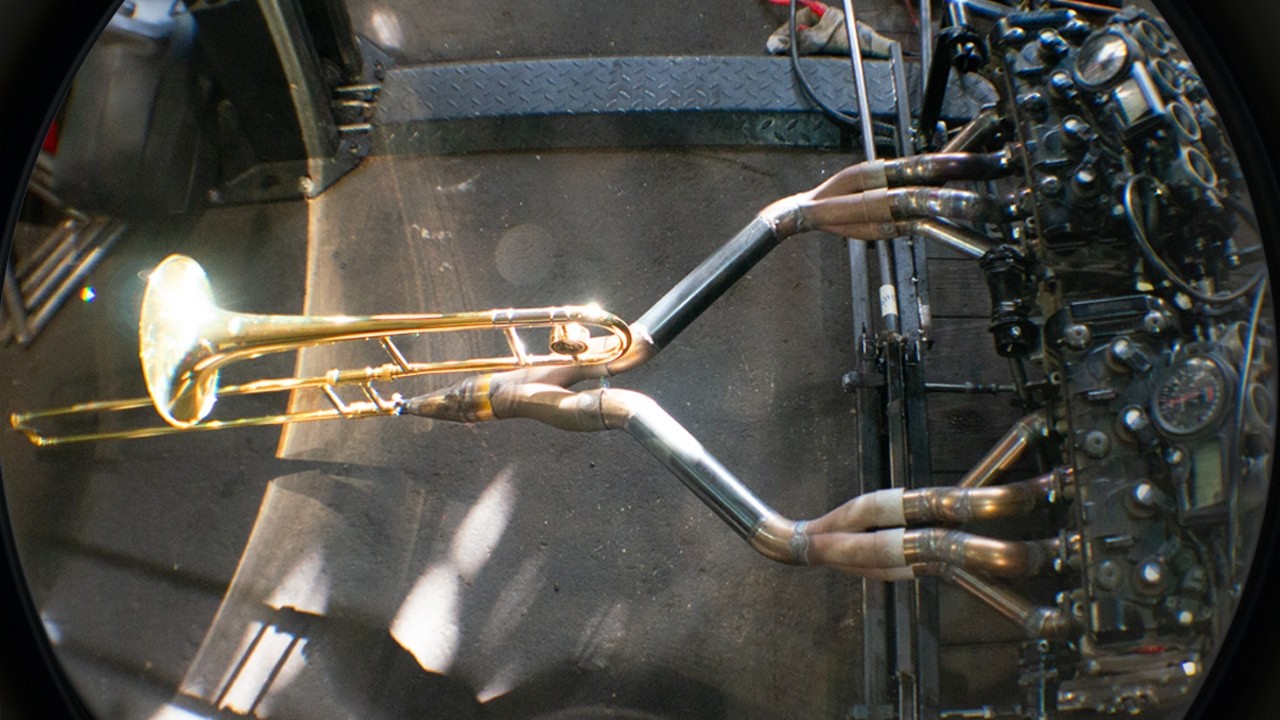
Some engine builds are polished masterpieces. Others are rolling science experiments with just enough courage, CAD, and bad judgment to become internet legend. This one belongs in the second category, and that is exactly why it is so wonderful. The so-called “Franken-engine” at the heart of this story is not a tidy factory V8 wearing a nice valve cover and pretending to be respectable. It is a wild attempt to mechanically link two high-revving inline-four motorcycle engines, spin the whole contraption toward 15,000 rpm, and then celebrate the occasion with a trombone exhaust like a mechanical jazz funeral.
That is not a typo. It really involves a trombone. It also involves chain-drive headaches, extreme rotational forces, custom-fabricated parts, and the kind of determination usually found in people who either invent the future or accidentally launch a gearbox into the next zip code. In pure automotive theater, it is hard to beat.
But beneath the absurdity is something genuinely fascinating. A build like this reveals why high-rpm engines are so intoxicating, why motorcycle powerplants keep showing up in strange custom projects, and why making an engine sound glorious is often just as complicated as making it run. It also proves a timeless gearhead truth: sometimes the most unforgettable machine is the one that almost works, screams like a banshee, and bows out in a shower of drama.
What This Franken-engine Actually Is
The basic idea is gloriously unhinged: take two compact, high-revving inline-four motorcycle engines, mechanically link them, and chase the sound and sensation of an eight-cylinder monster without the bulk of a traditional car V8. The project has been described as a modern backyard echo of the old Chrysler A57 Multibank tank engine, which famously tied five inline-six engines together during World War II. That old Chrysler setup was not elegant, but it worked. This modern build follows the same broad philosophy with far less sheet metal, far more rpm, and considerably more chaos.
That difference matters. The old Chrysler giant lived in a world of comparatively low engine speeds. This modern twin-engine experiment is playing near 15,000 rpm, which is motorcycle superbike territory, not lazy flathead territory. At those speeds, every assumption changes. Parts that seem manageable at 3,000 rpm start behaving like they were designed by a vengeful physics professor. A heavy chain is no longer merely heavy. It becomes a spinning punishment device loaded with centrifugal force, vibration, alignment sensitivity, and the mechanical equivalent of attitude.
And yet, the concept is strangely logical. Motorcycle inline-fours are compact, powerful for their size, and built to live high in the rev range. Custom builders have long stuffed bike engines into tiny cars, oddball EVs, and absurd garage creations because they offer big performance in a tiny package. When builders do that, they are not just chasing speed. They are chasing a certain kind of madness: featherweight internals, screaming top-end power, and the sort of soundtrack that makes your brain whisper, “This is probably a terrible idea,” while your heart yells, “Again!”
Why 15,000 RPM Is Such a Big Deal
At High RPM, Physics Stops Being Polite
Anybody can talk about horsepower at a car meet. High rpm is where the real engineering bar fight begins. At elevated engine speeds, valvetrain control becomes critical. Valves can start losing contact with cam profiles, a nasty condition known as valve float. When that happens, the engine is no longer operating with precision; it is improvising, and pistons are rarely amused by improvisation. This is why high-revving engines rely on lighter valvetrain components, careful spring control, better materials, and precise geometry. The faster everything moves, the less room there is for sloppiness.
Lubrication also turns into a life-or-death matter for the engine. Oil is no longer just there to keep things slippery. It is helping cool components, maintain film strength, and prevent fast-moving parts from deciding they would rather become scrap metal. Sustained high-rpm operation demands more than brute strength. It demands breathing, oiling, heat management, and careful control of reciprocating mass. This is why the best high-revving production engines are engineered like symphonies, not bar fights.
Why Motorcycle Engines Love the Upper End
Motorcycle engines, especially sportbike inline-fours, are natural candidates for projects like this because they were born to rev. Their compact packaging, short strokes, and lightweight internals make them comfortable in operating ranges that would make many car engines file a formal complaint. Honda’s old pursuit of motorcycle-derived top-end character shaped technologies like VTEC, which sought to combine civilized low-speed manners with a serious appetite for rpm. That same spirit lives in modern superbike engines and, by extension, in custom builds that borrow them for weird and wonderful new jobs.
There is also a romance to a high-revving engine that no torque graph can fully explain. When an engine lunges from idle to redline in a blink, the experience feels less like machinery and more like musical performance. That is why so many beloved engines, from the Lexus LFA’s Yamaha-tuned V10 to exotic flat-plane and race-bred screamers, are remembered as much for their voice as for their output. High rpm is not just a number. It is a personality trait.
The Trombone Exhaust Is Not Just a Joke
Well, it is a joke. But it is also more revealing than it first appears.
Engines sound different because combustion pulses do not simply disappear once they leave the cylinder. They travel, collide, reinforce, cancel, and resonate through manifolds, pipe diameters, mufflers, and everything in between. Firing order matters. Engine layout matters. Exhaust routing matters. Tuned lengths matter. One reason some engines sound silky and others sound like they are chewing nails is that the pulses are being arranged differently on their way out to the atmosphere.
That is why legendary-sounding engines are not accidents. Engineers tune exhaust layouts and intake harmonics the way a producer tunes a recording session. The Lexus LFA became famous partly because its sound was deliberately shaped for harmonic richness. Flat-plane V8s, cross-plane V8s, inline-fives, V10s, and race engines all develop distinctive voices because their firing events and plumbing create different acoustic signatures. So when this Franken-engine spits fire and sends its noise through a trombone-shaped path, it is ridiculous, yes, but it also serves as a giant brass reminder that engine sound is mechanical rhythm made audible.
And honestly, if your engine project is already a rolling mechanical fever dream, adding a trombone is not mission creep. It is branding.
The Real Villain: Synchronizing Two Engines at 15,000 RPM
Most engine swaps are hard because of packaging, cooling, wiring, and drivetrain alignment. A twin-engine build adds another problem that is both more basic and more terrifying: the two engines need to work together without trying to destroy the link between them. At mild rpm, you might get away with a rough-and-ready mechanical connection for a test. At 15,000 rpm, rough-and-ready becomes expensive confetti.
The chain in this build is the perfect symbol of why the project is both brilliant and doomed, at least in its first form. On paper, a chain link between crankshafts sounds straightforward enough. In practice, high rotational speed multiplies loads, highlights imbalance, punishes misalignment, and encourages every tiny flaw to audition for a catastrophe. What works in one part of a drivetrain may not survive when asked to synchronize two angry engines living near superbike redline.
Then there is resonance. Long or complex rotating systems can develop destructive vibrations that are not obvious at low speed. That is one reason giant, weird, or improvised crank-connected assemblies make experienced engineers nervous. An engine does not need to explode because the idea is wrong. It can explode simply because the timing of vibration, tension, stiffness, and mass lines up in exactly the wrong way. Mechanical tragedy, like comedy, is all about timing.
Why Builders Keep Doing This Anyway
Because reason is overrated, but also because projects like this sit at the sweet spot between engineering and art. The builder workflow here is deeply modern: 3D scanning, CAD modeling, CNC-machined parts, SLS-printed components, iterative fabrication, and real-world testing. That combination matters. It means a person in a garage can now attempt mechanical ideas that once would have needed a much bigger shop, much deeper pockets, or a very persuasive friend at a race team.
That democratization is a big part of the story. The modern custom scene is no longer just about wrenching with hand tools and a prayer. It is about hybrid craftsmanship. Old-school fabrication meets digital modeling. Wild intuition meets simulation. The result is a build culture where somebody can seriously attempt to create an eight-cylinder sound from chained motorcycle engines, fail spectacularly, and still earn admiration for the attempt.
That matters because many of the best ideas in enthusiast culture are not neat, finished products. They are prototypes with scars. They are half-victories that teach the next lesson. They are swan songs that double as rehearsal tracks for whatever comes next.
The Swan Song Part Is What Makes It Memorable
The title fits because this engine does not simply run. It performs, protests, and then apparently takes a bow with all the melodrama of a rock star smashing a guitar on the last song of the night. There is something poetic about a machine like this finding its voice right around the moment it proves why the design still needs work. That is not failure in the boring sense. That is failure with style.
And style counts for a lot in engine culture. People still obsess over high-revving naturally aspirated engines because they feel alive in a way many efficient, rational powertrains do not. A good screamer climbs through the rev range like it has somewhere urgent to be. The best ones do not just make power. They build anticipation, pitch, texture, and emotion. This build taps into that obsession in the rawest way possible. It is not polished enough to be sterile. It is not successful enough to be smug. It is just ambitious enough to be unforgettable.
There is also a quiet lesson buried under all the noise: engineering is often a conversation with reality. You propose an idea. Reality laughs, throws a chain problem at your forehead, and tells you to revise the drawing. Builders who stay in the game are the ones who treat that not as humiliation, but as data.
What It Feels Like to Experience a 15k-RPM Franken-engine
Watching a project like this is a strange and wonderful emotional cocktail. First comes curiosity. You see two motorcycle engines linked together and think, “That cannot possibly be sensible.” Then comes respect, because even an obviously insane engine concept takes an absurd amount of work to build. Mounting, alignment, fabrication, cooling, controls, structural support, and packaging do not solve themselves just because the internet thinks the idea is funny. Somebody had to actually make all of that real.
Then the engine fires, and the experience changes from intellectual to physical. A high-rpm engine does not merely make sound; it occupies the air. The pitch rises so fast that your brain almost stops processing it as a mechanical event and starts hearing it as a living thing. The closer it gets to the top of the rev range, the less it sounds like transportation and the more it sounds like intent. You do not listen so much as brace.
That is part of why wild custom engine projects have such a hold on enthusiasts. They compress so many emotions into one moment. There is suspense because you know something could go wrong. There is humor because a trombone exhaust is the kind of idea that should live in a cartoon, yet here it is making honest-to-goodness combustion music. There is admiration because even when the concept is flawed, the effort is not. And there is a little bit of heartbreak when the machine reveals its limits just as it begins to sound transcendent.
A truly high-revving engine always feels slightly defiant. It is a declaration that mass can be lightened, chaos can be disciplined, and metal can be persuaded to dance faster than common sense recommends. A twin-engine homemade screamer takes that sensation and turns the volume up. It feels rebellious, improvised, and almost theatrical. It reminds you that the internal-combustion engine is not only an industrial object. In the right hands, it becomes performance art with oil pressure.
There is also something deeply human in a build that falls short in public. Perfect machines are impressive, but imperfect machines are relatable. When a project like this nearly pulls off the impossible, then stumbles because reality asked for one more level of engineering, it becomes more than just a spectacle. It becomes a story about experimentation. You can practically see the next version forming in the background: a lighter link, a better synchronization method, revised geometry, improved stiffness, cleaner control. The machine sings, breaks character, and leaves behind a setlist for the sequel.
That is why the “swan song” matters. It suggests finality, but in the custom world it often means the opposite. One dramatic last run is usually just the end of version one. Somebody goes back to the CAD file. Somebody orders another part. Somebody rethinks the problem at two in the morning while staring at a workbench and muttering things the neighbors should probably not hear. The song ends, but the obsession does not.
And maybe that is the most satisfying part of all. A 15,000-rpm Franken-engine is not lovable because it is practical. It is lovable because it is gloriously, defiantly impractical in pursuit of something visceral: a sound, a sensation, a mechanical idea too entertaining to leave alone. Even when it fails, it proves that automotive passion still has room for nonsense of the highest caliber. Frankly, the world could use more of that.
Conclusion
Franken-engine Plays Its Own Swan Song At 15k RPM is the kind of story that reminds us why engine culture remains so magnetic. It blends homemade engineering, digital fabrication, motorcycle-derived insanity, acoustic drama, and a wonderfully stubborn refusal to keep things sensible. The result is not a polished showroom triumph. It is better than that. It is a noisy, fiery, brass-assisted reminder that the most exciting machines are often the ones still arguing with physics.
Yes, the chain-driven concept hit a wall. Yes, 15,000 rpm is a brutally unforgiving neighborhood. Yes, a trombone has no business being involved in engine development unless your goal is to delight the internet and confuse future historians. But the build still succeeds where it matters most: it makes people care. It makes them laugh, flinch, learn, and turn the volume up.
In an age increasingly obsessed with frictionless competence, this Franken-engine feels refreshingly human. It is ambitious, flawed, loud, creative, and just a little ridiculous. In other words, it is exactly the kind of mechanical swan song people remember long after the last note fades.












