
In the 1983 film WarGames, the fictional War Operation Plan Response computer delivers one of the most memorable lines in tech-pop-culture history: “The only winning move is not to play.” Decades later, the first WOPR Summit borrowed that Cold War computer mystique and gave it a friendlier mission: bring hackers, makers, security professionals, radio enthusiasts, hardware builders, students, and curious tinkerers into the same room and see what happens.
Spoiler alert: nobody launched anything dramatic, unless you count solder smoke, blinking LEDs, and conversations that started with “What does this pin do?” and ended with three new friends around a workbench. The first WOPR Summit, held in Atlantic City, New Jersey, proved that the winning move was not avoiding the game. The winning move was playing together, sharing knowledge, and making the hacking community feel a little less divided.
At a time when cybersecurity events can feel split into separate planetsapplication security over here, hardware hacking over there, radio frequency experiments somewhere near the snack tableWOPR Summit attempted something refreshingly simple: build one open, collaborative learning environment. The result was a conference that mixed technical talks, workshops, contests, badge hacking, software-defined radio, hardware design, and hallway learning into one compact but memorable East Coast hacker gathering.
What Was the First WOPR Summit?
The first WOPR Summit was an immersive hacking convention focused on hardware, software, and wireless technologies. Its mission was not merely to place speakers behind podiums while everyone else politely nodded and checked email. Instead, WOPR Summit emphasized hands-on learning, community participation, technical curiosity, and the belief that hacking is an art form when practiced ethically and constructively.
The event brought together several overlapping communities: makers, hackers, AppSec professionals, DevOps practitioners, red teamers, blue teamers, wireless enthusiasts, students, and builders who enjoy taking things apart just to understand why they worked in the first place. That combination mattered. Many tech events say they are interdisciplinary, but WOPR Summit actually put people from different corners of the hacking universe in the same physical space and gave them reasons to talk.
The summit’s name nodded to WarGames, but its tone was less “global thermonuclear drama” and more “bring your soldering iron, your curiosity, and maybe a backup battery.” It was serious about learning without taking itself too seriously, which is exactly the kind of balance technical communities need. After all, if a conference badge cannot blink mysteriously while someone explains radio packets nearby, are we even living?
Why the “Winning Move” Was Community
Hacker culture has always had a complicated public image. To many people outside the field, the word “hacker” still suggests a shadowy figure in a hoodie doing suspicious things in a dark room. In reality, the hacking community includes engineers, artists, defenders, educators, researchers, hobbyists, and people who simply enjoy understanding systems deeply. WOPR Summit leaned into that broader meaning.
The summit’s most important achievement was not a single talk or gadget. It was the way it blurred boundaries. Attendees interested in hardware had reasons to listen to security talks. Security people had reasons to pick up components and think about fabrication. Wireless enthusiasts could connect their radio experiments to real-world security and engineering questions. The event reminded everyone that building, breaking, fixing, and learning are not separate disciplines. They are steps in the same dance, even if the dancer occasionally trips over a USB cable.
An Eclectic Mix of Talks and Workshops
One of the highlights of the inaugural WOPR Summit was its broad technical range. It was not just a software security conference. It was not only a maker event. It was not strictly a wireless gathering either. It sat somewhere in the lively middle, where a conversation about penetration testing could be followed by a workshop on moving a hardware idea from concept to prototype.
This mix gave the event a practical advantage. Real systems do not live in neat categories. A connected device may involve embedded firmware, printed circuit board design, radio communication, cloud services, user authentication, mobile apps, physical access, and supply chain decisions. A conference that reflects that messy reality prepares attendees better than one that pretends technology comes in tidy boxes labeled “software” and “everything else.”
WOPR Summit’s format also matched how many people actually learn technical skills. They do not absorb everything from slides. They learn by watching, asking, touching, debugging, failing, and then pretending the first three failures were “important research.” The summit’s combination of workshops, talks, open hacking space, contests, and informal discussion created a learning environment where beginners and experienced practitioners could both find something useful.
Badge Hacking on the Boardwalk
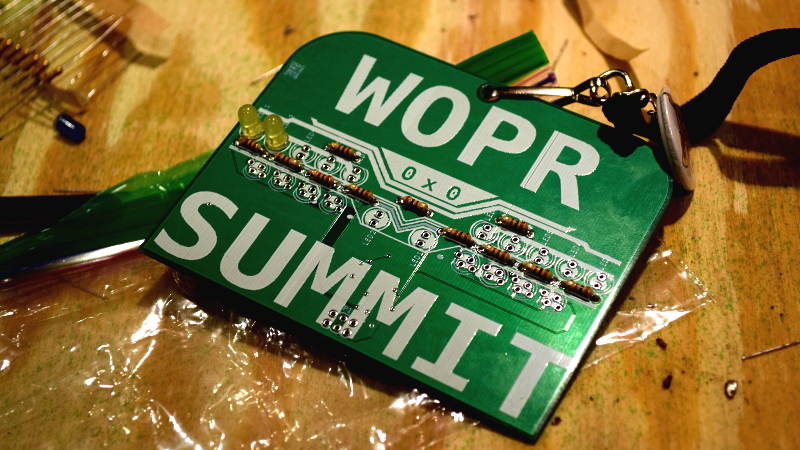
No hacker conference is complete without a badge, and WOPR Summit understood the assignment. The event badge drew inspiration from the fictional WOPR computer and included LEDs, battery holders, and an ATtiny841 microcontroller. It was not just a plastic name tag. It was a small electronics project, a social icebreaker, and a tiny glowing declaration that said, “Yes, I came here to learn, and yes, I may need help finding pin one.”
What made the badge experience stand out was that attendees assembled the badges themselves. That turned a simple object into a shared activity. People compared parts, asked questions, helped each other solder, and debugged mistakes. For newcomers, this kind of guided chaos can be more valuable than a polished lecture. A blinking badge gives instant feedback. It either works, or it stares at you silently while you question your life choices and recheck the resistor orientation.
Badge culture has become a major part of hacker conferences because it combines electronics, art, puzzle design, identity, and community. A good badge is not merely swag. It is an invitation. It says: modify me, understand me, improve me, show me off, and maybe make friends while doing it. WOPR Summit’s badge did exactly that.
The Open Hacking Area: Where the Real Magic Happened
Conferences often advertise talks, but the most memorable moments usually happen between scheduled sessions. WOPR Summit’s open hacking area gave attendees a place to experiment with projects, meet presenters, ask questions, and see what others had brought from home. In many ways, this was the heart of the event.
Open hacking spaces are valuable because they make learning visible. Instead of only hearing about finished work, attendees see the messy middle: half-built devices, unexpected bugs, wires that were definitely organized five minutes ago, and experts who are still learning new things. That environment lowers the intimidation barrier. It reminds beginners that technical mastery is not magic. It is curiosity plus practice, multiplied by patience and occasionally divided by a missing jumper wire.
At WOPR Summit, software-defined radio also played a role in the hands-on experience. With Raspberry Pi workstations and SDR receivers available, attendees could explore the invisible world of radio signals around Atlantic City. For many learners, radio is a perfect gateway topic because it turns the air itself into a classroom. Suddenly, aircraft beacons, local transmissions, and wireless devices are not abstract concepts. They are signals that can be observed, studied, and understood in a safe educational context.
Hardware, Software, Wireless: Why the Blend Worked
The phrase “hardware, software, and wireless technologies” might sound like a conference brochure trying to win keyword bingo, but at WOPR Summit it described a real educational strategy. Modern cybersecurity and engineering problems rarely belong to one layer. A vulnerability may begin in a design decision, pass through a network protocol, appear in an application, and become visible only when someone looks at the physical device.
That is why events like WOPR Summit matter. They encourage systems thinking. A hardware builder who learns basic security principles may design safer products. A software developer who understands radio limitations may make better IoT decisions. A defender who sees how devices are assembled may understand what attackers and testers look for. A student who tries all three may discover a career path they never knew existed.
This blended approach also aligns with the broader direction of cybersecurity education. Organizations such as OWASP encourage awareness of common software risks, while NIST’s Cybersecurity Framework organizes security outcomes around governance, identification, protection, detection, response, and recovery. CISA and the NICE Framework emphasize cybersecurity workforce development across many roles and skill areas. WOPR Summit’s community-first model put those ideas into a more informal, practical setting.
The Venue: Atlantic City Takes a Gamble on Hackers
Holding the first WOPR Summit in Atlantic City was both bold and slightly mischievous. The Boardwalk setting gave the event personality, and the off-season timing made the venue more accessible than it might have been during peak tourism months. Bally’s provided plenty of space, perhaps even more than the first-year event could fully use.
There is something wonderfully odd about placing a hacker convention inside a casino environment. Casinos are full of systems: surveillance, access control, networks, logistics, timing, incentives, and human behavior. That does not mean attendees were there to poke at the venue, of course. It means the setting itself felt like a giant reminder that technology lives inside social and physical environments. Also, buffet lines are a surprisingly effective networking protocol.
The event reportedly faced rough weather as a storm hit the New Jersey coast during the weekend, but attendees still came away impressed. That is a strong sign for any first-year conference. Every new event deals with uncertainty. Rooms are too large or too small. Schedules shift. Equipment misbehaves. Someone inevitably needs tape. The fact that WOPR Summit still felt smooth and promising suggests the organizers understood the most important rule of community events: people forgive rough edges when the core experience is good.
Room to Grow: What Future WOPR Summits Could Improve
No first event is perfect, and WOPR Summit was no exception. One obvious opportunity was recording talks. In-person attendance creates energy, but recorded sessions extend a conference’s impact far beyond the venue. For students, remote learners, and community members who cannot travel, online talks can become long-term educational resources.
Another area for growth was space utilization. A larger vendor area, more demo tables, expanded villages, or additional hands-on stations could make future events feel even more active. The first summit already had the ingredients: technical diversity, enthusiastic attendees, and a strong mission. The next step would be scaling those ingredients without losing the friendly, volunteer-driven feel.
That balance is not easy. Small conferences often succeed because they feel personal. As they grow, they risk becoming crowded, commercial, or overly polished. The best community events preserve the hallway magic while improving logistics. WOPR Summit’s early feedback cultureasking attendees what they wanted nextwas a promising sign that the organizers understood this.
Lessons for Cybersecurity Beginners
For beginners, the first WOPR Summit offers an encouraging lesson: you do not need to know everything before joining the community. In fact, nobody knows everything. The person teaching soldering may be new to web security. The application security expert may be confused by RF terminology. The wireless hobbyist may have never designed a printed circuit board. That is the point.
Good hacker spaces and conferences reward curiosity over ego. They make it acceptable to ask basic questions, as long as you are willing to learn responsibly. They also reinforce ethics. Security knowledge should be used to protect, improve, test with permission, and build safer systems. The best hacking communities do not celebrate harm. They celebrate understanding.
A beginner attending a WOPR-style event should focus on three goals: try one hands-on activity, attend one talk outside their comfort zone, and introduce themselves to at least one person working on something interesting. That simple formula can turn a conference from a passive schedule into an active learning experience. Bonus points if the badge lights up before lunch.
Why WOPR Summit Still Matters
The first WOPR Summit mattered because it represented a healthier vision of technical culture. Instead of treating hardware, software, wireless, and security as rival kingdoms, it treated them as neighboring workshops with open doors. Instead of presenting hacking as secretive or destructive, it framed hacking as creative problem-solving. Instead of relying only on polished presentations, it encouraged hands-on practice and community exchange.
That model is especially important today, as connected devices, AI systems, cloud platforms, embedded electronics, and wireless networks become more intertwined. The next generation of cybersecurity professionals will need more than narrow tool knowledge. They will need curiosity, ethics, communication skills, and the ability to understand systems from multiple angles.
WOPR Summit’s winning move was not a flashy keynote or a perfect schedule. It was creating a place where different technical tribes could recognize that they were part of the same larger community. In a field that changes constantly, that may be the most durable lesson of all.
Personal Experiences and Reflections Related to WOPR Summit
Anyone who has attended a small technical conference knows the feeling: you walk in expecting talks and maybe a sticker table, but you leave with a half-finished idea, three new bookmarks, a weird badge, and the sudden belief that you absolutely should learn PCB design this weekend. That is the kind of energy WOPR Summit represents.
The most relatable part of the WOPR story is the badge-building experience. A hands-on badge is humble, but it teaches several lessons at once. You learn that electronics are physical. Components have orientation. Solder joints have personalities. Instructions are helpful, but peer support is better. And nothing bonds strangers faster than staring at a silent LED and saying, “Yours works? Interesting. I am happy for you. Deeply.”
Events like WOPR also remind us that learning works best when it becomes social. Watching a tutorial alone can be useful, but working beside someone else changes the rhythm. You hear how they think. You see their mistakes. They see yours. A five-minute conversation can explain what an hour of searching could not. This is why open hacking areas matter so much. They create the conditions for accidental mentorship.
Another experience connected to the WOPR Summit theme is the joy of stepping outside your lane. A web developer who wanders into an SDR demo may suddenly understand that wireless communication is not wizardry. A hardware hobbyist who attends an application security talk may realize that product safety includes code and user permissions, not just enclosures and batteries. A student who came for one workshop may discover that cybersecurity is not a single job title but a landscape of roles.
There is also a deeper emotional lesson. Technical communities can sometimes feel intimidating, especially when everyone seems to speak in acronyms. WOPR Summit’s model suggests a better approach: make room for curiosity, humor, and practical experimentation. A person should be able to ask what RF means without being treated like they accidentally typed their password into the projector. Welcoming spaces create stronger experts because they keep more learners in the room long enough to grow.
The “winning move” idea also works as a life lesson for builders. Sometimes the safest move is not to pretend you know everything. Sometimes the smartest move is to ask, test, document, and learn. Sometimes the best move is to avoid reckless behavior and choose responsible experimentation instead. In ethical hacking, restraint is not weakness. It is professionalism.
That is what makes WOPR Summit such a useful story for modern technology culture. The event was not famous because it was enormous. It was memorable because it had a clear soul. It valued learning over showing off, building over gatekeeping, and community over categories. In a world full of giant conferences, livestreamed keynotes, and corporate booths large enough to have their own weather systems, a volunteer-driven hands-on summit can still make a powerful impression.
For anyone planning a similar event, the lesson is simple: give people something to do, not just something to watch. Put beginners near experts. Mix disciplines. Make the badge meaningful. Leave space for hallway conversations. Feed people if possible, because snacks are the unofficial middleware of civilization. Most importantly, build a culture where the person holding the soldering iron for the first time feels just as welcome as the person giving the advanced talk.
In the end, the first WOPR Summit found the winning move by rejecting the idea that communities should stay in their silos. It played the game carefully, ethically, and collaboratively. And unlike the fictional supercomputer that inspired its name, it discovered that sometimes the winning move is absolutely to playas long as everyone learns something, nobody breaks the rules, and at least a few LEDs blink triumphantly before closing remarks.
Conclusion
The first WOPR Summit proved that a new hacker convention can succeed when it focuses on the right things: hands-on learning, ethical curiosity, technical variety, and genuine community. By bringing together hardware builders, software developers, wireless enthusiasts, security professionals, makers, and students, the event showed how much stronger technical culture becomes when people cross boundaries instead of guarding them.
Its badge hacking, open hacking area, SDR experiments, talks, workshops, and Atlantic City setting created a memorable first chapter. More importantly, WOPR Summit offered a blueprint for future community events: be practical, be welcoming, be weird in the best possible way, and give people a reason to learn from one another. For a conference named after a computer that once advised not playing, WOPR Summit made a pretty convincing case that the real winning move is to play responsibly, together.












