
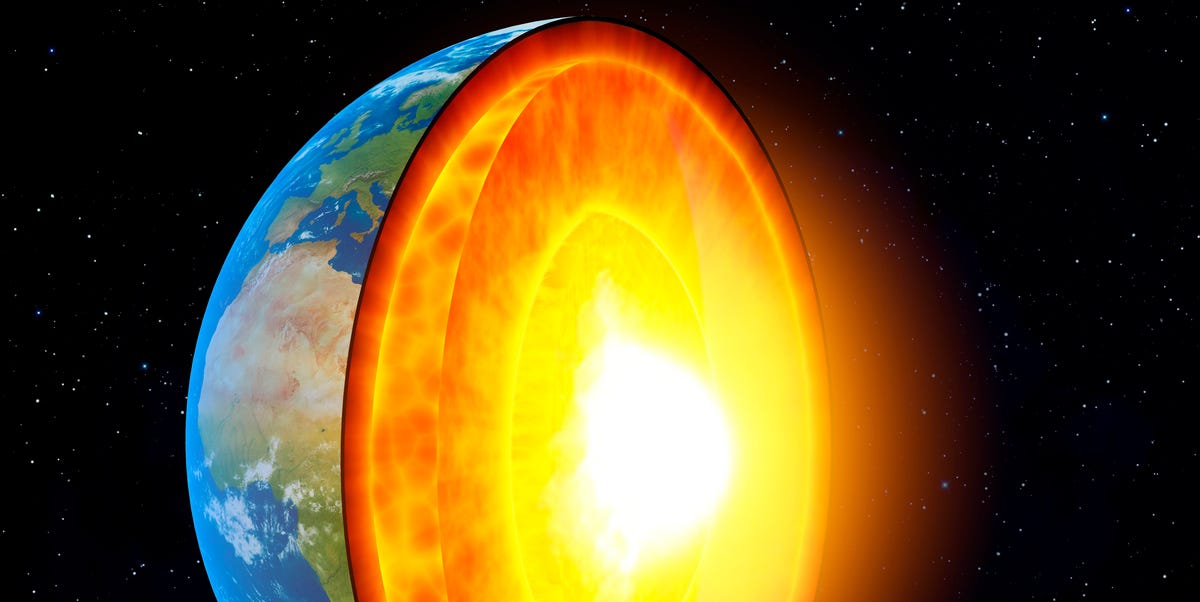
Thousands of miles beneath your chair, car, coffee shop, and carefully ignored laundry pile, a solid metal sphere is moving differently from the rest of the planet. Research has found evidence that Earth’s inner core can speed up, slow down, and even reverse its motion relative to the mantle above it.
One influential study proposed that this motion follows a roughly six-year oscillation. That finding inspired headlines claiming that Earth’s core switches direction every six years. The headline is wonderfully dramatic, but the real science is more precise: the inner core’s relative rotation appears to move back and forth rather than behaving like a motor that suddenly slams into reverse.
The distinction matters. Earth is not preparing to spin backward, gravity is not taking the weekend off, and nobody needs to purchase an emergency “core reversal” helmet. Instead, researchers are using tiny changes in seismic waves to investigate one of the most inaccessible and dynamic regions of our planet.
What Is Earth’s Inner Core?
Earth is built in layers. We live on the crust, a thin outer shell resting above the much thicker mantle. Beneath the mantle lies the liquid outer core, and at the center sits the solid inner core.
The inner core is a sphere made primarily of iron and nickel. It has a radius of about 759 miles, or 1,221 kilometers, making its diameter approximately comparable to that of Pluto. Temperatures near the center may reach about 9,800 degrees Fahrenheit, or 5,400 degrees Celsius. Iron would normally melt at such temperatures, but the crushing pressure at Earth’s center keeps the inner core solid.
Surrounding it is an approximately 1,400-mile-thick layer of molten iron and nickel called the outer core. Movement within this electrically conducting liquid generates most of Earth’s magnetic field through a process known as the geodynamo.
Because the inner core is surrounded by liquid, it is partly decoupled from the rocky mantle. It can therefore rotate at a slightly different rate. Think of a passenger walking inside a moving train. The passenger and train are both traveling forward, but the passenger can move faster or slower relative to the carriage.
Does Earth’s Core Really Switch Direction?
Yes, according to some observationsbut the word direction requires a scientific asterisk large enough to deserve its own office.
The inner core does not necessarily stop rotating in space and begin spinning the opposite way. Earth and all its major layers continue rotating eastward. Scientists are generally describing differential rotation: the difference between the inner core’s motion and the rotation of the mantle and crust.
When the inner core moves slightly faster than the mantle, researchers call it super-rotation. When it moves more slowly, it is described as subrotation or backtracking. From the viewpoint of someone standing on the surface, sufficiently slow relative motion can look like a reversal.
A useful comparison is a car passing a slower vehicle. Both cars may be traveling east, but the slower car appears to move backward when viewed from the faster one. Nobody has actually shifted into reverse; the relative speeds have changed.
Where the Six-Year Cycle Came From
In 2022, geophysicists Wei Wang and John Vidale published a study examining seismic signals produced by underground nuclear tests conducted between 1969 and 1974. Unlike natural earthquakes, controlled explosions can provide unusually useful comparisons because their locations and timing may be known with considerable precision.
The researchers analyzed data from two American tests beneath Amchitka Island in Alaska and Soviet tests at Novaya Zemlya in the Russian Arctic. Signals from the explosions were recorded by the Large Aperture Seismic Array, a network of more than 300 instruments that once operated in Montana.
The study found evidence that the inner core subrotated by at least 0.1 degree between 1969 and 1971. Between 1971 and 1974, it appeared to super-rotate by approximately 0.29 degree. Those small but opposite changes did not fit a model in which the inner core steadily rotates faster than the mantle.
Instead, the observations were consistent with a model in which the inner core oscillates around an equilibrium position with a period of about six years. Under this interpretation, it spends roughly three years moving one way relative to the mantle and roughly three years moving back.
The displacement is tiny on a planetary scale. Researchers have estimated that points on the inner core’s surface may shift back and forth by only a few kilometers. For an object approximately 1,500 miles wide, that is less of a grand migration and more of a metallic fidget.
How Scientists Observe a Place They Cannot Visit
No drill can reach Earth’s core. The deepest human-made boreholes extend only a few miles into the crust, while the inner core begins more than 3,000 miles beneath the surface. Scientists therefore study it indirectly, primarily by examining seismic waves.
Seismic Waves Act Like Medical Imaging
Earthquakes and explosions send vibrations through the planet. P waves, or primary waves, can travel through solids and liquids. S waves cannot pass through the liquid outer core, which is one reason scientists know that layer is molten.
Some P waves cross the mantle, enter the outer core, pass through the inner core, and eventually reach seismic stations on the opposite side of Earth. Their travel times, shapes, and scattering patterns contain information about the materials they encountered.
The technique resembles a planetary CT scan, except the “patient” is Earth, the scanner is a global network of seismometers, and asking the patient to remain still is not an option.
Repeating Earthquakes Provide Better Comparisons
Scientists are especially interested in earthquake doublets and multipletsevents that occur in nearly the same location with similar seismic characteristics. Because their waves follow almost identical paths, differences between recordings made years apart may reveal changes inside the planet rather than changes at the earthquake source.
The measurements are extremely delicate. Researchers compare signals that have traveled thousands of miles and look for differences measured in fractions of a second. Instrument changes, uncertain earthquake locations, inner-core structure, and deformation near its boundary can all complicate the interpretation.
Why Would the Inner Core Oscillate?
The inner core does not float freely like a marble in soup. It is held near Earth’s center by gravity and interacts with both the liquid outer core and the solid mantle.
Gravitational Coupling
The mantle and inner core are not perfectly uniform spheres. They contain variations in density, while the boundaries between layers have subtle topography. These uneven structures can exert gravitational torques that encourage the inner core to align with the mantle.
If the inner core moves away from its preferred orientation, gravitational forces may pull it back. Momentum can carry it past equilibrium before the restoring force reverses its motion again. The behavior is called libration and is conceptually similar to a pendulum swinging around its resting position.
Magnetic and Fluid Forces
The churning liquid outer core also exerts electromagnetic forces on the inner core. Large-scale flows of molten metal can accelerate or slow its relative rotation. Researchers continue to investigate how magnetic torque, gravitational coupling, and fluid motion work together.
That complexity is one reason a perfectly regular six-year schedule should not be treated like a planetary train timetable. The deep Earth is a coupled system, not a kitchen clock.
The Link to Changes in the Length of a Day
An Earth day is not always exactly 86,400 seconds. Winds, ocean currents, tides, ice movement, groundwater changes, earthquakes, and activity inside the core can all alter Earth’s rotation by tiny amounts.
When one part of Earth gains angular momentum, another part must compensate. A familiar example is a spinning skater pulling in their arms and rotating faster. Inside Earth, exchanges of angular momentum among the core, mantle, oceans, and atmosphere can slightly change the speed of the surface.
Scientists have identified a roughly six-year signal in length-of-day measurements. The 2022 inner-core oscillation model matched the timing and approximate scale of that pattern, strengthening the argument that the two phenomena may be connected.
These changes are generally measured in fractions of a millisecond. They matter for precision geodesy, astronomical observations, satellite navigation, and models of Earth’s interior, but they will not make Monday afternoon noticeably longer. Sadly, the core cannot be blamed for a meeting that feels like it lasted four days.
Why Scientists Still Debate the Six-Year Claim
The six-year model is important evidence, not a universally accepted final answer. Other research has identified longer cycles or offered different explanations for changing seismic signals.
A 2023 study based on repeating earthquakes proposed that differential inner-core rotation varies over approximately seven decades, with turning points separated by roughly 35 years. That research suggested the inner core approached a relative pause around 2009 and then began moving more slowly than the mantle.
A major 2024 analysis strengthened evidence that the inner core had backtracked. Researchers examined 121 earthquakes occurring between 1991 and 2023 near the South Sandwich Islands. Many seismic waveforms changed and later returned to earlier patterns, behavior consistent with the inner core moving to a new relative position and then revisiting its previous orientation.
Research published in 2025 added another twist: part of the signal may reflect changes in the shape of the inner core’s shallow surface. Its outermost region may deform slowly as it interacts with turbulent flow in the outer core and density variations in the mantle.
The latest picture is therefore more interesting than a simple choice between rotation and deformation. Both processes may occur. The inner core can change its relative rotation rate while its surface also shifts or deforms.
What the Discovery Does Not Mean
- Earth will not begin rotating backward. The proposed reversal concerns tiny differences between the inner core and mantle.
- It does not predict a major earthquake. Most earthquakes originate in the crust or upper mantle, far above the core.
- It is not the same as a magnetic pole reversal. Earth’s magnetic field is generated mainly by fluid motion in the outer core.
- It will not create dramatic changes in gravity. The inner core remains centered by immense gravitational forces.
- It is not an immediate threat to life. Any effects at the surface are extremely small.
Why Earth’s Inner Core Motion Matters
Understanding inner-core rotation helps scientists reconstruct how Earth formed, cooled, and evolved. The inner core is gradually growing as liquid metal freezes onto its surface. That process releases heat and separates lighter elements into the outer core, helping provide energy for the geodynamo.
Its movement may also reveal the distribution of dense structures deep in the mantle. If gravitational irregularities tug on the inner core, its oscillation becomes a probe of regions that cannot be observed directly.
Better models of the core can improve interpretations of Earth’s magnetic field, length-of-day variations, polar motion, and seismic wave behavior. The findings are unlikely to change anyone’s morning commute, but they can change our understanding of the machinery that keeps the planet active and magnetically protected.
Experiencing the Discovery: Listening to Earth’s Hidden Clockwork
Following research on Earth’s inner core is a peculiar scientific experience because almost everything meaningful is invisible. There is no glowing doorway into the planet, no research submarine descending through molten iron, and no camera livestreaming from the center. The evidence arrives as rows of waves on a screensmall wiggles carrying stories from thousands of miles away.
Imagine sitting in a seismic laboratory and comparing two recordings made several years apart. At first, the lines appear nearly identical. Both earthquakes occurred in almost the same location, and their waves traveled along approximately the same route. Then a researcher notices that one tiny section no longer matches. A pulse arrives slightly earlier, or a scattered wave has changed shape.
On an ordinary graph, the difference may look unimpressive. It certainly lacks the visual enthusiasm of an erupting volcano. Yet that subtle mismatch could mean a metallic sphere at Earth’s center changed its position relative to the surface.
The experience rewards patience. Scientists may spend months checking whether an apparent signal came from the inner core or from a relocated earthquake, an updated instrument, local geology near a station, or noise in an old recording. Historical nuclear-test data present additional challenges. Some measurements were preserved on aging magnetic tapes that had to be recovered before the information disappeared.
There is also an emotional swing between discovery and restraint. Finding a possible six-year oscillation is exciting. Writing “Earth’s core reverses direction” will understandably make readers imagine a catastrophic planetary gearbox failure. The responsible experience is to enjoy the wonder while explaining that the motion is relative, gradual, and measured in fractions of a degree.
For the public, the topic offers a new way to experience apparently solid ground. A sidewalk feels permanent, but the planet beneath it is layered and active. The mantle creeps, tectonic plates move, molten metal circulates, and the inner core adjusts its rotation. Earth is not a rigid ball. It behaves more like a collection of nested systems exchanging heat, force, and angular momentum.
The discovery can even change the experience of an earthquake report. A distant earthquake is not only a destructive surface event; it is also a flashbulb illuminating the planet’s interior. Waves from one quake may cross the outer core, travel through the solid center, and emerge on the other side carrying clues about iron crystals, boundary deformation, and differential rotation.
Perhaps the most memorable experience is recognizing the scale involved. Scientists infer motion of only a few kilometers on the surface of a sphere located more than 3,000 miles below us. They do it without seeing or touching the object, using signals that have crossed an entire planet. That is the geophysical equivalent of hearing a faint creak in a locked building across town and correctly determining which chair moved.
The six-year cycle may eventually be modified as more observations become available. It may be part of a larger pattern involving annual, six-year, decadal, and multidecadal changes. That uncertainty is not a weakness. It is the experience of science working normally: one study uncovers a pattern, another challenges its timing, and later research reveals that multiple mechanisms may be operating together.
Earth’s center remains mysterious, but it is no longer silent. Every carefully measured earthquake gives researchers another chance to listen.
Conclusion
Evidence shows that Earth’s inner core does not rotate at one perfectly steady rate relative to the mantle. A 2022 study found that it moved more slowly during one period between 1969 and 1971 and faster during another between 1971 and 1974, supporting a six-year oscillation model.
However, “switching direction every six years” should be understood as a compelling interpretation rather than an unquestioned law. Other studies point to multidecadal changes, while newer observations indicate that the inner core may deform as well as rotate.
The scientific takeaway is not that Earth’s engine has suddenly gone into reverse. It is that our planet’s deepest layers are dynamic, coupled, and surprisingly active on human timescales. Far below our feet, a Pluto-sized sphere of metal may be rocking back and forth, nudged by gravity, magnetic forces, and a restless ocean of molten iron.












