
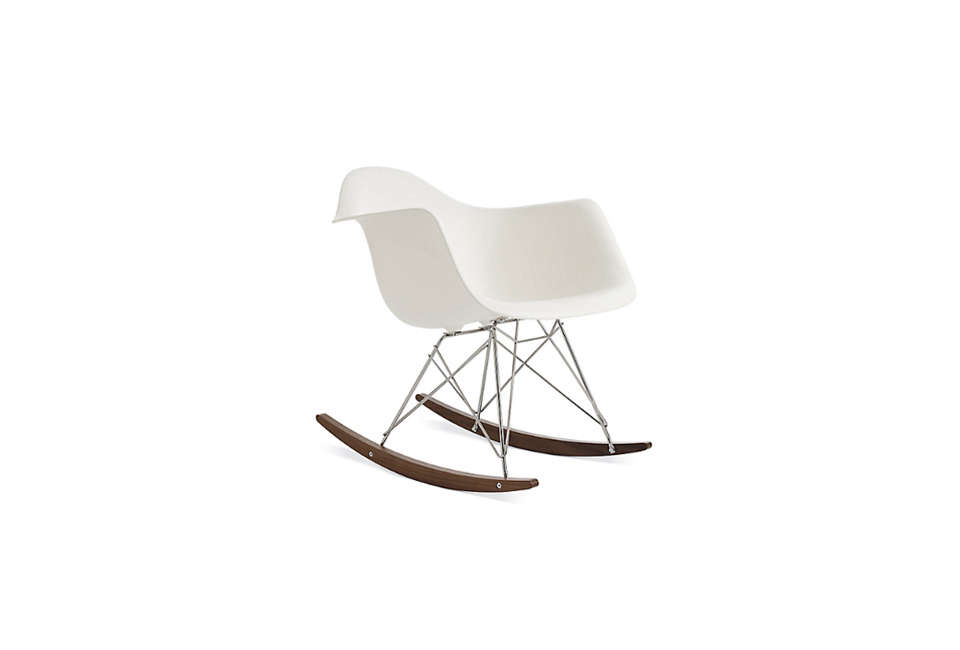
Some chairs are designed to disappear politely into a room. The Eames Molded Plastic Rocker does the opposite. It sits there with a sculptural shell, a wiry architectural base, and two curved wooden runners that quietly suggest, “Go ahead. Cancel your next appointment.”
Designed by Charles and Ray Eames as part of their groundbreaking exploration of molded shell seating, the rocker combines industrial experimentation with an almost playful domestic personality. It is modern without being cold, recognizable without requiring a giant logo, and comfortable without resembling an overstuffed marshmallow.
The design belongs to the larger Eames shell-chair story that transformed twentieth-century furniture. The Eameses spent years investigating how a chair could support the human body with a shaped surface rather than heavy upholstery. Their experiments moved through molded plywood, metal, fiberglass-reinforced plastic, wire, and later generations of plastic materials. That long search for an efficient, comfortable shell became one of the defining achievements of American modern design.
Today, the Eames rocker remains desirable because it is more than an attractive vintage silhouette. It represents a design philosophy based on experimentation, adaptability, mass production, and the surprisingly radical idea that useful furniture could also be delightful.
What Is the Eames Molded Plastic Rocker?
The Eames Molded Plastic Rocker is essentially an armchair shell mounted on a rocking base rather than conventional legs. Vintage and collector discussions commonly refer to the rocking version by the shorthand RAR. Its basic visual recipe is wonderfully simple: an organically curved shell, a network of metal rods, and wooden rockers beneath.
That sounds straightforward until you look closely. The shell flows continuously from the seat into the back and arms. The metal base creates a delicate geometric structure under the larger sculptural form, while the wooden runners introduce warmth and movement. Hard, soft, curved, straight, industrial, naturalthe chair is a small design argument in which every side somehow wins.
The rocking base was not an unrelated decorative experiment. Archival material associated with the Eameses’ work for the 1948 International Competition for Low-Cost Furniture Design documents armchair concepts with several interchangeable bases, including a rocker base. This modular approach allowed one carefully developed seating shell to serve different functions and environments.
The Design Story Behind an Icon
The Search for a One-Piece Shell
Before there was an Eames plastic rocker, there was a stubborn design problem.
Charles and Ray Eames wanted to create seating that supported the body through shape rather than excessive padding. During the 1940s, they became famous for experiments with molded plywood. Their wartime work with molded materialsincluding the production of plywood splintshelped expand their technical understanding, but plywood presented limitations when they attempted to create a complex, continuous seat-and-back shell.
Instead of deciding that the idea was impossible and going home for snacks, they changed materials.
The Eameses’ experimental process eventually led them toward fiberglass-reinforced plastic. The material could be molded into the complex curves required for a one-piece seating surface and produced industrially. The resulting shell chairs entered production around 1950 and became among the most influential furniture designs of the postwar era. MoMA’s collection includes a 1950 side chair made from molded polyester reinforced with glass fibers, while the Metropolitan Museum of Art notes the Eameses’ significant role in aesthetically exploiting fiberglass as an exposed furniture material.
A Chair Designed as a System
One of the smartest aspects of the Eames shell-chair family is that the seat was not married to a single base.
The same fundamental shell concept could be adapted to wire bases, dowel-leg structures, stacking frames, pedestal bases, and rocking supports. In contemporary product language, we might call this a “platform.” In normal human language, it means the Eameses designed one exceptionally useful form and then kept asking, “What else can this thing do?”
This flexibility helped the chairs move between homes, offices, schools, restaurants, waiting areas, and public interiors. The rocker brought the shell into a more relaxed domestic context. It retained the technological confidence of postwar modernism but added something wonderfully old-fashioned: the calming motion of a rocking chair.
Why the Eames Molded Plastic Rocker Still Looks Modern
It Balances Organic and Geometric Forms
The shell is soft and sculptural. The base is precise and architectural. The runners are warm and familiar. Those three visual languages create tension without creating chaos.
This is one reason the Eames Molded Plastic Rocker works in so many interiors. In a minimalist room, it adds personality. In a colorful room, it does not panic. In a mid-century modern interior, it feels historically appropriate. In a contemporary home, it can look surprisingly current.
Many pieces advertised as “timeless” are really just beige. The Eames rocker earns the description through adaptability.
The Profile Is Instantly Recognizable
Viewed from the side, the chair has a memorable silhouette. The shell rises in a continuous curve while the rocker base spreads beneath it in a compact web of rods and wood. From the front, the arms create a welcoming shape without making the chair visually bulky.
This visual clarity matters. Great furniture can often be recognized from across a room, and the Eames rocker has that quality. It has enough character to serve as a focal point but is small enough to avoid dominating a space.
It Mixes Materials Without Looking Busy
Plastic, metal, and wood could easily become a three-material traffic accident. Here, each material performs a clear job.
The molded shell receives the body. The metal structure connects and supports. The wooden runners meet the floor and provide the rocking motion. Because each component has an obvious function, the overall design feels logical rather than decorative.
That functional clarity reflects the broader Eames approach. The Library of Congress describes their furniture as a search for forms that support the body through three-dimensional surfaces and flexible materials rather than relying primarily on conventional cushioned upholstery.
Fiberglass, Plastic, and the Evolution of the Shell
The phrase Eames Molded Plastic Rocker can describe chairs from different production eras, and that history matters.
The early shell chairs were produced in fiberglass-reinforced plastic. Vintage examples are often loved for the visible fibers, subtle color variation, and textured character of the material. With age, the surface may develop a patina that collectors find attractive, although condition varies enormously.
Production materials later evolved. Concerns surrounding older fiberglass manufacturing processes contributed to a move toward polypropylene. Improved technologies eventually allowed fiberglass versions to return through more environmentally considered production methods, while the broader Eames molded-plastic family has continued to evolve toward recycled plastic options. Herman Miller describes the shell-chair concept as material-independent: the essential idea survives even as available materials and manufacturing methods change.
That distinction is important when shopping. An early fiberglass rocker, a later plastic example, and a contemporary licensed shell chair may share the same design lineage while differing in texture, construction details, markings, color, and collector value.
Is the Eames Molded Plastic Rocker Comfortable?
Yesbut understanding the type of comfort it offers prevents disappointment.
This is not a giant recliner designed to swallow your entire weekend. The comfort comes primarily from the shaped shell, supportive arms, relaxed posture, and gentle rocking motion. The chair feels more structured than upholstered lounge seating.
For reading, talking, enjoying coffee, or taking a quiet break, the design can be remarkably pleasant. The rocking movement adds another layer of comfort because the chair is not completely static. Small shifts in body position become part of the experience.
Body size and personal preference matter, of course. Some people love the molded shell immediately; others prefer padding. A seat pad can soften the experience, although purists may argue that covering too much of the shell is like putting a winter coat on a sculpture.
Where the Eames Rocker Works Best
Living Rooms
In a living room, the rocker works well as a compact accent chair. Its open base helps preserve visual space, making it particularly useful in rooms where a bulky upholstered chair would feel heavy.
Pair it with a low side table, a floor lamp, and a textured rug. The contrast between the smooth shell and softer materials keeps the room from feeling like a design museum where everyone is afraid to touch anything.
Bedrooms and Reading Corners
The chair’s relatively compact footprint makes it suitable for a bedroom corner or reading area. It can create a functional destination in a space that might otherwise collect laundry with impressive efficiency.
A rocker near a window is especially appealing. The chair does not need an elaborate setup; natural light and a small table are often enough.
Nurseries
The Eames rocker has long been associated with nursery-style interiors because rocking is naturally useful when soothing a baby. However, anyone considering it for extended feeding sessions should test the chair personally. A beautiful silhouette cannot negotiate with your lower back.
For some users, the supportive shell and arms work well. Others may prefer a larger upholstered glider. Design greatness and individual ergonomics are allowed to disagree.
Home Offices and Creative Spaces
The rocker can also serve as a secondary chair in a home office or studio. It creates a place to step away from a desk without leaving the room entirely. That small shift can be useful for reading, reviewing ideas, or pretending that rocking thoughtfully counts as strategic planning.
How to Style an Eames Molded Plastic Rocker
One advantage of the Eames rocker is that it does not require an entire mid-century modern interior. In fact, placing it in a room full of period-perfect furniture can sometimes make the space feel more like a showroom than a home.
Use Contrast
Place a clean, modern rocker beside an antique cabinet, a handmade rug, or a rough plaster wall. The contrast emphasizes the design without turning the room into a theme.
Let Color Do Some Work
Depending on the era and production version, Eames shells can appear in a broad range of colors. A neutral shell offers flexibility, while a stronger color can become the visual punctuation mark in an otherwise restrained room.
A bright rocker does not need six matching accessories. Let it be the colorful one. Every room needs at least one personor chairwilling to carry the conversation.
Consider the Floor Surface
Rocking performance depends partly on the surface below. A thick rug may slow or restrict movement, while a hard floor allows freer rocking. The condition of the wooden runners also matters, especially with vintage examples.
Protect delicate flooring appropriately and inspect older runners for roughness, damage, or previous repairs before putting the chair into daily use.
Buying an Authentic Eames Rocker
The popularity of the design has produced a very large market of reproductions, inspired versions, replacements, vintage combinations, and outright copies. Buyers should therefore separate two questions: Do I like this chair? and Is this an authentic licensed Eames product?
Both questions are legitimate, but they are not the same.
Authenticating a vintage Eames rocker may involve examining manufacturer markings, labels, shell material, shock mounts, base construction, hardware, proportions, production details, and provenance. These features can vary by period, so a single online checklist should not be treated as universal truth.
Licensed Eames furniture has historically been associated with authorized manufacturers including Herman Miller in the United States and Vitra in Europe. Older shells and bases may also have complicated histories because components can be replaced or combined over decades of use.
For a valuable vintage purchase, detailed photographs are essential. Inspect the underside of the shell, attachment points, runners, welds, labels, and any repaired areas. A chair can be genuinely old without being completely original, and a replacement base does not magically become vintage because it spent five minutes under a 1950s shell.
Vintage Original or Modern Version?
A vintage Eames rocker offers history, material character, and the possibility of a unique patina. For collectors, early fiberglass texture and period-specific details can be a major part of the appeal.
The trade-off is uncertainty. Vintage chairs can have stress cracks, brittle shock mounts, weakened adhesive, damaged runners, replaced hardware, faded surfaces, or undocumented modifications. Restoration quality varies from meticulous conservation to the furniture equivalent of “my cousin had a glue gun.”
A newer licensed chair or shell-family product may offer more predictable condition and easier everyday ownership, although available materials, colors, bases, and rocking configurations depend on the manufacturer, market, and production period.
The better choice depends on your goal. Collectors may value originality and provenance. Daily users may prioritize durability and consistency. Design lovers who simply want the silhouette should still understand what they are buying before paying an authenticity premium.
Care and Maintenance
Routine care should be gentle. Dust the shell regularly and use a soft cloth for light cleaning. Avoid aggressive abrasives that can alter the surface, particularly on older fiberglass shells where texture and patina may contribute to the chair’s character.
Vintage chairs deserve periodic inspection around the shock mounts and connection points. Movement, cracking, or failed adhesive should be evaluated before the chair is used heavily. The metal base should also be checked for corrosion, loose connections, or poor previous repairs.
Wooden runners can develop scratches and wear naturally. Minor evidence of use is not automatically a problem, but structural cracks are another matter. A rocking chair repeatedly transfers load through its runners, so “probably fine” is not an engineering standard.
Why the Eames Molded Plastic Rocker Matters
The importance of the Eames rocker does not come from its fame alone. Its real significance lies in the ideas behind it.
It demonstrates that a chair can be conceived as a flexible system. It shows how industrial materials can produce an organic, human-centered form. It bridges mass production and visual personality. Most importantly, it reflects Charles and Ray Eames’s habit of treating design as an ongoing process rather than a single flash of inspiration.
The shell-chair family became a landmark of modern furniture because it answered practical questions while remaining visually memorable. Museums including MoMA preserve Eames shell designs in their collections, and major institutions continue to study the Eameses’ broader influence on American design.
The rocker may be playful, but the thinking behind it was serious.
Living With an Eames Molded Plastic Rocker: The Experience
The most revealing thing about an Eames Molded Plastic Rocker is how different it feels in a real room compared with a photograph. Online, the chair often appears as a pristine design object: perfectly lit, carefully angled, and surrounded by the sort of empty floor space that exists mainly in furniture catalogs. In daily life, it becomes much less formal.
The first experience is usually visual. The chair has a surprisingly strong presence without occupying much space. Because the wire structure beneath the shell is open, you can see the floor through it. That makes the rocker feel lighter than an upholstered chair of similar width. In a small room, this matters. You get a genuine accent piece without adding a large visual block.
Then you sit down and discover that the experience is more active than sitting in a conventional lounge chair. The shell positions the body, but the runners allow movement. A small shift of weight produces a gentle response. You do not have to rock dramatically like a movie character waiting for a thunderstorm. Even subtle motion changes the feeling of the chair.
That movement is especially pleasant during activities that benefit from a slower rhythm. Reading works well. So does drinking coffee, listening to music, or having a long conversation. The chair creates a subtle sense of pause. You are technically still doing something, but you are also rocking, which makes almost everything feel approximately 14 percent less urgent.
There are practical discoveries too. The floor surface changes the experience more than many first-time owners expect. On a hard floor, the motion can feel smooth and immediate. On a thick rug, the rocker may behave more like a chair with ambitious plans. Placement therefore matters.
The molded shell is another adjustment. People accustomed to deeply padded furniture sometimes expect an iconic chair to provide luxury-hotel softness. The Eames rocker offers a different kind of comfort. It supports through shape. You remain aware of the chair instead of sinking into it. Some people find that wonderfully supportive; others immediately start negotiating for a cushion.
In a mixed interior, the rocker often becomes a social object. Guests recognize it, ask about it, touch the shell, or test the rocking motion. A vintage fiberglass example invites even more attention because the visible fibers and surface variation make the material feel almost geological compared with perfectly uniform modern plastic.
Living with the chair also teaches an important lesson about famous design: an icon does not have to be precious. The Eames philosophy was deeply connected to useful objects and industrial production. The rocker makes the most sense when it is actually used. A chair permanently protected from human contact may preserve its condition, but it misses a significant part of the point.
That does not mean treating a rare vintage example recklessly. Older shock mounts, runners, shells, and bases deserve respect. But there is a satisfying balance between preservation and participation. Sitting in the chair allows you to understand why the form survived decades of changing trends.
The longer-term experience is perhaps the strongest argument for the design. Many statement chairs eventually become visually exhausting. The Eames rocker tends to settle into a room. Its curves soften modern architecture, its wooden runners add warmth, and its base contributes detail without creating clutter. It can move from a living room to a bedroom, from a reading corner to a studio, and still appear intentional.
That adaptability is the real charm of the Eames Molded Plastic Rocker. It is historically important, but it does not need a history lecture to work. It is technologically inventive, but it feels friendly. It can be collected, studied, styled, photographed, and debatedbut at the end of the day, it remains a chair designed to receive a human body and, quite literally, move with it.
More than seven decades after the Eames shell chairs entered the modern furniture conversation, that combination of usefulness, experimentation, and personality still feels fresh. Trends continue to arrive, announce themselves loudly, and disappear before the paint has dried. The Eames rocker simply keeps rocking.
Note: Materials, colors, dimensions, markings, licensed manufacturers, and available configurations can vary by production era and market. Buyers should verify current manufacturer specifications and carefully document provenance when purchasing collectible vintage examples.











