
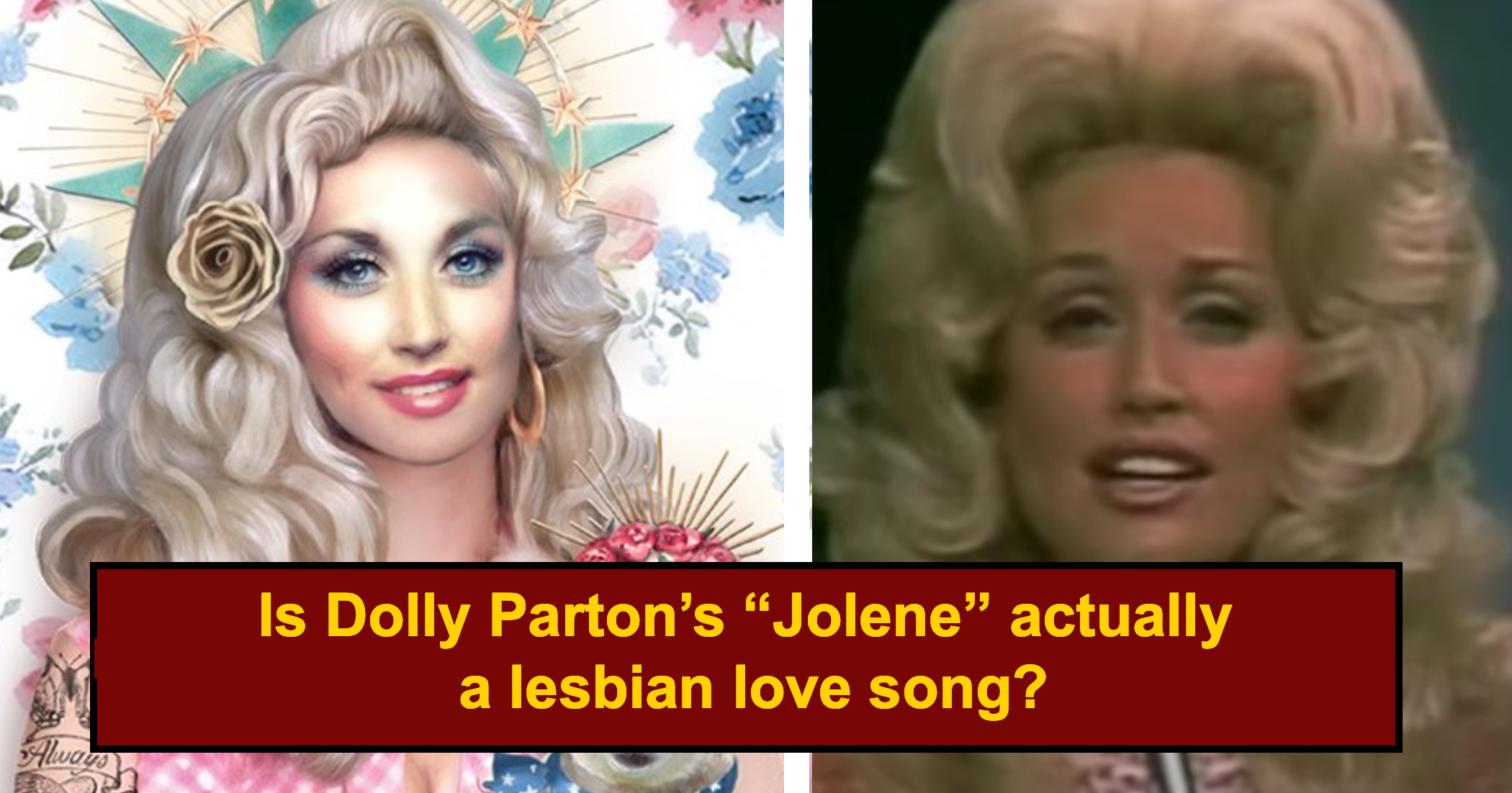
Editorial note: This article is an interpretive cultural analysis, not a claim that Dolly Parton intentionally wrote "Jolene" as a lesbian anthem. The reading below is grounded in well-known song history, country music scholarship, queer music criticism, and Parton's own public comments about the song's origin.
Some songs walk into a room wearing a perfectly sensible hat, then quietly wink at everybody who knows how to read the brim. Dolly Parton's "Jolene" is one of those songs. On the surface, it is country music's cleanest possible drama: a woman begs another woman not to steal her man. Simple, right? Three people, one triangle, several gallons of emotional hairspray.
But the more closely you listen, the more the triangle starts looking suspiciously like a spotlight. The narrator spends much of the song describing Jolene's beauty, power, voice, and irresistible presence. The man is the supposed prize, yet he is barely a character. Jolene, meanwhile, is practically painted in neon. She is not just a rival; she is the center of gravity. That is why Dolly Parton's "Jolene" works so well as a stealth lesbian love song: it hides queer longing inside the familiar clothing of jealousy.
This does not mean we need to drag Dolly into court, place one hand on a rhinestone Bible, and demand she confess a secret master plan from 1973. Parton has explained that "Jolene" was inspired by two real-life sparks: a red-haired bank employee who flirted with her husband, Carl Dean, and a young fan whose name caught Dolly's songwriter ear. Still, great songs often become bigger than their origin stories. A seed can grow into a tree that offers shade to people the seed never imagined. "Jolene" is that tree, and yes, it is wearing fabulous boots.
The Official Story Behind "Jolene"
"Jolene" was released in the early 1970s and became one of Dolly Parton's signature songs. It helped define her solo rise after years of public association with Porter Wagoner, and it remains one of the most recognizable recordings in country music. The title track appeared on Parton's 1974 album Jolene, and the song became her second solo No. 1 country single.
Parton's own explanation is charmingly practical, which is very Dolly: half sparkle, half storytelling mechanics. The name came from a young girl she met after a performance. The emotional situation came from teasing her husband about a woman at the bank who seemed a little too interested in him. Dolly has often told the story with humor, suggesting the bank visits became suspiciously frequent. In other words, "Jolene" began as domestic comedy, not a secret diary entry carved under moonlight.
But country music has always known how to smuggle complicated feelings into plain language. A porch song can contain a courtroom. A cheating song can contain a philosophy seminar. A three-minute ballad can do what a 900-page novel does, except with better guitar picking and fewer descriptions of wallpaper.
Why the Queer Reading Makes Sense
The lesbian love song reading of "Jolene" rests on one very important observation: the narrator's emotional energy flows toward Jolene more intensely than toward the man. The man is technically the reason for the conversation, but Jolene is the obsession. The song's speaker does not merely accuse her. She studies her. She admires her. She almost worships her.
Music scholar Nadine Hubbs has famously argued that "Jolene" transforms the country "other woman" trope. Instead of demonizing the rival woman, the narrator addresses her with fascination and tenderness. WNYC's Dolly Parton's America explored this idea in its episode "The Only One For Me, Jolene," describing the song as a cheating-song disguise that can be heard as women loving, not simply women competing.
That is the stealth genius. Traditional country songs about romantic rivals often come with verbal pitchforks. The other woman is wicked, shameless, painted as a threat to home and virtue. "Jolene" does something stranger and more interesting. The narrator does not call Jolene trash. She does not threaten to key a truck. She does not even claim moral superiority. Instead, she says, in effect: I understand why anyone would want you. That is not just jealousy; that is recognition.
The Man Is Almost Beside the Point
One of the funniest and most revealing things about "Jolene" is how little personality the man has. He is desired, apparently. He is asleep at some point. He may or may not be emotionally available. Congratulations to him on this robust character development.
Jolene, however, is vividly imagined. The narrator gives her texture, color, movement, and atmosphere. In a straight rivalry reading, that detail establishes why Jolene is dangerous. In a queer reading, it establishes why Jolene is desirable. Both readings can exist at the same time, which is why the song is so durable. It is not a puzzle with one answer. It is a mirror ball: turn it slightly, and another wall lights up.
This is also why the song has aged so well. Modern listeners are comfortable asking questions that country radio in the 1970s might not have welcomed. What if the narrator is not only afraid of losing her man? What if she is also unnerved by her own attraction? What if the panic in the song comes from realizing that desire does not always follow the approved floor plan?
Jealousy and Desire Are Cousins
Jealousy often contains admiration. We envy what we notice. We fear what fascinates us. "Jolene" captures that uncomfortable emotional overlap with surgical precision. The narrator is not just saying, "Stay away." She is saying, "I see exactly why you are impossible to ignore."
That is why the song feels so intimate. It is framed as a plea, but it sounds like a confession trying to wear a disguise. The narrator's vulnerability is not only about romantic loss; it is about being overwhelmed by another woman's presence. She is not fighting Jolene so much as orbiting her.
For queer listeners, especially women who have experienced attraction before having language for it, that emotional confusion can feel familiar. Sometimes the first stage of desire is not clarity. Sometimes it is irritation, comparison, panic, or the sudden urgent need to talk about someone's hair for an entire verse. The closet has many architectural styles; one of them is apparently country gothic with acoustic guitar.
Dolly's Public Persona Makes the Reading Even Richer
Dolly Parton has long occupied a rare cultural position: beloved by conservative country audiences, pop fans, drag performers, feminists, grandparents, theater kids, and people who own at least one glittery mug that says something about being "too blessed to be stressed." Her appeal is not accidental. Dolly's art often combines sincerity with exaggeration, innocence with innuendo, and tradition with sly rebellion.
She has also been warmly embraced by LGBTQ+ fans. Parton has joked about identifying with drag aesthetics, has performed playful variations of "Jolene" for gay audiences, and has repeatedly shown comfort with queer fandom around her work. This does not retroactively define the song's original intent, but it does help explain why queer audiences feel invited into the Dollyverse. She leaves the porch light on.
Her image itself is a masterclass in performance. Dolly has built a persona so exaggerated that it loops back into honesty. The wigs, rhinestones, jokes, and self-awareness are not barriers to authenticity; they are part of it. Queer culture understands that deeply. Sometimes the costume is not hiding the truth. Sometimes the costume is how the truth survives in public.
"Jolene" and the Country Music Tradition
Country music is often stereotyped as conservative, but its history is full of gender trouble, heartbreak, coded longing, and people refusing to behave according to respectable expectations. The genre has always made room for outsiders, even when the industry did not. Songs about cheating, shame, leaving home, and secret love can easily become queer listening spaces because they already deal in hidden desire and social risk.
"Jolene" fits perfectly into that lineage. It uses the structure of a conventional country cheating song, then softens the expected hostility. Instead of revenge, we get awe. Instead of a showdown, we get surrender. Instead of a villain, we get a woman so magnetic that the narrator cannot stop describing her.
That is what makes the song subversive. It does not announce itself as radical. It simply refuses to hate the other woman. In country music, where female rivalry has often been treated as a spectator sport, that refusal matters. It turns competition into intimacy. It turns the rival into a beloved object of attention. It turns the entire emotional map sideways.
Modern Covers Prove the Song Keeps Changing Shape
One reason "Jolene" remains culturally alive is that artists keep discovering new doors inside it. The song has been covered by performers across genres, from rock to a cappella to pop-country hybrids. Pentatonix and Dolly Parton won a Grammy for their collaborative version, while the original recording is part of the Grammy Hall of Fame.
In recent years, queer and queer-adjacent interpretations have become especially visible. Lil Nas X performed "Jolene" during a BBC Radio 1 Live Lounge session, and Dolly publicly approved his version. Okay Kaya released "Jolene From Her Own Perspective," explicitly imagining the story from a queer angle. Beyoncé's 2024 reimagining on Cowboy Carter also proved the song can be rewritten as warning, empowerment, and pop-cultural conversation all at once.
Every cover asks a new question. What if Jolene answers back? What if the narrator gets angry? What if the man becomes irrelevant? What if the two women realize they have more chemistry with each other than with him? "Jolene" survives because it is not locked. It is a house with too many interesting rooms.
So, Is "Jolene" Really a Lesbian Love Song?
The best answer is: it works as one. That wording matters. We do not need to claim that Dolly Parton sat down and intentionally wrote a coded lesbian masterpiece. In fact, when the queer reading was discussed with Parton on Dolly Parton's America, she did not present it as her original intention. But art is not limited to intention. Songs are living things. They travel through eras, bodies, bars, bedrooms, headphones, karaoke nights, and heartbreaks. They collect meanings like denim jackets collect pins.
As a stealth lesbian love song, "Jolene" succeeds because it captures the blur between envy and attraction. It gives us a woman looking at another woman too closely, too tenderly, too memorably for the song to remain only about a man. The official plot says, "Please do not take him." The emotional camera says, "I cannot look away from you."
That is the queer magic: not contradiction, but double exposure. The straight reading is still there. The lesbian reading is also there, glowing under it like stage lights beneath a church dress.
Why This Reading Matters
Queer interpretations are not about stealing songs from their original audiences. They are about noticing how art can hold more people than it was expected to hold. For listeners who grew up in conservative environments, a song like "Jolene" can be a small safe place: emotional, dramatic, deniable. You could sing it loudly without explaining why it made your chest feel strange. You could admire Jolene because the song told you to. You could feel the pull and call it jealousy until you were ready for another word.
That is powerful. Pop culture often gives people emotional rehearsal rooms before real life offers them permission. A listener may not immediately say, "I am attracted to women." But she may say, "Why does this song about a romantic rival feel like a love letter?" That question can be a doorway.
And honestly, if any country song was going to become a secret queer portal, of course it would be a Dolly Parton song. She has spent her career making the artificial feel honest, the exaggerated feel intimate, and the old-fashioned feel strangely progressive. She can turn a bank-teller anecdote into a cultural Rorschach test. She can make heartbreak sparkle. She can make one name sound like destiny.
Experiences: Listening to "Jolene" Through a Queer Lens
The first time many people hear "Jolene," they do not analyze it. They feel it. That opening pulse arrives like a nervous heartbeat, and suddenly the room gets smaller. Whether the song is playing in a car, a thrift store, a family kitchen, or a karaoke bar where someone is absolutely overconfident after one margarita, it has a way of pulling everyone into the same emotional weather.
Through a queer lens, the experience becomes even more layered. Imagine being a young listener who has not yet named her attraction to women. She hears the narrator describe Jolene with a level of detail usually reserved for romance. She notices that the supposed male love interest feels strangely blurry, while Jolene appears vivid and unforgettable. She may not think, "This is queer." She may simply think, "Why do I understand this so much?"
That is how coded songs often work. They do not always arrive waving a rainbow flag from the balcony. Sometimes they arrive as emotional permission. "Jolene" lets listeners stare at another woman's beauty while pretending the subject is competition. For queer women, that can feel almost hilariously accurate. Many people have mistaken attraction for rivalry, especially in adolescence. You think you dislike someone because she is pretty, confident, magnetic, or impossible to ignore. Then, years later, your brain quietly taps you on the shoulder and says, "Bestie, that was not hatred. That was a crush wearing a fake mustache."
In real life, this experience often happens in small, ordinary scenes. A girl in high school becomes obsessed with another girl's handwriting, perfume, laugh, or ability to make a ponytail look like a moral achievement. She tells herself it is envy. She tells herself she just wants to be like her. She tells herself a lot of things, because self-discovery is not always a lightning bolt; sometimes it is a very slow loading screen.
"Jolene" gives that confusion a soundtrack. The narrator's plea sounds desperate, but it is not cruel. She does not want to destroy Jolene. She wants Jolene to understand her power. That distinction matters. The song captures the ache of being overwhelmed by someone and not knowing whether to run, fight, bow, flirt, or write a country classic about it.
For adult queer listeners, revisiting "Jolene" can feel like finding an old message in a jacket pocket. Suddenly the song says more than it used to. The familiar story opens up, and the emotional emphasis shifts. The man becomes background furniture. Jolene becomes the plot. The narrator's fear becomes desire's shadow. The song does not change, exactly; the listener does. That is one of the great pleasures of classic music: it waits for you to catch up.
This is also why "Jolene" thrives in communal spaces. At queer karaoke nights, drag shows, pride playlists, and late-night living room singalongs, the song can be both camp and sincere. People laugh because the drama is enormous. People sing hard because the feeling is real. That combination is very queer and very country: heartbreak with eyeliner, vulnerability with a punchline, longing with a chorus everyone can survive together.
In the end, the experience of hearing "Jolene" as a stealth lesbian love song is not about proving one interpretation and defeating all others. It is about recognizing how deeply the song understands fascination. It knows that desire can hide inside jealousy. It knows that admiration can sound like panic. It knows that the person you call your rival may be the person you cannot stop imagining. And it knows that sometimes the most revealing thing in a love triangle is not who gets the man, but who gets the song.
Conclusion
Dolly Parton's "Jolene" endures because it is emotionally simple and psychologically sneaky. It tells a story anyone can follow, then leaves enough open space for listeners to discover their own secret rooms inside it. As a straight country classic, it is brilliant. As a queer reading of desire disguised as jealousy, it is even more fascinating.
The song's power lies in its ambiguity. Dolly gave the world a woman pleading with a rival. Listeners heard fear, admiration, obsession, vulnerability, and maybe even love. That does not weaken the song's original story; it enriches it. "Jolene" is not less country because queer listeners claim it. It is more country because it understands longing in all its messy, human, rhinestone-covered forms.












