
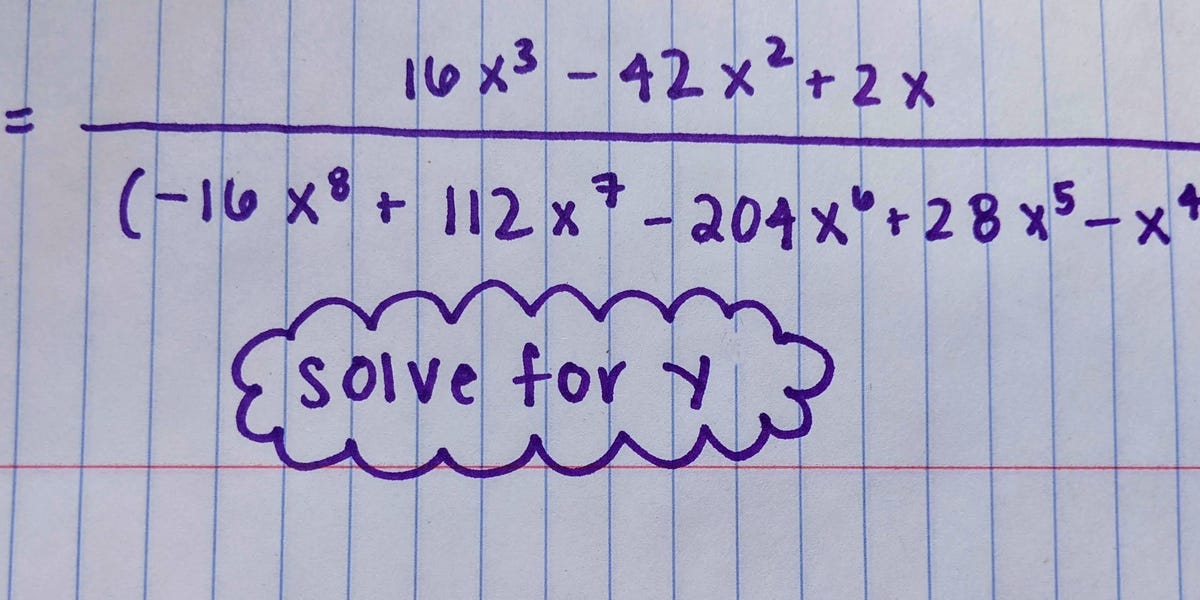
Differential equations sound like the kind of math topic that enters a room wearing a lab coat and asking everyone to please stop having fun. But underneath the intimidating name is a simple idea: they describe change. Population growth, radioactive decay, fluid motion, epidemics, stock volatility, electrical circuits, falling objects, heat flow, and even how neural networks learn all involve quantities that change over time or space. In other words, differential equations are the grammar of motion, and calculus is the dictionary.
Now add a Facebook neural net to the story, and things get more interesting. In 2019, researchers at Facebook AI Research, now part of Meta AI, showed that neural networks could be trained to solve symbolic mathematics problems, including integrals and certain ordinary differential equations. That was surprising because neural networks were famous for recognizing cats, recommending posts, translating language, and occasionally making everyone wonder whether the toaster was becoming self-aware. Symbolic math seemed different. It required structure, rules, exactness, and the kind of step-by-step reasoning that calculators and computer algebra systems had handled for decades.
This article explains how differential equations connect to calculus problems, why neural networks can help, what the Facebook neural net actually did, and where this field is heading. No chalk dust required.
What Are Differential Equations?
A differential equation is an equation involving a function and one or more of its derivatives. A derivative measures a rate of change. So, instead of simply asking, “What is the value of this function?” a differential equation asks, “How does this function change?” That small shift turns regular math into a modeling machine.
For example, the equation dy/dx = ky says that the rate of change of y is proportional to y itself. This appears in exponential growth and decay, such as bacteria multiplying in a dish or a hot cup of coffee cooling on a desk while you pretend you will drink it soon.
Ordinary vs. Partial Differential Equations
An ordinary differential equation, or ODE, involves a function of one independent variable. Time is the usual suspect. A partial differential equation, or PDE, involves functions of several variables, such as time and space. PDEs appear in wave motion, heat transfer, quantum mechanics, weather prediction, and other areas where the universe decided one variable was simply not enough.
ODEs are common in early calculus and engineering courses because they are easier to introduce. PDEs are more complex and usually require deeper mathematical tools, numerical methods, and a good relationship with caffeine.
Why Calculus Problems Matter in AI
Calculus is not just a school subject with suspiciously long problem sets. It is the engine behind modern machine learning. Neural networks learn by adjusting parameters, usually called weights, to reduce errors. This process depends on derivatives. When a model makes a prediction, calculates a loss, and updates itself through gradient descent, it is performing calculus in the background.
In a typical neural network, the model takes inputs, passes them through layers, compares the output with the expected answer, and then uses backpropagation to calculate how each parameter contributed to the mistake. The model then adjusts those parameters slightly. Repeat this process millions or billions of times, and the network gets better. It is basically trial and error, except the “error” has a spreadsheet, a derivative, and a gym membership.
Gradients: The Calculus Behind Learning
A gradient tells a model which direction to move in order to reduce loss. If the loss is a mountain landscape, the gradient points uphill, and gradient descent walks downhill. This is why derivatives are central to neural networks. Without them, training a deep learning model would be like trying to find your keys in the dark while wearing oven mitts.
Modern tools such as PyTorch use automatic differentiation to calculate gradients efficiently. This lets researchers build large models without manually deriving every partial derivative. Automatic differentiation does not remove the math; it industrializes it.
The Facebook Neural Net That Solved Calculus Problems
The phrase “Facebook neural net” refers to work by Guillaume Lample and François Charton at Facebook AI Research. Their project, often discussed under the title Deep Learning for Symbolic Mathematics, trained neural networks to handle advanced symbolic tasks such as integration and solving certain differential equations.
The clever idea was to treat math expressions somewhat like language. Just as a translation model can learn to map a sentence in English to a sentence in French, a symbolic math model can learn to map a problem expression to a solution expression. In this setup, the input might be an integral or differential equation, and the output is the symbolic answer.
Turning Equations Into Language
Mathematical notation can be messy. The same expression can be written in many equivalent ways. To make equations easier for a neural network to process, researchers represented expressions as structured sequences. Think of it like translating a wild-looking formula into a clean sentence the model can read.
For example, a differential equation might be converted into a tree-like structure where operations, variables, constants, and functions appear in a logical order. The model does not “understand” calculus in the human sense. It learns patterns from huge numbers of generated examples. Still, the result was impressive: the system could produce exact-looking symbolic answers for many problems in its training domain.
What Made It Surprising?
Neural networks had long been strong at approximate tasks: image recognition, speech processing, language prediction, and recommendation systems. Symbolic mathematics is different because a small error can make an answer completely wrong. In a photo classifier, calling a husky a wolf is embarrassing but understandable. In calculus, changing a minus sign can send the whole solution into the mathematical swamp.
That is why the Facebook AI result attracted attention. It suggested that neural networks could learn useful symbolic patterns, not merely approximate numerical answers. The model was not a replacement for all computer algebra systems, and it worked best within carefully defined problem types, but it opened a door between deep learning and formal math.
How Differential Equations Become Training Problems
Training a neural network to solve differential equations requires examples. A lot of examples. Researchers can generate equations and their solutions automatically, then train the model on pairs: problem in, answer out.
Suppose the model sees many equations related to exponential growth, such as dy/dx = 3y, dy/dx = -2y, and dy/dx = xy. Over time, it may learn that certain derivative structures correspond to certain solution families. The network is not following a classroom proof step by step, but it is learning statistical regularities in symbolic form.
A Simple Example
Consider the differential equation dy/dx = 2xy. A human might solve it by separation of variables:
(1/y)dy = 2x dx
After integrating both sides, we get:
ln|y| = x² + C
So the solution can be written as:
y = Ce^(x²)
A symbolic neural network trained on enough similar examples might learn to produce the final expression directly. That is both exciting and slightly annoying if you spent three weeks memorizing separation of variables with flashcards.
Neural ODEs: When Neural Networks Become Differential Equations
There is another related idea called Neural Ordinary Differential Equations, or Neural ODEs. While the Facebook symbolic math work used neural networks to solve equations, Neural ODEs use differential equations as part of the neural network itself.
Traditional deep networks pass information through discrete layers: layer one, layer two, layer three, and so on. Neural ODEs imagine the transformation as continuous. Instead of saying, “The hidden state moves from one layer to the next,” they say, “The hidden state evolves according to a differential equation.”
This creates a bridge between deep learning and continuous dynamical systems. It can be useful in problems where data naturally evolves over time, such as medical measurements, physical simulations, motion tracking, and time-series forecasting.
Why This Matters
Neural ODEs show that the relationship between calculus and AI goes both ways. Neural networks can help solve differential equations, and differential equations can help define neural networks. That is the mathematical equivalent of two Spider-Men pointing at each other.
These approaches are especially important in scientific machine learning, where researchers want models that are not just accurate but also connected to physical laws. If a model predicts the motion of a pendulum, the temperature in a material, or the flow of air around a wing, it should not ignore centuries of physics just because the dataset looks trendy.
Physics-Informed Neural Networks
Physics-informed neural networks, often called PINNs, train neural networks while enforcing known differential equations. Instead of learning only from labeled data, the model also receives a penalty when it violates a physical law. This is useful when data is limited, noisy, or expensive to collect.
Imagine trying to model heat flow in a metal plate. You may not have temperature measurements at every point and every time. A PINN can use the heat equation as part of its training objective, guiding the model toward solutions that make physical sense. The model learns from both data and math. It is like having a tutor who says, “Nice guess, but thermodynamics would like a word.”
PINNs vs. Symbolic Solvers
Symbolic solvers aim for exact formulas when possible. Numerical solvers approximate solutions at specific points. PINNs often learn flexible approximations that satisfy constraints. Each tool has a role.
For classroom calculus problems, a symbolic solution is usually best. For complex real-world systems with messy boundaries, partial data, or unknown parameters, neural methods can be powerful. The future is not “AI replaces math.” The better version is “AI works with math so humans can solve nastier problems faster.”
Common Differential Equations in Calculus Problems
Students usually encounter a few classic types of differential equations. These are also useful examples for understanding how AI models might learn mathematical structure.
Separable Equations
A separable equation can be rearranged so all terms involving y appear on one side and all terms involving x appear on the other. These are friendly by differential equation standards, which is like saying a crocodile is friendly because it smiled first.
Example: dy/dx = xy. Rearranging gives (1/y)dy = x dx, and integration leads to an exponential solution.
Linear First-Order Equations
A first-order linear equation often looks like dy/dx + P(x)y = Q(x). These are commonly solved using an integrating factor. They appear in circuits, cooling models, mixing problems, and other systems where one variable changes in response to another.
Second-Order Equations
Second-order differential equations involve second derivatives, such as acceleration. They are essential in mechanics, vibrations, springs, waves, and electrical systems. A mass on a spring, for example, is usually modeled using a second-order equation because position, velocity, and acceleration all matter.
Why AI Struggles With Math Anyway
Even advanced neural networks can struggle with exact mathematics. There are several reasons. First, symbolic math requires precision. Second, equivalent expressions can look very different. Third, models may learn shortcuts from training data rather than general rules. Fourth, verifying a symbolic answer can be difficult unless the system checks it with mathematical operations.
This is why research in neural-symbolic AI is so important. Pure neural models are flexible, but they may hallucinate. Pure symbolic systems are rigorous, but they can be brittle. Combining the two may produce systems that are both adaptable and trustworthy.
The Limitations of the Facebook Neural Net
The Facebook AI symbolic math model was impressive, but it did not mean neural networks had conquered all of mathematics. The model performed well on generated tasks within a defined distribution. Real textbook problems often include context, diagrams, assumptions, boundary conditions, and wording that require interpretation. A model trained only on expression-to-expression pairs may not handle those gracefully.
So, the correct takeaway is not “AI solved calculus forever.” The better takeaway is: “Neural networks can learn meaningful symbolic patterns when math is represented carefully and training data is designed intelligently.” That is still a big deal.
Practical Applications
The combination of differential equations, calculus, and neural networks has applications across science and industry. In medicine, differential equations model disease spread, drug concentration, and biological processes. In engineering, they describe control systems, vibration, heat, and fluid flow. In finance, stochastic differential equations appear in risk modeling and option pricing. In climate science, PDEs help simulate atmosphere and ocean dynamics.
Neural networks add value when systems are too complex for clean formulas or when data reveals patterns that traditional equations miss. A hybrid model can use known science where available and learn the unknown parts from data.
Education and Problem Solving
For students, AI tools can be helpful when used correctly. A good AI assistant can explain why separation of variables works, show a solution path, generate practice problems, and point out common errors. The danger is using AI as an answer vending machine. That creates the illusion of learning, which is like buying running shoes and assuming your marathon is finished.
The best use is interactive: ask for hints, compare methods, test your reasoning, and request similar problems. Differential equations reward pattern recognition, but they also require discipline. AI can help with both, as long as the learner stays in the driver’s seat.
Experience Notes: Learning Differential Equations With AI Tools
One of the most useful experiences related to differential equations, calculus problems, and the Facebook neural net idea is realizing that math learning changes when equations become searchable, generatable, and explainable. In a traditional classroom, a student might solve ten examples of separable equations and hope the pattern sticks. With AI-assisted learning, that same student can generate fifty variations, ask for one hint at a time, and compare multiple solution strategies. The learning becomes less like staring at a wall and more like having a stubborn but patient practice partner.
A practical workflow begins with classification. Before solving a differential equation, identify the type: separable, linear, homogeneous, exact, second-order constant coefficient, or something else. Many mistakes happen before the first line of algebra because the student chooses the wrong method. AI tools can help by asking guiding questions: Can the variables be separated? Does it fit the linear form? Is there an initial condition? Are we solving symbolically or numerically?
The next experience is verification. A differential equation solution should be checked by differentiating and substituting back into the original equation. This step is boring, which is exactly why it is important. Neural networks can produce confident-looking answers, but calculus has a built-in truth detector: plug the answer back in. If the derivative satisfies the equation, the solution is probably valid. If not, the model has produced mathematical confetti.
Another helpful habit is connecting formulas to stories. The logistic equation is not just dy/dt = ry(1 - y/K); it is a population growing quickly at first, then slowing as it approaches a carrying capacity. A second-order spring equation is not just symbols; it is motion, resistance, and restoring force. When learners connect equations to meaning, they stop memorizing and start modeling.
Working with neural networks also changes how people think about calculus. Backpropagation is not magic. It is repeated application of the chain rule. Gradient descent is not mysterious. It is a derivative-guided search. Neural ODEs are not science fiction. They are a way to describe continuous transformations inside a model. Once these connections click, AI feels less like a black box and more like a large, complicated calculus machine wearing sunglasses.
The biggest lesson is balance. Use AI to explore, not to outsource thinking. Let it explain a method, then close the tool and solve a similar problem alone. Let it generate examples, then verify the answers manually. Let it compare symbolic, numerical, and neural approaches, then decide which is appropriate. Differential equations teach how systems change. AI teaches how patterns can be learned. Together, they offer a powerful way to understand both mathematics and modern machine learning.
Conclusion
Differential equations sit at the center of calculus, science, engineering, and increasingly, artificial intelligence. The Facebook neural net research showed that neural networks can learn to solve certain symbolic calculus problems when equations are represented as structured sequences and supported by large training datasets. Neural ODEs and physics-informed neural networks push the relationship even further by embedding differential equations inside AI systems or using them as training constraints.
The important point is not that neural networks make calculus obsolete. They do not. Instead, they expand the toolkit. Human mathematical reasoning, symbolic systems, numerical solvers, and machine learning models each bring different strengths. The smartest future is not a fight between calculus and AI. It is a collaboration, preferably one where the equations behave and the neural net does not try to reinvent algebra before lunch.












