
Earthquakes are nature’s least polite houseguests. They do not knock, they do not wipe their feet, and they certainly do not care how much you spent on imported tile. For centuries, builders have tried to answer one stubborn question: how do you keep a structure standing when the ground itself decides to dance?
Modern engineers usually answer with steel frames, base isolation systems, dampers, flexible joints, seismic codes, and enough calculations to make a calculator ask for a vacation. But an unusual idea has been gaining attention: instead of simply making buildings stronger, what if we could guide earthquake energy around them? In other words, what if a city could wear something like an invisibility cloak for seismic waves?
That futuristic-sounding concept has a surprising historical echo. Some researchers have suggested that patterns in ancient Roman urban design, monuments, foundations, and repeated structural forms may have behaved in ways similar to what modern physicists call seismic metamaterials. The Romans were not writing equations about wave propagation on wax tablets between gladiator shows, of course. But they were master builders who understood mass, rhythm, arches, concrete, foundations, and repetition in ways that still make engineers lean forward in their chairs.
So, can we really talk about deflecting earthquakes the way ancient Romans did it? The honest answer is: partly, carefully, and with a healthy respect for both science and history. The Romans did not stop earthquakes. Nobody does. But their building habits may offer clues for designing structures and urban layouts that scatter, absorb, redirect, or survive seismic energy more intelligently.
What Does It Mean to “Deflect” an Earthquake?
To understand the Roman connection, we first need to understand what earthquake deflection means. An earthquake begins when rock masses slip along a fault and release stored energy. That energy travels through the ground as seismic waves. When those waves reach buildings, bridges, roads, and walls, they shake them in different ways depending on the wave type, soil, distance, building height, and structural design.
Traditional earthquake-resistant design focuses on helping a building survive the shaking. That can mean giving it ductility, so it bends without suddenly breaking; adding shear walls or bracing, so it resists lateral forces; or using base isolation, so the ground can move while the structure above moves less violently. Think of it as teaching a building to “roll with it” instead of standing stiffly like a marble statue with overconfidence issues.
Deflection takes the idea one step earlier. Instead of only protecting the building after seismic waves arrive, scientists ask whether the ground around a structure can be engineered to redirect or reduce the waves before they do their worst. This is where seismic metamaterials enter the story.
The Modern Science: Seismic Metamaterials and Earthquake Cloaks
A metamaterial is not magic, even if it sounds like something Tony Stark would order in bulk. It is a material or engineered arrangement whose structure gives it unusual wave-manipulating properties. In optics, metamaterials have been studied for bending light. In acoustics, they can affect sound waves. In earthquake engineering, the big dream is to design patterns in the ground that influence seismic waves.
Modern seismic metamaterial ideas include arrays of boreholes, buried columns, resonators, piles, trenches, or specially arranged underground structures. These features can change how waves travel through the soil. In some models and experiments, repeating patterns create a “shadow zone” where wave energy is reduced. In others, the system scatters energy or shifts it away from the protected area.
Imagine a line of waves approaching a pier in the ocean. The pier does not delete the water, but it changes the pattern of movement around it. Seismic cloaking works on a similar basic idea, except the waves are moving through soil and rock, and the “pier” might be a carefully designed pattern of holes, columns, or foundations.
This is not yet a simple plug-and-play technology for every neighborhood. Earthquakes are messy, soils vary wildly, and seismic waves arrive in complex frequencies and directions. Still, the concept is important because it changes the conversation. Buildings are not lonely objects sitting on passive ground. They are part of a larger wave environment. That idea is where ancient Rome becomes unexpectedly interesting.
Why Ancient Rome Keeps Showing Up in Engineering Conversations
The Romans built on a scale that still feels slightly rude to the rest of history. Roads, bridges, aqueducts, amphitheaters, baths, harbors, domes, vaulted halls, and multi-story urban buildings spread across a vast empire. Many were damaged, repaired, looted, buried, recycled, or abused by time, yet enough survived to make one thing clear: Roman builders knew what they were doing.
Their greatest advantage was not one secret ingredient, but a construction culture. They combined strong materials, repeated forms, practical geometry, local geology, skilled labor, and relentless standardization. They were especially good at three things that matter for seismic resilience: distributing loads, creating durable mass, and using repeated structural patterns.
Roman arches and vaults turned vertical loads into compressive forces that moved through supports. Roman concrete allowed large monolithic masses, curved spaces, and thick walls that could behave differently from stacked stone blocks. Roman urban complexes often placed columns, walls, foundations, and underground voids in rhythmic patterns. Those patterns, viewed through today’s wave-physics lens, are what make the “Roman seismic cloak” idea so fascinating.
The Colosseum, Repetition, and the Seismic Cloak Hypothesis
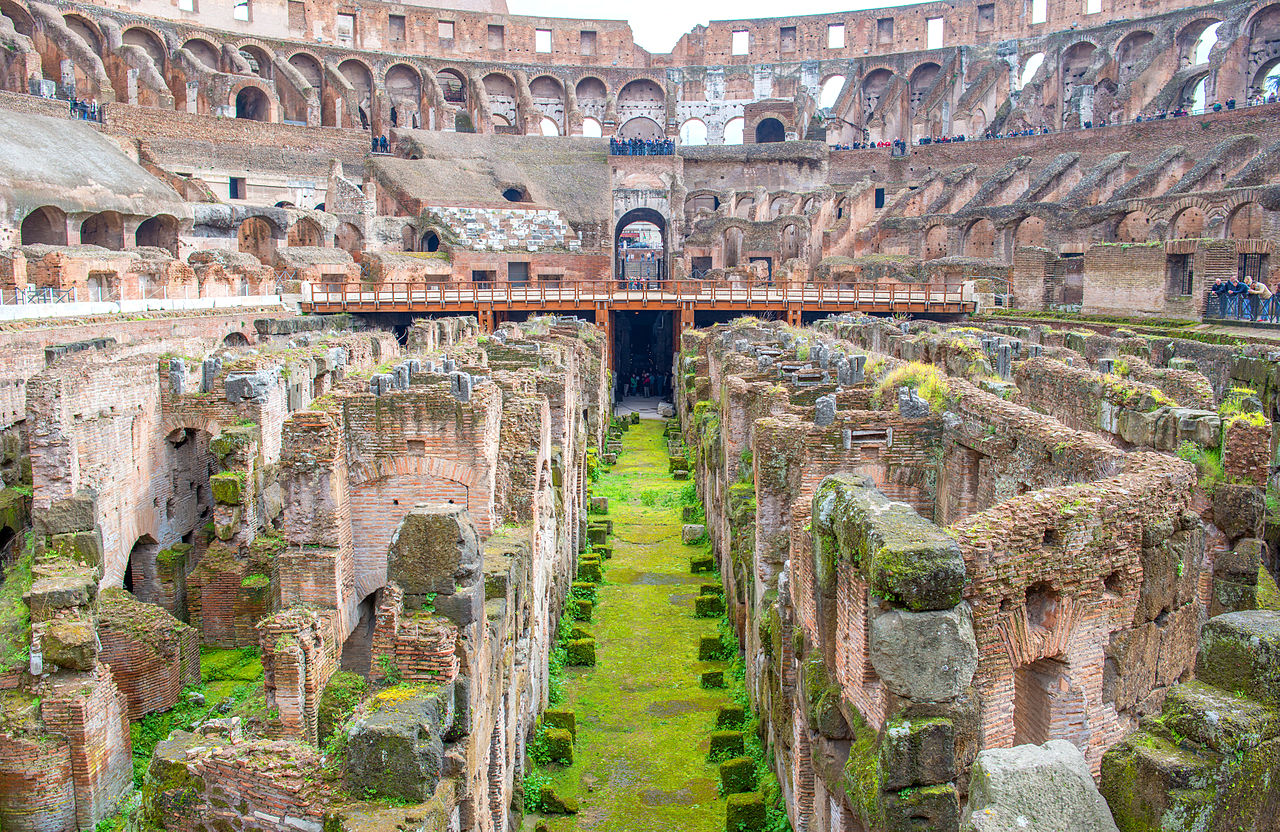
The Colosseum is usually discussed as a monument to spectacle, architecture, and imperial ambition. It was also, unintentionally or not, a giant lesson in structural repetition. Its rings of arches, radial walls, corridors, and foundations created a highly organized pattern of mass and void.
Some researchers and science writers have pointed out that such regular architectural patterns resemble the kind of periodic structures used in metamaterial design. In modern terms, periodicity matters because waves interact with repeating elements. If the spacing and size of those elements relate to the wavelength of incoming vibrations, they can affect how the waves move.
That does not mean Roman architects sat around saying, “Let us create a band gap for surface waves before lunch.” More likely, their decisions came from experience, available materials, construction logistics, crowd movement, and structural necessity. Still, the result may have produced wave effects that are relevant to modern seismic design.
The phrase “seismic invisibility cloak” can be a bit dramatic, like naming a garden hose “The Dragon of Hydration.” But the underlying idea is serious. Large, repeated subsurface or structural patterns can interact with seismic waves. If ancient Roman sites accidentally demonstrate some of those effects, then studying them could help modern engineers design protective layouts around critical infrastructure.
Roman Concrete: The Ancient Material That Refused to Retire
Any discussion of Roman engineering eventually ends up at concrete, because Roman concrete is the historical equivalent of that one grandparent who still climbs ladders and refuses help. The Romans used mixtures involving lime, volcanic ash, volcanic rock, brick fragments, and other aggregates. In marine environments, volcanic materials reacted in ways that helped Roman harbor concrete remain durable for centuries.
Recent research has highlighted the role of lime clasts and hot mixing. In simplified terms, some Roman concrete appears to have included calcium-rich fragments that could react when cracks formed and water entered. These reactions could help fill cracks over time, creating a form of self-healing behavior. That is not the same as modern reinforced concrete, and it was not uniform across every Roman wall, but it helps explain why certain Roman structures have aged with almost suspicious elegance.
Durable materials matter in earthquake zones because small cracks can become serious weaknesses over repeated shaking, weathering, and poor maintenance. A material that resists decay, tolerates moisture, and heals microcracks has obvious appeal. Modern researchers are studying ancient concrete not because we should copy it blindly, but because it suggests new pathways for longer-lasting, lower-maintenance infrastructure.
Arches, Vaults, and Domes: Geometry Doing Heavy Lifting
The Romans loved the arch, and the arch loved them back. An arch is brilliant because masonry and concrete are strong in compression. Instead of spanning space with a flat beam that bends, an arch transfers loads along a curve into its supports. Vaults extend arches into corridors and rooms. Domes rotate the arch into a grand overhead shell.
For earthquake resistance, geometry can be both friend and troublemaker. Heavy masonry can be dangerous if poorly tied together, but well-designed arches and vaults can distribute loads efficiently. Roman builders often combined mass, curvature, buttressing, and thick supports to create structures that behaved as integrated systems.
This is one reason ancient Roman lessons should not be reduced to “build everything heavy.” Heavy buildings can perform terribly in earthquakes if brittle, poorly connected, or placed on bad soil. The better lesson is: shape, continuity, load path, and material behavior matter. A strong piece is not enough. The whole system must know where the forces go.
Foundations and the Ground Beneath the Empire
Earthquake damage is not only about the building. Soil can amplify shaking, settle unevenly, liquefy, or transmit waves in surprising ways. Modern seismic design pays close attention to site conditions, and ancient builders also learned from ground behavior, though through observation rather than computer modeling.
Roman engineers used different foundation strategies depending on soil, structure, and location. They built on bedrock when possible, used deep foundations where necessary, and created massive substructures for large monuments. In some cases, repeated foundation elements may have influenced how ground vibrations moved through a site.
Modern seismic metamaterial concepts often use the ground itself as part of the defense system. Boreholes, piles, columns, and resonators can be arranged to modify wave paths. The Roman parallel is not exact, but it is suggestive: foundations are not merely supports. They can be active participants in the way a structure meets the earth.
What the Romans Got Right Without Knowing the Equations
Ancient Roman builders had no seismographs, finite element models, or building-code PDFs to read on a sleepy Monday morning. What they had was experience at empire scale. They saw what failed. They repaired what cracked. They reused techniques that worked. Over generations, that practical knowledge became a design tradition.
They got several big ideas right. First, redundancy matters. A structure with many repeated supports does not depend on one heroic column to save the day. Second, load paths matter. Forces need a continuous route to the ground. Third, materials matter. Concrete, stone, brick, lime, and volcanic ash behave differently, and the Romans learned how to combine them. Fourth, maintenance and repair matter. Ancient structures that survive today are often the result of original strength plus centuries of intervention, restoration, and luck.
And finally, context matters. A building is not separate from its city, its soil, its neighbors, or its foundations. That idea feels very modern, but Rome had already built entire urban landscapes where repeated structures interacted with the ground around them.
What Modern Engineers Can Actually Learn
The Roman lesson is not that we should build new cities as giant amphitheaters, although traffic might be more entertaining. The real lesson is that earthquake resilience benefits from layered thinking. A building can be protected by its material, geometry, foundation, site layout, and surrounding infrastructure.
Modern engineers can use this layered approach in several ways. Self-healing concrete research can help produce infrastructure that lasts longer and needs fewer repairs. Seismic metamaterials may one day protect hospitals, bridges, nuclear facilities, data centers, schools, and emergency-response buildings. Urban planners can think more carefully about how clusters of buildings affect ground motion rather than treating each structure as an isolated box.
Base isolation and dampers already show that controlling energy is often smarter than simply resisting it. Seismic cloaking pushes that logic outward into the soil. The building is no longer the only actor. The surrounding ground becomes part of the design.
The Limits of the Roman Comparison
It is tempting to turn the ancient Romans into time-traveling physicists in sandals, but that would be unfair to both Rome and physics. The Romans did not possess modern wave theory. They did not intentionally design seismic metamaterials in the technical sense. Many Roman buildings collapsed, cracked, or required repair. Ancient cities were not safe by modern standards, and we should not romanticize them into perfect engineering utopias with better mosaics.
The best interpretation is more nuanced. Some Roman structural patterns may have produced effects similar to wave-scattering or wave-deflecting systems. Roman materials and forms also offered durability and load distribution. These features are worth studying because they reveal how built environments can interact with seismic energy.
Modern science can test these ideas with simulations, field measurements, laboratory models, and careful archaeology. If the Roman example inspires better seismic design, wonderful. If it only reminds us that ancient builders still have things to teach us, that is already a pretty good return on a two-thousand-year-old investment.
Could Future Cities Deflect Earthquakes?
The future of earthquake protection may look less like one miracle invention and more like a toolbox. Some buildings will use base isolation. Others will rely on high-performance materials, tuned mass dampers, flexible frames, smart sensors, and better retrofits. Critical sites may someday use engineered ground barriers or metamaterial-inspired arrays to reduce incoming seismic energy.
In that future, the Roman spirit is not about copying ancient ruins. It is about designing with the whole system in mind. The Romans understood that a bridge, aqueduct, bath, or amphitheater was more than a pile of materials. It was a relationship between geometry, ground, loads, water, people, and time.
Deflecting earthquakes the way ancient Romans did it means thinking beyond brute strength. It means respecting patterns. It means building materials that age intelligently. It means designing foundations that do more than hold weight. It means accepting that the ground is not a quiet stage beneath architectureit is part of the performance.
Practical Experiences and Lessons Inspired by Roman-Style Earthquake Deflection
When people first hear about deflecting earthquakes, they often imagine a giant underground shield that makes a building untouchable. The real experience is less like science fiction and more like careful problem-solving. In earthquake-prone regions, the most valuable lesson is that resilience begins long before the shaking starts. It begins with where you build, how you build, what you build with, and whether anyone remembers to inspect the structure after the ribbon-cutting ceremony.
One practical experience from studying older structures is that small design decisions can have long-term consequences. A wall with poor drainage may weaken over decades. A foundation built on soft, waterlogged soil may amplify shaking. A beautiful but brittle façade may become a hazard if it is not tied back properly. Roman builders often worked with local materials and thick structural systems, but they also benefited from repetition and repair. Modern homeowners, architects, and city planners can take a similar mindset: do not just ask whether a building looks finished; ask whether it can keep performing under stress.
Another useful lesson is that durability is not glamorous, but it wins. A self-healing concrete concept sounds flashy, yet its real value is humble: fewer cracks, fewer repairs, less water intrusion, and longer service life. The same principle applies to modern seismic upgrades. Bolting a house to its foundation, bracing cripple walls, securing masonry chimneys, reinforcing soft-story buildings, and anchoring heavy equipment are not dramatic. Nobody throws a parade for a properly fastened water heater. But when the ground moves, these modest details can make an enormous difference.
For engineers and designers, the Roman-inspired experience is also a reminder to look outside the building envelope. Many seismic failures are influenced by the relationship between structures and soil. A building that performs well on one site may behave differently on another. This is why geotechnical investigation, soil improvement, drainage, foundation design, and neighborhood-scale planning matter. A seismic metamaterial barrier, if used in the future, would not replace good structural design. It would become one layer in a larger protection strategy.
There is also a communication lesson. “Seismic cloak” is an exciting phrase, but it can easily mislead the public into thinking earthquakes can be made harmless. A better way to explain the concept is to compare it to traffic calming. Speed bumps do not eliminate cars; they change how cars move through a space. Seismic barriers or patterned foundations would not eliminate seismic waves; they would attempt to reduce, redirect, scatter, or tune the energy that reaches a protected structure. That distinction matters because good earthquake safety depends on realistic expectations.
In heritage conservation, Roman lessons become even more practical. Ancient buildings cannot simply be wrapped in steel or rebuilt to modern codes without damaging their historical value. Engineers must balance preservation and safety. That often means using discreet reinforcement, improving drainage, monitoring cracks, strengthening foundations, and understanding original construction methods. The same approach can help protect older buildings in American cities where unreinforced masonry remains a risk.
For everyday readers, the biggest takeaway is refreshingly simple: earthquake resilience is not one product, one trick, or one ancient secret. It is a mindset. The Romans built systems that combined materials, geometry, repetition, and site awareness. Modern science adds sensors, codes, modeling, and advanced materials. Put those together, and the future of seismic design becomes less about fighting the earth and more about negotiating with it.
Conclusion: Ancient Wisdom, Modern Waves
Deflecting earthquakes the way ancient Romans did it is not about pretending Rome had hidden superhero technology buried under every amphitheater. It is about recognizing that ancient construction can still inspire modern engineering. Roman concrete shows how materials can become more durable over time. Roman arches, vaults, and foundations show how geometry and mass can organize forces. Roman urban patterns hint at the possibility that repeated structures can interact with waves in ways worth studying.
Today, seismic metamaterials and earthquake cloaking remain developing fields, not everyday construction standards. But they represent an exciting shift in thinking. Instead of only asking buildings to survive shaking, engineers are asking whether the environment around buildings can help manage the shaking before it arrives.
The ancient Romans may not have deflected earthquakes on purpose. But their work reminds us that resilience is rarely born from a single invention. It comes from materials, patterns, foundations, repairs, observation, and time. In other words, the Romans did not just build for the day. They built in ways that still make us ask questions two millennia later. That, by any standard, is a pretty solid foundation.













