
Markets have a funny way of turning decades into a highlight reel. Not the fun highlights, either.
The kind where your brain yells, “PLAY IT AGAIN!” while your stomach files a formal complaint.
Ben Carlson’s A Wealth of Common Sense popularized a sticky idea: in investing, crashes don’t just happenthey become the story.
Entire eras get summarized by the worst few months, even when the long-term results were… objectively pretty great.
It’s like judging a whole pizza by the one slice you dropped face-down.
Why Crashes Stick (Even When Gains Were Bigger)
1) Your brain treats losses like an emergency
There’s a reason a market drop feels personaleven when you haven’t sold a thing.
Behavioral finance calls it loss aversion: losses hurt more than gains feel good.
In plain English: winning $100 is “nice,” but losing $100 is “WHO DID THIS TO ME?”
Carlson has pointed to research summarized by Jason Zweig’s work on investor behavior:
financial losses can light up the same alarm systems tied to physical threat, which helps explain why people can obsess,
replay decisions, and even lose sleep after a downturn.
Your portfolio isn’t being chased by a bear, but your nervous system didn’t get the memo.
2) The news has incentives (and “steady compounding” isn’t clickbait)
A steady 0.04% daily drift upward is great for retirement accounts and terrible for prime-time television.
Crashes come with villains, plot twists, and dramatic music. A normal year of volatility comes with… spreadsheets.
When headlines yell “historic sell-off,” your brain assumes action is required.
But “historic” is doing a lot of work theremarkets are volatile by nature, and declines happen frequently.
3) Recency bias turns the latest downturn into “the new normal”
After a crash, it’s common to hear, “This time is different,” followed by a list of reasons that are genuinely scary.
Sometimes the reasons are valid. Sometimes they’re a remix of older fears with a fresh beat.
Either way, the human brain tends to overweight what just happened and underweight what usually happens.
Corrections Are Normal (Yes, Even When the Year Ends Up Positive)
Think of volatility as the admission price
One of the most useful mindset shifts is this: market declines aren’t a surprise penalty
they’re part of the deal. For example, Fidelity’s long-term look at the S&P 500 shows that since 1980,
declines of 5%+ have occurred in the vast majority of calendar years, and 10%+ declines happen in nearly half of them.
Yet the market has still posted positive average calendar-year returns over that same stretch.
“But why does it feel like the world is ending?”
Because during a correction your portfolio updates faster than your emotions can process.
Also, your apps are basically tiny slot machines that refresh your adrenaline every time you pull to update.
(Very efficient. Extremely rude.)
Bear markets: shorter than bull markets, louder than both
Charles Schwab’s historical market research has shown a consistent pattern: bull markets tend to last longer than bear markets.
Bears can be sharp and fast (like early 2020), while bulls often grind higher for years.
That mismatchslow gains, fast lossesis a big reason crashes dominate memory.
What History Remembers vs. What Investors Earned
Decades get reduced to their worst moment
Carlson’s classic examples are basically the investing version of “I went on a great vacation, but the airline lost my bag,
so now I hate travel forever.”
- The 1980s: stocks rose dramatically over the decade, yet the 1987 crash often becomes the headline memory.
- The 1990s: bond investors had strong total returns, but people still fixate on sharp rate spikes and “bond crashes.”
- Emerging markets in the 1990s: big gains happened, yet the 1997 currency crisis lives rent-free in investor lore.
- The tech boom: the build-out and innovation were enormousyet the narrative often collapses into dot-com bust memes.
Why the “crash story” is so dangerous
When crashes become the entire story, investors are tempted to plan their future around avoiding pain instead of pursuing goals.
That usually leads to one of two unhelpful strategies:
- Overreacting: selling after losses because fear feels like insight.
- Overwaiting: staying in cash “until things calm down,” which often means missing the recovery.
The uncomfortable truth is that the worst market days and the best rebounds can cluster together.
If you try to dodge every downturn, you risk dodging the comeback too.
When “Everything Is Crashing” Is the Point
Crashes aren’t exclusive to stocks
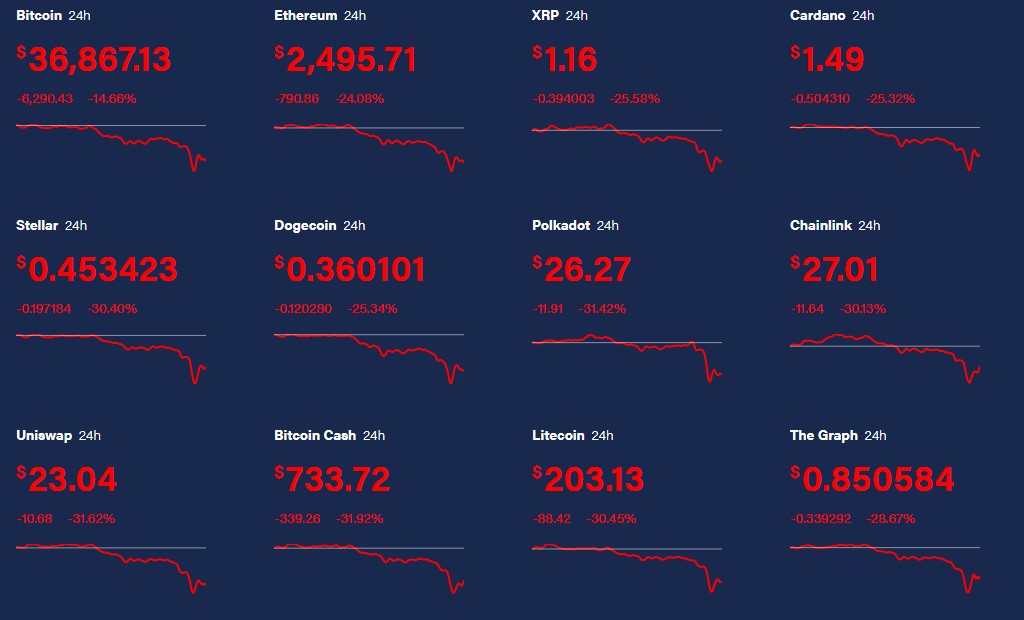
In 2021, Carlson pointed out something investors relearn every cycle: what worked last year can crash this year.
He noted sharp drawdowns across the “hot” corners of the marketcrypto, SPACs, frothy growth names, IPOs,
and even commodities like lumber after extreme runs.
High upside often comes with high wobble
Assets that can double quickly can also halve quicklyespecially when expectations are doing the heavy lifting.
That doesn’t automatically make them “bad,” but it does mean your plan needs to match their personality.
If an investment can move 20% in a week, your emotional expectations need to be wearing a helmet.
Leverage turns a bad day into a trapdoor
Many dramatic drops get amplified by leverage: borrowed money, margin, forced selling, liquidity gaps.
In those moments, prices can fall faster than narratives can keep up.
The reason often matters less than the reflexive chain reaction.
A Practical Crash Plan (That Doesn’t Require Superhuman Calm)
1) Decide your “sleep-at-night” allocation before the market decides for you
A good portfolio isn’t the one that earns the highest return in a perfect backtest.
It’s the one you can stick with during imperfect reality.
If your allocation makes you panic-sell, it’s not “aggressive”it’s “not aligned.”
2) Diversification is a seatbelt, not a force field
Schwab emphasizes a helpful truth: diversification can’t prevent losses,
but it can cushion the ride because different assets don’t always fall (or recover) the same way.
The goal isn’t to avoid every drawdownit’s to avoid the kind that makes you abandon the plan.
3) Use rules that kick in when emotions are loud
Great investors don’t rely on willpower alone. They rely on systems:
- Rebalance: if your target mix shifts, nudge it back on a schedule (not in a panic).
- Automate contributions: consistent investing reduces the temptation to “wait for the perfect moment.”
- Limit checking: if you refresh your account 40 times a day, you’re basically day-trading your mood.
4) Keep a real-world buffer (so the market isn’t your emergency fund)
One of the most underrated crash strategies is boring: keep enough cash for near-term needs
so you aren’t forced to sell investments at a bad time.
A downturn is stressful; a downturn plus a surprise bill is how bad decisions get made.
5) Replace predictions with preparation
Nobody rings a bell at the top. Nobody texts you the bottom.
So instead of trying to forecast, prepare:
know your time horizon, your goals, your risk tolerance, and your next sensible action.
A plan beats a prophecy.
Real Examples: Three Investors, One Messy Market
Example A: “All-in and anxious”
Jordan invests 100% in stocks, checks balances daily, and changes strategy whenever the news feels scary.
In a 10% correction, Jordan sells “to be safe,” then waits for certainty.
The market rebounds while Jordan waits for an all-clear that never arrives with confetti.
Result: Jordan turns volatility into permanent damage.
Example B: “Balanced and boring (the compliment)”
Casey holds a diversified mix, rebalances once or twice a year, and keeps a cash buffer.
During the same correction, Casey feels nervous (because Casey is human),
but doesn’t need to sell to pay bills and doesn’t change course mid-storm.
Result: Casey lets time do the heavy lifting.
Example C: “Cash-only and confident… until the market climbs”
Riley moves to cash after hearing “crash” for the 900th time.
When the market rises, Riley waits for a pullback. When the pullback comes, Riley waits for “more clarity.”
When clarity arrives, prices are higher.
Result: Riley avoids some drawdowns but also avoids compoundingdeath by a thousand “not yet” decisions.
The takeaway isn’t that one mix is always best. It’s that the best plan is the one you can follow
through both the drop and the rebound.
So… Does Crash Really Rule Everything?
Crashes rule the conversation because they hijack attention.
But they don’t have to rule your outcomes.
If corrections are common, then your plan should assume they’ll happen.
If bear markets can be sharp, then your finances should be built so you don’t have to sell in fear.
The goal isn’t to become emotionally bulletproof.
The goal is to build a setup where you can be a normal humanslightly nervous, mildly annoyed
and still make smart, consistent moves.
Experiences from the Crash Zone (Extra )
If you want to understand “Crash Rules Everything Around Me,” don’t start with charts.
Start with what it feels like when markets drop and your brain begins writing dramatic screenplays.
These are common experiences investors report across cyclesdifferent years, different headlines, same human wiring.
The first moment: “Let me just check…”
It usually begins innocently. You open your brokerage app to “take a quick look.”
The numbers are lower. Your brain does the fastest math it has ever done:
“If it drops this much again tomorrow, then by Friday I’ll be living under a tasteful bridge.”
It’s not logical. It’s instant. And it’s powerful.
This is why crash narratives spread so quickly: fear travels faster than nuance.
The group chat phase: doomscrolling as a sport
Next comes the social layer: friends, coworkers, and the internet.
Someone posts a headline with words like “plunge,” “bloodbath,” or “panic.”
Another person confidently predicts a second Great Depressionusually in all caps.
Suddenly you’re not just reacting to prices; you’re reacting to other people reacting to prices.
The emotional volume gets turned up by the crowd.
The temptation: “I’ll sell now and buy back lower”
This is the classic move that sounds brilliant in the shower and brutal in real life.
In the moment, selling feels like taking control. It feels responsible.
But to make it work, you have to be right twice: when you sell and when you buy back.
And the market has a weird sense of humorrecoveries often start when confidence is still missing.
Many people who sell in fear end up waiting for “confirmation,” which often shows up after prices have already risen.
The relief trap: feeling better after selling (even if it’s costly)
One sneaky part of a crash is that selling can reduce anxiety instantly.
Your account stops falling (because you stepped off the ride), so your nervous system calms down.
The problem is that short-term emotional relief can come with long-term opportunity cost.
You traded future compounding for present comfort.
That’s not “stupid”it’s human.
The solution isn’t shame; it’s building a plan that reduces the odds you’ll need that kind of emergency exit.
The comeback confusion: “Wait… it’s going up?”
Recoveries can feel insulting because they don’t wait for permission.
Bad news can still be everywhere while markets rise.
That disconnect makes people suspicious: “This can’t be real.”
But markets are forward-looking, and prices often turn before the story feels better.
Investors who stick to a rules-based approachrebalancing, steady contributions, diversified exposureoften benefit
not because they’re fearless, but because their process keeps them from making the two most damaging moves:
panic selling near lows and “waiting for certainty” during rebounds.
What experienced investors learn (the hard way)
Over time, many investors come to a calmer conclusion: crashes are awful, but they’re not alien.
They’re part of the market’s rhythm.
The practical lesson is to design your money life so that a crash is a stressful headlinenot a personal emergency.
That usually means: appropriate risk, diversification, a cash buffer, and rules you can follow when you’re not feeling heroic.
Crashes may rule the conversation, but your plan can rule your behavior.












