
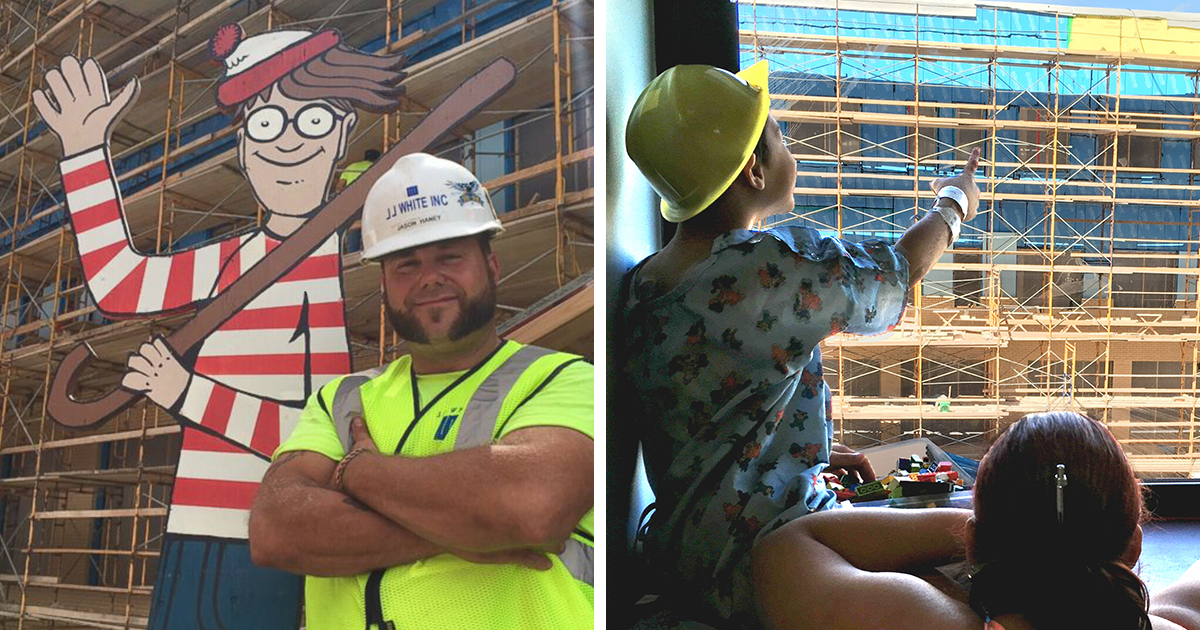
Construction sites usually offer two things: noise and dust. Maybe a third thing if it’s Friday: a mysterious sandwich that’s been sitting in a truck since 6:12 a.m. So when a construction worker decides to turn a jobsite into a daily, window-side scavenger hunt for kids in the hospital next door, it hits differentin the best possible way.
The premise is simple, the execution is hilarious, and the impact is the kind of wholesome you can’t fake: a life-sized Waldo (yes, that red-and-white-striped Waldo) gets hidden somewhere on the active build. Kids in nearby hospital rooms scan the steel, the scaffolding, the beams, the forkliftseverythinguntil someone inevitably yells, “I FOUND HIM!”
And just like that, a place designed for concrete and schedules becomes, for a few minutes each day, a place designed for hope.
How a Worksite Became a Daily “Where’s Waldo?” Game
In South Bend, Indiana, a labor foreman named Jason Haney helped build an expansion at a children’s hospitaland also helped build something less official but arguably just as powerful: a daily routine kids could look forward to. The version of Waldo in this story wasn’t a tiny ink drawing hiding behind a cartoon palm tree. It was a big, bold, wooden cutouttall enough that you’d think it should’ve needed its own hard hat.
The game worked like this: the kids could see the construction site from their hospital windows. Waldo would appear somewhere in view, perched among the real-world maze of beams, ladders, equipment, and half-finished structure. When a child spotted him, word made its way back to the crew, and Waldo would “migrate” to a new hiding spot so the hunt could start all over again.
Why Waldo? Because Hospitals Can Feel Like Time Moves Sideways
Anyone who’s spent time in a hospitalespecially kidsknows the weirdness: days can be long, nights can be longer, and even “good news” can come with needles. Waldo turns a window into a mission. It gives kids something to do that isn’t “wait,” “hurt,” or “be brave.” It’s “be a detective.”
The Origin Story Usually Includes a Snowman (Seriously)
One reason this idea keeps popping up is because it often starts the same way: someone on the crew does a small, goofy thing for the kidslike putting up a seasonal decorationthen somebody cracks a joke, and the joke becomes a tradition. In Indiana, early versions of “let’s give them something fun to look at” included winter-time site creativity. Then someone floated the idea: what if it was Waldo? A joke with legs. Striped legs.
It’s Not Just Indiana: The “Hidden Waldo” Tradition Spreads
The best community ideas tend to travel. Not with a press release. More like a campfire story: “Hey, did you hear what that crew did for the kids next door?” Before you know it, another jobsite is pulling out plywood and paint.
Seattle: The Crew That Showed Up EarlyJust to Set Up Waldo
Years before the Indiana story went viral, a construction team working near Seattle Children’s turned “Where’s Waldo?” into a daily ritual using a Waldo-dressed mannequin. The foreman behind the effort reportedly arrived early to place Waldo somewhere new on the site each morningso kids could start their day scanning the scene from their windows.
That detail matters: arriving early isn’t flashy philanthropy. It’s a quiet sacrifice of time. It’s someone saying, “I’m going to do one extra thing today, not because I have to, but because it helps.”
Sacramento: Two Hospitals, a Tower, and a 6-Foot Waldo With Weather Resistance
Fast-forward to Sacramento, where a crew building a major medical tower created their own version of the game near pediatric hospitals. Instead of a single tiny Waldo, it became a bigger operationWaldo(s) positioned in the steel frame so kids at neighboring hospitals could spot him from their rooms. The team moved the figure every few days, keeping the challenge alive while the building climbed higher.
This is the part where you realize construction workers might secretly be elite entertainment producers. No fancy screens. No subscription. Just real-world hide-and-seek at industrial scale.
Why This Works So Well: The Psychology of “Positive Distraction”
If you ask a child life specialist what helps kids cope in hospitals, you’ll hear a familiar theme: preparation, play, and distraction. Not distraction in the “ignore your problems” way, but in the “give your brain a break so you can handle the hard stuff” way.
Small Games Create Big Control
In a hospital, kids lose control over a lotschedules, tests, treatments, even when the lights go off. A daily Waldo hunt gives them a tiny piece of control back. They can choose when to look. How to look. Whether to recruit Mom, Dad, a nurse, or that cool aunt who brought gummy bears.
It’s Cognitive Exercise That Doesn’t Feel Like Therapy
Waldo is basically a stealth brain workout: scanning, pattern recognition, attention, patience, persistence. Kids aren’t thinking, “I’m practicing focus.” They’re thinking, “He’s gotta be near that ladder. I know his vibes.” And that’s the magic.
It Helps the Whole Room, Not Just the Patient
Parents and caregivers carry stress too, and they can’t always “fix” what’s happening. But they can play. Waldo is a team sport: a shared mission that turns anxious minutes into lighter ones. Even staff get drawn inbecause humans are powerless against a mystery involving stripes and glasses.
What Makes a “Hospital-Next-Door Waldo” Setup Successful
This kind of kindness looks spontaneous, but the best versions are quietly thoughtful. Here’s what the strongest “construction worker hides Waldo” stories tend to have in common.
1) A Clear Line of Sight (And a Clear Safety Plan)
The game only works if kids can actually see the figure from their windows. That sounds obvious, but it’s the difference between “adorable daily tradition” and “Waldo is technically present… somewhere… behind a concrete wall… in another zip code.”
And because this is still a jobsite, safety comes first: the cutout needs to be secured, wind-resistant, and placed so it doesn’t distract workers, block pathways, or create hazards.
2) A Simple Feedback Loop
The charm is in the reset: once Waldo is found, he moves. That requires communicationmaybe a nurse tells someone on-site, maybe a child life team relays the message, maybe there’s a designated point person. It doesn’t need to be fancy. It just needs to be consistent.
3) A “Character” That Reads Well From a Distance
Waldo is perfect because he’s high-contrast and iconic. But the broader idea is “find the friendly thing.” Some projects use multiple figures, seasonal themes, or rotating charactersanything easily visible from across a courtyard.
4) Respect for the Hospital Environment
Hospitals aren’t theme parks. That’s why the best versions stay gentle: no loud stunts, no startling visuals, no “jump scare” energy. Just a steady, daily smile.
The Real Hero Move: Making Joy Part of the Job
Here’s the truth: construction work is demanding. It’s early mornings, weather, logistics, heavy materials, tight deadlines, and a never-ending list of things that can go sideways. So when a crew chooses to add “delight pediatric patients” to their unofficial scope of work, it’s not small. It’s a decision.
In Indiana, this became personal. The story of Waldo wasn’t just a random gagit was connected to family, to gratitude, to the memory of needing specialized care and wanting other kids to feel less alone. That’s why the game resonated. It had roots.
And in Sacramento, the framing was similar: a team building healthcare infrastructure also wanted to build community connection a reminder that the structure rising outside the window isn’t just steel. It’s future care. It’s progress you can point to, literally.
How to Start a “Find Waldo” Tradition on Any Community Project
If you’re a contractor, a project manager, a hospital neighbor, or just someone who loves the idea of turning everyday work into everyday kindness, here’s a practical blueprint.
Step-by-step checklist
- Coordinate with the hospital (often child life teams): confirm windows, sightlines, and what feels appropriate.
- Choose a safe, durable figure: weather-proof materials, secure mounting, and high-visibility design.
- Assign a “Waldo captain”: one person who handles placement and the “found it” reset.
- Set a schedule that fits real work: daily if feasible; every few days still keeps the fun alive.
- Keep it flexible: construction changes fast; your hiding strategy should too.
- Invite gentle participation: photos, window waves, thumbs-upssmall interactions go a long way.
The best part? This is one of those rare morale boosters that improves more than one morale. Kids feel lighter. Parents breathe easier. Staff get a moment of normal. And crews get reminded that what they build mattersbecause they can literally see who they’re building it for.
Conclusion: Waldo Is a Stripey Reminder That People Still Show Up for Each Other
A construction worker hiding Waldo on a site every day isn’t “just a cute story.” It’s a case study in how tiny rituals can help people endure hard days. The jobsite stays a jobsite. The hospital stays a hospital. But for a few minutes each morning, the space between them becomes a bridgebuilt out of plywood, humor, and human decency.
And if you ever doubt whether small actions matter, remember this: somewhere, a kid in a hospital gown pressed their face to a window, scanned a forest of steel, and smiled because they spotted a ridiculous red-and-white legend waving back.
Extra 500-Word Field Notes: What This Kind of Kindness Feels Like in Real Life
If you’ve never worked a site next to a hospital, here’s the part nobody puts on the project schedule: you hear life happening right beside you. Sirens arrive. Families come and go. Sometimes you’ll see a nurse pause at a window with a coffee like it’s the only calm minute in a marathon shift. The building you’re raising isn’t abstractit’s personal, and it’s happening in real time.
That’s why a “Where’s Waldo?” tradition lands so hard. It’s not a donation with a ribbon-cutting. It’s a daily, ordinary choice. Somebody has to remember to do it. Somebody has to carry the cutout, find a spot that’s visible but not in the way, secure it so wind doesn’t turn Waldo into an unlicensed drone, and then go right back to real work.
And yet, crews who do this kind of thing often describe the same unexpected side effect: they start looking up more. Not just for hazardsup at the windows. Up at the faces. Up at the reason. Construction can be head-down work: measure, lift, place, repeat. But once you know kids are watching, you feel that attention like sunlight. You want to do a good job. You also want to give them something to talk about that isn’t test results.
The “found it!” moment is its own reward. It might come through a staff member who pops outside to say, “They got him again.” Or maybe you see it without being told: a small silhouette at a window, an excited wave, a little bounce you can recognize even from far away. It’s oddly electricbecause it’s joy that doesn’t require you to solve an impossible problem. You don’t have to cure anything. You don’t have to explain anything. You just have to keep the game going.
Over time, it becomes a mini culture on-site. Workers start pitching hiding spots like it’s a tactical operation: “What if we put him near the cross-bracing?” “Too easy.” “What if he’s behind the lift but angled toward the windows?” “Now you’re thinking.” Someone inevitably suggests a second character. Someone else suggests seasonal costumes. And suddenly you’ve got a crew of adults in safety vests debating Waldo strategy with the seriousness of a playoff coach.
The biggest lesson is also the simplest: kindness doesn’t need a perfect moment. It can live inside the workday. It can be scrappy. It can be a plywood cutout and a routine. When people talk about “community,” it’s easy to make it sound like a slogan. But a hidden Waldo is community you can point to. It’s proof that even in loud, messy, complicated places, humans still find ways to careone ridiculous set of stripes at a time.











