
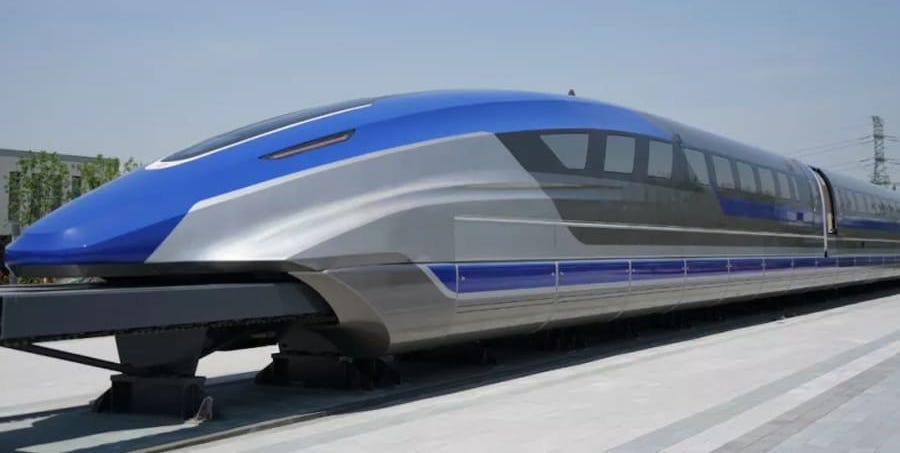
China has a talent for making transportation headlines sound like science fiction with a punctuality problem. The latest attention-grabber is a high-speed magnetic levitation train said to reach 373 mph, or 600 km/h. That is not just fast for a train. That is “your coffee is still hot when you arrive in another megacity” fast.
But before we picture commuters casually levitating from Beijing to Shanghai while answering emails and pretending not to hear phone calls, there is an important detail: the 373 mph claim refers to China’s ultra-high-speed maglev train, not a regular wheel-on-rail bullet train. Maglev is short for magnetic levitation, which means the train floats above a guideway using electromagnetic force. No wheel-to-rail contact. Less friction. More futuristic humming. And yes, probably still someone loudly unwrapping snacks in carriage five.
The story matters because China is not simply showing off a shiny prototype. It is pushing a bigger transportation strategy: connect huge cities faster, compete with short-haul flights, reduce congestion, export rail technology, and make high-speed travel feel less like a luxury and more like infrastructure. The 373 mph train is a symbol of that ambition, even if commercial service at that speed still depends on tracks, safety systems, energy economics, route planning, and the small matter of building the world around it.
What Is China’s 373 mph Train?
The train usually described in reports as China’s “new bullet train” is more accurately a 600 km/h high-speed maglev system developed by CRRC, China’s state-owned rolling stock giant. It was first shown as a prototype in 2019 and later debuted as a completed system in Qingdao in 2021. Chinese officials and state media presented it as the fastest ground transportation vehicle available for commercial development.
At 600 km/h, the train would sit in the awkwardly exciting zone between conventional high-speed rail and domestic aviation. It is faster than China’s current wheel-on-rail high-speed trains, faster than most commercial rail services worldwide, and close enough to airplane travel times that the old “train versus flight” debate starts sweating through its blazer.
The proposed advantage is not just top speed. Airplanes are fast in the air, but passengers must reach the airport, pass security, wait at the gate, board, taxi, fly, land, taxi again, and then travel from an airport that is often nowhere near downtown. A maglev line between city centers could shrink total journey time on certain routes, especially for trips in the 500-to-900-mile range.
Maglev vs. Bullet Train: Why the Difference Matters
The phrase “bullet train” is often used loosely for any very fast train with a sleek nose and heroic marketing photos. Technically, however, China’s 373 mph concept belongs to the maglev family, not the same category as the conventional high-speed trains that run on steel wheels and rails.
Conventional high-speed rail
Conventional bullet trains, such as China’s Fuxing fleet, France’s TGV, Japan’s Shinkansen, and Spain’s AVE, use wheels on rails. Engineers can make these trains astonishingly fast, but friction, track wear, noise, braking distance, and aerodynamic resistance become harder to manage as speeds rise. China’s CR400 Fuxing trains operate at up to 350 km/h, while the newer CR450 generation is designed for even faster service, generally discussed around 400 km/h operation and 450 km/h testing.
Maglev trains
Maglev trains float above the guideway and are propelled by magnetic forces. Because there is no physical wheel contact during high-speed movement, friction is dramatically reduced. That does not mean maglev trains are magic carpets with cupholders. They still face aerodynamic drag, noise, power demands, guideway costs, control-system complexity, and safety requirements. But they do remove one of the major mechanical limits of traditional rail.
In simple terms: a bullet train rolls very quickly; a maglev glides very quickly. Both are engineering flexes. One just sounds more like it belongs in a superhero lair.
Why 373 mph Is Such a Big Number
To understand the scale of 373 mph, compare it with familiar travel speeds. A typical U.S. interstate highway trip may average 60 to 75 mph. Amtrak’s Acela can reach up to 150 mph on parts of the Northeast Corridor. Many modern high-speed rail systems operate around 186 to 217 mph. China’s current fastest conventional services can run at about 217 mph. A 373 mph maglev would be in a different league.
At that speed, a theoretical Beijing-to-Shanghai trip could become competitive with flying when total door-to-door time is considered. Reports have often cited a potential journey time of around 2.5 to 3.5 hours, depending on the assumptions used. That corridor is more than 800 miles long, making it one of the most important travel markets in China. If a train could offer city-center access, frequent departures, smooth boarding, and less weather disruption, airlines would have a very serious steel-and-magnet competitor.
Of course, “could” is doing some heavy lifting here. A train capable of 373 mph is one thing. A full passenger route safely operating at that speed is another. The train is the glamorous part. The guideway, signaling, maintenance depots, evacuation planning, power supply, and land acquisition are the less glamorous cousins who actually make the wedding happen.
China’s High-Speed Rail Strategy
China’s interest in a 600 km/h maglev makes more sense when viewed against its broader railway expansion. Over the past two decades, China has built the world’s largest high-speed rail network. It has linked provincial capitals, industrial zones, tourist cities, and mega-regions with a level of rail connectivity that reshaped domestic travel.
High-speed rail in China is not just about moving people. It is also about economic development, national integration, industrial policy, and technological independence. A fast train line can turn distant cities into practical business neighbors. It can reduce pressure on airports. It can move workers, students, tourists, and executives without adding another runway or another traffic-choked expressway.
The 373 mph maglev fits into that vision as a premium layer above existing high-speed rail. Think of it as the espresso shot of the network: expensive, intense, and not something you build everywhere unless you enjoy financial heartburn. It is most likely to make sense on dense corridors where passenger demand is huge and where the time savings are large enough to justify the cost.
The Engineering Challenge: Speed Is Only the Headline
A train reaching 373 mph sounds like the main achievement, but high-speed rail engineering is full of unglamorous enemies. Air resistance grows brutally at higher speeds. Noise becomes harder to control. Tunnels create pressure waves. Curves must be gentler. Tracks or guideways must be extremely precise. Emergency braking distances become longer. And every component must behave predictably, because “we’ll see what happens” is not an acceptable safety philosophy at airplane-like speeds.
Aerodynamics
At very high speeds, the train has to slice through air efficiently. That is why high-speed trains often have long noses, smooth sides, sealed gaps, and carefully shaped bodies. The faster the train goes, the more it fights the atmosphere. Air may be invisible, but at 373 mph it becomes a very expensive wall.
Noise and tunnel boom
When a high-speed train enters a tunnel, it pushes air ahead of it like a piston. At extreme speeds, pressure waves can create a loud “tunnel boom” when the compressed air exits. Researchers have worked on tunnel entrance hoods, porous structures, and pressure-relief designs to reduce shock waves. Without those solutions, communities near tunnels might not greet the future with applause.
Infrastructure cost
Maglev systems cannot simply use existing railway tracks. They need special guideways, power systems, switches, control technology, stations, and maintenance facilities. That makes them expensive to build. The train itself may be the poster child, but the infrastructure is the bill that arrives after the party.
How China Compares With Japan, Europe, and the United States
China is not the only country chasing ultra-fast rail. Japan has long been a leader in magnetic levitation technology. Its L0 Series maglev reached 603 km/h in testing, and the planned Chuo Shinkansen aims to connect Tokyo and Nagoya at high speed, though the project has faced delays and enormous construction challenges. Japan’s system is famous for precision, safety culture, and engineering discipline.
Europe has also shaped high-speed rail history. France’s TGV has set famous speed records and built a strong commercial network. Spain, Germany, and Italy have extensive high-speed services. European systems show how rail can compete with flights on city pairs such as Paris-Lyon, Madrid-Barcelona, and Milan-Rome.
The United States, meanwhile, remains a complicated case. The country has strong aviation, car culture, sprawling suburbs, freight-dominated rail corridors, political fragmentation, and high construction costs. Acela is useful in the Northeast, but it is not comparable to China’s broad high-speed network. California’s high-speed rail project has moved slowly, while private projects in Texas, Nevada, and Florida have tried different approaches. In other words, America has plenty of rail dreams, but the dreams keep getting stuck in permitting traffic.
Could a 373 mph Train Replace Flights?
On certain routes, yes, at least in theory. High-speed trains are most competitive when they connect large city centers at distances where flying is fast but inconvenient. For trips under roughly 500 miles, conventional high-speed rail can already dominate. For longer trips, a 373 mph maglev could stretch rail’s competitive range.
Imagine a traveler going from one major downtown to another. If the station is central, security is simpler, boarding is faster, and departures are frequent, the train may beat the plane even if the aircraft’s cruising speed is higher. It also offers a more comfortable experience: bigger seats, easier walking, fewer baggage headaches, better scenery, and less time pretending that a tiny bag of pretzels is a meal.
Still, maglev is not a universal replacement for air travel. For long-distance international trips, aviation remains essential. For lower-demand routes, the cost of building maglev infrastructure may be impossible to justify. The best use case is likely dense domestic corridors where millions of passengers already travel by rail or air.
Environmental Promise and Practical Questions
Supporters argue that ultra-fast electric trains can reduce emissions by shifting travelers from planes and cars to rail. If powered by a cleaner grid, a maglev system could offer lower operational emissions than aviation on comparable routes. It could also reduce airport congestion and free runway capacity for longer flights.
However, environmental benefits depend on the full lifecycle. Building new guideways requires concrete, steel, land, energy, and major construction. The electricity must come from somewhere. Maintenance is complex. If trains run half-empty, the climate math looks less impressive. Sustainable transportation is not just about maximum speed; it is about passenger volume, energy source, land use, durability, and integration with local transit.
In other words, a 373 mph train is not automatically green because it looks like it escaped from a wind tunnel. It becomes green when the system around it is designed intelligently.
The Business Case: Where Would It Work?
A 600 km/h maglev makes the most economic sense where three conditions overlap: huge passenger demand, high-value time savings, and strong government or institutional capacity to build infrastructure. China has several corridors that could meet those conditions, including Beijing-Shanghai and major city clusters such as the Yangtze River Delta and Greater Bay Area.
The challenge is cost. Maglev infrastructure is generally more expensive than conventional rail. It also has compatibility limits. A conventional high-speed train can often share parts of a broader rail ecosystem. A maglev needs its own guideway. That separation may improve performance but reduces flexibility.
This is why China’s conventional CR450 high-speed train may be just as important as the maglev story. A wheel-on-rail train designed for 400 km/h operation could improve service on more routes without requiring a completely separate maglev network. The maglev is the moonshot. The CR450 is the high-performance upgrade that may be easier to scale.
Why the 373 mph Claim Still Deserves Caution
Technology announcements often arrive wearing their best suit. A claimed top speed does not necessarily mean passengers will experience that speed daily. Commercial service depends on certification, route design, safety testing, operating economics, and real-world demand. The difference between “capable of” and “regularly does” is the difference between owning running shoes and finishing a marathon.
China has demonstrated serious rail-building ability, so the claim should not be dismissed as fantasy. At the same time, a 373 mph maglev network is a much harder achievement than unveiling a trainset. The world should watch the project with interest, but also with a stopwatch in one hand and a spreadsheet in the other.
What Riders Might Experience on a 373 mph Maglev
If commercial service becomes reality, the passenger experience could be surprisingly calm. Maglev trains are often described as smooth because they do not rely on steel wheels rolling on rails at high speed. Acceleration may feel strong but controlled. Cabins would likely emphasize quietness, stability, pressure comfort, and airline-like interior design.
Boarding could resemble high-speed rail more than air travel: station access, ticket gates, platforms, assigned seats, and frequent departures. The biggest difference would be psychological. Watching a screen show 600 km/h while your water bottle sits politely on the tray table would feel like cheating at physics.
The best high-speed trains make speed feel boring. That is the real miracle. Anyone can make a vehicle seem thrilling by shaking it around. The engineering achievement is making 373 mph feel like a normal Tuesday.
Experiences Related to China’s 373 mph Train
For travelers who have ridden high-speed trains in Asia or Europe, China’s 373 mph maglev idea feels less like a random fantasy and more like the next chapter in a familiar story. The first time many people ride a true high-speed train, they expect drama: roaring engines, rattling windows, maybe a soundtrack. Instead, the experience is often almost suspiciously civilized. The doors close, the train glides away, and a few minutes later the countryside is scrolling past like someone put the landscape on fast-forward.
That is what makes the 373 mph concept so fascinating. The human brain is not built to understand that kind of ground speed from inside a quiet cabin. In a car, 80 mph feels fast. On a plane, 500 mph feels abstract because clouds provide no useful reference points. But on a train, you can see buildings, rivers, farms, bridges, and stations passing by. Speed becomes visible. It turns geography into a moving slideshow.
Imagine arriving at a station in central Beijing in the morning. You scan a ticket, buy a coffee, find your seat, and roll out toward Shanghai. Instead of spending half the morning getting to an airport and waiting in lines, you are already moving. The train accelerates without the engine roar of a jet. There is no takeoff angle, no seatbelt sign dinging like a tiny authority figure, and no awkward armrest diplomacy with a stranger during turbulence. You look down and realize the train is moving faster than most small aircraft during parts of their journey, yet the cabin feels steady enough for a laptop.
Business travelers would value the time savings, but tourists might appreciate something else: continuity. Rail travel keeps passengers connected to the places between origin and destination. A flight makes distance disappear; a train makes distance understandable. Even at extreme speed, the route still tells a story. Mountains, suburbs, industrial parks, farmland, rivers, and skylines appear in sequence. A maglev would compress that story, but not erase it.
There would also be funny everyday adjustments. People would still complain about legroom. Someone would still bring food with a smell powerful enough to challenge national infrastructure. A child would still ask, “Are we there yet?” approximately seven minutes after departure. The future may levitate, but human behavior remains firmly attached to the ground.
The most meaningful experience, however, would be psychological. A successful 373 mph train would change how people think about distance. Cities that once felt like separate travel commitments could become part of the same practical day. Meetings, family visits, weekend trips, conferences, and tourism could reorganize around a new sense of reach. That is what major transportation technology always does. It does not merely move people faster; it redraws the mental map.
For the rest of the world, China’s maglev push is also an experience in comparison. It forces countries to ask why some places build fast rail while others debate it for decades. It raises questions about cost, governance, land use, climate policy, and public patience. The 373 mph train may or may not become common soon, but it already performs one useful service: it makes slow infrastructure feel very slow indeed.
Conclusion
China’s claim that its new train can hit 373 mph is more than a flashy number. It represents a serious attempt to occupy the space between high-speed rail and aviation. The technology is maglev, the ambition is national-scale mobility, and the challenge is turning a record-ready vehicle into a reliable passenger system.
The promise is enormous: faster intercity travel, less dependence on short-haul flights, smoother passenger experiences, and another leap in rail engineering. The obstacles are just as real: cost, infrastructure, safety certification, route selection, energy demand, and commercial practicality.
So, will China’s 373 mph train change the future of travel? Possibly. But the real revolution will not happen when a prototype reaches a headline speed. It will happen when ordinary passengers can board, sit down, sip coffee, and cross a country at near-airplane speed while barely noticing the miracle beneath them.













