
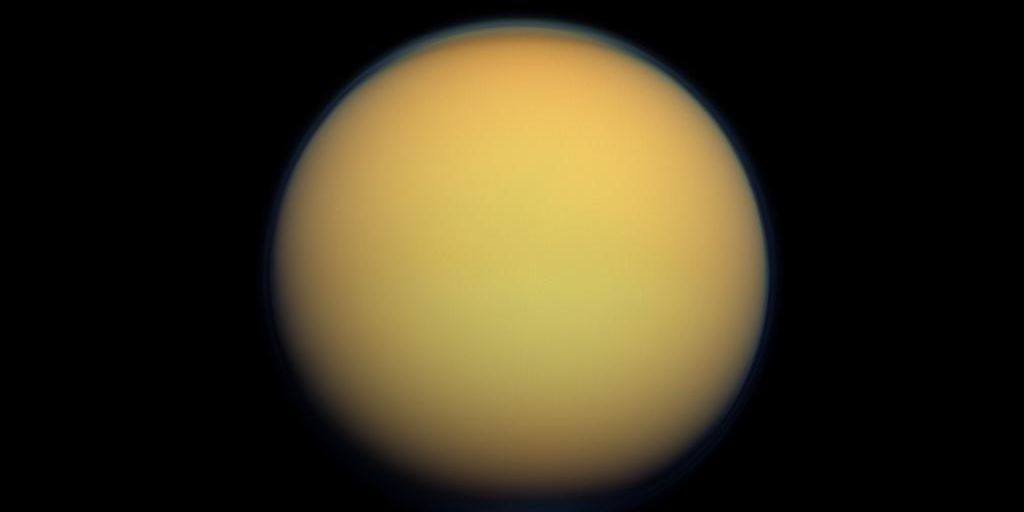
Titan has never been a normal moon, and frankly, it seems committed to staying weird. Saturn’s largest moon has lakes, rivers, rain, dunes, and a thick atmosphere, which makes it sound suspiciously Earth-like until you remember the “water” is actually methane and ethane, the temperature is brutally cold, and any tourist brochure would have to come with a large “absolutely not for humans” warning label.
That strangeness is exactly why Titan keeps stealing the spotlight in astrobiology. For years, scientists have wondered whether life on Titan, if it exists at all, would have to be built from chemistry that looks nothing like life on Earth. One of the boldest ideas in that conversation centers on a molecule called acrylonitrile, also known as vinyl cyanide. Researchers found this chemical in Titan’s atmosphere and proposed that, under Titan’s extreme conditions, it could help form membrane-like structures similar to the cell membranes that make life on Earth possible.
That is the headline-friendly version, and yes, it is still fascinating. But the fuller story is even better. Titan’s chemistry is not just a tale of one miracle molecule. It is a larger scientific detective story about what membranes do, why they matter, and whether alien environments could produce their own versions of life’s most basic architecture. The more scientists study Titan, the more they realize this moon is less like a frozen rock and more like a giant chemistry experiment with weather.
Why Titan Makes Scientists Lose Sleep in a Good Way
Titan is one of the most intriguing places in the solar system because it combines familiar planetary behavior with utterly unfamiliar ingredients. It has a dense, nitrogen-rich atmosphere, seasonal weather, methane clouds, methane rain, and large lakes and seas on the surface. In a broad, poetic sense, Titan behaves a little like Earth. In a chemical sense, though, it is operating with an entirely different pantry.
On Earth, life depends on liquid water. Water acts as a solvent, helps molecules move around, and supports the formation of lipid bilayers, the membranes that wrap around cells and keep the inside separate from the outside. Titan does not offer that setup on the surface. Its lakes and seas are made of hydrocarbons, not water, and the moon’s surface hovers around minus 290 degrees Fahrenheit. In that kind of cold, Earth-style membranes would not be flexible little biological miracle wrappers. They would be more like frozen crackers.
That is why Titan pushes scientists to think beyond standard habitability checklists. If water is not available, could another liquid play the same role? If phospholipid membranes fail, could some other molecule step in? Titan is the moon that keeps asking science, “Have you tried not being so Earth-centric?”
The Chemical Everyone Started Talking About: Acrylonitrile
Acrylonitrile is not the sort of word that usually inspires wonder. It sounds more like something you would avoid spilling in an industrial lab than something that might help explain alien biology. On Earth, the compound is associated with manufacturing plastics and synthetic materials. On Titan, however, acrylonitrile became a scientific celebrity.
The excitement began with theoretical work suggesting that acrylonitrile could be a strong candidate for forming stable membrane-like structures in Titan’s methane-rich environment. Scientists proposed that the molecule might organize into small, flexible spheres called azotosomes. These would be an alien cousin to the lipid membranes used by life on Earth.
The appeal of that idea was enormous. Cell membranes are not just packaging. They are one of the reasons biology works at all. A membrane creates a boundary, and a boundary creates possibility. It allows useful molecules to stay close together, helps chemical reactions happen in a confined space, and gives a system an “inside” and an “outside.” Without that separation, chemistry just kind of sloshes around and hopes for the best. Life, by contrast, is usually much pickier.
Then came the observational boost. In 2017, NASA scientists reported a definitive detection of acrylonitrile in Titan’s atmosphere using data from the Atacama Large Millimeter/submillimeter Array. That mattered because the membrane idea no longer depended only on computer modeling. The molecule was not just hypothetical. It was really there.
How a Membrane Could Work on Titan
Earth’s membranes rely on water
On Earth, cell membranes are built from lipids with water-loving heads and water-hating tails. In liquid water, these molecules naturally arrange themselves into bilayers. It is elegant, efficient, and one of biology’s greatest hits.
But Titan’s lakes are nonpolar hydrocarbon liquids, not polar water. That changes everything. The molecule arrangement that works beautifully in Earth’s oceans would not behave the same way in a methane sea. If Titan hosts membrane-like structures, they would need a different chemical logic.
Azotosomes were the proposed alternative
The azotosome idea was exciting because it suggested that acrylonitrile might provide that alternative. Instead of imitating Earth life directly, Titan chemistry could produce a membrane that serves a similar function through a different structure. This is one of the most interesting concepts in astrobiology: the possibility that life’s essential jobs might stay the same even when the ingredients change.
Think of it like cooking in another country with a completely different kitchen. The recipe may not use your usual tools, spices, or ingredients, but if the final dish still performs the same delicious function, you are looking at a meaningful analog. Titan may not have Earth’s recipe for life, but scientists are asking whether it has its own strange cookbook.
Why the Discovery Was Such a Big Deal
The discovery of acrylonitrile on Titan mattered for several reasons. First, it reinforced Titan’s reputation as a world rich in complex organic chemistry. This moon is not chemically barren. It is bustling with carbon-based molecules, atmospheric reactions, and surface liquids that could support unusual forms of prebiotic chemistry.
Second, the finding gave astrobiologists something tangible to work with. There is a big difference between saying “maybe some suitable molecule exists” and saying “we found a specific molecule that could plausibly do the job.” Acrylonitrile offered a real target for future modeling, lab experiments, and mission planning.
Third, the discovery broadened the definition of where interesting biology-related chemistry might happen. Titan is far outside the classic “liquid water on the surface” comfort zone. Yet it remains one of the most compelling places in the solar system to ask how life could begin, adapt, or organize itself under radically different conditions.
That is why Titan is so beloved by scientists. It is not merely a possible place to find life. It is a place that forces us to rethink what life might require in the first place.
The Plot Twist: Newer Studies Complicate the Story
Now for the part science loves and headlines hate: the follow-up.
Later work challenged the original azotosome idea. A 2020 study argued that these polarity-inverted membranes would be unlikely to self-assemble under Titan-like conditions. More recently, experimental work published in 2026 suggested that acrylonitrile-based azotosomes are unlikely to form in Titan’s lake fluids as originally imagined. In plain English, the membrane story got messier.
That does not mean the original excitement was foolish. It means the scientific process is doing exactly what it is supposed to do. A bold idea gets proposed. Other researchers test it from different angles. Simulations improve. Lab work gets closer to real conditions. Some possibilities survive. Others wobble. A few collapse dramatically. Science is less a straight road and more a very smart obstacle course.
What is especially interesting is that the newer skepticism does not kill Titan’s astrobiological appeal. Instead, it refines the question. Scientists are now asking whether Titan might form membrane-like vesicles through other mechanisms. NASA-backed work in 2025 explored a different pathway in which amphiphile-coated droplets, splashed up by methane rain, might create stable vesicles in Titan’s hydrocarbon lakes. In other words, the simple version of the acrylonitrile story may be weaker than once hoped, but the broader search for Titan protocells is still very much alive.
That is a useful reminder for readers and writers alike: “could form cell membranes” is not a final verdict. It is an invitation to keep investigating.
What Titan Teaches Us About Life Beyond Earth
The Titan membrane story matters even if no living thing ever swims through Kraken Mare waving a tiny hydrocarbon flag. Why? Because it expands the scientific imagination in disciplined ways. Titan forces researchers to ask what is fundamental to life and what is merely familiar because we live on Earth.
For example, must life always need water as a solvent? Must membranes always be made from the same kinds of lipids? Must biology always emerge in mild, sunlit environments? Titan says, “Please show your work.”
This is why discussions about Titan often blend chemistry, planetary science, and origin-of-life research. The moon offers an active natural laboratory where methane, nitrogen, sunlight, and time have been interacting for ages. Even if Titan is not alive, it may still preserve stages of chemical organization that help scientists understand how complexity begins.
There is also a humbling philosophical angle here. Humans tend to assume that the conditions we need are the conditions all life must need. Titan challenges that instinct. It suggests the universe may be far more inventive than our textbooks once implied.
Dragonfly Could Be the Mission That Changes Everything
If Titan is the solar system’s weirdest chemistry lab, NASA’s Dragonfly mission is the long-awaited field trip. Dragonfly is a rotorcraft mission designed to explore Titan’s surface and atmosphere, moving from site to site to study the moon’s chemistry, geology, and habitability. It is scheduled to launch no earlier than 2028 and arrive in 2034.
Dragonfly will not splash down into Titan’s seas, so it will not directly scoop up lake membranes like a cosmic soup ladle. But it will do something almost as important: study the broader environmental context that shapes Titan’s chemistry. It will help scientists better understand which organic compounds are present, how surface and atmospheric processes interact, and how far prebiotic chemistry may have progressed.
That matters because the membrane question does not exist in isolation. A membrane only becomes biologically interesting if the surrounding environment can support additional steps toward complexity. Dragonfly can help answer whether Titan is merely chemically interesting, or chemically promising.
Also, let us pause to appreciate that humanity is building a nuclear-powered flying robot to explore a moon wrapped in orange haze nearly a billion miles from the Sun. If that sentence does not make your inner science nerd sit up straighter, check your batteries.
So, Could This Chemical on Titan Form Cell Membranes?
The honest answer is: possibly, but not as simply as once believed.
Acrylonitrile remains one of the most important molecules in the Titan story because it is present, relevant, and chemically intriguing. The original proposal that it could form membrane-like azotosomes was a serious and creative scientific idea, not science fiction dressed up in a lab coat. But later studies have made that specific scenario look less certain, and in some cases unlikely, under real Titan lake conditions.
Still, the larger concept has not evaporated into Titan’s haze. Scientists continue exploring whether other membrane-like compartments or vesicles could arise there through different routes. So while the neatest version of the story has softened, the bigger astrobiology question remains deliciously open.
And maybe that is the real takeaway. Titan is not exciting because we already know it hosts alien cell membranes. Titan is exciting because it keeps presenting chemistry that is just plausible enough to prevent scientists from shrugging and moving on. It keeps saying, “You sure you know how life works?” and science, to its credit, keeps answering, “Not completely, but we’re trying.”
The Experience of Following the Titan Story
There is something uniquely thrilling about following a story like this one, because Titan sits at the intersection of hard chemistry and wild imagination. You start with a molecule that sounds like it belongs in a factory manual, and suddenly you are asking whether it could help build the boundary of an alien cell. That jump, from ordinary chemistry to extraordinary possibility, is part of what makes space science so addictive. It takes the most technical subjects and sneaks wonder into them through the side door.
For many readers, the Titan story feels like an intellectual roller coaster in the best way. First comes the excitement: a chemical has been found on Saturn’s moon, and it might form something like cell membranes. Then comes the pause: hold on, Titan’s lakes are methane, not water, and the place is colder than a freezer’s nightmare. Then comes the bigger thrill: scientists are not backing away from the weirdness; they are leaning into it. They are asking how chemistry behaves when the rules we know from Earth stop being useful. That is not just astronomy. That is creative scientific thinking in action.
The experience also mirrors what science really feels like when you watch it closely. Big ideas rarely arrive polished and undefeated. They arrive bold, messy, and ready to be challenged. One paper suggests acrylonitrile could make azotosomes. Another argues that self-assembly is unlikely. A later study proposes that rainfall and amphiphiles could help vesicles form another way. To an outsider, that might look confusing. To anyone who loves science, it looks healthy. It means researchers are not protecting a favorite idea; they are stress-testing it. Titan, meanwhile, just keeps being gloriously uncooperative.
There is also a strangely human element in all this. We are tiny creatures on one planet, trying to imagine what “inside” and “outside” might mean for life on a moon we have only visited with robotic explorers. We use the language of membranes, droplets, vesicles, and lakes, because those are the conceptual bridges we have. Through them, Titan becomes less a distant orange blur and more a place with weather, chemistry, seasons, and possibilities. It becomes a world we can almost picture, even though it remains alien enough to keep our assumptions from getting too comfortable.
And that is the emotional power of this topic. Titan is not only a scientific destination; it is a perspective-shifter. It reminds us that life may not be a single recipe repeated across the cosmos. It may be a broader principle expressed through different materials in different settings. Even if Titan never produces clear evidence of life, it still expands the imagination of biology. It makes the universe feel less standardized and more inventive.
Following this research can leave you with a rare combination of feelings: informed, humbled, and quietly delighted. Informed because you learn the chemistry. Humbled because every answer creates three new questions. Delighted because the universe continues to outdo fiction with a straight face. A moon with methane rain and possible membrane-like chemistry sounds like a novelist got carried away, yet here it is in the scientific literature, demanding careful analysis and better instruments.
That is why stories like “Chemical on Saturn’s Moon Titan Could Form Cell Membranes” resonate so strongly. They are not just about molecules in a distant atmosphere. They are about the experience of watching human curiosity stretch itself. They are about seeing science move from “that sounds impossible” to “let’s test it anyway.” And, honestly, they are about the pleasure of realizing that the solar system is still far stranger, and far more interesting, than we were taught in our neat little classroom posters.
Conclusion
Titan remains one of the best places in the solar system to study life as we do not know it. The discovery of acrylonitrile in its atmosphere gave real weight to the idea that membrane-like structures might form there, offering a serious alternative to Earth-style biology. While later studies have challenged the simplest azotosome scenario, they have not drained the mystery from Titan. If anything, they have made the moon more scientifically irresistible.
The headline still works because the core idea still matters: chemistry on Titan may be capable of creating compartments that play membrane-like roles. The difference now is that scientists are approaching that possibility with more nuance, better models, and sharper experiments. Titan is no longer just a moon with weird weather. It is a reminder that biology’s building blocks might be more flexible than we once imagined.











